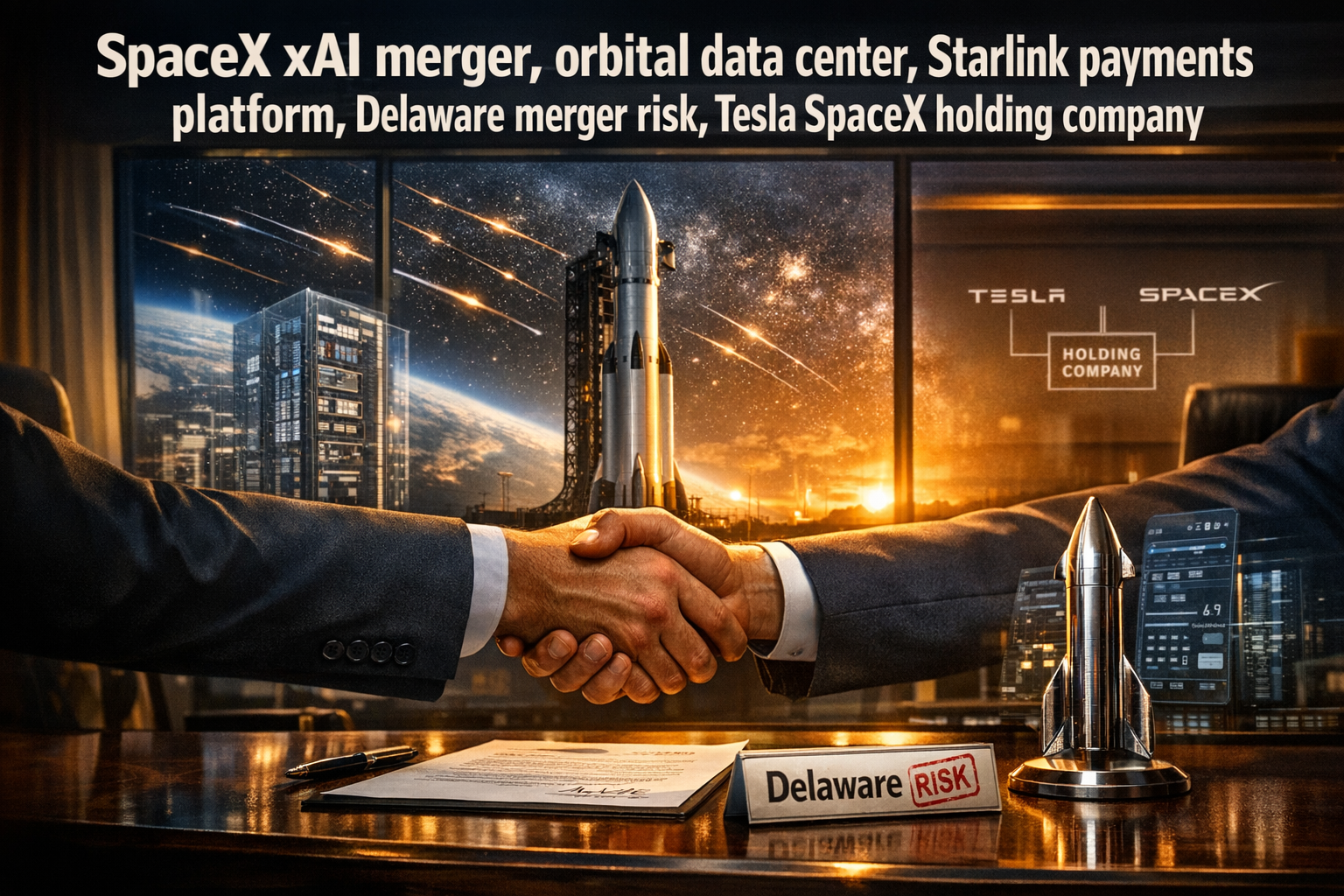
● SpaceX-xAI Megamerger, Power Grab, Orbital AI Empire, Starlink-X Payment Lock-in
Following the SpaceX–xAI Merger Announcement, the Capital Flows Behind a Potential “Space AI Empire” Are Becoming Clearer
This report consolidates four points:
First, why the SpaceX–xAI combination is less an “AI race” than a power-and-infrastructure contest.
Second, how the “space data center” (compute-satellite) concept functions as a capital-markets narrative as much as a technical plan.
Third, how platform concentration can emerge when Starlink, X (formerly Twitter), smartphones, and payments are integrated.
Fourth, what Wall Street is likely to challenge (cash burn, dilution, regulation) and why the strategy may still be pursued.
1) One-line takeaway: Not a conventional merger, but a declaration of end-to-end vertical integration of power and compute
The core signal is not simply that SpaceX and xAI are combining. The message is that AI bottlenecks are shifting from data/model availability to electricity, cooling, land, and permitting—and that the proposed solution is to bypass terrestrial constraints via space-based infrastructure.
This frames AI competition as an energy/infrastructure acquisition and scaling problem rather than purely a model-performance contest. In current markets, access to power capacity is increasingly treated as the binding constraint, not GPUs alone.
2) Stated rationale vs. underlying economic rationale
2-1. Stated rationale
Terrestrial AI data-center expansion faces physical and administrative limits: grid congestion, escalating cooling costs, local opposition, and permitting delays that prevent scaling at the desired pace.
Space is presented as abundant in area; solar generation is positioned as near-continuous; vacuum conditions are described as advantageous for heat management.
2-2. Underlying economic rationale
The combination can be interpreted as a capital-structure design intended to offset xAI’s loss profile with SpaceX’s credibility and cash-generation narrative. xAI is described as operating with roughly USD 1 billion per month in cash burn.
SpaceX, by contrast, has demonstrated a cash-flow trajectory through Starlink and benefits from contract credibility via defense and space programs.
Accordingly, the transaction functions not only as technical integration but also as a reframing of AI financing into an “orbital infrastructure” story. In a higher cost-of-capital environment, narrative coherence materially influences funding access and survival.
3) The “space data center” concept: the economic worksheet matters more than the technology pitch
3-1. Plan outline as described
Reference is made to an FCC filing seeking authorization for 1,000,000 solar-powered compute-dedicated satellites.
The proposal cites Starship-enabled orbital lift of millions of tons per year, targeting ~100 GW of incremental AI compute capacity annually.
A timeline is suggested in which space-based AI could become cheaper than terrestrial data centers within 2–3 years.
3-2. Primary economic constraint: not launch cost, but power access and interconnection lead times
The central target is not a simple capex comparison of “orbit vs. ground.” Terrestrial data centers increasingly face multi-year delays even with available capital because utilities cannot deliver incremental power in time. This is simultaneously a cost and time-to-scale problem.
If orbit-based solar generation supplies power without grid interconnection queues, it could bypass the dominant bottleneck and accelerate scaling relative to terrestrial competitors constrained by permitting and interconnection timelines.
3-3. Cooling, maintenance, and replacement cycles: the cost of operating in space
While vacuum is often described as beneficial for cooling, the absence of convection elevates the importance of radiator design and thermal engineering.
Maintenance is structurally harder than on Earth; modularity, redundancy, and fault-tolerant design may increase cost and complexity.
The potential advantage of bypassing grid bottlenecks may be partially offset by higher operational difficulty and lifecycle costs in orbit.
4) Why xAI needs SpaceX: the implication of a USD 20 billion GPU procurement commitment
xAI is described as having entered into a ~USD 20 billion arrangement to secure Nvidia chips. This indicates a sustained, multi-year capital requirement rather than a one-time scaling step.
Current AI competition is increasingly a “scale of capital” dynamic: expanding training and deployment simultaneously raises compute, power, and data-center costs, while supply chains link power, semiconductors, and advanced packaging.
In this context, combination with SpaceX can be viewed as credit enhancement for continued financing.
5) Starlink V3 + direct-to-satellite smartphones + X payments: a structurally different form of platform concentration
5-1. Connectivity shift: satellite-direct as a default mode
The narrative suggests that broad Starlink V3 coverage could enable direct device-to-satellite connectivity without reliance on terrestrial base stations, potentially shifting market structure from telecom-centric to satellite-network-owner-centric.
5-2. AI shift: from cloud-only to an integrated “device + satellite + AI” stack
The concept implies embedding xAI capabilities at the device level while using satellite links for real-time data exchange. Key implications:
First, reduced dependence on carriers, app stores, and traditional cloud chokepoints, narrowing distribution “gates” to a single ecosystem.
Second, consolidated data (conversations, search, payments, location) could accelerate model improvement within the same stack.
Third, network effects extend from social networking to an integrated communications + financial + AI system.
5-3. Financial layer shift: payments as the primary data terminal
Positioning X as a remittance/payment/banking application is less about payment margins than about controlling high-fidelity behavioral and transactional data.
Payments can feed advertising, subscriptions, commerce, lending, and insurance. When AI and payments are integrated, recommendation, underwriting, and risk management can operate as a closed loop within one platform, materially increasing platform power.
6) Key investor concerns: transferring cash-flow quality to fund a loss-making engine
6-1. Cash burn risk
A cash burn profile cited at ~USD 1 billion per month is a principal trigger for institutional investors. In current markets, cash-flow stability is often valued alongside growth, and the combination can compress that premium.
6-2. Dilution and governance complexity
Reference is made to an Echostar spectrum transaction context (~USD 19.6 billion) and post-announcement concerns regarding SpaceX value dilution. The issue is structural: a combined entity can shift valuation frameworks and capital structure expectations.
6-3. Regulatory and approval risk
Combining entities across public/private structures increases disclosure, internal-control, and conflict-of-interest scrutiny, raising U.S. securities and related regulatory risk.
Moreover, “AI + connectivity + payments + space” overlays multiple regulatory regimes, creating execution risk where scaling may be constrained by compliance rather than engineering.
7) The K2 entity structure and “Kardashev scale” framing: fundraising language, not branding
References to structures such as K2 Merger Inc and K2 Jet 2 LLC, and the linkage of “K2” to a Kardashev Type 2 concept, function as signaling to investors, talent, regulators, and government/defense stakeholders.
The positioning implies an ambition to redesign energy and compute infrastructure at system scale, supporting large-scale capital formation.
8) IPO timing: liquidity design rather than a discrete event
A cited prediction-market reference assigns a 76% probability to an IPO by end-2026. More material than timing is the purpose:
If the narrative is accepted, an IPO can facilitate a consolidated re-rating across orbital infrastructure (launch/satellites), AI infrastructure (compute), and platform layers (connectivity/payments).
If the market deems the thesis too distant, an IPO process can instead surface risks and constrain optionality.
9) Key points often underweighted in mainstream coverage
9-1. This resembles the creation of a power-centric enterprise as much as an AI combination
The core is power procurement and self-supply. As terrestrial grids constrain AI scaling, structures that produce and consume power internally become a competitive differentiator. AI leadership increasingly depends on power, semiconductors, cooling, land, and permitting.
9-2. Starlink + X payments is less about cheaper connectivity than a cross-border financial layer
Satellite-direct connectivity plus a payments-enabled super-app can reduce reliance on national telecom and banking rails, partially lowering cross-border friction. This increases regulatory sensitivity but, if executed, can also increase control over a critical economic layer.
9-3. Space compute infrastructure may be valued and regulated as a strategic asset
Orbital compute becomes intertwined with national security. The regulatory frame may shift from commercial data-center logic to strategic-infrastructure oversight, which can materially affect valuation and pace of deployment. Insurance, liability, and security requirements may drive near-term market reactions.
10) Global macro checkpoints (2026–2028)
If grid bottlenecks persist, data-center investment may pivot from land availability to power purchase agreements (PPAs) and interconnection rights.
Semiconductor constraints may extend beyond GPUs to HBM, advanced packaging, and power semiconductors.
The U.S., China, and the EU may increasingly classify AI infrastructure as strategic, raising the intensity of regulation and controls.
This environment can elevate inflation pressure in power, equipment, and construction labor while increasing sensitivity to interest rates.
Operationally, the cycle can be summarized as: interest rates drive financing cost; inflation shifts capex feasibility; AI semiconductors create bottlenecks; data centers absorb incremental power; and global supply chains constrain speed.
< Summary >
The SpaceX–xAI combination is best framed as a declaration of competition for power and infrastructure, not merely AI model performance.
The space data-center thesis targets grid bottlenecks and faster scaling, but carries significant operational, regulatory, and security risk.
If Starlink V3, AI-enabled devices, and X payments are integrated, a closed-loop communications + finance + AI platform could materially increase concentration risk and platform power.
Investor concerns center on xAI cash burn, dilution, and regulatory complexity; however, if the narrative unlocks financing, the addressable scale of capital formation expands.
[Related]
SpaceX: How Starship and Starlink Are Reshaping the Space Infrastructure Competitive Landscape
Data Center Power Constraints: The 2026 Global Grid Bottleneck and Its Investment Implications
*Source: [ 오늘의 테슬라 뉴스 ]
– 스페이스X와 xAI 전격 합병 선언! 머스크가 그리는 ‘우주 AI 제국’의 실체는?
● SpaceX xAI Merger Shockwaves Tesla Dry Process Crushes Costs Starlink One Million Satellites Delaware Risk Fallout
Why the SpaceX–xAI “Merger” Could Ripple Into Tesla: Dry Electrode Manufacturing, 1,000,000 Satellites, and Delaware Legal Risk
This report consolidates five core items in a news-style format.
1) How the SpaceX & xAI merger is increasingly being treated as “effectively confirmed”
2) Why scenarios linking Tesla (reverse merger/holding company) continue to surface
3) How Tesla’s “dry process” can materially reshape EV cost structure (including scale-up implications)
4) Why SpaceX’s “1,000,000 satellites” target can be framed as an industrial manufacturing problem rather than rhetoric
5) How post-Delaware rulings (Judge McCormick) influence merger design via legal-risk minimization
At the end, the key points typically underemphasized by mainstream coverage are summarized separately.
1) Breaking Timeline: “Bloomberg → Musk Response → De Facto Confirmation”
Core sequence
• Bloomberg reported that Musk is engaged in advanced discussions regarding a SpaceX–xAI merger
• Musk’s subsequent reaction broadly aligned with the report, leading markets to interpret it as de facto confirmation
Why it matters
• SpaceX is private and xAI is effectively private; governance consolidation can directly affect fundraising, compute access, data strategy, and speed of service expansion
• The transaction is better viewed as a precursor to the next step (holding-company structure, listing route, capital reallocation) rather than a standalone event
Market framing (keywords included)
• The topic can drive near-term U.S. equities volatility and may also intersect with risk-asset repricing dynamics in a rate-cut environment
2) Why “Tesla Must Be Included” Keeps Appearing: Holding Company (X Holdings) and Reverse-Merger Scenarios
Recurring market thesis
• The post SpaceX+xAI step could structurally include Tesla
• Some market narratives view using an already-listed Tesla as a faster route to liquidity than a separate IPO (reverse merger/holding-company reorganization)
Why reverse merger/holding company is frequently cited
• Investor viewpoint: Tesla shareholders could gain bundled exposure to SpaceX/AI growth without selling Tesla shares
• Capital markets viewpoint: a large private asset (SpaceX) could obtain an accelerated liquidity pathway
Reality check (material)
• “Ongoing discussions” and “Tesla inclusion” are distinct; the latter is not confirmed
• However, recurring indications that Musk favors umbrella/holding structures continue to reinforce the narrative
Macro linkage
• Holding-company or merger narratives are sensitive to the cost of capital and liquidity conditions
• As inflation stabilizes and rate-cut expectations increase, markets often become more receptive to large-scale growth narratives
3) Tesla “Large-Scale Dry Process”: Not a Battery Feature, but a Cost-Structure Shift
Key point
• Musk’s messaging has moved beyond “dry process achieved” toward implications of large-scale manufacturability
Why the dry process is material (simplified)
• Wet process: coating followed by drying creates major bottlenecks in energy, time, equipment, and footprint
• Dry process: reduces or removes the drying bottleneck, enabling
- smaller plant footprint
- lower energy consumption
- simplified capex structure
- shorter production lead times
Implication of “large-scale implementation”
• Pilot success and mass production are fundamentally different; scale risk is typically the market’s primary concern
• If large-scale deployment is validated, Tesla’s EV and energy storage cost curves could shift downward
Industry impact
• Competitive dynamics may continue shifting from specifications toward manufacturing cost and process advantage
• If peers cannot replicate similar processes, margin defense during price reductions may become more difficult
Macro linkage (keywords included)
• Battery cost declines can reinforce broader global supply chain reconfiguration across materials, equipment, power sourcing, and plant siting
4) SpaceX “1,000,000 Satellites”: Primarily a Manufacturing-and-Operations Constraint
Key point
• SpaceX references a system targeting up to 1,000,000 satellites in filings and related documentation
Common misunderstanding
• Discussion often centers on collision risk and orbital debris
• Operational feasibility depends more heavily on manufacturing scale and network operations than on “space availability” alone
Primary bottlenecks
• Achieving 1,000,000 satellites requires industrial execution across
- satellite manufacturing (modularization, process control, quality, testing)
- ground infrastructure and network operations
- orbit maintenance and collision-avoidance software
- power, thermal management, and component supply chains
• The system must function with factory-like throughput and reliability
Why Tesla enters the narrative
• Large-scale satellite deployment is increasingly framed as a high-volume manufacturing plus network-operations problem
• Tesla’s manufacturing automation, factory operations discipline, and cost-reduction capabilities are viewed as strategically relevant
5) Delaware (Judge McCormick) Variable: Legal Risk Directly Shapes Merger Architecture
Key point
• Delaware litigation and rulings intensified governance scrutiny around shareholder votes and compensation-related disputes
• The situation has also accelerated discussions of corporate domicile and structural defenses (e.g., Texas), affecting future reorganization optionality
Why it matters
• In large transactions, legal/regulatory approval and shareholder processes often dominate technical considerations
• Delaware-related experience increases the likelihood that any merger design becomes more conservative and litigation-resistant
6) (Additional) Epstein-Related Issue: How Reputational Risk Can Enter Pricing
Key point
• Public disclosures suggest an invitation occurred while emphasizing no confirmed visit
• Counterarguments focus on the existence of contact regardless of attendance
Investment relevance
• Regardless of underlying facts, such issues can affect
- institutional compliance constraints
- brand and consumer response
- government contracting and regulator posture
• These factors can increase near-term equity volatility and raise perceived risk premia
7) Why the Karpathy “Slope” Comment Appears Here: Valuing Tesla by Trajectory Rather Than Current Level
Core framing
• Market disagreement often reflects a focus on current metrics versus the slope of change
Application to the Musk ecosystem
• Current indicators (quarterly results, margins, deliveries) can appear constrained
• A trajectory-based view emphasizes compounding variables: autonomous driving data accumulation, robotics manufacturing scale, compute investment, and satellite-network expansion
Conclusion
• Independent of whether mergers proceed, markets are increasingly attempting to price the Musk ecosystem as an integrated platform spanning manufacturing, AI, and global network infrastructure
8) Key Points Often Underemphasized
1) The strategic core is not the AI model; it is vertical integration across data, compute, and distribution.
• xAI requires compute (power, chips, data centers), data, and distribution
• SpaceX provides distribution via Starlink and global coverage
• Tesla provides real-world robotic endpoints (vehicles, humanoid robots) as data generators and scalable manufacturing systems
→ Under unified control, the loop of training (compute) → deployment (distribution) → feedback (data) can accelerate materially
2) The deeper implication of “1,000,000 satellites” is potential planet-scale edge compute and sensing, not only connectivity.
• Higher satellite density supports capabilities such as
- real-time positioning and timing synchronization
- disaster, defense, and logistics monitoring
- connectivity for remote robotics, drones, and vehicles
• This shifts the system toward a “real-world operating layer”
3) The dry process can alter factory design, not just battery cost.
• Changes in footprint, flow, and energy infrastructure can affect
- payback periods
- expansion speed
- location decisions driven by power pricing and regulation
→ This is a manufacturing-structure shift rather than a narrow technology update
4) If restructuring advances, shareholder votes and disclosure timing may become the primary triggers.
• In large reorganizations, filings, voting mechanics, and legal wording frequently determine the outcome
5) The narrative is sensitive to macro liquidity conditions.
• Growth narratives typically correlate with liquidity and rate expectations, which are also influenced by FX dynamics
• In periods of strong capital inflows to U.S. markets, large platform narratives can become more aggressively priced
< Summary >
• SpaceX–xAI merger discussions are being interpreted as de facto confirmed following Bloomberg reporting and Musk’s response
• Markets continue to explore holding-company and reverse-merger scenarios involving Tesla, though confirmation is absent and should be distinguished from speculation
• Large-scale dry-process implementation would be a potential manufacturing cost-structure shift affecting capex, footprint, and ramp speed
• A 1,000,000-satellite objective is constrained primarily by manufacturing and operations at scale; this reinforces the perceived relevance of Tesla’s manufacturing capabilities
• Delaware governance and litigation experience is likely to influence future merger architecture toward greater legal defensibility; shareholder votes and disclosures may become key catalysts
[Related Articles…]
- https://NextGenInsight.net?s=Tesla
- https://NextGenInsight.net?s=SpaceX
*Source: [ 허니잼의 테슬라와 일론 ]
– [테슬라 대형속보] 공식 합병 발표! 스페이스X & xAI / 다음 단계는 테슬라와 합병, 벌써 충분한 힌트는 나왔습니다 / 대규모 건식 공정 확인 / 델라웨어 맥코믹판사는 귀인
● Fed Freeze, Dollar Slide, KOSPI Surge, Buyback Boom, Oil Shock Risk
Post-KOSPI 5,000 Investment Strategy: A Consolidated View on the Fed, USD, JPY, Commercial Act Reform, and the Semiconductor Cycle (Based on content recorded on 2026-01-29)
This report consolidates five interlinked themes:1) Why markets are less volatile despite a Fed “hold” (transition from liquidity-driven to earnings-driven conditions).
2) The new Fed Chair as a variable, and the “core risks” for 2H 2026 (oil, tariffs, bond yields).
3) Why USD weakness and a sharp FX move can be supportive for Korean equities.
4) Why Commercial Act reform and treasury share cancellation are pivotal triggers to reduce the Korea discount.
5) KOSPI 5,000–high 5,000s / KOSDAQ dynamics and a practical February trading framework (50-day moving average, pyramiding).
1) [Macro] Fed Holds Rates: A “Constructive Hold,” with Focus on Statement Language
Key takeaways
- The rate hold was largely priced in (consensus probability ~95%).
- The primary signal was the removal of wording implying “labor-market instability,” indicating a firmer growth assessment.
- The press conference messaging reduced near-term policy uncertainty by signaling that a rate hike is not the baseline path.
Why markets are less rate-sensitive than before
- Market regime appears to be shifting from liquidity-driven to earnings/macro-driven performance.
- Corporate earnings (notably semiconductors) and growth expectations are exerting greater influence than marginal policy changes.
Forward event risk
- Market-implied timing for rate cuts may shift from March/June toward June/September.
- Key checkpoints: early February (January employment) and early March (February employment).
- Revisions to seasonal hiring from the year-end period (January–February) are a key sensitivity.
2) [Policy] New Fed Chair: “Ultra-Hawkish” Appointment Risk Appears Low
Core view
- Daily headline volatility around potential nominees may persist.
- However, the appointment is ultimately political; the probability of a comparatively accommodative (dovish-leaning) selection is viewed as higher.
- Even historically hawkish figures have shown evolving narratives (e.g., AI-driven disinflation arguments).
Higher-impact risks are elsewhere
- More material than the chair transition are oil prices, tariffs, and bond-yield spikes.
- Even a dovish policy preference can be constrained by renewed inflation pressure.
3) [2H Risk] Oil at USD 80 Scenario; Tariffs Likely Constrained in Practice
Oil: suppression now can create later risk
- Oil has been pressured by production dynamics, but a policy/political inflection later in the year could allow a rebound.
- A move to USD 80 implies >30% YoY and could lift the inflation floor, complicating rate-cut expectations.
Tariffs: high headline impact, meaningful practical constraints
- Constraints cited include:1) Limited escalation capacity beyond existing emergency authorities.
2) Statutory limits tied to presidential discretion (e.g., cap levels, time limits, and extension requirements).
3) A 1st-term precedent where tariff escalation coincided with equity weakness and higher inflation, creating political cost. - Conclusion: a tariff path severe enough to structurally impair markets in 2026 is viewed as less likely.
4) [FX and Global Flows] Why USD Weakness Can Be Supportive for Korea
USD weakness increases allocation flexibility
- A strong USD typically concentrates global capital into U.S. assets.
- USD weakness increases the scope for diversification into non-U.S. markets, including Korea.
- A scenario discussion referenced a potential move in the dollar index toward the low 90s during 1H.
Why foreign investors can buy despite FX volatility
- Equity returns can be dominated by earnings revisions: a 5–10% FX move may be outweighed by 30–50% earnings upside in cyclical upswings.
- For global allocators, earnings and the cycle (especially semiconductors) are the primary drivers.
JPY appreciation: liquidity-drain concerns may be overstated
- Rapid JPY moves can trigger “U.S. liquidity withdrawal” fears.
- The interpretation emphasized administrative signaling aimed at limiting speculative extremes and managing pace, not a sustained one-way regime shift.
5) [Korea Equities] KOSPI 5,000–High 5,000s: Upside While Forward EPS Trends Higher
Targets and rationale (forward EPS as the anchor)
- A 1H KOSPI target of 5,300 was referenced, with potential upside optionality.
- The argument relies on rising 12-month forward EPS, historically tightly correlated with KOSPI since 2001 (correlation ~0.93).
Interpreting “overheating” signals
- Technical indicators may show overbought conditions; however, the emphasis is that overbought entry is not the sell trigger—overbought exit is more informative.
- Base case: strong primary trend with scope for short-term consolidation.
Why semiconductors remain decisive
- U.S. leadership may be led by a single name, but Korea’s index sensitivity is driven by two major constituents with outsized weights.
- 2025 earnings growth was highly semiconductor-concentrated (~130% contribution); 2026 is framed as less concentrated (~96%), implying broader sector participation potential.
6) [Korea Discount] Commercial Act Reform + Treasury Share Cancellation: A Structural Shift via Lower Free Float
Central mechanism
- A persistent Korea discount is linked to recurring increases in effective share supply.
- Sustained supply growth can keep indices range-bound even during earnings improvement.
Reform focus: treasury share cancellation
- Broad adoption of treasury share cancellation reduces free float and mechanically supports EPS via fewer shares outstanding.
- Recent reversals of spin-off listing decisions are aligned with the same objective: limiting incremental tradable supply.
Link to U.S.-style rerating
- U.S. markets have institutionalized buybacks/cancellations, supporting long-term index compounding.
- A durable shift toward similar mechanisms in Korea would make discount compression more quantifiable rather than rhetorical.
7) [KOSDAQ] Institutional Buying: Policy, Budget, and Seasonality Aligning
Why KOSDAQ is strengthening
- Renewed policy emphasis on KOSDAQ and related measures.
- Seasonality: historically stronger relative performance in January–February (post-2000 average).
What is different this cycle: R&D and industrial policy budgets
- Prior years saw budget compression; this year is framed as improving:
- R&D budget: +19.4%
- Industrial policy budget: +14.7%
- Potential demand catalysts include higher pension benchmark allocation to KOSDAQ and policy-driven weighting adjustments.
Strategic implication
- KOSDAQ may outperform even if KOSPI consolidates.
8) [February Execution] “Buy the Pause” + 50-Day Moving Average + Pyramiding
February pattern: consolidation risk over crash risk
- After earnings season momentum fades, the market may enter a sideways/soft pullback phase, consistent with prior seasonal behavior.
Key level: 50-day moving average
- Strong leaders often respect the 50-day moving average, using it as support.
- The 50-day area is treated as a potential tactical entry zone.
Pyramiding as an execution framework
- Rather than attempting to time the exact bottom, scale in progressively (e.g., 5 → 7 → 15 → 30 → 40).
- Applied particularly to semiconductor leaders using a “buy on pullbacks” discipline.
Short-term rotation candidates during consolidation
- Maintain core leaders while tactically trading rotations over a 2-week to 3-month horizon, including domestic demand, pharmaceuticals/biotech, and laggards.
9) Key Points Often Underemphasized
1) The core of the KOSPI 5,000 debate is not rates; it is effective share supply.
- If cancellation becomes institutionalized, the market-level valuation framework can shift alongside earnings.
2) “USD weakness equals U.S. equities weakness” is not a rule; dispersion increases.
- Index beta matters less than company-level profitability and balance-sheet quality.
3) The principal 2H shock vector is oil and bond yields, not the Fed Chair.
- Yield spikes disproportionately pressure high-duration and financially weaker AI-exposed companies via valuation and funding channels.
4) Mega IPOs (e.g., large-scale listings) may represent capital rotation, not net new inflows.
- Even “positive” listing news can create drawdowns in other assets due to funding needs.
10) Investor Summary (One Line)
For 1H 2026, the combination of earnings strength (semiconductors), reduced Korea discount potential (treasury share cancellation/Commercial Act reform), and USD weakness is framed as supportive for Korean equities; for February, a consolidation base case favors 50-day moving-average entries and pyramided buying.
< Summary >
- The Fed hold was expected; markets are increasingly driven by earnings and macro, not liquidity alone.
- Rate cuts may shift toward June–September; January–February employment and revisions are key.
- 2H volatility is more likely driven by oil, bond yields, and tariffs than by the new Fed Chair.
- USD weakness supports global diversification flows and can favor Korean equities.
- A step-change in KOSPI valuation is tied to whether Commercial Act reform and treasury share cancellation reduce effective share supply.
- February positioning emphasizes consolidation risk management via the 50-day moving average and pyramided accumulation.
[Related…]
- https://NextGenInsight.net?s=KOSPI
- https://NextGenInsight.net?s=FX
*Source: [ Jun’s economy lab ]
– 코스피 5000 투자 전략 이렇게 해야 됩니다(ft. 이경민 부장 2부)