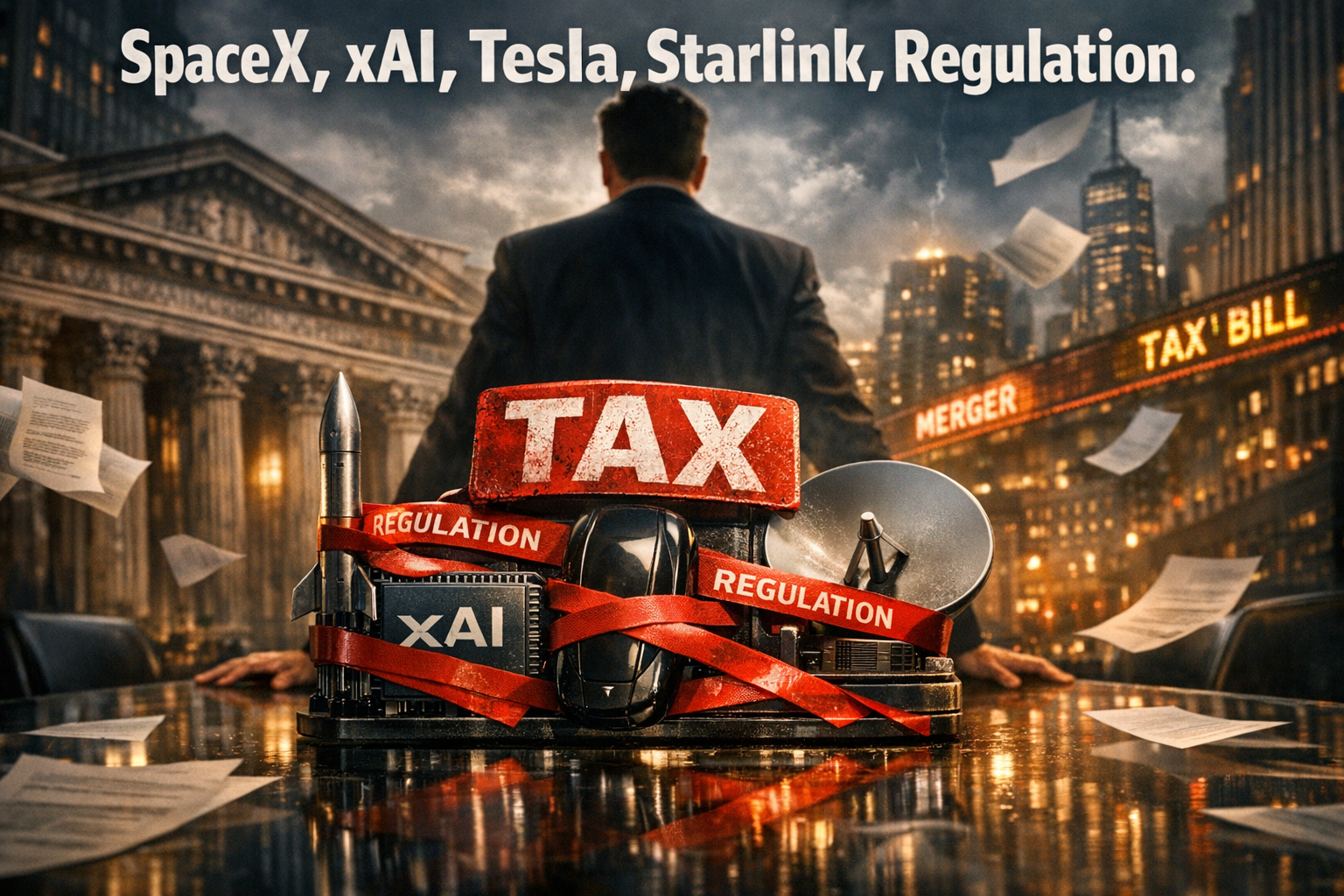
● Musk Mega-Merger Sparks Tesla Repricing, Korean Investors Face Tax Bomb
If Musk’s “Triple Combination (SpaceX, xAI, Tesla)” Materializes, Why Korean Investors Could Face a Disproportionate “Tax Shock”
This report covers:
1) The core linkage explaining why a SpaceX–xAI merger (mega-cap scale, ~$1.25T) can translate into a “Tesla re-rating”
2) The underlying logic behind Wall Street (Dan Ives) discussing a “next step: Tesla–SpaceX merger” scenario
3) Bloomberg’s key strategic factor beyond capital: the data pipeline (Starlink) and the space-based data center concept
4) A Korea-specific risk: in a merger/holding-company restructuring, “share exchange” may be treated as a taxable disposal (capital gains) under Korean tax rules
5) How this issue intersects with broader market drivers: IPO supply, policy rates, inflation, FX, and AI semiconductors
1) Key News Briefing
1-1. “Official SpaceX–xAI Merger” → A ~$1.25 Trillion-Scale Entity
The text states that a SpaceX–xAI merger has been formalized, with an implied valuation around $1.25 trillion (approximately KRW 1,700 trillion).
This is positioned not as a typical startup combination, but as the integration of space infrastructure (launch, satellites) with an AI engine (models, training), drawing heightened market attention.
1-2. Tesla Operational Update: Model Y Trim Simplification (U.S.)
Tesla’s U.S. website reportedly reorganized Model Y into five clearer trims.
A new base AWD at $41,990 is $2,000 above the RWD at $39,990, with 0–60 mph around 4.6 seconds (noted as a meaningful improvement), but with reduced range.
Cost/positioning-driven specification reductions are cited (e.g., glass roof, HEPA filter, speaker count).
This is framed as a potential signal of “higher-margin/higher-efficiency” production focus, with incremental capacity potentially shifting toward Optimus scaling.
1-3. China Regulatory Variable: Restrictions on Flush Electronic Door Handles
From 2027, new vehicles in China would effectively face tighter limits on flush electronic door handles, with previously approved models requiring design changes by 2029.
The policy rationale is safety: in power-loss scenarios (accidents/fires), doors may not open promptly, delaying rescue.
Tesla Model 3/Y may need to meet requirements such as mechanical release levers and physical access provisions, introducing China-specific design and cost uncertainty.
2) Wall Street Scenario: Why “Next Is a Tesla–SpaceX Merger” Is Being Discussed
2-1. Dan Ives (Wedbush): Framing as Structural Convergence
Following the SpaceX–xAI merger, Dan Ives is cited as raising the possibility of a Tesla–SpaceX merger.
The central rationale is full integration of space (infrastructure) and ground (data, hardware).
SpaceX would provide space infrastructure (communications, launches, satellite networks, potential space-based data centers), while Tesla would function as the “physical AI” layer collecting and executing data via vehicles/robots.
Under this framing, Tesla is positioned less as an EV manufacturer and more as a physical AI platform, supporting a re-rating narrative.
2-2. “If Market Caps Converge, a 1:1 Stock Swap Becomes Mechanically Simpler”
A cited view (Ross Gerber) suggests that if Tesla’s value and the combined SpaceX–xAI entity’s value become comparable, premium calculations may simplify, making a 1:1 share-exchange merger structurally cleaner.
Practical execution remains constrained by regulation, governance, shareholder approvals, and antitrust considerations; the key point is that investors are beginning to model the “mechanical” scenario.
3) Bloomberg Angle: The Strategic Advantage Is the “Data Pipeline,” Not Just Capital
3-1. Capital Intensity: xAI Cash Burn vs SpaceX Cash Generation
The text describes xAI as burning approximately $1 billion per month.
Combining with SpaceX’s comparatively stronger cash generation could materially improve funding resilience for AI scaling costs.
This is positioned as a valuation-relevant factor for AI equities, tied to business model durability, financing conditions, and IPO narratives.
3-2. Starlink Data Policy Expansion → Potential Data Sharing with xAI
Bloomberg is described as highlighting that Starlink may broaden data collection scope (e.g., location, financial, file-related data) and potentially share it with the combined entity (xAI side).
The competitive axis in AI is compute (AI semiconductors) + data + distribution; Starlink can function as both a global real-time data pipeline and a distribution channel.
This differs from the internet/cloud/service data advantages of large incumbents and could introduce a distinct class of real-time mobility/communications data inputs and deployment leverage.
3-3. Space-Based Data Centers: A Potential Workaround to Power and Cooling Constraints
Terrestrial data centers face bottlenecks from power, cooling, and siting constraints.
A space-based approach may appear unconventional, but it is presented as a long-duration narrative that could reshape infrastructure assumptions.
In a higher-rate environment with elevated cost of capital, access to lower-cost power and reliable cooling becomes a key determinant of AI infrastructure competitiveness.
4) Korea-Specific Sensitivity: “Share Exchange = Taxable Disposal” Risk
4-1. Treatment May Differ from U.S. Tax Deferral Expectations
In U.S. restructurings (holding-company conversions or mergers), automatic exchange of old shares into new shares may be treated as tax-deferred in certain cases for U.S. investors.
For Korean tax residents, Korean tax interpretation may treat share exchanges between foreign corporations as a “disposal”, triggering capital gains taxation.
This can create a scenario where no cash is received, yet tax becomes payable as if the investor sold and repurchased securities.
4-2. Rocket Lab Case (Cited): 1:1 Exchange Leading to Korean Tax Issues
The text references Rocket Lab’s holding-company conversion as a case where Korean investors encountered capital gains tax issues.
After interpretations were clarified, brokerages reportedly applied taxation, with perceived burden elevated once local surtaxes were included.
4-3. Worst-Case Structure: Bundling Tesla, SpaceX, and xAI Under a Holding Company via Share Exchange
If a combination involves (1) a merger, (2) a holding-company conversion, and (3) share-exchange mechanics, Korean investors may face an abrupt taxable event.
Two practical risks are highlighted:
First, funding tax liabilities may require forced partial sales (cash-flow shock).
Second, if the exchange is priced during an unfavorable valuation window, tax is locked in while price volatility remains, increasing downside stress.
5) Market Interpretation: This Is a Capital Markets Event, Not Only a Tesla-Specific Catalyst
5-1. IPO Demand “Black Hole”: Potential to Disrupt IPO Timing for Other AI Players
Dan Ives is described as noting an earlier-than-expected timing shift (from year-end expectations to early February), framed as a move that can disrupt competitors’ IPO calculus.
Investor capital is finite; a mega-scale IPO can absorb demand and reduce capacity for other offerings.
This can affect growth equity flows and interacts with the policy-rate environment via discount rates.
5-2. Regulatory Risk: Rising Political and Compliance Costs
As consolidation increases, political and regulatory factors can dominate over technology execution.
If communications (Starlink), AI (data), and mobility (Tesla) converge, antitrust, privacy, and national security frameworks may apply simultaneously.
Accordingly, rapid realization of optimistic scenarios is not assured.
6) Key Points Often Under-Addressed
6-1. Core Thesis: Data Ownership and Distribution Rights, Not Only Technology
Market commentary often focuses on FSD improvements or AI integration into Optimus.
The central issue is who can legally collect data, on what terms, and through which distribution channels.
Starlink is positioned not merely as an internet service, but as infrastructure enabling control over connectivity and data at global scale, potentially shifting AI competition from “model performance” toward “infrastructure moat.”
6-2. For Korean Investors, “Tax Structure Events” May Precede Price Re-Rating
Large mergers and holding-company conversions can drive re-rating narratives.
For Korean investors, the more immediate risk may be a “tax-confirmation event” triggered by share exchange mechanics.
As merger likelihood rises, the priority shifts from headline directionality to transaction structure (exchange method, ratio, and tax interpretation).
6-3. Operational Details (e.g., China Door-Handle Rules) Can Compound into Margin Pressure
Large-scale narratives can overshadow implementation details.
Design changes in major markets can impair manufacturing efficiency and parts commonality strategies.
Accumulated cost frictions can pressure margins, and margin volatility can affect growth-equity valuations, potentially amplifying sensitivity to inflation and policy rates.
7) Investor Checklist
1) Whether any merger/holding-company conversion uses a “share exchange” structure and whether a cash-election option exists
2) Brokerage notices and Korean tax authority interpretive updates (taxability and timing)
3) Starlink data-policy changes and regulator responses (privacy, antitrust, national security)
4) Potential spillover of China vehicle regulations to other jurisdictions
5) Effects of AI infrastructure capex competition on AI semiconductor supply chains and pricing
< Summary >
A SpaceX–xAI merger is framed as the integration of “space infrastructure + AI engine,” reinforcing the possibility of a broader combination that could include Tesla.
Market focus extends to IPO demand absorption, the Starlink data pipeline, and long-duration infrastructure narratives such as space-based data centers.
For Korean investors, a primary risk is that a share exchange may be treated as a taxable disposal, creating a potentially abrupt capital gains tax liability.
[Related Articles…]
*Source: [ 오늘의 테슬라 뉴스 ]
– 댄 아이브스 “테슬라·스페이스X 합병” 예고! 하지만 한국에선 ‘세금 폭탄’ 걱정 이유는 ?
● Tesla SpaceX Merger Bombshell – Dilution Panic vs IPO Overhang Chaos
Is a Tesla–SpaceX Merger Truly “Toxic”? The Investor-Relevant Issues Are Elsewhere
Market attention has focused on whether a Tesla–SpaceX merger would disadvantage Tesla shareholders. This report summarizes, in a fact-oriented manner:
(1) structural reasons a transaction could be considered
(2) the distinction between ownership dilution and price/value dilution
(3) how IPOs, reverse mergers, and overhang dynamics can pressure Tesla shares
(4) an “X” (umbrella holding company/brand) scenario and Tesla’s role within it
(5) why Tesla is pursuing federal-level autonomous-driving regulation
1) Issue Briefing: “SpaceX and xAI have merged; is Tesla the final piece?”
The narrative assumes a confirmed SpaceX–xAI combination and suggests market focus is shifting to the possibility of a Tesla–SpaceX transaction. However, the “confirmed” premise is not necessarily supported by fully verifiable, public filings; investors should rely on official disclosures and credible reporting.
Market sensitivity to this narrative reflects the possibility that Musk-affiliated entities could be consolidated under an “X” brand and/or governance structure, potentially reframing Tesla’s valuation narrative.
2) Interpreting “Official Account Signals”: the Cybertruck account’s “X” image
A widely cited signal is an image from Tesla’s (Cybertruck) official account showing the Cybertruck pressing an “X” key.
Two primary interpretations have emerged:
1) Tesla signaling entry into an “X universe” (brand/governance consolidation)
2) “X” as a product-line symbol tied to changes in the Model S/X lineup (repositioning or de-emphasis)
This should be treated as narrative reinforcement rather than a confirmatory fact. Markets often respond to narratives before formal disclosures.
3) From “Earth” to “Galaxy”: implications of Musk’s “X brand” messaging
Statements expanding “X” from the “most valuable brand on Earth” to “in the galaxy” function as an attempt to raise the perceived ceiling of addressable value.
Positioning “X” as an umbrella platform/holding structure across multiple industries can drive multiple re-rating (valuation framework changes), independent of macro drivers such as rate expectations.
4) IPO vs. Reverse Merger: why a standalone SpaceX listing could pressure Tesla (overhang)
A key mechanism is overhang (potential selling pressure) driven by capital rotation:
Scenario A) SpaceX conducts a standalone IPO
→ some Tesla shareholders may sell Tesla to buy SpaceX
→ near-term selling pressure on Tesla (overhang) may increase
Scenario B) Tesla consolidates SpaceX via reverse merger or integration
→ reduces the need to sell Tesla to gain SpaceX exposure
→ may mitigate overhang and reduce shareholder rotation
This is framed as a capital-market plumbing issue (flows and liquidity), not merely executive preference.
5) Clarifying dilution: what retail investors should actually evaluate
Core point: ownership dilution does not mechanically imply an immediate decline in share price.
1) Ownership dilution
- Increasing total shares reduces an investor’s percentage ownership and voting influence
- Typically more relevant to control and governance-sensitive holders
2) Price/value dilution
- Occurs when acquired assets fail to meet expected fundamentals, profitability, or growth
- Risk is driven by asset quality and transaction pricing (exchange ratio)
For most investors, the key question is whether SpaceX would be accretive or dilutive to Tesla’s valuation on a fundamentals-adjusted basis (e.g., launch economics, contract durability, Starship timelines, government/defense exposure).
6) Conditions under which a merger becomes a risk vs. a benefit
Risk conditions
- Unfavorable exchange ratio for Tesla shareholders (overpayment vs. intrinsic value)
- Regulatory or geopolitical constraints delaying space-sector monetization
- Higher governance complexity leading to holding-company discount
- Expanded governance and conflict-of-interest scrutiny (key-person concentration)
Potential benefit conditions
- Extends Tesla’s growth narrative from autos to AI/robotics to space infrastructure
- Structural reduction of overhang via minimized shareholder rotation
- Re-rating potential from consolidation under an “X” umbrella
- Increased index-linked ownership via Tesla as a proxy exposure channel
Outcomes depend less on “merge vs. not merge” and more on transaction design (share exchange, holding-company structure, reverse merger mechanics, partial spin/trackers).
7) Investor process: decisions should be based on explicit assumptions and rules
This is an event-driven topic with high short-term noise. Investors should define:
- time horizon (e.g., 6-month trade vs. 5-year holding)
- macro sensitivity (rates, inflation, USD strength) given growth-multiple exposure
- explicit risk controls (rebalancing rules, sizing, hedging, stop/trim criteria)
8) Tesla near-term focus: expanding autonomous-driving regulation to a federal framework
Tesla is seeking to shift autonomous-driving regulatory frameworks from state-level variance toward federal-level standards.
Relevance: commercialization of robotaxis/autonomy is constrained by regulation as much as technology. A federal framework could:
- accelerate deployment timelines
- simplify insurance and liability standards
- enable faster network scaling and expand total addressable market
Policy incentives may increase around major visibility events where national technological leadership is emphasized, potentially affecting regulatory pacing.
9) Key points often underweighted in general coverage
1) The merger logic may be driven by flow management (overhang), not narrative appeal
- A standalone SpaceX IPO could plausibly trigger capital rotation away from Tesla
- Consolidation can be framed as reducing forced switching
2) For most retail investors, ownership dilution is not the primary risk
- The decisive factors are fundamentals and transaction pricing/governance terms
- “Dilution” headlines can obscure the real valuation drivers
3) “X” is more consequential as a governance/holding structure than as an app concept
- Product features are incremental; structural consolidation can change valuation frameworks
4) The next inflection point may be regulatory, not a technical demo
- Federal standardization can convert localized approvals into scalable national rollout
10) Checklist: 7 questions to translate the narrative into an investable view
1) Is there official support (filings/disclosures/credible reporting) for any transaction claim?
2) Would terms (exchange ratio, governance) protect Tesla shareholders?
3) Are SpaceX growth drivers (unit economics, contract base, Starship schedule) credible?
4) Is Tesla autonomy constrained primarily by regulation or by technology readiness?
5) What is the defined investment horizon (6 months vs. 5+ years)?
6) How exposed is the portfolio to rate/inflation shocks (growth-multiple risk)?
7) Are add/trim/hedge rules defined for volatility around merger/IPO headlines?
< Summary >
The central investor issue is not “dilution fear” but potential Tesla-share overhang from capital rotation if SpaceX lists independently, and the transaction structure (exchange ratio and governance) if consolidation is pursued. “X” is potentially more material as a holding-company/governance reconfiguration than as an app narrative. Tesla’s next major catalyst may be the establishment of a federal autonomous-driving regulatory framework rather than a technology announcement.
[Related Links…]
- Tesla stock volatility: key variables to monitor
https://NextGenInsight.net?s=tesla - Why autonomous-driving regulatory shifts can change market structure
https://NextGenInsight.net?s=autonomous-driving
*Source: [ 허니잼의 테슬라와 일론 ]
– [테슬라 합병 이슈] 스페이스X 합병이 정말 테슬라에게 독일까? 투자자의 결정은 ‘이것’을 기반으로 해야 한다!
● Private Equity Pours Cash Into Exploding Non-Alcoholic Beer Boom
Why Private Equity Is Betting on Non-Alcoholic Beer: A Structural Shift in Consumption, Not a Passing Fad
1) Key Takeaway: Non-alcoholic beer is emerging as a second growth engine adjacent to the core alcohol market
Non-alcoholic (NA) beer is shifting from a substitute for non-drinkers to a default option for consumers who moderate intake by occasion, particularly in the U.S.
This appears less cyclical and more structural: while traditional beer demand slows, NA beer grows alongside it as a distinct category. For consumer companies, this is a portfolio reallocation issue; for investors, it is a trigger to reassess long-term growth and category mix.
2) The investment case was distribution velocity, not celebrity branding
Tom Holland’s NA beer brand, Bero, reportedly raised investment (approximately KRW 300 million equivalent) within one year of launch.
The core rationale is not celebrity-driven demand, but evidence of early-scale execution:
- Rapid placement across major retail channels and online distribution
- Immediate expansion of consumer touchpoints
- Category-level re-rating of NA beer as a scalable growth segment
For private equity, the primary diligence focus is typically whether the brand has entered a repeatable distribution loop and can sustain unit economics (price, margin, repeat purchase), rather than media visibility alone.
3) Primary demand driver: occasion-based moderation, not abstinence
Consumers are increasingly managing alcohol intake by context rather than fully quitting. High-frequency use cases include:
- Driving
- Post-exercise
- Next-day commitments
- Sleep quality management
Among Gen Z and millennials, “non-intoxicating drinking” is becoming normalized: preserving taste and social context while reducing performance and health trade-offs. Habit formation in this area can create durable demand and influence long-term category growth assumptions.
4) Product technology has reached investable quality thresholds
Historically, adoption was constrained by taste. Recent improvements in dealcoholization and brewing processes have materially increased product quality.
Approaches such as:
- Brewing as standard beer first, then removing alcohol at the endtend to better preserve flavor, body, and aroma.
This creates a dual-engine setup: behavioral tailwinds (moderation) plus product parity improvements (technology).
5) Market sizing: meaningful scale, with greater significance in low penetration
5-1) Global market outlook
- 2025 global NA beer market: approximately USD 24–25 billion
- CAGR: approximately 7–8%
- Projections exceed USD 50 billion by the mid-2030s
The contrast is material versus a mature/slow-growth mainstream beer market, supporting capital reallocation toward higher-growth subcategories.
5-2) U.S. market: +175% volume growth, yet only ~2% share of total beer
- U.S. NA beer sales volume: approximately +175% (2019–2024)
- Share of total beer market: still in the ~2% range
High growth with low penetration is a key investor attraction, implying substantial runway.
Additional cited estimates:
- U.S. NA beer market size (2024): approximately USD 6.15 billion
- Forecast (2030): approximately USD 11.2 billion
- IWSR: U.S. NA market volume CAGR approximately 18% (2024–2028)
These rates are high relative to typical consumer staples growth, with potential resilience characteristics as NA products shift from “occasion substitute” to “weekday routine beverage.”
6) Why traditional beer players face simultaneous pressure
NA growth is not purely incremental; it partially substitutes for alcoholic beer in certain occasions.
Cited signals of legacy-category softening:
- 2024 U.S. beer production/import volume: approximately -1% YoY
- Craft beer volumes: decelerating
- Global alcohol consumption (2024): approximately -1% (analysis cited)
Drivers appear multi-factor:
- Inflation-driven pricing pressure
- Health and wellness preferences
- Improved NA alternatives
This mix suggests persistence beyond a single macro cycle.
7) Company-level implications: who is absorbing the transition
7-1) Incumbents under volume pressure (common driver: slowing shipments)
- AB InBev (Budweiser/Bud Light): examples cited of share price declines following results impacted by volume issues
- Constellation Brands (Modelo/Corona): demand softening led to guidance reductions and stock declines (examples cited)
- Molson Coors: volume pressure and cost burdens contributed to outlook adjustments
Strategic paths:1) Defend core alcoholic portfolio (pricing/marketing)2) Rebalance toward NA/low-ABV offerings
A higher NA/low-ABV mix can support valuation re-rating if it improves long-term growth visibility.
7-2) Why Heineken’s positioning appears structurally advantaged: “same brand experience”
Heineken launched Heineken 0.0 in 2017. The differentiator was brand architecture:
- Retained core bottle design, logo, and green identity
- Clearly marked 0.0% ABV
- Positioned as an option within the same brand experience, not a separate substitute category
As consumer behavior shifted, this approach gained traction; cited trend indicates NA volumes have grown cumulatively by 50%+ in recent years. This reflects portfolio design rather than reactive trend-chasing.
8) Underappreciated point: competitive rules are shifting
8-1) The battlefield is moving from branding to shelf-space power
Despite low category share, large retailers are increasingly treating NA beer as a core stock-keeping segment. Early shelf positioning can create structural barriers via future slotting and distribution costs.
Competitive advantage is likely to be driven more by:
- durable channel placementthan by:
- celebrity visibility
8-2) NA beer creates both incremental demand and cannibalization risk
NA can add revenue while reducing alcoholic sales in overlapping occasions. This forces internal changes to KPIs, sales incentives, and channel contracting. Faster organizational alignment may translate into superior long-term outcomes.
8-3) Macro framing: categories with lower price resistance can outperform in inflationary environments
As NA beer becomes a routine beverage, repeat purchase can improve and price resistance may be lower than discretionary alcohol occasions. This can support more stable cash-flow characteristics within consumer portfolios.
9) Practical investor watchlist
Key indicators to monitor:
- Growth rate of major retail placements (offline shelf expansion)
- Online subscription and repeat purchase metrics
- SKU expansion (lager/IPA/stout segmentation)
- Price ladder formation (premium vs mass-market)
- Mix shift at incumbents (NA revenue contribution)
If the trend persists, the growth narrative for brewers may increasingly be rewritten around NA/low-ABV and functional adjacencies (e.g., sleep, low sugar), with market preference skewing toward firms that operationalize the transition.
< Summary >
Non-alcoholic beer is benefiting from a structural shift toward occasion-based moderation rather than a short-lived health trend. Bero’s early funding appears driven by distribution scale-up and category growth, not celebrity effects. U.S. volumes have accelerated while penetration remains ~2%, indicating substantial runway. Traditional beer demand is softening, and companies that integrate NA as a core brand option (e.g., Heineken) appear better positioned. Key differentiators are shelf-space control, repeat purchasing, and speed of portfolio reallocation.
[Related Links…]
Non-alcoholic market growth and consumer investment opportunities
How private equity evaluates consumer brand investments
*Source: [ Maeil Business Newspaper ]
– [어바웃 뉴욕] “요즘 누가 취하도록 마셔요?” 사모펀드도 베팅한 무알콜 맥주 | 길금희 특파원