● Claude Co-work, Excel-PPT Hijack Sparks SaaS Stock Shock
Claude Co-work + Opus 4.6 Update, Why “You Don’t Need to Learn Excel or PPT” Isn’t an Exaggeration (And the Real Point Behind Why Software Stocks Shook)
This post includes exactly four things for sure.
1) How Claude Co-work is different from existing chatbots (why it’s called an “agent”)
2) What Excel and PowerPoint “integration” really means (how far work automation can go)
3) The core point behind the Opus 4.6 performance leap (the “felt in real work” parts, not benchmark numbers)
4) The “risks and investment angle” other YouTube/news rarely talk about (B2B share shifts, security/data, SaaS re-rating)
1) Today’s headline: “Claude Co-work opens an era where AI manipulates your PC like an OS”
Key takeaway
Co-work is not a “chatbot that only talks,” but is closer to an agent that actually operates my PC’s folders/files/apps and finishes the job.
Because AI takes over the workflow itself, the core point is that this is not a simple feature add-on, but an event that changes the productivity structure.
2) Why Co-work is an “agent”: It closes the loop by itself from planning → execution → deliverables
Existing chatbots
The user pastes materials, and the chatbot provides only answers/summaries/first drafts
Co-work (agent-type)
1) It asks follow-up questions about what information is needed (requirements clarification)
2) It sets up a work plan on its own (task decomposition)
3) It opens Chrome/apps, finds files, creates documents
4) It directly leaves “outputs” in PPT/Excel/calendar, etc.
Why this is scary
Now we move from “AI that tells you” to “AI that finishes the work for you.”
That’s why people say the premium that “work SaaS” enjoyed (subscription-based stability) could be shaken.
3) What Excel and PPT integration means: “Office automation” rises from a feature to an operating level
What changes in Excel
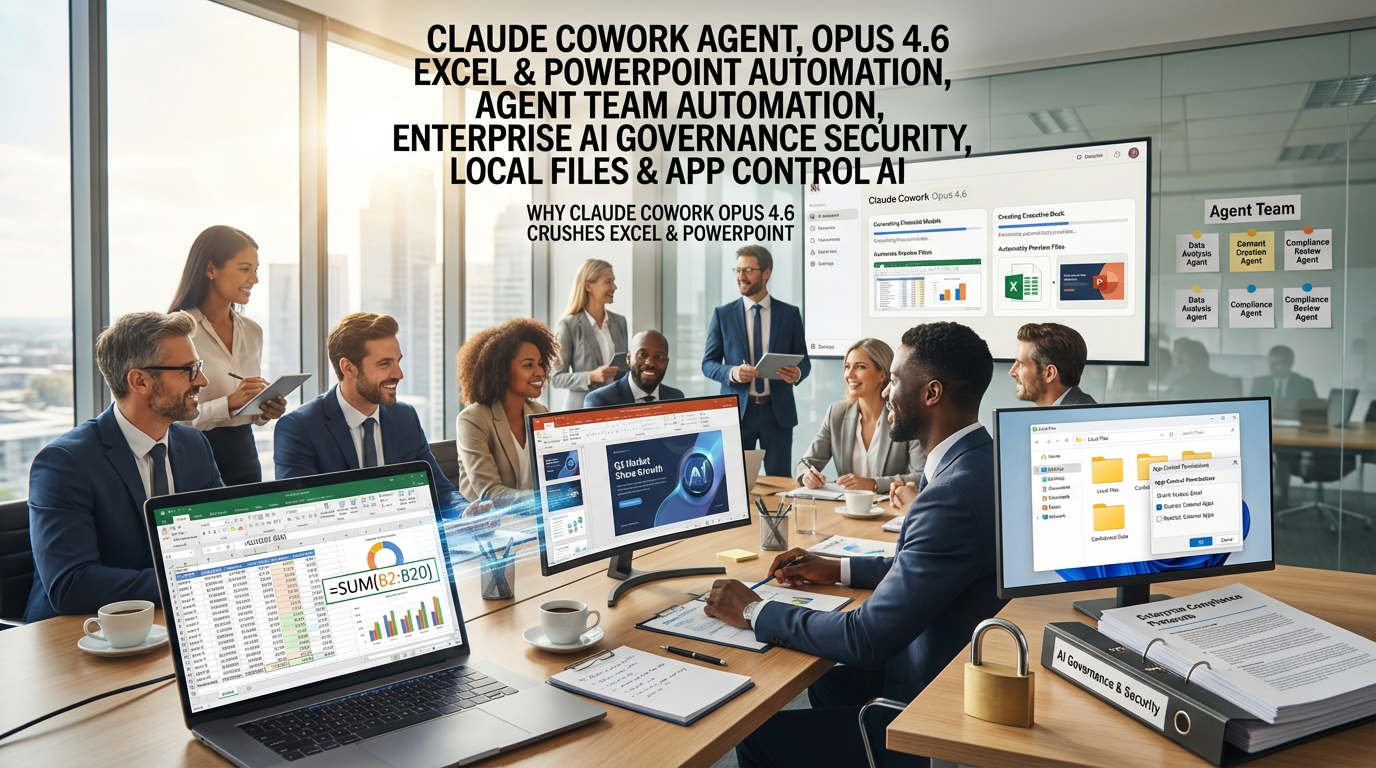
Claude enters in the form of an Excel sidebar,
and beyond simple tasks like pivots/charts, the flow where it designs and writes even complex models (e.g., DCF) becomes realistic.
What changes in PPT
Not just a plausible-looking “single slide,”
but evolving toward creating it to fit the work context (meeting notes/folder materials/requirements) by setting structure → narrative → per-page messaging.
Why this is a game-changer
Until now it was “AI makes a draft and humans finalize,”
but going forward, the speed at which it becomes “humans only approve/give feedback and AI finalizes” accelerates sharply.
4) Three “felt” points of Opus 4.6: Not performance, but where the “work feel” changes
(1) Dominant in office productivity benchmarks
It’s said to have scored highly on the “office work productivity” type benchmarks mentioned in the source,
which ultimately means strength in tasks that plug directly into real enterprise work like “documents/tables/slides.”
(2) Improvements in agentic search (browser control)
The point that its ability to directly control a browser like Chrome to find and organize information has improved is important.
This affects the search market/research work/lead generation (sales) as well.
(3) Reduced long-context “decay” (memory drop)
It handles long documents well, but the core point is that the phenomenon of forgetting more as the conversation gets longer (context decay) has decreased.
It’s mentioned that performance rose sharply in certain tests, and practically in real work this means
less rework in long-horizon tasks like “long-term project docs / policies / contracts / technical specifications.”
5) The “agent team” is more fundamental: Now it moves from 1 person to “team-level automation”
The most future-oriented part in the source was this.
A method where you run up to five agents and split roles across front-end/back-end/documentation/testing/PM.
What this change means
Now work capability is redefined not by “how good I am,” but by
“how well I command and review multiple AIs.”
Realistic downside
Tokens (cost) can increase exponentially.
So at first, rather than being a “feature everyone uses,” it’s likely to attach starting with
teams that make money (development/consulting/research/sales operations) while calculating ROI.
6) Global market reaction: “A seismic shift in B2B LLM API share” is the investment point
According to the source, on the enterprise (B2B) side, Claude’s camp share rises significantly,
and OpenAI is observed to be under downward pressure.
Key interpretation here
Consumer (general user) traffic/awareness and the enterprise (API contracts, workflow embedding) winner can be different.
Why software-related stocks wobble
If the place where companies spend money
was previously “subscribing to many SaaS tools,”
it could be reorganized into “one or two agent platforms + minimal SaaS.”
This hits cloud computing cost structures, the quality of subscription revenue, and valuation (multiple) as well.
In other words, short-term volatility increases,
and in the mid-to-long term, the possibility grows that leadership of digital transformation shifts from “tools” to “agent platforms.”
7) The five “most important things” other YouTube/news rarely say
1) The value of “people who are good at Excel” doesn’t fall; the value of “people who decide with Excel” rises
Hands-on skills (pivots, functions) are automated, but
which metrics to use for decision-making and how to set assumptions are still human responsibility.
Going forward, what gets rewarded is not the “operator” but the “decision designer.”
2) Agent adoption is not an IT project but a “control design” project
The moment it touches local files/apps,
without permissions, logs, audits, data boundaries, and internal controls, incidents happen.
In other words, the essence of AI adoption is not functionality but governance.
3) SaaS doesn’t die, but “function-type SaaS” may see price rebalancing
Repetitive-work-focused SaaS faces pressure,
while vertical SaaS deeply embedded in regulation/security/workflows may become stronger.
4) An “agent team” even impacts hiring/org design
If junior hiring is reduced instead,
and a structure emerges where seniors command AI, the organizational pyramid can change.
This is not just a tech issue; it links to the labor market and productivity, and ultimately to interest rates and policy variables.
5) Security becomes not an option but the center of cost
If agents touch local environments, the risk of personal/corporate data leakage increases.
So future AI adoption budgets may increase not only for “model usage fees” but also alongside
costs like VPN, access control, DLP, audit logs, and endpoint security.
8) A practitioner action plan: 7 steps to “switch my work over to Co-work”
1) Write down three tasks I repeat every week (reporting/organizing/extracting)
2) Classify where the required input data lives (email/drive/local/messenger)
3) Define outputs (Excel templates, PPT outlines, document formats)
4) Fix a “working folder” and an “output folder” for the agent
5) Start the first run in small units (summary → table creation → chart → slide)
6) Create a result review checklist (assumptions/numbers/sources/wording)
7) Apply the principle of least privilege at the end (block access to sensitive folders, leave logs)
9) One-line conclusion from a macro perspective: AI agents hit not “productivity” but “economic structure”
If AI starts finishing office work,
companies will recalculate labor costs, subscription costs, and cloud costs,
and in that process, the speed of supply-chain digitization, investment priorities, and software valuations can be reshuffled.
In short, this is not an AI feature update, but
a signal that generative-AI-based work automation is rising into an “enterprise operating system.”
< Summary >
Claude Co-work is not a chatbot but an agent that directly handles local files and apps, so work is moving from “draft generation” to “execution and finalization.”
Opus 4.6 increased real-work impact through Excel and PPT integration, agentic search, long-context improvements, and multi-agent teams, and B2B API share shifts can be a trigger for software market re-rating.
The most important thing is not features but control, security, and governance, and the human role will shift from operator to AI orchestration and decision design.
[Related posts…]
- Office automation reshaped by Claude Co-work, enterprise business process restructuring scenarios
- The beginning of the agent economy: how multi-agent teams change hiring, organizations, and productivity
*Source: [ 월텍남 – 월스트리트 테크남 ]
– 이제 엑셀, PPT 배우지 마세요.. 진짜 클로드가 다해줍니다