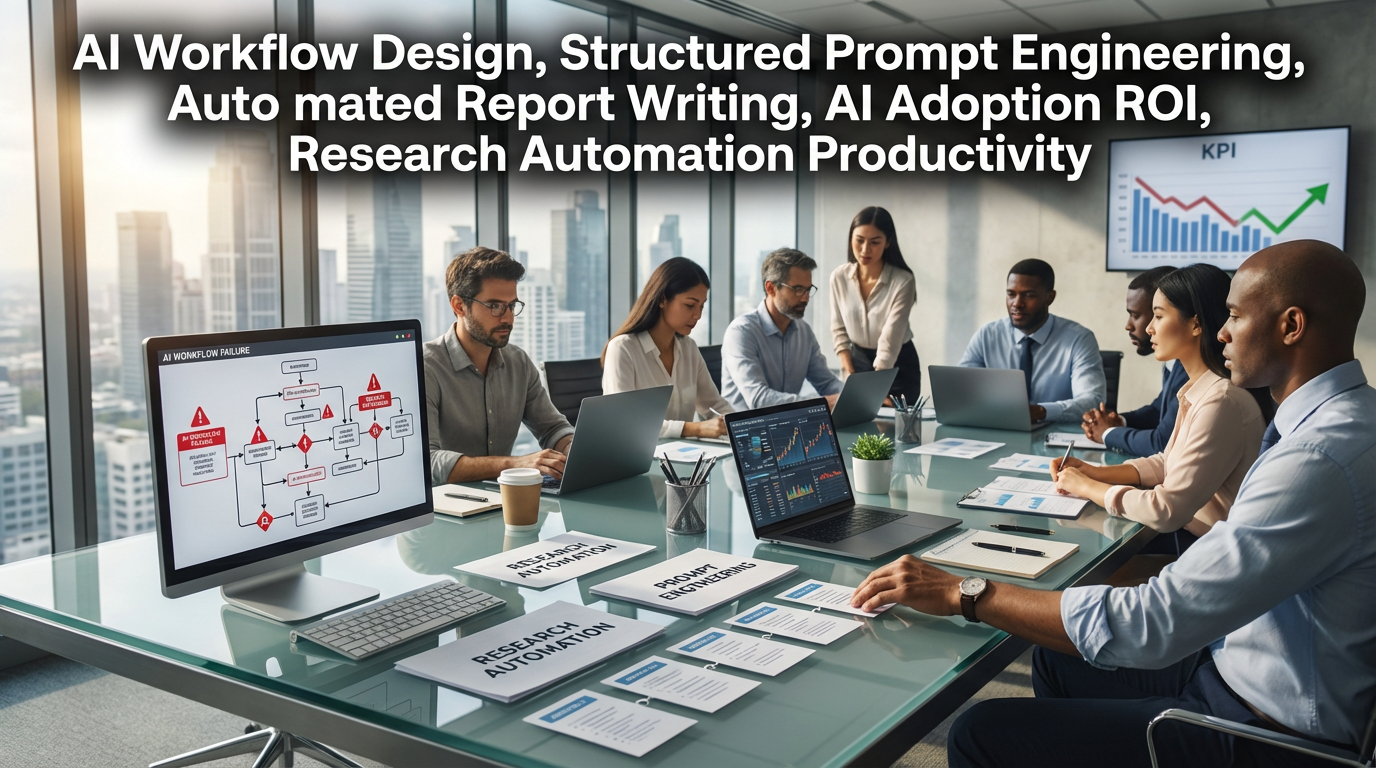
● AI Workflow Hacks Crush Report Bottlenecks
You Adopted AI, But “Why Isn’t Our Team Delivering Results?” The Answer Is Not the Tool, It’s the Workflow (HR EXChange 2026 & Workflow Redesign Key Takeaways)
This post clearly includes exactly three things.
First, the real reason companies subscribe to AI and still fail to produce high-quality research/reports.
Second, the core framework behind what Deokjin Kim and Aram Kim call “not an AI usage class, but a workflow design class” (immediately applicable to real work).
Third, the single most important point that, in today’s AI training market, hardly anyone says out loud—and a distilled summary of it.
1) News Briefing: HR EXChange 2026 Key Information
Korea’s largest HR conference, “HR EXChange 2026 : From Insight to Action”, is being held.
It is a conference centered on real-world cases that cover the role HR must play in the AI era and how organizations actually changed their “ways of working” in practice.
Key takeaway
27 HR practitioners from Korea and abroad will share their cases directly.
The message itself—“don’t stop at insight; move to action”—perfectly pinpoints the reality of corporate AI transformation today.
Date/Time Tuesday, March 31, 10:00 AM – 6:00 PM
Venue COEX Grand Ballroom (Lectures) / COEX Conference Room (Workshops)
Contact event@offpiste.ai / (02) 6339-1015
2) “Everyone Else Says It’s a New World—So Why Can’t My AI Do the Work?” The Problem Definition Has to Change
The message most strongly repeated in the original text is this.
The quality of AI outputs is determined more by the “work instruction structure (workflow)” than by “AI performance.”
A common pattern in corporate settings is also neatly summarized.
When AI produces an unsatisfactory answer, people fall into an endless loop of “rewrite it, rewrite it,” and it ends there.
But that’s not how we assign work to humans in the first place.
With people, we normally have purpose → scope → deliverable format → validation criteria, but we omit all of that only for AI.
This phenomenon is less about an individual’s lack of prompting skill and more accurately seen as a problem caused by
a collision between the organization’s existing process inertia (how reports are produced, approval lines, template culture) and AI-driven ways of working.
3) “Using AI Tools Well” vs “Designing AI Workflows Well” (The Most Practical Distinction)
The metaphor in the original text is truly clean.
Using tools well = driving skill
This includes shortcuts, features, and prompting tips.
Changing the workflow = redesigning the route/destination itself
This includes how you break work into steps, at which stage you exchange inputs/outputs with AI, where humans make judgments, and how you leave the work in a reusable form.
This is where today’s corporate digital transformation and productivity improvement efforts actually split into success vs failure.
If you only do tool training, “driving practice” improves, but without “route design,” arrival time does not decrease.
4) Why Prompt Engineering Became Less Hot, Yet Why “Structuring” Became Even More Important
The original text honestly points out the trend these days.
As AI keeps getting smarter, the term “prompt engineering” itself is used less than before.
But that does not mean “you can say anything however you want.”
In fact, what separates results in real work is something else.
Writing long, rambling prompts vs writing modular, structured prompts is the real difference.
The basic building blocks of a structured prompt emphasized in the course feel like this.
Role → Rules → Input Information (Context/Data) → Output Format
When you write it this way, the advantage shows up immediately.
Reusability appears.
The moment it becomes “next time I only need to change this part,” personal work turns into a system.
At the organizational level, this becomes the foundation that leads to AI automation.
5) “Our Company Has Limited Tools…” That’s Exactly Why Workflow Matters Even More
In large enterprises, regulated industries, and high-security environments, you cannot freely use the latest tools.
It is also common to experience that something works outside the company but is blocked internally.
A crucial perspective shift emerges here.
Even without agent tools, it is possible to design “maximum efficiency with minimal tools.”
In other words, the correct answer is not “performance is poor because our tool stack is weak,” but
“we must redesign the process with realistic tool constraints as a premise.”
This is also the core of improving AI adoption ROI at the organizational level.
6) Practical Section: How to Break Down the Workflow from Information Gathering (Research) → Report Writing
6-1) Repetitive Work (e.g., Weekly Reports) Is the Number-One Automation Candidate
Weekly reporting takes a lot of time, yet the impact of the output is often limited.
That’s why automation efficiency tends to explode the most there.
The key is not “full automation,” but
designing the steps based on a template-defined structure so you can
quickly collect only the necessary information → summarize/organize → compress into one page.
Also, as mentioned in the original text,
if you attach scheduling/task features of services like ChatGPT or Perplexity, “regular execution” also becomes possible.
But before that, what you need first is a “prompt template (module)” that can actually run reliably.
6-2) A Questioning Method That Enables Deep Research: Big Picture → Issues → Pros/Cons → Narrowing
An example used the EV battery market, and this frame is extremely versatile.
Step 1: Summarize 5 major market issues (big picture)
Step 2: Select one of them (e.g., commercialization of solid-state batteries)
Step 3: Pros/cons debate + status of major companies (secure decision-making grounds)
Step 4: Comparative analysis of Korea’s three battery companies (narrow the scope)
This is not at the level of “Can I just run AI multiple times?”
It is essentially the same as how you split tasks and assign work to team members within an organization.
So once this method starts running,
the organization’s knowledge accumulation speed itself increases.
As a result, even during a economic downturn, operations that reduce costs and increase decision speed become possible.
7) A Report “Table of Contents” and “Design” Are Different: A Gap That Widens Further in the AI Era
A table of contents is closer to a “list of what to include,”
while design includes “why it must be in this order, whether this structure persuades, and whether the message is delivered to the audience.”
The key point is this.
A report changes completely depending on the audience (for the CEO / for executives / for managers).
But when people assign work to AI, they often forget this premise.
That is one decisive reason output quality becomes unstable.
This is also why the course says “AI training will become job-function training.”
Report structure, storyline, and logical validation are the core of work competency in the first place.
8) If AI Saves Time, That Time Must Be Reinvested into “Better Outputs”
The most practical sentence in the original text was this.
If the goal is to reduce a report that used to take 4 hours down to 2 hours,
the remaining time should be used to create a “richer report.”
That is, the goal of adopting AI is not merely leaving work earlier,
but transforming outputs into higher persuasiveness/completeness within the same time.
This connects directly to individual evaluation and also links to organizational performance.
9) Truly Important Content Others Don’t Talk About Much in News/YouTube (Separate Summary)
Core point 1: The essence is not “AI can’t answer well,” but “the organization fails to leave work in reusable forms.”
The value of modular prompts is not “getting it right once,” but “repeating the same quality next time as well.”
When this scales to the team level, it becomes a standard operating process.
Core point 2: The next stage of AI education is not tool training, but “work scenario/step design training.”
When tools change, feature training becomes outdated quickly.
By contrast, workflow design remains even when tools change.
With this perspective, training investment efficiency appears even under cost-pressure environments such as interest rate hikes.
Core point 3: Don’t use an “AI employee” as a junior—use it as a senior reviewer if you want better reports.
The hardest part of writing reports is that you cannot see the gaps in your own logic.
In a reality where it is hard to get interim reviews from your boss every time,
positioning AI to validate logic/check coherence/propose counterarguments increases the density of the deliverable.
Core point 4: For deep research, shift from “requesting the correct answer” to “requesting grounds for judgment.”
If you build the habit of also asking for pros/cons, risks, weaknesses, and alternative scenarios,
AI becomes not a “writing machine” but “decision support.”
As global supply chain issues repeat in today’s global markets, this approach becomes even more important.
Core point 5: AI is not a technology trend; it is a tool that changes a company’s “cost structure.”
If AI adoption is designed not as a mere convenience feature, but to reduce operating costs by tying together research-reporting-approval-reuse,
then the organization’s production function itself changes from that point on.
This is where corporate AI investment connects to the U.S. economy (corporate CAPEX, the productivity debate).
10) Why You Lose Out If You See HR EXChange 2026 as “An HR-Only Event”
In the AI era, HR’s role is expanding beyond hiring/evaluation
toward designing how an organization “should work so that AI can produce results.”
So this conference is not only for HR, but also likely to yield practical hints for
planning/strategy/marketing/PM/operations/training managers.
In particular, the keyword “From Insight to Action” itself
looks like a signal that it squarely addresses the bottleneck companies struggle with most these days: converting into execution.
< Summary >
When AI outputs are underwhelming, the reason is often not the AI but weak workflow design.
More important than tool know-how is creating a structure that breaks work into 4–6 steps and coordinates back-and-forth with AI.
Rather than writing prompts long, modularizing them into role/rules/information/output format improves both reusability and quality.
Repeated reports like weekly reporting have a fixed template structure, so automation impact is the greatest.
Reports must be “designed,” not just outlined, including audience and logical flow, and using AI as a reviewer improves quality.
HR EXChange 2026 is a conference that covers real-world cases of transforming how organizations work in the AI era.
[Related Posts…]
- What HR Organizations Must Do in the AI Era: Workflow Before Policies
- AI Workflow Design: How to Double Report and Research Productivity
*Source: [ 티타임즈TV ]
– 김덕진, 김아람의 ‘워크플로우 리디자인 강좌’ 맛보기