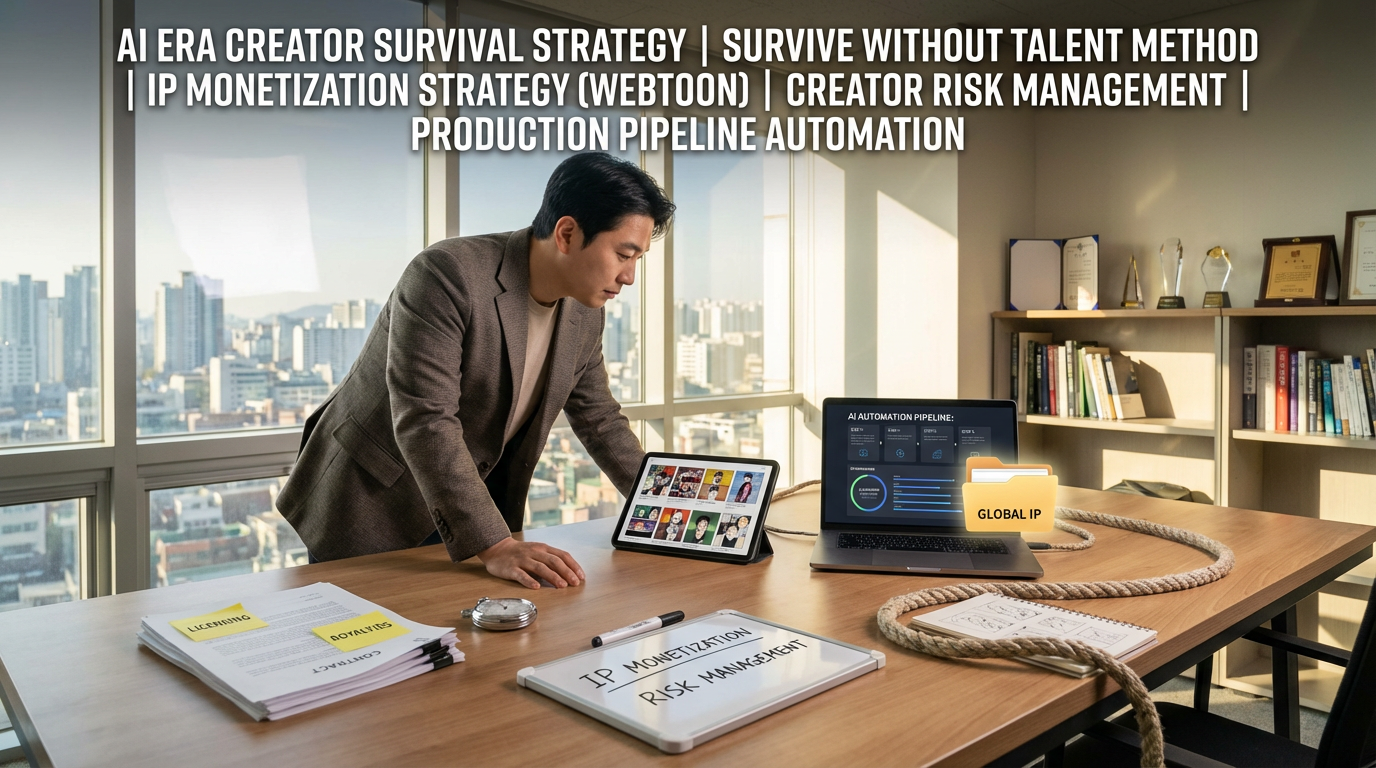
● Talent Myth Crushed, AI Survival Formula Revealed
In the AI Era, If You Don’t Have “Talent,” One Thing You Must Realize Fast: The Survival Formula Webtoon Creator Josaek Talked About (Hate Comments, Deadlines, and Even the Age of AI Replacement)
Today’s post includes the following.
First, three survival principles a first-generation webtoon creator realized while “taking real-time hate comments.”
Second, the method used to build a revenue structure that surpasses a major-company salary (and the hidden risks behind it).
Third, the real reason he doesn’t get shaken by other people’s success, and what the “one thing you must realize fast” is if you have no talent.
Fourth, how to develop the “irreplaceable ability” creators need to survive in an AI-saturated era.
And lastly, I’ll separately summarize the “most important point” that other YouTube channels/news outlets rarely highlight (the difference between what realistically makes money vs what lets you last a long time).
1) Today’s Core Point News Briefing: Josaek’s “Creator Survival Formula”
The message of this conversation can be summarized in one line.
Rather than “whether you have talent or not,” ditch the fantasy of talent quickly and secure “a repeatable method that works for you in the market.”
Here, the market isn’t limited to the webtoon market.
As AI and automation accelerate like they do now, whether you’re an office worker or a creator, competitiveness ultimately comes down to how long you can keep running the “produce–feedback–improve” loop.
2) What the “Trick to Never Miss a Deadline by Even One Second” Really Means
On the surface, it looks like a “tip for meeting deadlines,” but it’s actually a structural story that applies to work/creation in general.
The key takeaway is the habit of “breaking the deliverable into parts and making sure you’re effectively finished before the deadline.”
People who try to finish everything in one shot on the due date always collapse when variables hit.
On the other hand, if you’ve already made the “shape of a finished product” in advance, the last step is just quality tuning, so deadline stress drops dramatically.
Why this matters even more in the AI era is that AI keeps pushing production speed upward.
Then humans end up competing on “the ability to deliver repeatedly while maintaining completeness.”
3) Three Things He Realized While Watching Real-Time Hate Comments (The Realistic Version)
In the original timeline, there’s a part where he talks about what he realized while watching “hate comments tearing him apart in real time,” and this section hits hard not only for creators but also for office workers.
① Don’t take every evaluation as about ‘me’; separate it into the ‘work/deliverable’
If you take hate comments/feedback as “denying my existence,” continuing becomes impossible.
But if you see it as “so this is how the market is reading this deliverable right now,” you burn less emotion and only the improvements remain.
② Treat audience reactions not as ‘the answer’ but as ‘data’
Public reactions fluctuate with that day’s condition, platform mood, trends, and algorithms.
So if you bet your life on a single reaction, you’ll keep getting dragged around.
③ Protect your mentality not with ‘steel’ but with a ‘system’
A lot of people only think “I need to get mentally stronger,” but long-term survivors like Josaek usually build systems.
For example, limiting when/how you read comments, or locking in your work routine first.
4) The Secret to Beating a Major-Company Salary with a Single Webtoon: Structure Over “Talent”
What matters here isn’t “one big hit,” but “structure.”
Webtoons are fundamentally an industry that can expand into an IP (intellectual property) business.
In other words, once you expand beyond just page rates into secondary works (books, goods, video adaptations, ads, characters, etc.), the revenue curve changes.
From an economics perspective, it becomes not just labor income but more like asset-income characteristics (IP revenue) the moment that switch happens.
Even in today’s high-interest-rate environment, IP with strong cash flow tends not to lose value easily.
One point readers will care about here.
This pattern applies exactly the same not only to webtoons but also to solo creators, SaaS, ebooks, and educational content.
The key is whether “my output can be sold repeatedly in a repeatable form.”
5) The Real Reason He Doesn’t Get Shaken by Other People’s Success
The reason you get shaken when you see others succeed is simple.
It’s because you don’t have your own standard (your own game rules), so you grade yourself using someone else’s report card.
The point Josaek emphasizes generally reads like this.
“No matter how someone else blows up, I keep improving the format I’m good at.”
Why this matters is that these days platform algorithms can make success look “random.”
Just because someone suddenly took off doesn’t necessarily prove absolute skill.
So paradoxically, the person who keeps their routine ends up with higher odds of winning.
6) The “One Thing” You Must Realize Fast If You Have No Talent (My Interpretation of the Core Point)
This section is the centerpiece of today’s post.
If you have no talent, you must quickly give up the “game where you win with talent” and survive with a “repeatable method.”
Put more realistically, it means this.
The moment most people feel they lack talent, they go in two directions.
One is quitting.
The other is grinding themselves down with stronger stimuli (comparison, jealousy, self-loathing).
But the direction Josaek points to is a third one.
“Finish judging whether you have talent quickly, and build a sustainable production system.”
This is even more advantageous in the AI era.
Because the more AI advances, the cheaper a “single flash of inspiration” becomes.
Instead, humans differ in “the ability to build long-term relationships with the audience, accumulate context, and build trust through detail.”
7) Why He “Abandoned the Work That Made Him a Fortune and Started from Rock Bottom”
This choice looks like an emotional decision, but economically it’s closer to portfolio rebalancing.
When a single work becomes hugely successful, it becomes a “brand,” but at the same time it can become “shackles.”
Because the market tries to consume that creator only through a specific format.
So to survive long term, you need to experiment with the next food source even while doing what’s working.
For a company, that’s building a new business/new product lineup; for an individual, it’s diversifying career assets like a distributed investment.
In phases like now, where recession worries rise and fall, relying on “a single revenue line” becomes riskier.
In the end, what reduces uncertainty is diversification of abilities + diversification of income sources.
8) The Desperate State of the Webtoon Industry Where People “Crank Out Mass-Produced Works Like Crazy”
This part shows the structural pressure of the creator ecosystem.
As platform competition intensifies, supply (content) increases, upload cycles shorten, and creators’ stamina gets ground down.
It becomes a “quality vs speed” game, and if AI gets added, the speed race becomes even more extreme.
So going forward, two groups may split more clearly.
1) Teams/individuals who embrace AI and maximize their “production pipeline”
2) Teams/individuals who abandon the speed race and build “fandom, worldbuilding, and relationships”
Both paths exist.
But the problem is, if “you want to do #2, but you try to live using #1’s method,” you’ll break down.
9) One Thing the Creator Realized in an Era Where AI Is Everywhere
Most people only cling to the debate of “AI will replace drawing / it won’t,” but the more fundamental point is this.
AI is less a ‘technology’ than a ‘price-collapse device.’
Production that used to be expensive (sketching, coloring, storyboarding, idea variation) becomes cheaper and faster.
Then the market naturally demands “more, faster,” and pressure builds for average unit prices to drop.
This trend isn’t just in creative work; it hits office work documents/planning/analysis in exactly the same way.
So it’s dangerous if individuals see AI only as an “opponent”; they need to bundle it as a “productivity tool” and incorporate it into their system.
10) How to Build “My Own Ability” That AI Can’t Copy Even If It Tried
What AI is weak at is surprisingly clear.
① Specific observations drawn from my life experience
AI is great at producing average patterns, but it can’t automatically create “details I actually experienced.”
② Maintaining consistency in long-form narratives (serialization)
Whether it’s webtoons, YouTube, or a career, people feel trust through “consistency of identity.”
AI can make a single output well, but maintaining “that person-ness” over the long term ultimately must be designed by a human.
③ Relationship-based trust (fandom, community, customer understanding)
As content becomes more abundant and cheaper, people will pay more attention to “who made it.”
This connects to personal branding, community operation, and understanding customer data.
④ Selection and editing ability (the ability to decide what to discard)
AI can generate infinite options, but “which direction is right” is ultimately something a human must take responsibility for.
11) (What Others Rarely Talk About) The Truly Important Point: It’s Not “Talent,” It’s “Risk Management”
Most videos/interviews end on an inspirational note, but in my view, this is the core point.
In the AI era, creative work/careers have become a ‘risk game’ before they are a ‘skill game.’
Because when production tools get leveled up across the board, skill gaps shrink, but market volatility grows.
Algorithms, platform policies, trend shifts, copyright issues, burnout… these risks shake a career.
So the people who survive from now on must secure this checklist first.
– Diversify income sources (reduce dependence on a single platform)
– Standardize the work process (build a pipeline including AI)
– Health/time management (burnout is an immediate exit ticket)
– Understand IP/contracts (if you don’t know the rights structure, you can lose money even if you work hard)
This perspective applies 그대로 not only to webtoons but also to startups, office-worker careers, and freelancers.
12) The Next Trend for the “AI-Content Industry” From a Global Economics Perspective
These days, the global market is broadly volatile, and companies are under cost-cutting pressure.
In times like this, the first thing to accelerate is automation and productivity innovation, and AI sits at the center of it.
So the content industry is likely to be reshaped going forward in ways like these.
– Hyper-personalization (personalized content for each individual) expands
– Capital concentrates around IP (a premium attaches to reusable assets)
– Unit prices fall for simple producers, while value rises for “planning/editing/worldbuilding design”
This trend also affects valuation logic in the stock market for AI-related companies and platform companies.
In other words, AI will continue to be treated as a tech trend and also as a productivity variable in macroeconomics.
13) An “AI-Era Survival Routine” You Can Apply Right Now (For Office Workers/Creators Alike)
1) Once a week, break my work into ‘process steps’
If you stage it as idea → draft → feedback → revision → distribution, you start to see where to attach AI.
2) Every day for 30 minutes, write an “observation note”
What AI can’t do is the details of my experience, so you have to accumulate that as an asset.
3) Once a month, check income sources/platform dependency
These days, a single misstep can cause income to plunge, so structure checks are survival.
4) Use AI not as ‘replacement’ but as ‘amplification’
If you attach AI to repeating your strengths faster, competitiveness rises sharply.
Josaek’s message is that survival is decided by a “sustainable production system” rather than “talent.”
Treat hate comments and comparison not as the answer but as data, and the key takeaway is to protect your mentality not by becoming stronger but by using a system.
In the AI era, production unit costs collapse and the speed race intensifies, but the irreplaceable areas are observation detail, long-term consistency, relationship-based trust, and editing/selection ability.
The truly important point is risk management rather than skill (diversifying income sources, standardizing pipelines, preventing burnout, and understanding IP/contracts).
[Related Posts…]
- Job and Career Survival Strategies as AI Automation Changes Work
- An Investment/Spending Checklist Individuals Should Prepare in a High-Interest-Rate and Inflation Regime
*Source: [ 지식인사이드 ]
– AI시대, 재능이 없다면 빨리 깨달아야 하는 ‘1가지’ (조석 작가)