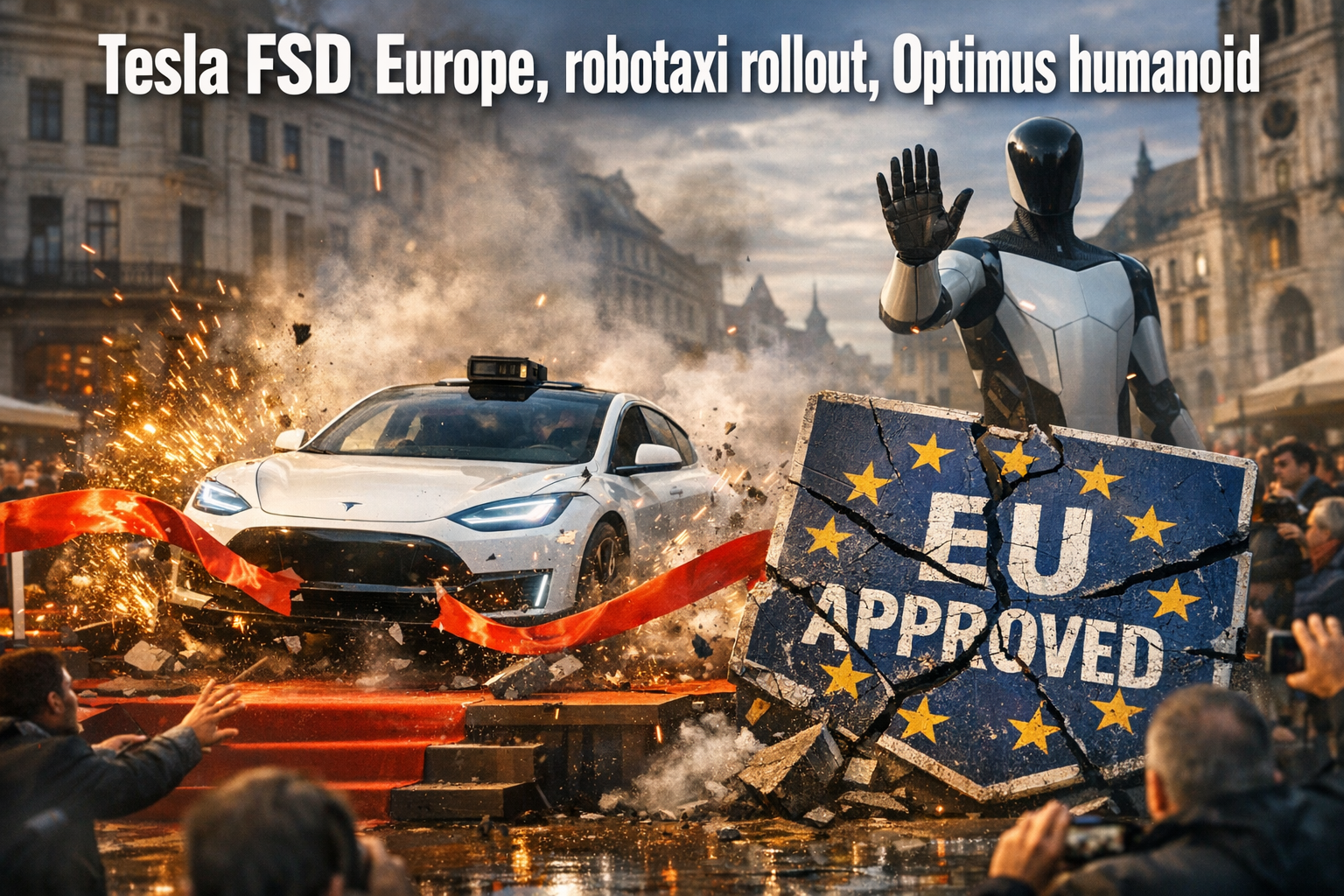
● Tesla Europe FSD Greenlight Sparks Robotaxi Manufacturing Blitz
From the March 20 “European FSD Approval” to April “Cybercab Volume Production”: Why Tesla Is Reshaping the Industrial Landscape (Key Timeline + Investment/Industry Implications)
This report covers:1) Why a March 20 “Supervised FSD approval” in the Netherlands could become a catalyst for broader EU rollout.
2) How the start of “Cybercab volume production” in April could mark the transition from an automaker to a robotaxi platform operator.
3) What vertical integration (Gigafactory Berlin battery cells; Texas lithium/nickel refining) implies for supply security, cost structure, and margins.
4) Why Musk repeatedly frames Optimus (humanoid robot) as a “new supply chain,” beyond a demonstration milestone.
5) Under-discussed factors (EU regulation, plant expansion constraints, political-economy risks) consolidated in a dedicated section.
1) One-line summary: Tesla is not primarily an auto company; it is an industrial-scale producer of real-world AI
Tesla’s positioning can be summarized as follows:
- FSD is vision-based decision AI intended to operate in complex real-world environments.
- Tesla is integrating AI + manufacturing + energy into a single vertically integrated system: FSD, Cybercab (robotaxi), Optimus (robotics), battery cells/refining (materials), and Semi (commercial).
2) Timeline-driven briefing: March 20 (Europe) → April (Cybercab) → Year-end (meaningful volumes)
2-1. March 20: Indication of pending FSD approval in the Netherlands
Key point: Musk stated he had heard from regulators that approval in the Netherlands could occur on March 20.
Investment relevance:
- The Netherlands is less important than whether it becomes a first workable regulatory precedent within Europe.
- In the EU, liability, safety compliance, and data governance are structurally stringent; operational precedent in one jurisdiction can accelerate acceptance elsewhere.
- If commercialization is enabled, EU revenue pathways (subscription/feature upsell) may expand.
2-2. “Technically possible this year to sleep to destination” statement
Interpretation:
- Technical capability and regulatory approval/liability/insurance frameworks are separate tracks.
- Markets may treat this as a signal of continued improvement velocity in FSD performance, which can influence valuation tied to AI/platform optionality.
2-3. April: Cybercab volume production at Gigafactory Texas → “meaningful production” by year-end
Key point: Musk indicated production has started, with volume production beginning in April and meaningful production targeted by year-end.
Strategic implication:
- If Cybercab is designed around robotaxi deployment, Tesla’s business model shifts from unit sales toward utilization-based cash generation (operations/service).
- This reframes key performance metrics from deliveries to utilization, cost per mile, safety/claims, and regulatory/insurance scalability.
3) Industrial scaling: five plants ramping, battery cells, and refining capacity
3-1. Battery cell production: cell manufacturing referenced at Gigafactory Berlin
Implications:
- Battery cells are central to EV cost structure.
- Localized EU cell production supports supply resilience and logistics/cost optimization.
3-2. Texas lithium refining + nickel cathode refining described as “already a startup”
Implications:
- Moving upstream into refining reduces exposure to commodity price volatility and supports margin durability.
- In higher supply-chain risk environments, vertical integration can be a differentiator in operational stability.
3-3. “Five factories begin volume production this year”
Implications:
- Software progress must translate into production, delivery, and operational cash flow.
- Tesla is attempting simultaneous scaling of manufacturing capacity and AI productization.
4) Optimus (humanoid robotics): from “one useful unit” to supply-chain scale as the primary constraint
4-1. Core framing: “No one has made a truly useful humanoid yet”
Operational constraint highlighted:
- Hand design and dexterity remain difficult engineering bottlenecks.
- Humanoid robots require a largely new component and manufacturing supply chain, potentially more limiting than software demonstrations.
4-2. “Labor becomes optional within 10 years” as an economic signal
Macro relevance (conditional, not determinative):
- If realized, humanoid robotics could drive a productivity shock with implications for wages, inflation, social spending, and policy debates (including basic income).
- Early demand could concentrate in aging economies and labor-constrained sectors (care, logistics).
5) Assessment of European auto industry: low differentiation, EV transition resistance, autonomy as a necessity
5-1. Diagnosis: limited product change versus five years ago
Claimed implication:
- Weak differentiation among legacy OEM products and slower EV transition dynamics.
5-2. “Non-EV + non-autonomous vehicles become niche”
Strategic argument:
- EV architectures are simpler and can be more efficient on total cost of ownership.
- Autonomy is positioned as a required capability due to safety and time-value benefits.
6) Gigafactory Berlin expansion condition: political/regulatory risk as a binding constraint
Key statement: external pressure could limit further expansion; the factory would not close, but expansion could be constrained.
Implications:
- In Europe, growth is not driven solely by demand; regulation, labor relations, and political pressures materially influence expansion feasibility.
- The statement pairs ambition (potential to become Europe’s largest factory complex) with a conditional dependency on governmental and public support.
7) Under-covered but decision-relevant points
7-1. The March 20 FSD issue is primarily about liability and insurance, not functionality
- Scaling autonomy requires institutional clarity on accident liability (driver vs manufacturer vs software) and insurance structures.
- The Netherlands matters as a potential inflection point for establishing a workable EU framework.
7-2. Cybercab’s inflection is utilization, not unit sales
- Robotaxi economics are driven by operating hours (utilization), unit economics per mile, safety/claims, and compliance/insurance scalability.
- These variables depend on AI performance plus service operations (maintenance, parts, fleet management).
7-3. Lithium/nickel refining functions as an inflation and volatility hedge
- Commodity inputs are sensitive to cycles, geopolitics, tariffs, and export restrictions.
- Upstream integration can stabilize long-term cost structure across shifting macro regimes.
7-4. “Expansion may not happen” functions as a negotiating lever in Europe
- Expansion would meaningfully affect jobs, tax base, and industrial spillovers.
- Signaling a willingness to pause expansion can be used to counter regulatory or political pressure.
8) Why this matters for global macro and industrial policy
- EV and battery vertical integration intersect with supply-chain reconfiguration and industrial policy.
- Autonomy and robotaxis intersect with labor markets and productivity.
- Market sensitivity may increase to CPI/inflation trends, EU regulatory developments, and energy/commodity price movements, making interpretation multi-factor rather than single-news driven.
< Summary >
- Musk referenced potential approval of supervised FSD in the Netherlands on March 20 and stated that, technically, end-to-end “sleep to destination” capability could be achievable this year.
- Cybercab production has started at Gigafactory Texas; volume production is targeted for April, with meaningful production by year-end.
- Vertical integration (Gigafactory Berlin battery cells; Texas lithium/nickel refining) is positioned to improve supply stability and support cost/margin resilience.
- Optimus faces scaling constraints tied to hardware complexity and the buildout of a new supply chain, with potential long-term implications for labor and productivity.
- The dominant variable for European expansion is not demand but regulatory/political conditions and liability frameworks.
[Related…]
- https://NextGenInsight.net?s=FSD
- https://NextGenInsight.net?s=robotaxi
*Source: [ 오늘의 테슬라 뉴스 ]
– “3월 20일 승인예정!” 일론 머스크가 직접 밝힌 테슬라 보유 이유와 사이버캡 양산 일정 [한글자막 풀영상]
● AI Layoff Shockwave Sparks Bank Loan Panic, Tesla Robotaxi Gap Exposed, Cybertruck Demand Explodes
From a Tesla/AI-Driven “Layoff Rally” to Robotaxi Performance Gaps: Five Key Takeaways
1) Why AI-automation-driven “mass unemployment fears” can spill into financials (loan credit deterioration)
2) The mechanism behind post-layoff share price spikes (the market’s margin re-rating formula)
3) Cybertruck: the data point that contradicts “weak demand” (deliveries pushed to 2027)
4) Autonomous driving: why Tesla vs. Waymo diverge materially even under the same “robotaxi” label
5) Realistic scenarios for Korea’s autonomous-driving regulation/commercialization and how that could intersect with Tesla FSD
1) Primary Market Catalyst: AI-Driven Layoff Diffusion and Transmission Into Financial Stress
News brief
- Accelerating AI transitions are increasing volatility in IT, with spillover effects into financials.
- The core transmission path is: employment insecurity → income decline → weaker debt service capacity → rising delinquency/NPL risk.
- Reports (e.g., from UBS) flag potential credit deterioration, contributing to broader pressure on financial equities.
Why the risk appears more acute now
- Unlike prior slowdowns driven mainly by demand contraction, current dynamics include structural disruption from changing production methods.
- Faster AI adopters can combine stable/growing revenue with rapid cost reduction, making workforce redeployment and headcount cuts more likely.
Investor focus (macro view)
- Near term: heightened job insecurity can slow consumption; delinquencies may first emerge among vulnerable borrowers.
- Medium term: higher productivity can lift corporate earnings, potentially supporting equities (notably large-cap technology).
2) The “Layoffs, Then a Stock Surge” Formula: Block (Jack Dorsey) and AI-Era Valuation
News brief
- Block signaled large-scale layoffs (referenced at ~40%), followed by a rapid share price increase.
- Markets typically interpret layoffs as balance-sheet and operating resilience improvements.
Why prices rise (core investment logic)
- If (1) revenue is stable or growing, and (2) operating costs (labor/overhead) are reduced materially, then (3) forward margins can expand sharply.
- When AI automation supports the expectation that service quality can be maintained with fewer employees, layoffs shift from a one-time cost action to a structural margin re-rating catalyst.
Key risk framing
- Positive for individual companies; potentially negative for the broader economy if unemployment shocks weaken consumption and credit cycles.
- This creates a dual regime: equity support via margins vs. macro fragility via labor/credit stress.
3) Cybertruck: Demand Signal That Challenges the “No Demand” Narrative (Deliveries Shifted to 2027)
News brief
- Cybertruck delivery wait times have extended rapidly, with references indicating slippage to 2027.
- Anticipated changes in pricing and purchase conditions around the USD 60k band are reinforcing urgency effects.
How current demand differs from prior reservation waves
- Earlier: higher “place a deposit and wait” behavior.
- Now: demand appears closer to purchase intent under more defined pricing/terms.
FSD term changes and incremental “deadline demand”
- With FSD moving toward subscription and reduced availability of one-time purchase, windows that preserve legacy FSD rights/transferability are perceived as higher value.
- This can be viewed as an embedded call option on future autonomous-driving value rather than a simple add-on feature.
4) Autonomous Driving: Same “Robotaxi” Label, Different Performance and Economics (Tesla vs. Waymo)
Core conclusion: not primarily sensors; the differentiator is operating model + intelligence architecture
4-1. Tesla (highlighted points from shared footage/cases)
- User cases cite long-distance operation (e.g., ~650 km) without intervention.
- Demonstrations emphasize early decision-making in low-salience situations (distant trucks, narrow roads), including proactive yielding and rerouting.
- Recognizing hand signals without remaining stopped indefinitely (progressing under defined safety conditions) is positioned as relevant to operational stability in real deployments.
4-2. Waymo (highlighted points from shared footage/cases)
- Even with extensive sensors, decision deadlocks on narrow roads have been shared.
- Repeated edge cases increase dependence on localized rule handling and remote intervention, which can slow scalability.
4-3. Practical implication
- The key is not whether autonomy works in principle, but how smoothly software resolves exceptions and scales with minimal remote intervention.
- Unit economics can diverge materially due to remote-operations staffing, mapping/sensor cost structure, and rollout velocity.
5) Tesla FSD’s Strategic Evolution: When a Conversational Agent Sits on Top of Driving
News brief
- Demonstrations emphasize voice-based, multi-step requests (destination, schedule, shopping lists) rather than lane-keeping alone.
- This reframes the system from “driving AI” to a broader “daily-life AI agent.”
Why this matters
- Driving is a feature; a conversational agent is a platform layer.
- Platformization can turn the vehicle into a commerce/reservations/advertising/content endpoint.
- This increases the probability of valuation framing shifting from automaker to AI platform narrative.
6) Europe Approval Catalyst: Implications of Potential Netherlands-Led FSD Expansion
News brief
- Commentary indicates expectations around a Netherlands regulatory decision timeline (around March 20).
- A positive signal in the Netherlands is viewed as potentially opening a path to broader European adoption.
Investor checkpoints
- Beyond market size, regulatory standardization can accelerate diffusion.
- More important than approval timing is the final framework language on liability, insurance, and data governance.
7) Korea Autonomous Driving: Strategic Meaning of “Waymo-Style Sensor-Based Robotaxi Commercialization” Discussions
News brief
- Domestic discussion around robotaxi commercialization is expanding, alongside increased public-sector exposure and interest in FSD.
Realistic scenarios for Korea
- (1) Initial rollout likely favors sensor- and map-dependent models with constrained operating domains.
- (2) Once the market opens, regulation/insurance/liability debates begin to be shaped by real operational data.
- (3) This can create stronger justification and potentially faster pathways for camera-centric, scalable models such as Tesla’s approach.
Operationally efficient adoption sequence
- Beyond central-city showcases, deployment in mobility-disadvantaged regions (including aging populations) may deliver clearer social utility and facilitate regulatory alignment.
8) Under-Discussed Core Points
Core Point 1: AI-driven layoffs are both a recession signal and a productivity surge signal
- The key question is where excess productivity is allocated.
- If captured primarily by corporate profits, equity support strengthens; if distributed to households, consumption resilience improves.
Core Point 2: financial instability is driven less by “AI itself” and more by transition-speed dispersion
- AI winners can expand rapidly, while lagging roles/industries face income volatility.
- Credit stress tends to appear first in vulnerable segments, not in averages.
Core Point 3: autonomy competition is decided by remote-intervention cost and scaling cost, not demo optics
- Sensor density does not eliminate operational drag if edge cases increase remote-operations load.
- Robotaxi viability is highly sensitive to remote-intervention rate per autonomous mile and related staffing intensity.
Core Point 4: Cybertruck demand is reinforced by option value (FSD/pricing/terms), not only popularity
- Current demand includes economically motivated behavior around changing purchase conditions.
Core Point 5: markets are becoming more sensitive to productivity than rates at the margin
- Rates remain relevant, but AI-driven productivity increasingly determines equity beta and valuation elasticity.
9) Investor/Professional Checklist (Next 1–3 Months)
- Whether large-scale layoff announcements broaden further (especially large-cap tech/fintech)
- Whether financial institutions revise guidance on delinquency rates and provisioning
- How regulatory language on liability/insurance evolves in FSD-related news (Europe/Korea)
- In robotaxi content, prioritize signals on remote-intervention dependency and operational stability over visual novelty
< Summary >
AI automation is accelerating layoffs, increasing employment insecurity, and elevating concerns about consumer credit deterioration and loan losses.
When revenue remains stable, layoffs translate into cost compression and margin expansion, often functioning as a strong equity catalyst.
Cybertruck wait times extending toward 2027 indicate sustained demand pressure, with FSD term changes amplifying purchase urgency.
In autonomy, Tesla and Waymo appear to diverge in exception handling, remote-intervention reliance, and scaling economics.
As Korea advances robotaxi commercialization discussions, the resulting regulatory framework could influence the feasibility and pace of Tesla FSD entry.
[Related Articles…]
- Autonomous-driving taxi commercialization: key points in Korea’s regulatory changes (https://NextGenInsight.net?s=autonomous%20driving)
- AI automation era: simultaneous unemployment fears and a productivity-driven rally (https://NextGenInsight.net?s=AI)
*Source: [ 허니잼의 테슬라와 일론 ]
– [테슬라 속보] AI가 불러온 대량 실업의 공포, 그러나 감원 후 폭등하는 주가 / 이름만 같은 자율주행, 성능은 ‘넘사벽’!
● New Balance Roars Back 92B Sales Surge Drop Hype DTC Power Community Lock In
New Balance’s Shift From “Dad Shoes” to a Global Growth Brand: The Core Drivers Behind Five Consecutive Years of Double-Digit Growth (and the Move That Matters More Than an IPO)
This report covers:1) 2025 revenue of $9.2B and how to interpret five consecutive years of double-digit growth
2) North America +20%, Europe +30%: why performance differed by region
3) How collaborations and limited drops enabled a “cultural resurgence”
4) The evolving profit model: beyond footwear into apparel and DTC (direct-to-consumer)
5) The most under-discussed factor: community-hub retail creating lock-in and a proprietary data asset
1) Key takeaway: New Balance has quietly re-established itself in the market core
One-line thesis
New Balance’s growth is not primarily trend-driven; it reflects a structural repositioning from a performance footwear company to a lifestyle brand.
On-the-ground observation (New York running community hub store)
The location operates as more than a sales outlet, offering locker-room functionality, pre-/post-run servicing space, route programming, and marathon-linked merchandise. This format is designed to increase repeat visits, conversion, and brand loyalty in a single system.
2) Performance check: 2025 revenue $9.2B (+19%), five consecutive years of double-digit growth
Key point: durability, not just growth
2025 global revenue reached $9.2B, approximately +19% year-over-year, marking five consecutive years of double-digit growth.
Why it matters
Footwear demand is highly trend-sensitive; single-product spikes are common. Sustained double-digit growth over five years implies alignment across operations, distribution, and brand strategy, supporting a market interpretation of structural rather than transient growth.
Macro context (keyword-aligned)
In a high-rate environment, brands with pricing power tend to defend demand and margins. New Balance has leaned on premium positioning, controlled scarcity, and DTC to support profitability under inflationary pressure.
3) Regional growth dynamics: North America +20%, Europe +30%
Why geographic breadth is a capability signal
Single-country momentum can be local and temporary. Concurrent growth in North America and Europe indicates cross-cultural resonance driven by brand interpretation (style/identity), not only product performance.
Why Europe outperformed (interpretation)
European demand tends to prioritize silhouette and overall aesthetic over overt logo signaling, with strong retro/heritage consumption patterns. Core retro franchises such as the 990 and 550 fit this preference set.
4) The engine of “cultural resurgence”: collaborations + limited drops + celebrity/athlete partnerships
Strategic distinction
Rather than relying on high-volume mass distribution typical of major sportswear peers, New Balance adopted fashion-like drop mechanics: limited quantities, timed releases, and collaboration-led storytelling that increases attention and perceived scarcity.
Observed effects (three-part mechanism)
1) Early-launch attention increases marketing efficiency
2) Resale and community activity sustain brand heat organically
3) Product is re-framed from “functional footwear” to “fashion item”
Resulting implication
This strategy supported a shift away from a pure “running shoe company” perception, enabling broader category demand.
5) Beneficiary of the “dad shoe” cycle: alignment with existing brand identity
Authenticity advantage
While many brands attempted to manufacture the “dad shoe” aesthetic, New Balance’s historically chunky, comfort-forward silhouettes were consistent with its legacy. This reduced perceived trend-chasing and strengthened authenticity.
Demographic expansion
Younger consumers adopt the retro positioning; older cohorts purchase for comfort. This widens the addressable market.
6) Structural shift in the business model: footwear-only to apparel + DTC
2025 mix indicators
- Apparel revenue: $1.0B+
- Company-owned retail (direct stores) revenue: $1.0B+
Why it matters
Diversification reduces dependence on the performance of a small number of footwear franchises and stabilizes revenue.
What changes as DTC scales
1) Improved gross margin capture versus wholesale
2) Direct customer data accumulation improves product planning and inventory discipline
3) Community and membership mechanics can increase repurchase rates
Investor relevance (keyword-aligned)
A combined “brand + channel” model tends to improve resilience during economic slowdowns. This is consistent with the broader consumer premium applied to brands with strong DTC execution.
7) Revenue growth since 2020: approximately +180%
Scale change
Based on disclosed figures, 2023 revenue was approximately $6.5B. Reaching $9.2B by 2025 implies a rapid step-up in scale within two years.
Market expectation
The trajectory supports a plausible path to $10B+ annual revenue, consistent with a transition from trend-driven demand to a mainstream lifestyle platform.
8) IPO remains distant, but institutional attention persists
Status
New Balance remains privately held under a family ownership structure, limiting direct public equity access.
Why it is viewed as a high-quality potential IPO candidate
1) Five-year double-digit growth record
2) Geographic expansion with simultaneous North America and Europe momentum
3) Portfolio diversification (footwear to apparel and DTC)
4) Strengthening brand equity via cultural relevance
Rate-cycle context (keyword-aligned)
In easing-rate cycles, capital allocation often shifts back toward growth narratives. Independent of listing status, this supports continued attention to brand-led growth models.
9) Under-covered but material factors
1) Community-hub retail builds more than sales
Running-community spaces embed the brand into customers’ routines, shifting acquisition from persuasion-based advertising to habit-driven lock-in.
2) Marathon and event sponsorship validates brand identity
Partnerships tied to major races reinforce performance credibility, which is difficult to sustain for brands driven primarily by fashion momentum.
3) The drop strategy also functions as inventory-risk management
Beyond scarcity marketing, limited releases reduce SKU risk and inventory overhang. In sneakers, excess inventory typically leads to discounting and brand dilution.
4) “Dad shoe” silhouettes reduce cyclicality via longevity
Extreme designs can reverse quickly when cycles turn. Comfort-based core silhouettes tend to have longer life cycles, improving product LTV.
10) Key monitoring points
1) Timing of $10B revenue and sustainability of growth rates
As growth normalizes toward single digits, the focus shifts to whether premium positioning and DTC can defend margins and demand.
2) Apparel penetration as a test of true lifestyle positioning
Many footwear brands fail to drive repeat purchase in apparel. Having exceeded $1.0B, the next metric is repeatability and retention.
3) Supply chain and input-cost management
Pricing power under cost volatility remains a primary indicator of brand strength.
4) Indirect exposure framework (keyword-aligned)
With direct investment limited, relevant signals may come from adjacent ecosystems (sportswear peers, retail, materials, distribution) and related ETF flows. This differs from technology equity dynamics (e.g., Nasdaq) but can support portfolio diversification.
New Balance reported 2025 revenue of $9.2B (+19%), extending five consecutive years of double-digit growth and evidencing a measurable cultural and commercial resurgence.
North America (+20%) and Europe (+30%) growth indicates global expansion rather than a single-market trend.
Collaboration-led drops repositioned products as fashion assets, while legacy “dad shoe” authenticity strengthened brand credibility.
Apparel and DTC each exceeded $1.0B, reducing reliance on footwear-only demand and supporting a more durable growth model.
A key structural driver is community-hub retail, which creates lock-in and a proprietary customer data asset that can improve retention and execution.
[Related Articles…]
- https://NextGenInsight.net?s=DTC
- https://NextGenInsight.net?s=IPO
*Source: [ Maeil Business Newspaper ]
– [어바웃 뉴욕] “롱런이란 이런 것” 5년 연속 두 자릿수 성장의 비밀은? | 길금희 특파원