● Musk TerraFab Bombshell, AI Power Grab, Space Chip War
Core Takeaways from Elon Musk’s TerraFab Announcement: Space-Based AI, Terawatt Computing, and Why the Petawatt Narrative Matters for Investment and Industrial Realignment
This is not a conventional “build one more semiconductor fab” announcement.
Three points define the thesis:1) The binding constraint for AI infrastructure is shifting from model capability to power availability and chip manufacturing capacity.
2) The strategic arena is moving from terrestrial data-center competition toward space-based AI computing.
3) If executed, the concept could reshape semiconductors, space, power, robotics, and global supply chains in parallel.
This report summarizes the TerraFab announcement in a structured, news-style format, clarifies why Tesla, xAI, and SpaceX are positioned to operate as an integrated industrial bloc, highlights signals for the US and global macro outlook, and isolates underemphasized points that are material for investors.
1. TerraFab in one sentence
Musk framed the “true bottleneck” of the AI era as chips and electricity, proposing a large-scale industrial program that combines on-Earth semiconductor manufacturing with space-based solar-powered AI computing.
The implied shift is from “best model wins” to “lowest-cost power, highest chip throughput, fastest manufacturing iteration, and cheapest deployment wins.”
2. News-format key summary
2-1. Musk’s core claims
- A multi-planetary civilization cannot rely solely on increasing power generation on Earth.
- Earth captures only a small fraction of available solar energy; scaling civilization requires direct utilization of space-based solar energy.
- AI computing should therefore expand beyond terrestrial data centers toward large-scale orbital power and compute infrastructure.
2-2. Definition of TerraFab
TerraFab is positioned as an integrated, high-velocity semiconductor system that consolidates:
- chip design
- mask fabrication
- logic production
- memory production
- packaging
- testing
- redesign
The intended advantage is an accelerated “build–test–modify–rebuild” loop within a single facility, enabling rapid recursive hardware iteration versus conventional foundry workflows.
2-3. Why now
- Musk cited current global AI compute production capacity at approximately ~20 GW per year, arguing it is insufficient for terawatt-scale computing.
- He stated that even the full global semiconductor supply chain would represent roughly ~2% of the capacity required for his target scale.
- The implication is that scaling via incremental purchases of existing GPUs is structurally constrained; vertical integration and process internalization become strategic.
3. Industrial structure shifts implied by the announcement
3-1. AI’s center of gravity is moving from software to infrastructure
Market attention has focused on model competition (e.g., leading AI labs). The announcement emphasizes lower-layer constraints:
- semiconductors
- power generation and grid infrastructure
- launch systems
- cooling and thermal management
- space logistics
As AI matures, infrastructure control may become a primary barrier to entry and determinant of long-run competitiveness.
3-2. Tesla, xAI, and SpaceX as a de facto vertical-integration strategy
Musk described the initiative as a joint effort across SpaceX, xAI, and Tesla:
- Tesla: edge AI demand (vehicles, humanoid robotics)
- xAI: large-scale training and inference demand
- SpaceX: transport and orbital deployment
This structure links demand, production capability, and logistics within one ecosystem, aligning with reshoring dynamics, supply-chain security priorities, and US strategic industrial policy objectives.
4. Itemized explanation
4-1. Rationale for running AI in space
Terrestrial scaling faces constraints:
- power procurement and grid congestion
- land availability
- permitting and local opposition
- cooling requirements
- weather and climate risks
The claim is that space offers:
- higher solar utilization efficiency (no atmospheric attenuation)
- continuous exposure (no night/seasonal intermittency in relevant orbits)
- lower climate-related operational risk
Musk’s economic argument is threshold-based: if launch cost declines sufficiently, orbital infrastructure could become cost-competitive relative to terrestrial buildouts.
4-2. Why Starship is central
Space-based AI requires low-cost deployment of large masses to orbit.
- Musk referenced a long-term requirement on the order of ~10 million tons per year of orbital lift to enable terawatt-scale compute infrastructure.
While extreme by current standards, the logic is consistent with SpaceX’s historical focus on cost reduction through reusability and throughput.
4-3. TerraFab’s principal differentiator is iteration speed
The differentiated value proposition is not only volume or leading-edge node leadership, but the compression of development cycles by integrating mask, fabrication, test, and redesign within a single loop—treating hardware improvement with a software-like feedback cadence.
4-4. Target chip categories
Two primary categories were referenced:1) Edge inference chips for Tesla vehicles and Optimus humanoids (low-power, high-efficiency, real-time inference).
2) High-power, space-oriented chips designed for non-terrestrial constraints:
- radiation and high-energy particle exposure
- charge accumulation
- thermal management under different design trade-offs
- potential operation at higher temperatures to reduce radiator mass
4-5. Why Optimus matters to the plan
Musk suggested long-run humanoid robot production could exceed automotive volumes by 10x to 100x.
Regardless of the specific magnitude, the strategic relevance is that large-scale robotics adoption would materially expand demand for edge compute silicon, positioning TerraFab as a foundational supply asset for a robotics-driven hardware economy.
5. Macro and global economic implications
5-1. A high-visibility instance of US reshoring
Emphasis on Austin/Texas support aligns with broader US efforts to onshore strategic capacity across:
- semiconductors
- batteries
- AI data centers
- defense and space
Potential domestic effects include higher capex, specialized manufacturing employment, and improved supply-chain resilience. Internationally, competitive and cooperative dynamics with incumbent players (foundry and memory) could become more complex.
5-2. Power infrastructure as a primary macro variable for the AI cycle
Equity narratives often concentrate on AI compute vendors, but the binding constraint may be the power system:
- generation buildout
- transmission investment
- grid interconnection timelines
- storage and peak management
- cooling and energy efficiency technologies
- power semiconductors
Space-based AI can be interpreted as an attempt to bypass terrestrial grid bottlenecks. The broader AI capex cycle has implications for inflation sensitivity, rate conditions, and infrastructure investment timing.
5-3. The new supply-chain benchmark may be “repeatable scale” more than “leading-edge node”
While the market emphasizes 2 nm / 3 nm node leadership, the announcement prioritizes:
- rapid iteration
- reliability and durability
- deployment speed
- cost efficiency at scale
For robotics, autonomy, and space applications, these characteristics can dominate over minimum feature size, with potential valuation implications for participants across the semiconductor value chain.
6. Underemphasized but material points
6-1. The core is energy economics, not space ambition
The proposal is framed around power as the limiting factor for AI and automation growth. Space-based compute is presented as an industrial response to energy scaling limits rather than a speculative space narrative.
6-2. TerraFab resembles a “physical AI R&D engine” as much as a factory
Musk indicated intent beyond conventional compute, including exploration of new physics-based possibilities. The operational model resembles a combined manufacturing-and-research engine optimized for high-frequency prototyping and iteration, unlike a traditional customer-order foundry.
6-3. Tesla’s strategic direction: internalized AI demand as an industrial platform
Connecting vehicles, humanoids, models, silicon, data centers, and space deployment implies a platform with substantial internal demand. Such internalization can support scale economics with reduced reliance on external customers, potentially shifting competitive dynamics.
6-4. “Petawatt era” implies a longer arc toward lunar logistics and manufacturing
References to petawatt-scale progression, lunar mass drivers, robotics, and human settlement suggest a long-horizon scenario where the supply chain transitions from “Earth-built, launched to orbit” toward “in-space or lunar-enabled production and assembly,” affecting future addressable markets in space power, manufacturing, and deep-space logistics.
7. Execution realism
7-1. Aggressive near-term targets; partial mid-to-long-term feasibility
Orbital lift of ~10 million tons/year and terawatt-to-petawatt compute are highly ambitious given technology, capital intensity, regulation, safety, and debris constraints. However, the method—reframing constraints as cost and throughput problems and addressing them via vertical integration—matches Musk’s historical playbook.
7-2. Highest-probability near-term deliverables
Most likely earlier steps:
- Austin-based semiconductor iteration capability
- custom silicon for Tesla and xAI workloads
- expansion of terrestrial AI compute capacity
- scaling edge inference chips for vehicles and humanoids
Space-based AI compute is structurally downstream, but timelines could compress if launch economics decline materially.
8. Investor checklist
8-1. Semiconductors
Incumbent foundry and memory leaders may remain critical partners in the near term. If hyperscalers and AI-native firms accelerate in-house silicon, the role of traditional vendors may shift toward deeper co-development rather than commodity supply.
8-2. Power and energy
AI beneficiaries extend beyond chip designers:
- grid equipment and transmission
- storage systems (ESS)
- solar and nuclear
- natural gas as transitional capacity
- cooling technologies
- power semiconductors
AI is, structurally, an electricity-intensive growth industry.
8-3. Space
Launch, space power systems, thermal/radiator technologies, orbital assembly, and communications remain early-stage markets but could become extensions of the AI infrastructure stack over time.
8-4. Robotics
If Optimus reaches mass production, demand could expand across sensors, batteries, actuators, lightweight materials, and on-device AI chips, with direct linkage to physical-economy productivity themes.
9. Interpretive framing: TerraFab as an “operating system” experiment for the next industrial cycle
The announcement is best interpreted as a systems-level design:
- AI models
- dedicated silicon
- large-scale power
- robotic labor
- space logistics
- reusable launch
- expanded operational domain for human and industrial activity
The key message is the transition of AI competition into an infrastructure-intensive phase spanning energy, manufacturing, logistics, and space.
10. Conclusion
TerraFab is presented as a program to address AI’s emerging bottlenecks:
- chip availability
- power availability
- manufacturing iteration speed
- deployment cost
The proposal bundles semiconductor internalization, accelerated hardware loops, space solar power concepts, high-throughput launch capacity, and a robotics-led demand thesis. For investors, the announcement is relevant not only to Tesla, but to broader US industrial investment, global supply-chain reconfiguration, space-sector optionality, and the power infrastructure capex cycle.
The central question posed to the market is: what constitutes the true bottleneck of the future AI economy—and which organizations can control it.
< Summary >
- TerraFab is positioned as an integrated industrial project to resolve AI bottlenecks in chips, power, and manufacturing speed.
- Musk emphasized space-based AI computing and solar power as a pathway beyond terrestrial data-center constraints.
- The strategic structure links Tesla, xAI, and SpaceX into a vertical stack connecting chip supply, compute demand, and space logistics.
- The concept has cross-sector implications for semiconductors, space, robotics, power infrastructure, US reshoring, and global supply-chain dynamics.
- A key underweighted interpretation is that the core driver is energy economics and infrastructure control in the AI era.
[Related Articles…]
- https://NextGenInsight.net?s=AI
- https://NextGenInsight.net?s=semiconductors
*Source: [ 오늘의 테슬라 뉴스 ]
– [한글자막] 일론 머스크 테라팹(TerraFab) 발표 풀버전: 우주 AI와 페타와트 시대의 시작!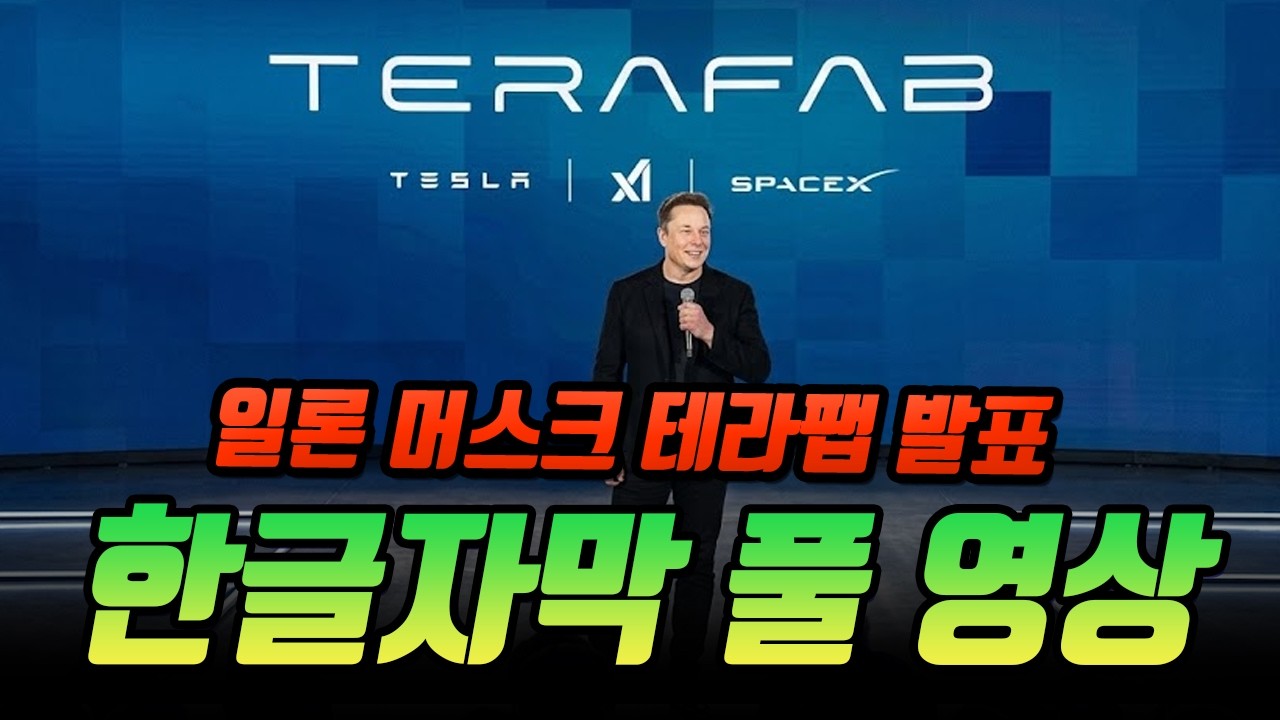
● Tesla Terafab Shock, AI Chip Power Grab, Space Data Empire
Official Announcement of Tesla’s “Terafab”: More Than a Semiconductor Plant—Key Takeaways Across AI Infrastructure, the Space Economy, and the Energy Transition
This announcement should not be interpreted as merely “Tesla is building a chip fab.”
Three core points:
1) Tesla aims to shift its AI semiconductor supply chain from external dependence to internal, vertically integrated control.
2) Tesla frames the primary bottleneck—data center power consumption—and proposes scaling compute beyond Earth as part of a long-horizon infrastructure concept.
3) The end objective is not incremental EV volume growth, but positioning for a new industrial stack combining humanoid robots, orbital compute, and energy infrastructure.
This is simultaneously a semiconductor development, an AI competitiveness move, an energy infrastructure signal, and a space-industry strategy.
1. At-a-glance: what was announced
Tesla presented “Terafab” as a vision for building an ultra-scale semiconductor and computing infrastructure production system.
Key elements:
- Vertical integration of AI chip design, fabrication, testing, and iterative improvement
- A fast iteration model integrating logic, memory, packaging, test, and mask-making within one building or one campus
- Separate design tracks for terrestrial chips and space-grade chips
- Long-term expansion toward orbital AI compute infrastructure rather than exclusively ground-based data centers
- Strategic linkage across SpaceX, xAI, Tesla, and Optimus (humanoid robotics)
This functions less as a “chip fab” announcement and more as an industrial infrastructure thesis for the AI era.
2. Strategic framing: why space and “civilization scale” were emphasized
The presentation prioritized a long-term infrastructure narrative over conventional metrics (production volume, revenue, CAPEX).
By referencing the Kardashev scale, the framing positioned energy capture and conversion as the defining constraint for future industrial capacity.
Implication: AI competition is constrained by:
- access to stable large-scale power,
- conversion efficiency from power to compute,
- and the lowest-cost operating environment for that compute.
In this framing, Terafab is positioned as an initial step toward “civilization-scale compute capacity.”
3. Why now: AI bottlenecks are chips and power, not software
The announcement aligns with current market dynamics: AI chips, data centers, and accelerating power demand.
Core claim:
- global AI demand is constrained by chip availability, power availability, and slow expansion cycles.
The message does not dismiss incumbent suppliers (e.g., leading foundries and memory producers), but implies external capacity expansion alone may be insufficient for Tesla/xAI timelines and potential space-scale compute ambitions.
AI competition increasingly resembles a supply-chain and infrastructure race: securing required chip volume on schedule.
4. The Austin advanced-tech fab concept: why end-to-end integration matters
Operational emphasis: integration of multiple steps into one location to compress iteration time:
- logic production
- memory production
- packaging
- testing
- lithography mask manufacturing
- rapid redesign and re-spin cycles
Competitive focus shifts from pure capacity to iteration velocity: design → test → defect discovery → mask update → re-fabrication → performance improvement.
Tesla indicated the iteration loop could be materially faster than industry norms (stated as up to an order-of-magnitude improvement).
5. Target chip categories: terrestrial vs. space-grade (distinct design priorities)
Two primary chip directions were referenced:
5-1. Edge inference chips
Likely use cases include vehicles and Optimus-class robots.
The thesis presented: humanoid robot unit volumes could ultimately exceed vehicle volumes by a large multiple, implying a potentially larger long-term demand base for low-power, high-efficiency, mass-manufacturable edge AI silicon.
Strategic implication: Tesla signaling a valuation narrative beyond an automotive framework, toward a robotics-scale production platform.
5-2. Space-grade high-performance chips
Space-grade requirements were positioned as fundamentally different:
- radiation tolerance
- thermal management optimization
- higher-temperature operation
- mass reduction
- maximum power efficiency
This suggests a distinct semiconductor sub-market: chips designed from first principles for orbital deployment rather than repurposed terrestrial server GPUs.
6. Highest-impact concept: “orbital data centers” vs. ground-only data centers
The most material long-horizon claim: a meaningful share of AI compute could migrate from Earth-based facilities to orbital infrastructure.
Rationale given:
- near-continuous solar availability in orbit
- no day/night cycle and reduced atmospheric losses
- potential for lighter solar panel structures
- reduced terrestrial grid bottlenecks, siting conflicts, and permitting friction
- potential for faster cost declines with scale (conditional on launch economics and system reliability)
Near-term constraint highlighted: grid interconnection capacity and available power, often more limiting than electricity price.
Strategic framing: relocate compute to power-abundant environments rather than only expanding constrained terrestrial grids.
7. Target scale: why “tera” (orders of magnitude)
Stated scale targets were presented as unusually large versus current industrial baselines:
- current global AI compute cited at approximately ~20 GW (annual scale referenced)
- long-term target: ~1 TW-class compute infrastructure
- required orbital transport capacity cited: ~10 million tons per year
- reliance on Starship-scale launch economics and cadence
- linkage to ~1 TW-scale solar expansion
While feasibility is debatable, the key signal is directional: Tesla anticipates AI demand exceeding current supply-chain and power-infrastructure expansion rates, motivating an integrated solution spanning semiconductors, energy, and launch.
8. Starship’s role: why launch capability was central to a semiconductor narrative
Orbital data centers and space-based solar only become economic under sustained, low-cost, high-throughput mass-to-orbit logistics.
The implied chain of reasoning:
1) AI requires very large chip volumes
2) chips require very large power inputs
3) terrestrial power and grid capacity face hard constraints
4) orbital solar and orbital compute become an alternative
5) this requires low-cost, high-cadence heavy-lift launch capability
This frames SpaceX launch economics as a core dependency in the broader infrastructure thesis.
9. Optimus linkage: a demand driver larger than automotive volume
Optimus was positioned as a primary strategic endpoint rather than an ancillary initiative.
A stated scenario: humanoid robot production could scale to 1–10 billion units annually (high uncertainty).
Strategic implication: Tesla positioning toward an AI-enabled physical labor platform business, requiring dedicated edge AI silicon optimized for cost, power efficiency, and manufacturability at extreme volume.
Potential second-order effects (if adoption scales) include disruption across labor markets, manufacturing, logistics, and service industries.
10. Macro interpretation: five implications for global markets
10-1. AI investment leadership may shift from software to infrastructure
Focus expands to semiconductors, data centers, power generation, grid equipment, cooling, and energy storage.
10-2. Rising pressure toward “de-outsourcing” in semiconductors
Design ownership may extend further into production process influence, packaging, and testing to secure supply and shorten development cycles.
10-3. Energy transition becomes a direct input to AI competitiveness
AI is power-intensive; therefore renewables, storage, grid expansion, nuclear policy debates, and transmission buildout increasingly tie to AI growth.
10-4. Space industry shifts from defense/exploration toward industrial infrastructure
Space becomes framed as an operational venue for compute and energy infrastructure, not only communications or defense assets.
10-5. Long-term linkage to labor market restructuring
Humanoid robotics plus dedicated AI chips could affect productivity and the structure of labor demand across multiple sectors.
11. Under-emphasized points in mainstream coverage
11-1. Terafab is fundamentally an “iteration-speed system,” not just a manufacturing facility
Competitive advantage is framed around shortening development loops rather than maximizing static capacity.
11-2. Orbital compute is positioned as a power-bottleneck avoidance strategy
The concept is presented as a response to terrestrial grid constraints rather than purely speculative futurism.
11-3. Tesla is repositioning from an automotive company toward a “civilization infrastructure” platform
EVs, batteries, charging, robotics, chips, satellites, rockets, and AI are presented as an integrated stack across the Musk ecosystem.
11-4. The initiative is both supply-defense and market creation
Not only addressing near-term chip scarcity, but also attempting to shape future demand across robotics, space, and energy.
12. Feasibility and key risks
Material execution risks remain:
- semiconductor manufacturing complexity differs fundamentally from automotive manufacturing
- advanced process tool access and yield ramp typically require long timelines
- orbital compute faces launch cost, maintenance, latency, and thermal management constraints
- ~10 million tons/year to orbit is highly aggressive relative to current capacity
- regulatory, geopolitical, and supply-chain risks persist
Near-term feasibility is uncertain; the strategic value is in signaling direction and attempting early platform positioning.
13. Investor monitoring checklist
Key items to track:
- Austin fab construction milestones and equipment delivery timelines
- scope of logic/memory/packaging internalization
- xAI cluster expansion pace and associated chip demand growth
- Starship launch cadence and cost-per-ton trend
- Optimus mass-production timeline and silicon architecture evolution
- expansion in solar and energy storage deployment
- partnership vs. competition dynamics with incumbent semiconductor vendors
14. One-sentence conclusion
The Terafab announcement is not primarily a plan to build a semiconductor plant; it is a platform strategy to integrate AI silicon supply, power infrastructure, orbital compute concepts, and robotics-scale demand to compete for future industrial control points.
< Summary >
Tesla’s Terafab announcement outlines an integrated strategy spanning AI semiconductors, data centers, energy transition, the space economy, and humanoid robotics. The core themes are semiconductor supply internalization, reframing terrestrial power constraints via orbital compute concepts, and expanding toward a robotics-led demand model. The central competitive mechanism emphasized is iteration speed rather than capacity alone, alongside a repositioning from automotive manufacturing toward broad infrastructure platform ambition. Execution risk is high, but the signal is meaningful for assessing shifts in AI and infrastructure investment priorities.
[Related…]
- https://NextGenInsight.net?s=AI
- https://NextGenInsight.net?s=semiconductors
*Source: [ 허니잼의 테슬라와 일론 ]
– [테슬라 초대형 속보] 테라팹 공식 발표! 단순한 반도체 공장 건설 발표가 아니다!! 전체 발표 영상 한국어 ��빙