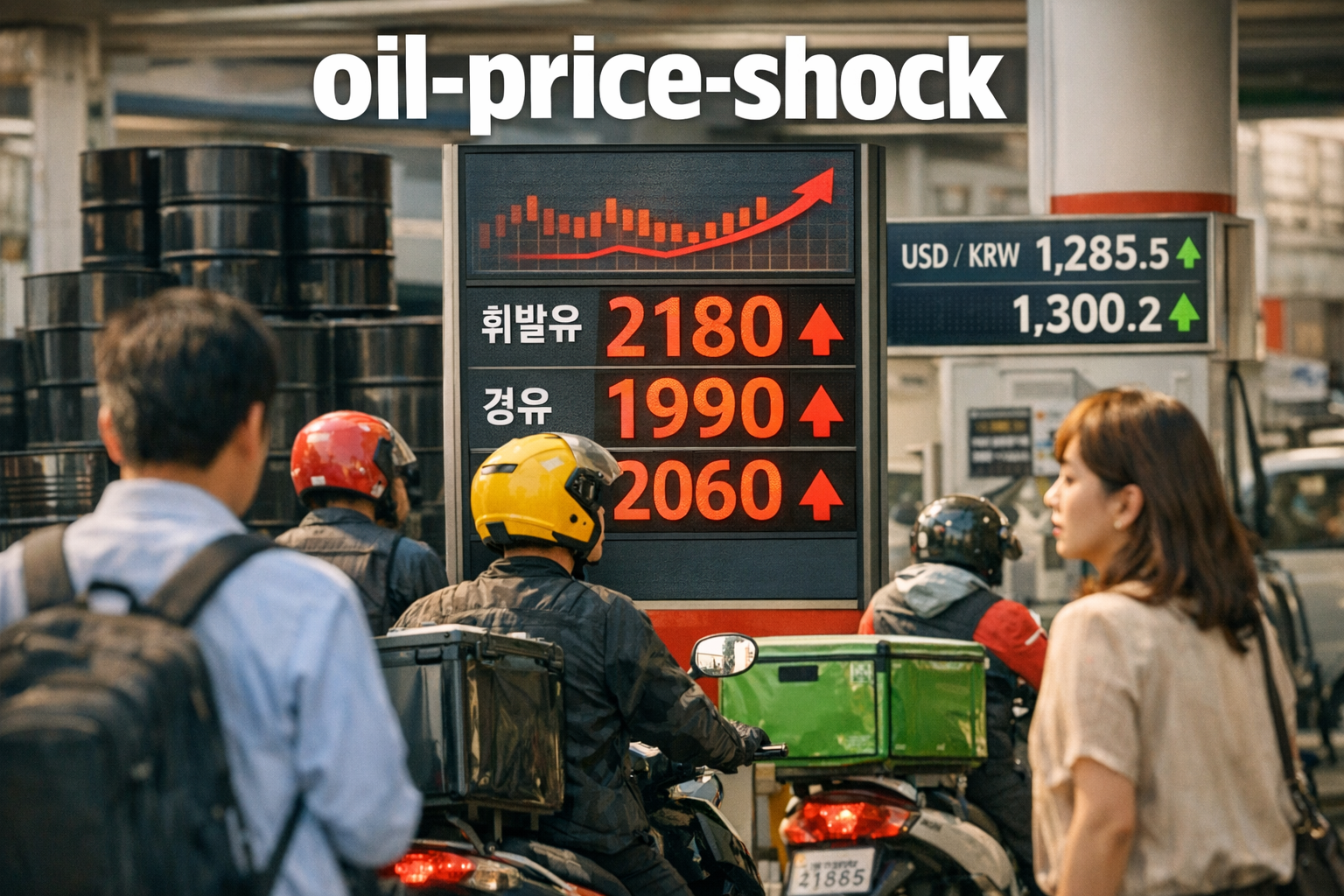
● Oil Shock, Won Crash, Market Panic
FX Rate Above KRW 1,500: Start of a Genuine Crisis? Core Scenarios Covering Oil, War, Rates, and U.S. Equities
The key issue is not whether the exchange rate crosses KRW 1,500 per USD. The more important question is whether this level signals second-order impacts through higher crude prices, Hormuz-related supply risk, U.S. equity drawdowns, renewed inflation pressure, and spillovers into the real economy.
This report organizes how Middle East geopolitical risk can transmit into Korea’s economy and global financial markets, focusing on: (i) why U.S.–Iran confrontation may persist, (ii) why oil may remain elevated, (iii) why KRW tends to weaken first, (iv) why U.S. equities appear structurally fragile, and (v) which asset classes investors typically monitor in similar regimes.
1. Primary focal point: the Strait of Hormuz
Market sensitivity is concentrated on one variable: normalization of transit through the Strait of Hormuz.
The strategic objective behind U.S. pressure is effectively whether Iran refrains from threatening and allows uninterrupted passage. The Strait is a critical chokepoint for global crude shipments; disruption rapidly transmits into energy prices, inflation expectations, and risk assets. This is better framed as a potential constraint on a core artery of the global economy rather than a localized conflict.
2. Why risk premia rose: Iran’s response is more forceful than markets expected
Historically, U.S. pressure campaigns often induce partial de-escalation. In this episode, Iran is signaling a more confrontational posture.
The implied message is that strikes on Iranian nuclear facilities or key sites could trigger retaliation targeting U.S. regional partners (e.g., Gulf infrastructure) rather than the U.S. mainland. For markets, this increases the probability that the conflict is not a short-lived event and that energy infrastructure risk could broaden, reducing the credibility of quick-resolution narratives.
3. U.S. force posture and budget actions imply potential duration risk
Investor concern is increasingly driven by actions rather than statements:
- Consideration of additional U.S. Marine deployments tied to the Hormuz theater
- Emergency requests to expand war-related funding
- Calls to scale missile production to replenish inventories
Such measures are less consistent with a rapid conclusion scenario. Markets interpret this as a gradual repricing toward prolonged uncertainty.
4. Why crude is not retracing: pricing favors persistent uncertainty over “quick fixes”
Crude oil is the key real-time indicator. Elevated prices despite stabilization efforts suggest markets are not treating the shock as transitory.
Main drivers:1) Low confidence in full and durable normalization of Hormuz transit
2) Practical limitations of rerouting and alternative export channels over time
3) In a prolonged conflict, risk premia for supply disruption tend to rise
References to a specific early-to-mid April window as a potential inflection point highlight that time is itself a risk factor.
5. The key risk is speed, not direction
Markets are more sensitive to rapid price increases than gradual moves. The recent pace of oil appreciation is viewed as steep in long-run context.
Transmission lags matter: corporate and household costs (logistics, manufacturing, airlines, petrochemicals, power) reprice over weeks to months. The focus therefore extends beyond immediate equity volatility to a 1–3 month horizon for higher consumer prices, import costs, and margin compression.
6. Korea’s higher vulnerability: import dependence plus KRW weakness
Korea is structurally exposed to geopolitical energy shocks due to:
- High dependence on imported energy and raw materials
- Export-led growth model sensitive to external shocks
- KRW typically weakens during global risk-off phases
A move toward or above KRW 1,500 is therefore not merely symbolic; it can amplify:
- Foreign outflow concerns
- Imported inflation
- Corporate input-cost pressure
- Household inflation expectations
- Financial market volatility
Korea and Japan, with substantial reliance on Middle Eastern crude and LNG, face more direct impacts from higher oil and gas prices.
7. Natural gas may be the larger tail risk than oil
A less emphasized but material variable is LNG. Concerns around Qatar-linked gas infrastructure can cause Asian and European gas prices to rise relative to the U.S.
For Korea, higher gas prices can feed through to:
- Electricity tariffs
- Industrial energy costs
- Cost structures in chemicals, refining, steel, semiconductors, and broader manufacturing
The U.S. benefits from domestic shale supply and typically lower sensitivity; Asia’s exposure is structurally higher, implying asymmetric economic stress under the same global shock.
8. Why U.S. equities look fragile: geopolitics plus rates and technical deterioration
Equity weakness is not solely driven by Middle East headlines. The standard tightening channel is active:
Oil up → inflation concerns rise → rate-cut expectations fade → valuation pressure increases
Major indices have weakened versus early-year levels; parts of the Nasdaq and mega-cap growth complex show larger peak-to-trough drawdowns. Breaches of the 200-day moving average are typically interpreted as reduced probability of a clean, durable rebound until uncertainty declines.
9. Market breadth is weak: individual stocks are deteriorating more than the index
Index performance can obscure internal damage. Many growth, software, and healthcare names are down materially more than the benchmarks, while a limited set of energy, memory, and AI-infrastructure-linked equities have supported index levels. This concentration increases dispersion and raises the risk that portfolio losses feel larger than index moves imply.
10. Why AI infrastructure is comparatively resilient
Despite broader volatility, parts of AI infrastructure remain relatively firm, including:
- Memory and storage
- Selected semiconductor equipment
- Power and grid-related infrastructure
This reflects sustained data-center capex and structurally rising power and storage needs linked to generative AI. However, performance is increasingly bifurcated between firms with observable earnings linkage and theme-driven names without cash-flow support.
11. Asset classes to monitor in the current regime
11-1. Energy-linked exposure
Energy is the most direct beneficiary during prolonged supply risk. Instruments include crude-related ETFs, energy sector ETFs, U.S. large-cap energy equities, and LNG export-linked companies. Allocation is more appropriately framed as a hedge within growth-heavy portfolios rather than a wholesale rotation.
11-2. USD assets
In KRW depreciation regimes, USD assets generally provide defensive characteristics. U.S. equity exposure also functions as currency diversification, not only a return-seeking allocation.
11-3. Ultra-short duration and cash-management ETFs
For investors not prepared to add risk, ultra-short Treasury ETFs can serve as carry-bearing parking instruments versus idle cash. In high-volatility periods, earning yield while preserving optionality is a valid positioning choice.
11-4. Staged entry assets
If U.S. equities experience further downside, staged buying in index ETFs or high-quality mega-cap franchises based on predefined drawdown thresholds may be more robust than single-entry timing. A structured plan across -10%, -15%, and -20% levels reduces timing risk.
12. Spillover into the real economy: Korea’s transmission can be faster
The market may be underweighting real-economy propagation. Potential channels include:
- Refining and petrochemical feedstock supply concerns
- Higher industrial gas prices
- Rising freight and logistics costs
- Consumer inflation pressure
- Hoarding dynamics driven by expectations
- Corporate cost increases
Expectation-driven demand spikes can occur before actual shortages, accelerating short-term inflation and volatility.
13. Why renewed rate pressure would worsen outcomes
The policy backdrop may constrain rapid easing. Higher oil raises inflation risk and can delay rate cuts; in some jurisdictions it can even revive hiking discussions. The adverse macro mix is:
- Oil higher
- Inflation sticky
- Rates unable to fall
- Equities under pressure
This configuration is particularly negative for high-duration growth, discretionary, and high-valuation segments.
14. One-sentence framing
The dominant risk is not “war headlines,” but the possibility that energy-driven inflation transmits into rates, FX, risk assets, and the real economy through a reinforcing feedback loop.
Key variables:
- Timing and durability of Hormuz normalization
- Crude and LNG price trend
- Whether KRW 1,500 becomes a sustained level
- Shifts in U.S. rate expectations (front-end and term structure)
- Recovery of the U.S. equity market above key technical support (including the 200-day moving average)
15. Under-discussed but critical points
15-1. The larger risk is cumulative cost shock, not the KRW 1,500 print
FX depreciation is visible, but the more material impact is the multi-month accumulation of higher import costs for energy, gas, and raw materials. The peak economic pain can occur with a lag of 1–3 months.
15-2. The U.S. has more shock absorption capacity; Korea and Japan are more exposed
With greater domestic energy supply, U.S. sensitivity is lower. Korea’s import dependence makes the same oil shock more economically binding, requiring simultaneous monitoring of FX and energy import dynamics.
15-3. Sector dispersion matters more than index levels
Energy and parts of AI infrastructure are providing support while broader market internals weaken. Sector-level assessment is more informative than index-only signals.
15-4. AI remains intact, but leadership is shifting toward infrastructure
AI exposure is increasingly concentrated in “must-have” enablers: data centers, memory, power, storage, and networking, rather than broad thematic beneficiaries.
16. Upcoming catalysts and scenario framework
Likely reaction sequence:
- Military and diplomatic developments tied to the Strait of Hormuz
- Crude and LNG price action
- Persistence of KRW 1,500+
- U.S. rate expectations across the curve and implied policy path
- U.S. equity technical recovery versus the 200-day moving average
Base upside scenario: easing tensions and lower oil reduce inflation pressure, improving the rate outlook and enabling a technically supported rebound in U.S. equities.
Downside scenario: delayed normalization and renewed oil upside intensify FX stress and real-economy pressure, with disproportionate strain on Korea and broader Asia.
17. Investor posture
Current conditions favor risk management over conviction-driven positioning. Core toolkit:
- Maintain appropriate cash allocation
- Hold USD exposure
- Add selective energy hedges
- Use ultra-short duration instruments for liquidity management
- Apply staged entry rules for risk assets
- Prefer selective AI infrastructure exposure over broad AI themes
For Korea-based investors, this is a regime where FX, energy, rates, and real-economy transmission should be monitored alongside U.S. equities.
< Summary >
The core risk is not the KRW 1,500 level itself, but the potential for Hormuz-related disruption to sustain higher oil and gas prices, re-accelerate inflation, shift rate expectations, pressure U.S. equities, and transmit into Korea’s real economy.
With U.S.–Iran confrontation appearing more durable, markets are assigning greater weight to prolonged uncertainty than to near-term resolution.
Korea may experience larger impacts due to energy import dependence and KRW depreciation sensitivity.
From an allocation perspective, USD assets, energy hedges, ultra-short duration holdings, selective AI infrastructure exposure, and staged buying plans are the primary tools. The current phase prioritizes risk control over aggressive positioning.
[Related Links…]
- https://NextGenInsight.net?s=FX
- https://NextGenInsight.net?s=AI
*Source: [ 소수몽키 ]
– 환율 1500원 돌파는 전조 신호? 전쟁 충격, 실물 경제 위기까지 번질까
● War, Oil Shock, Private Credit Time Bomb, Emerging Markets Panic, Korea Squeeze, AI Reality Check
Protracted Middle East War, Private Credit Risk, and Emerging-Market Stress: The Market’s Core Vulnerability Lies Elsewhere
Current market attention is focused on the Middle East conflict, crude oil, and inflation. However, a quieter and potentially more systemic risk is building beneath the surface.
This report consolidates: (i) how private credit could transmit stress into the broader financial system, (ii) why Asian emerging markets may face simultaneous shocks from higher oil, FX depreciation, and rising ocean freight costs, and (iii) how these dynamics may affect the Korean economy, the global macro outlook, and AI-related investment conditions. It also highlights under-discussed channels: delayed financial instability relative to war headlines, the relative sensitivity of Korea and Asian emerging markets versus China, and how tighter tech/AI risk appetite can pressure collateral values in private credit.
1. Executive Summary: Three Core Market Concerns
A simplified transmission path is as follows:
Protracted Middle East conflict → higher crude oil → renewed inflation pressure → prolonged rate burden → rising private credit impairments → intensified emerging-market fragility.
This is a compound risk spanning energy, credit, FX, and risk appetite, with interconnected channels:
- (1) Potential decline in private-credit collateral values
- (2) Renewed inflation pressure from a sharp rise in crude oil
- (3) Higher risk of stagflation across Asian emerging markets and Korea
2. Why Private Credit Risk Has Re-Emerged as a Priority
Private credit broadly refers to non-bank lending to borrowers that banks are less willing to fund, including private companies, startups, and growth-stage firms.
Following post-2008 bank regulation, non-bank lenders and funds expanded to fill the gap in riskier corporate credit. Large banks may have limited direct exposure, but often provide funding to private-credit vehicles or connected non-bank intermediaries, creating indirect linkages to the banking system and broader markets.
2-1. Why Collateral Value Compression Matters
A material portion of private credit relies on valuations of private companies as implicit or explicit support.
In periods of elevated geopolitical risk and volatility, investors tend to de-risk. Valuations in sectors dependent on long-duration growth assumptions—technology, AI, software, and healthcare—can compress. Public-market declines can translate into more conservative private-market marks, reducing collateral values and weakening credit protection.
Potential consequences include:
- Reduced stability of existing loan books
- More difficult incremental fundraising and refinancing
- Higher redemption pressure from fund investors
- Liquidity strain for private borrowers and higher default clustering risk
Small valuation changes can therefore amplify into broader liquidity stress.
2-2. A Structural Vulnerability: Liquidity Mismatch
Many private-credit products are designed as locked-up, hold-to-maturity structures. Market growth has increased the prevalence of vehicles offering quarterly or interim redemption features.
During stress, this can become a liability: investors seek liquidity, while the underlying assets are illiquid loans to private borrowers. The perceived liquidity offered to investors may therefore exceed the realizable liquidity of the portfolio, increasing systemic risk.
2-3. Why the AI Cycle and Private Credit Are Linked
Capital inflows into AI, software, cloud, and digital health have extended beyond public markets into private markets, making these sectors meaningful recipients of private credit.
As risk appetite shifts, funding conditions for AI-related private companies can tighten rapidly. Key diligence priorities therefore include: the quality and durability of funding, the extent of debt-financed growth, and whether valuation assumptions remain resilient under higher rates and heightened geopolitical risk.
3. The Real Macro Shock from a Protracted Middle East Conflict: Beyond Oil
Oil is the most visible channel, but the broader macro impact typically includes:
- Higher crude oil prices
- USD strength and FX depreciation in importing economies
- Higher ocean freight and insurance costs
- Expanded supply-chain disruption risk
When these channels move simultaneously, the shock is larger for commodity importers and manufacturing-heavy economies. Korea, with high energy-import dependence, is particularly exposed to multi-factor cost pressure.
3-1. How Oil Re-Accelerates Inflation
Energy costs feed broadly into production and distribution: refining, chemicals, metals, transportation, logistics, power, and food.
If oil rises, CPI pressure can re-emerge. With rates already restrictive, renewed inflation can delay easing cycles. This can tighten financial conditions across equities, corporate credit, growth stocks, and private-market assets.
3-2. Why the US May Be Relatively Less Exposed Than in Past Oil Shocks
The US is now one of the world’s largest oil producers, with a stronger net-export profile than in prior decades. Higher oil remains a consumer inflation headwind and a political constraint, but it can also support energy-sector earnings. As a result, the aggregate macro drag may be less unilateral than in historical oil-shock episodes.
This asymmetry underpins the view that Asia may face proportionally larger stress than the US.
4. Why Asian Emerging Markets May Be More Vulnerable Than China
A common assumption is that China, as a major oil importer, bears the greatest risk. A more granular assessment suggests that sensitivity may be higher in other Asian economies.
4-1. China Has More Policy and Supply-Side Buffers
Relative advantages include:
- Higher effective energy resilience than many Asian emerging markets
- Alternative supply channels, including Russian crude
- Rapid expansion of renewables
- Lower inflation baseline, allowing partial absorption of energy-driven pressures
- Continued policy capacity for stabilization
China faces meaningful costs, but generally has more tools to dampen market impact than smaller regional peers.
4-2. Korea and Asian Emerging Markets Are More Sensitive to the Combined Shock
Many Asian emerging markets have high dependence on Middle East oil, high FX sensitivity, and greater exposure to foreign capital flow volatility.
Dubai crude, which more directly reflects Middle East supply conditions relevant to Asia, can transmit stronger regional inflation pressure than Brent or WTI alone. If USD strength coincides with higher oil and freight, imported inflation can accelerate via:
higher oil + weaker FX + higher freight/insurance.
5. Why Korea Requires Elevated Caution
Korea is a highly open economy with strong external linkages; global slowdown often transmits quickly through exports. In the current setup, risks extend beyond exports to a multi-channel cost shock:
- Higher imported energy prices
- KRW depreciation versus USD
- Middle East-related supply-chain risk
- Higher ocean freight rates
- Weaker global risk appetite
This combination can raise corporate costs, constrain household purchasing power, and slow export momentum—conditions consistent with stagflationary pressure.
5-1. Why Stagflation Is Hard to Manage
Stagflation combines slowing growth with rising inflation, creating conflicting policy objectives:
- Supporting growth typically requires easing financial conditions
- Containing inflation typically requires tighter policy
This reduces the feasibility of rapid rate cuts and limits the effectiveness of fiscal measures in lifting trend growth.
5-2. Why Korea’s 2026 Outlook May Require More Conservative Assumptions
If conflict persistence keeps energy costs elevated, key downside channels include:
- Slower export recovery
- Delayed domestic demand normalization
- Higher inflation ceiling risk
- Reduced expectations for rate cuts
- Weaker corporate investment sentiment
High external-beta sectors may experience increased volatility, including semiconductors, autos, chemicals, refining, and shipping.
6. AI Trend Implications: Continuity in Secular Growth, Tightening in Funding Conditions
6-1. The AI Industry Continues, but Capital Discipline Tightens
AI remains a secular growth theme; however, dispersion across companies is likely to increase. In tighter liquidity and higher-rate regimes, markets typically become more conservative:
- Capital concentrates in AI businesses with clear monetization and cash-flow visibility
- Infrastructure-oriented and productivity-enhancing AI may be favored
- Narrative-driven startups face more restrictive funding
- Debt-dependent growth models become more fragile
The investment focus shifts from theme exposure to cash-flow durability.
6-2. AI Segments Potentially Supported by Supply-Chain and Cost Pressures
If geopolitical risk and supply-chain uncertainty persist, corporate demand may rise for AI that reduces costs and improves predictability, including:
- Supply-chain forecasting AI
- Energy efficiency and optimization AI
- Logistics operations automation AI
- Risk management and anomaly detection AI
- Industrial robotics and manufacturing AI
7. Under-Discussed Points with High Relevance
7-1. Financial Stress Can Materialize After the War Headline
War risk is immediately priced via oil and volatility. Private credit impairments, private valuation markdowns, redemption pressure, and non-bank liquidity constraints may emerge with a lag, potentially increasing downside convexity.
7-2. Korea and Asian Emerging Markets May Be More Sensitive Than China
A US- and China-centric framing can underestimate the regional impact on economies with higher energy-import dependence and FX pass-through. Monitoring Dubai crude, FX, and freight jointly is critical.
7-3. The AI Rally Enters a Quality-Selection Phase
The theme may persist, but funding quality and balance-sheet structure become differentiators. If private markets weaken, companies with stronger financing structures and clearer unit economics are more likely to retain access to capital.
7-4. Inflation Cannot Be Assessed via Oil Alone
Oil, FX, freight, insurance, and supply-chain disruptions can co-move. The combined effect may produce larger increases in import prices and consumer prices than oil-only analysis implies.
8. Practical Monitoring Framework for Investors
8-1. Priority Indicators (Suggested Sequence)
- Crude oil, with emphasis on Dubai crude
- USD/KRW exchange rate
- Ocean freight and logistics indicators
- Shifts in expectations for US rate cuts
- Credit spreads and private-credit related developments
8-2. Portfolio Risk Considerations
- Highly leveraged growth companies may exhibit higher volatility
- Private-market growth exposure warrants tighter scrutiny
- Energy, defense, commodities, and logistics-efficiency themes may show relative resilience, subject to volatility
- AI exposure should emphasize earnings quality and monetization rather than narrative momentum
8-3. Korea Sector Lens
- Refining/chemicals: analyze both crude and margin/spread dynamics
- Semiconductors: monitor global IT capex and risk appetite
- Autos: balance FX benefits against demand slowdown risk
- Shipping/logistics: freight upside may be cyclical and volatile
- Power/renewables: energy security considerations may support longer-term demand
9. Core Conclusion
The key is not the headline risk of war itself, but the downstream transmission into inflation, FX, financial conditions, corporate funding, and private-credit fragility.
The most relevant themes are: private credit risk, emerging-market stagflation pressure, Korea’s multi-factor cost shock, and quality dispersion within AI. Market direction is likely to depend on conflict duration, the persistence of elevated oil, and the capacity of the financial system to absorb delayed credit stress.
< Summary >
A protracted Middle East conflict is a compound risk affecting crude oil, FX, ocean freight, supply chains, and inflation.
A key latent vulnerability is private credit. If private valuations decline and redemption pressure rises, non-bank stress can transmit into broader financial conditions.
Korea and Asian emerging markets may be more sensitive than China due to dependence on Middle East oil, FX pass-through, and imported inflation, increasing stagflation risk.
AI remains a secular theme, but capital allocation is likely to become more selective, favoring sound funding structures and clear monetization.
The priority is to monitor financial risk transmission and macro spillovers rather than the conflict headline alone.
[Related Articles…]
- https://NextGenInsight.net?s=private%20credit
- https://NextGenInsight.net?s=Middle%20East%20war
*Source: [ 경제 읽어주는 남자(김광석TV) ]
– 중동전쟁 장기화, 사모대출 위험과 신흥국 불안 키우나? [경읽남 237화]
● K-Defense Shockwave, Hyunmoo-7 Fury, Global Arms Rush
Hyunmoo-7, Biho Hybrid, and K-Defense: Why Global Attention Is Returning to Korea
This development extends beyond rising export volumes. Three drivers are central:
1) The strategic implication of the Hyunmoo missile family and why it is described as “more dangerous than nuclear weapons” in deterrence terms.
2) The industrial rationale behind accelerating interest in Korean air-defense systems such as the Biho Hybrid in the Middle East and broader markets.
3) A structural shift in which K-defense links to national growth, export expansion, advanced manufacturing, and AI-enabled defense technologies.
This report consolidates the strategic significance of Hyunmoo-7, the operational competitiveness of Biho Hybrid, assessments of South Korea’s ground-force capabilities, and the increasing relevance of defense within global macro and Industry 4.0 trends. It also highlights a frequently overlooked factor: Korea’s competitive advantage is less about individual specifications and more about integrated production, delivery, and operational support.
1. Core Statement: Why “Hyunmoo-7 Is More Dangerous Than Nuclear Weapons” Was Said
The phrase implies not equivalence to nuclear weapons, but the strategic effect of high-yield conventional strike capabilities. If deeply buried command nodes, hardened bunkers, and critical military infrastructure can be neutralized precisely with conventional warheads, the perceived deterrent impact can approach nuclear-level coercive value for the adversary.
1-1. The Strategic Meaning of the Hyunmoo Family
The primary value is not maximum range, but:
- Precision
- Penetration capability
- Rapid responsiveness
- Strategic target neutralization
In an environment with extensive underground facilities and mobile launchers, effectiveness depends more on speed, accuracy, and depth of defeat than on range alone. This positions the Hyunmoo family as a core pillar of Korea’s conventional deterrence architecture.
1-2. Why Global Stakeholders Reassess
As South Korea’s independent long-range precision strike matures, regional strategic calculations may shift. This is not limited to Korean force improvement; it affects how the United States, China, Japan, Russia, and North Korea assess escalation dynamics and deterrence stability. Few states can materially raise strategic deterrence through conventional capabilities alone, contributing to the international re-rating of Korean defense technology and industry.
2. The Claim of “Top-5 Physical Power” and “World-Class Army”: How to Interpret It
Rather than treating rankings as definitive, the more relevant lens is South Korea’s structural advantages in readiness and ground-combat execution.
2-1. Why the Republic of Korea Army Is Considered Strong
Strength is driven by an integrated, high-density force posture:
- Sustained high readiness
- High firepower density
- Maneuver forces and massed artillery employment
- Command-and-control effectiveness
- Reserve force integration
Prolonged exposure to high-intensity contingencies has reinforced a “wartime-designed” operational system, which also improves feedback loops for weapon development and doctrine.
2-2. Meaning of “Better Than the U.S. in Many Areas”
This does not imply overall superiority relative to the United States. It indicates potential advantages in specific domains aligned to the Korean theater, including:
- High-density ground warfare
- Artillery-centric engagements
- Short-range air defense
- High-tempo readiness and mobilization
The U.S. military is optimized for global deployment; South Korea is optimized for a highly compressed, high-intensity theater. This distinction supports why Korean systems are increasingly viewed as operationally realistic rather than merely cost-competitive.
3. Biho Hybrid: Why UAE Demand Focused on Accelerated Delivery
Biho Hybrid is a low-altitude air-defense system combining anti-aircraft guns and guided munitions, designed for rapid engagement of drones, helicopters, and low-altitude threats.
3-1. Why Middle Eastern Buyers Are Interested
Regional threat profiles increasingly emphasize drones, cruise missiles, and low-altitude penetration. High-end long-range air defense alone cannot efficiently cover these targets due to cost-exchange imbalance. Biho Hybrid addresses the lower tier of layered air defense with more sustainable cost-per-intercept economics.
3-2. What Biho Hybrid Signals for K-Defense Positioning
The system illustrates areas where Korea can expand competitiveness:
- Counter-drone warfare
- Low-altitude layered air defense
- Integrated sensors and networking
- Mobile intercept systems
- AI-enabled detection, tracking, and engagement support
As warfare shifts toward unmanned systems and data-centric operations, Korea’s combined strengths in manufacturing, electronics, semiconductors, communications, and software are relevant to next-generation air-defense and ISR modernization.
4. “Combat Use Matters”: The Commercial Significance of Operational Validation
Operational use functions as high-value validation in defense procurement. Buyers prioritize reliability under stress, failure rates, maintenance and logistics burden, and tactical fit, not catalog specifications.
4-1. Operational Record as a De-Risking Mechanism
Combat-proven systems reduce procurement risk and can materially improve contract conversion rates, particularly when procurement timelines are compressed by active security threats.
4-2. Why Korean Systems Can Benefit
Korean platforms are shaped by demanding domestic user requirements and frequent iteration, supporting:
- Practical usability
- Rapid upgrades and configuration changes
- Higher confidence in field performance
This reinforces buyer trust in both the product and the supplier’s responsiveness.
5. A Potential Inflection Point: Why the Current Phase Matters
K-defense is transitioning from an export upswing to a higher-order industrial phase that can influence broader economic structure.
5-1. Then vs. Now: The Changing Nature of K-Defense
Historically perceived as domestically anchored, the sector is now demonstrating competitiveness across major categories such as:
- Self-propelled artillery
- Main battle tanks
- Multiple launch rocket systems
- Fighter aircraft
- Integrated air-defense systems
This shift has implications for exports, manufacturing investment, supply chains, technology ecosystems, and national brand equity.
5-2. Why Defense Matters in Macro and Industrial Policy Terms
In an environment shaped by high rates, supply-chain reconfiguration, geopolitical risk, and technology competition, defense combines cyclical industrial characteristics with strategic-state demand. For a manufacturing-intensive economy, defense exports can support:
- Trade balance dynamics
- Capital expenditure and capacity build-out
- Employment and regional industrial clusters
Defense is increasingly positioned alongside semiconductors and automotive as a potential long-cycle industrial pillar.
6. Industry 4.0 and AI: The Next Stage of Defense Competitiveness
Defense should not be analyzed as hardware manufacturing alone. The key variable is the speed and depth of AI and data integration into weapon systems.
6-1. How AI Changes Warfare
Future kill chains require faster automation across:
- Detection
- Tracking
- Identification
- Decision support
- Engagement and intercept management
Mass drone attacks exceed purely human processing capacity, increasing demand for AI-enabled target recognition, threat prioritization, and automated fire-control support.
6-2. Why Korea Is Positioned to Participate
Korea can combine AI, semiconductors, sensors, communications, displays, precision manufacturing, and software into integrated platforms. Expansion opportunities include:
- Manned-unmanned teaming
- Smart munitions
- Battlefield networking
- Air-defense automation
- ISR and data-fusion systems
AI adoption and defense modernization are converging rather than evolving independently.
7. Key Points (News-Style Summary)
First. The Hyunmoo family is assessed as a strategic conventional deterrence asset capable of precision defeat of hardened and underground targets.
Second. Biho Hybrid is gaining attention as a cost-effective lower-tier component of layered air defense against drones and low-altitude threats, aligning with Middle East demand patterns.
Third. South Korea’s ground-force capabilities are regarded as top-tier in high-intensity, theater-optimized readiness and execution.
Fourth. Operational validation, rapid iteration, and delivery reliability function as core drivers of export competitiveness.
Fifth. Defense is evolving from a military supply sector into a strategic industry linked to exports, advanced manufacturing, and AI-led technology investment.
8. The Most Overlooked Factor: Integrated Execution, Not Specs
Many narratives focus on performance and export headlines. A more durable advantage is Korea’s integrated execution capability across production, delivery, and sustainment.
8-1. Production Capacity and Delivery Schedules
In urgent security environments, speed-to-field can outweigh marginal performance advantages. Korea has demonstrated strengths in:
- Faster production ramp-up
- On-time delivery
- Localization and industrial cooperation
- After-sales support and sustainment
This advantage increases in periods of global supply-chain stress.
8-2. Exporting an Operational Package
Procurement is shifting toward package-based delivery that includes:
- Training
- Maintenance and spare parts
- Software updates
- Data links and integration
- Local production cooperation
Korea’s positioning is moving from “unit sales” toward “capability delivery,” which can support longer-duration revenue through sustainment and upgrades.
9. Forward Watch Items
- Further modernization of strategic strike systems, including the Hyunmoo family
- Export scalability of Biho Hybrid and next-generation low-altitude air-defense solutions
- Progress in counter-drone systems and AI-enabled air-defense automation
- Order backlog, manufacturing throughput, and localization strategy of K-defense primes
- Spillover effects on Korea’s equity market, manufacturing investment, and export growth
From an investment perspective, emphasis should extend beyond near-term headlines to long-term supply contracts, sustainment revenue, and AI-driven platform transitions.
10. Conclusion
Hyunmoo, Biho Hybrid, ground-force readiness, operational validation, and the sector’s inflection point are interlinked. Korea is increasingly perceived not only as a producer of capable weapons, but as a supplier able to manufacture quickly, field systems with operational credibility, and integrate AI and advanced manufacturing into next-generation defense solutions. The implications extend to exports, industrial policy, technology investment, and longer-cycle capital allocation themes.
< Summary >
- The Hyunmoo family supports conventional strategic deterrence through high-yield precision strike against hardened targets.
- Biho Hybrid addresses drones and low-altitude threats as a cost-effective lower-tier air-defense component and is drawing attention in the Middle East.
- Korea’s competitive edge is grounded in operational realism, delivery reliability, and integrated sustainment, not specifications alone.
- Defense is expanding as a strategic industry tied to export growth, manufacturing competitiveness, and AI-enabled future capabilities.
- Key differentiators to monitor include production capacity, sustainment economics, AI integration, and package-based exports.
[Related Posts…]
- K-Defense export expansion and implications for Korea’s manufacturing base and equity market: https://NextGenInsight.net?s=defense
- AI defense technologies, drone warfare, and Korea’s next industrial opportunity set: https://NextGenInsight.net?s=AI
*Source: [ 달란트투자 ]
– “현무-7 핵보다 위험하다” 전세계가 한국에 긴장하는 이유 | 진재일 교수 3부