● Tesla SpaceX XAI Push for Space-Based AI Power Crunch Breakthrough
Accelerating “Vertical Integration” all the way to Tesla·SpaceX·XAI? Musk’s terawatt-class AI chip/power/space data center plan; the core point is resolving bottlenecks
1) One-line summary of today’s news: A plan to break the AI growth bottleneck (chips·power) at terawatt scale by expanding data centers into space
There’s exactly one point from today’s video/presentation that really stands out.
Assuming the bottlenecks that stop AI from growing come down to semiconductors (chips) and power, Musk moves his answer from “on Earth” to “in space.”
From here, the picture isn’t one where Tesla·SpaceX·XAI were doing separate things anymore—it starts to be interpreted as a design that “vertically integrates” for the same project.
This article organizes the key points below in a news format.
- Why the AI bottleneck is ‘chips + power’
- The meaning of a terawatt-class (1TW) power plan for real costs and competitive dynamics
- The logic of ‘space-type infrastructure’ like D3 (data centers) and mini satellite data centers
- How reusable Starship rockets change the numbers (launch frequency)
- Why semiconductor process/fabrication licensing/equipment bottlenecks can’t be solved by “money alone,” either
And at the end of the article, it will also connect to reading material with similar keywords.
2) Why ‘terawatt-class’ is coming up now: the bottleneck in AI growth is chips and power
2-1. Data center power is already around 20GW… but the goal is 1TW
If we reconstruct the original flow as news, it goes like this.
- Current AI data center power usage: roughly 20GW
- Musk’s desired scale: 1TW (=1000GW)
So the core problem awareness is that “even 2% of the target can’t be used with today’s data center environment.”
What’s important here is the reality that “for AI to run well, not only performance but also power and chips must grow together.”
This connects directly to why the latest global investment and policy are focusing on semiconductors, power infrastructure, and AI infrastructure at the same time.
2-2. If you leave it to competitors, limits arrive: ‘in-Earth production capacity’ can’t keep up with terawatt scale
The original claims this.
- Even if you ask places like Samsung/TSMC/Micron to “increase production faster,”
- even if you run “all semiconductor factories on Earth” at full capacity,
- it’s likely to be insufficient for the project scale of Musk’s terawatt-class / solar-system-class initiative
This is the starting point for interpreting this presentation.
In other words, it’s not “just outsource manufacturing and that’s it.”
Musk appears to be aiming to expand the playing field himself — making chips, securing power, and even building the transportation/space infrastructure to move data.
3) Terawatt (chips) · FSD AI chips · Optimus AI chips · edge devices—thickening the ‘chip lineup’
3-1. ‘5 chips’ for FSD + ‘6 chips’ for Optimus… demand explodes on the edge side
The setup mentioned in the original looks like this.
- In the current Tesla/related lines, AI chips (5 chips) for running FSD come out (with references to Samsung/TSMC as the base)
- In the next step, an AI6 chip for Optimus bots is also planned
- And “edge device chips will become needed in huge quantities”
The reason is that production and deployment scale will grow.
- Tesla vehicles: mention of annual tens of millions of units scale
- Optimus: mention of hundreds of millions to tens of billions of units scale
If this logic holds, it means the phase where “hardware that carries inference” is needed in massive quantities will arrive sooner than the phase focused purely on training AI models.
From an investment perspective, this can also be seen as a signal that demand for AI semiconductors is expanding beyond ‘data centers’ into ‘devices/robots.’
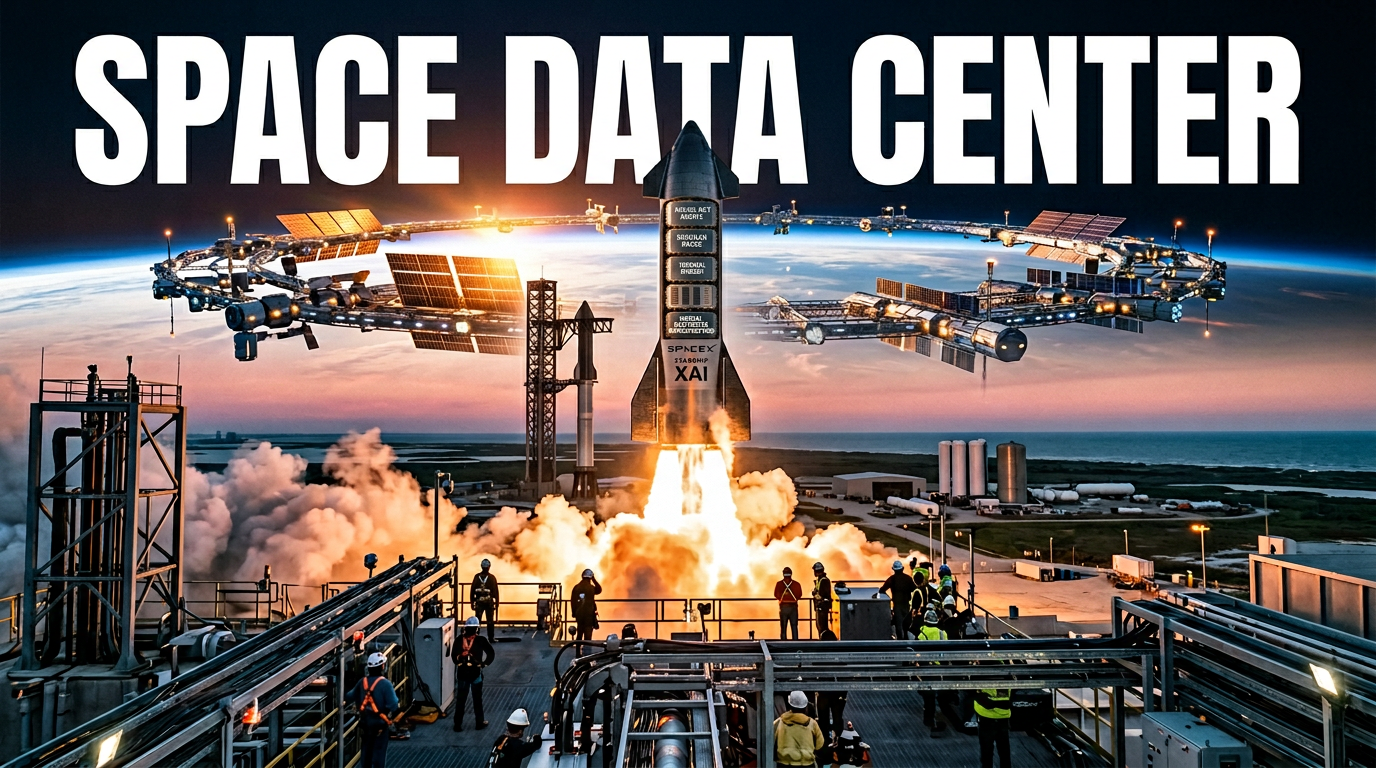
3-2. D3 chips: the beginning of a design that brings ‘data centers’ into space
The most interesting part in the original is D3.
- Interpretable as D3 = Data (data center) + 3?
- You directly build the “vessel” to hold a space data center
- And the identity of the initially shown “launch pad/something being blasted off” is tied to the idea of launching a data center into the Moon/space
Ultimately, to solve the AI bottleneck (chips·power),
you need not only chips but the data center infrastructure itself that uses power.
4) Why a space data center is needed: solar efficiency (energy) + the reversal of rising Earth costs
4-1. Rocket costs are enormous, but reuse/scale changes the cost curve
The original uses very aggressive numbers.
- To build a space data center, you need an annual 10 million tons payload
- Current global rocket launch volume is on the order of an annual thousands of tons
- So the issue is that you need to scale up by “thousands of times”
Here, Musk’s card is Starship.
- 1 Starship flight to orbit: 100~200 tons
- To lift 10 million tons per year: 50,000~100,000 launches
- On a daily basis: a strong assumption like more than 200 launches
And the original logic is this.
- Starship is reusable
- Over the long term, the cost per ton of launch drops to “a fraction of a few dozen”
- Then the economics open up to lay infrastructure in space
The core question is literally “does it bend the cost curve?”
4-2. Solar is more favorable in space than on Earth: the sun is always shining
There’s an explanation that strengthens the logic for the space data center even further in the original.
- In space, conditions to receive solar energy are more favorable
- Especially, when generating solar power in space, you can get more than 5 times the energy compared to Earth
- And then you make power to run the data centers on Earth (infrastructure cost increases)
- The cost to lift it into space is around about $2,700 per kg (mentioned)
- When Starship is completed, it could drop below $100 per kg (mentioned)
So over time, “Earth infrastructure expansion costs” keep rising,
while “space infrastructure expansion costs” gradually fall,
and at some point the claim is that space-type AI infrastructure becomes more economically reasonable.
5) You also need to look at objections: semiconductor manufacturing isn’t possible with money alone (real bottlenecks)
5-1. Process know-how, equipment (EUV), licensing, skilled personnel… not something that happens overnight
The reality-check section in the original is quite important.
- Semiconductor manufacturing requires
a foundation like process know-how (decades), skilled engineers (tens of thousands), and a supplier ecosystem (hundreds of companies) - There’s also a lot of licensing to handle
- Equipment like ASML EUV has limited annual production capacity
So, it’s true that production output expansion doesn’t happen instantly with only “willpower + capital.”
If you look at it the other way around, there’s a checkpoint that determines whether this presentation is just exaggeration or a roadmap that’s actually feasible.
That is, how quickly you can actually solve process bottlenecks (equipment, yield, licensing, personnel).
6) It’s read not as “absurd,” but as a design aiming for a “self-reinforcing loop”
6-1. Tesla and Optimus automate manufacturing, and that creates demand for chips/robots again
The original presents this perspective.
- Musk’s vision isn’t about humans doing everything by hand
but about Optimus (robots) automating the manufacturing process, so - the next generation chips and other Optimus robots get made, and
- a self-reinforcing loop that creates demand again keeps running
If that holds, it goes beyond simply increasing limits of production capacity on Earth.
It becomes an approach that changes the very method of production.
6-2. Ultimate goal: a civilization scale at the petawatt level beyond terawatt-class (‘power units’ as the strategy)
In the last part of the original, there’s an even larger picture.
- Terawatt-class isn’t the end
- They create a new civilization scale with petawatt-class
And then the electromagnetic mass driver (a Moon mass launcher) discussion connects.
- The Moon has gravity (1/6 of Earth) + no atmosphere
- it reduces the need for rockets
- and concentrates the plan on being able to “keep sending what you want” into space
In the end, this concept is interpreted as a strategy to bundle “power + transportation + infrastructure” and create an entirely different cost structure.
7) The 5 most important things I pull out separately (points not covered well elsewhere)
7-1. The core is not a ‘future vision,’ but a vertical integration to solve the AI bottleneck (chips·power)
If you view this presentation only as a Tesla/SpaceX showcase, you only see half of it.
The real 핵심 is
chips (computation) + power (energy) + data centers (infrastructure) + transport (space deployment costs)
a vertical integration strategy to bundle these four into one system.
7-2. The ‘space data center’ is centered on the timing of an ‘economic reversal,’ not on imagination
It’s not talking about space as romance;
it’s laying out the logic that there will be a moment when the cost curves flip over as time passes.
The variable that creates that moment is Starship reusability and the drop in cost per ton.
7-3. The starting point of the demand explosion is not just data centers, but an increase in ‘edge’ (robots/vehicles) count
If AI semiconductors surge not only in data centers but also in robots/vehicles,
a different market structure from the traditional “cloud-centered AI” could open up.
7-4. Semiconductor manufacturing bottlenecks (equipment, licensing, yield) are the biggest risks
This is a checkpoint for filtering out exaggeration or fantasy.
If there aren’t enough capital equipment like EUV, it’s highly possible that even a big vision won’t be able to keep up with supply.
7-5. The conclusion is whether AI-robot-manufacturing automation can create a ‘self-reinforcing loop’
Not a one-off product, but
manufacturing automation → expansion of chip/robot production → bigger demand → bigger manufacturing automation
If this loop actually runs, the competitive landscape itself changes.
8) Keywords that connect from an investment/industry perspective (for search)
This news flow ultimately touches on these issues.
- AI semiconductor supply chain
- Data center power infrastructure
- Energy (solar power/power transmission) scale
- Space infrastructure (launch vehicles/satellite-based infrastructure)
- Robot-based automation (a chain shift in manufacturing)
Especially in today’s global markets, it’s becoming important to look at AI semiconductors, data center power, and supply chains together at the same time.
Wrap-up: The connection among Tesla·XAI·SpaceX is a strategic attempt to expand the shortage of chips and power into space
To summarize, the “hidden terawatt-class intent” the original talks about
is closer to a plan to hit the real bottlenecks of the AI industry with a system approach, not vague futurism.
That said, mass scaling of semiconductor manufacturing and launch vehicles
is likely where the battle will be won or lost on ‘execution speed’ and the ‘cost curve.’
Instead of ending this presentation with “believe it or not,”
in the roadmap that gets released going forward,
checking these three things will let you view it much more practically:
- progress in actual production/process
- the speed of power/data center expansion
- the frequency of launches and the decline in cost per ton
< Summary >
- The bottlenecks in AI growth are chips and power, and the target scale is presented around 1TW
- With only semiconductor/infrastructure on Earth, it may not be possible to keep up with terawatt-class scale, so a “space-type data center” appears as an alternative
- Concepts of space deployment connect, such as D3 (data centers) and mini satellites/distributed data centers
- Using Starship reuse to reduce launch frequency/cost per ton in order to reverse the economics of space infrastructure
- Semiconductor manufacturing has large bottlenecks in process know-how/equipment (EUV)/licensing/personnel, making risks big as well
- It’s possible to interpret Tesla·Optimus·AI·SpaceX as a plan to pursue a “self-reinforcing loop (automation → production scale-up)”
[Related posts…]
*Source: [ 월텍남 – 월스트리트 테크남 ]
– 테슬라 중대 발표! 반도체 자체 생산에 숨겨진 “의도”