● Space Semiconductor Breakthrough
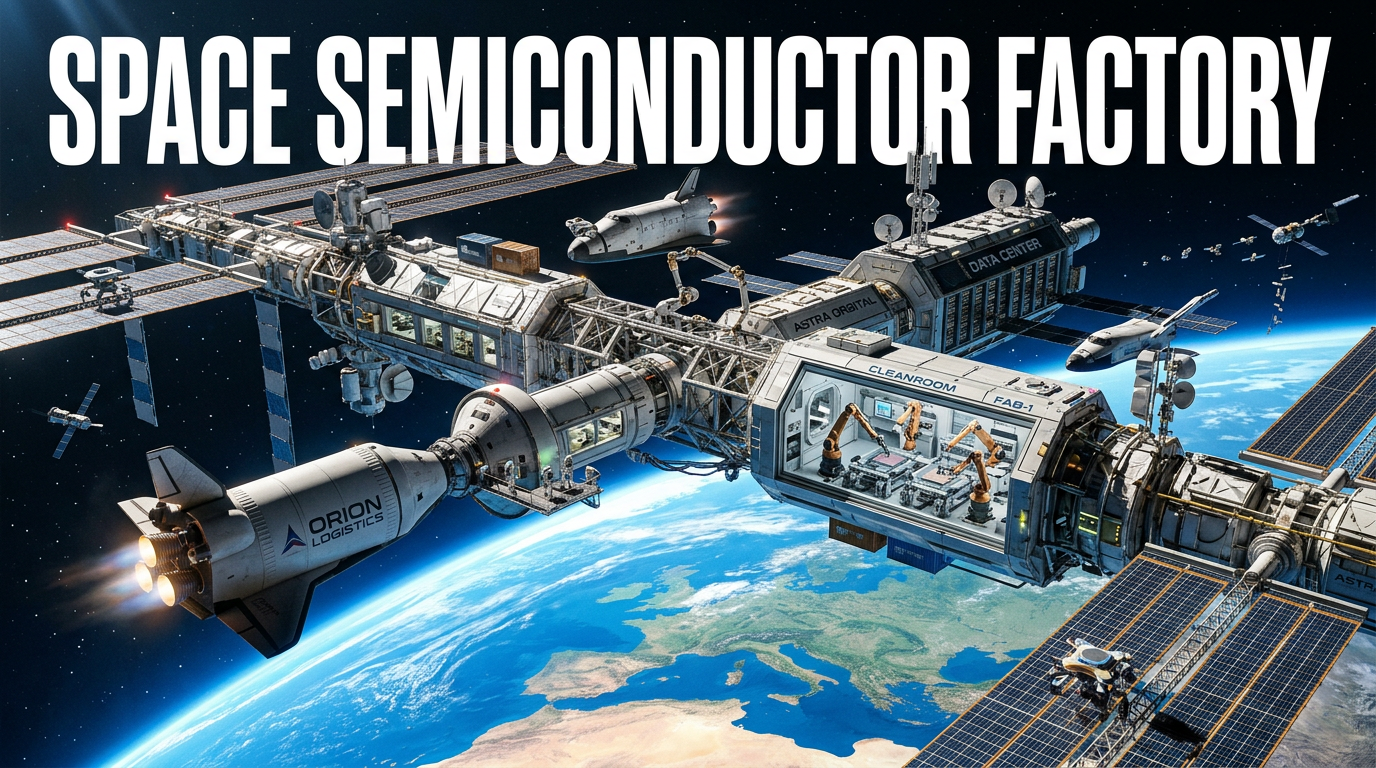
Space data centers next is “space semiconductor factory”… A complete roundup of the game-changers startups must capture
The 5 key takeaway points you absolutely need to cover in this article (so you can read them right above)
1) SpaceX-style “millions of satellites = a server per satellite” is theoretically possible, but because of economic feasibility and space debris (interference with observation), “other solutions” are more realistic.
2) So what’s drawing attention is the space data center “concept,” and the key to real implementation isn’t a ‘single massive structure,’ but a ‘modular build + robot-led maintenance’ strategy.
3) And the industry expected to take off at the next stage is space semiconductors (which can be made more cleanly/efficiently in space).
4) The space industry is growing with both civilian and defense use (dual-use), and defense, reconnaissance, and satellite-protection demand is accelerating technology commercialization.
5) In Korea, the argument is that the core is expanding the share of startups by moving away from a “structure that refuses to admit failure,” and it also lays out specifics up to the 10-year goal (global Top3 in space AS/maintenance).
News point—one-line briefing
Walkerreen Space CEO Kim Hae-dong emphasized that when SpaceX’s massive satellite network becomes a reality, the competitive landscape will become even more intense, and that space semiconductor factories and space maintenance (AS) services could rise as the next business opportunity.
1. “One million satellites = a data center”—can that work?
First, the question was, “Is it possible?” The answer is “theoretically, yes.”
1) The wall of cost and profitability
The idea of carrying a server on each of millions of satellites may be imagined technically, but the core issue is that costs—from launch and operation to components and replacement—could rise to an abnormal level.
2) Space environment is already a ‘congestion’ issue
As with the problem of astronomical observation being disrupted (flashing light) as ultra-large satellite constellations like Starlink grow, simply increasing the number of satellites carries high real-world risk.
3) So a more realistic alternative: “like a ground data center, but with structures in space”
CEO Kim talks about “space data centers” as the alternative.
Like placing a large data center in one location on the ground,
the perspective here is that in space, it makes more sense for robotic satellites to ‘assemble, connect, and maintain’ those structures.
2. How to build a space data center: like the International Space Station
It’s difficult to launch a data-center-level structure all at once into space.
Instead, the proposed realistic model is to launch smaller parts multiple times and then attach them in orbit to complete the system.
1) Don’t launch everything at once
The starting point isn’t ‘everything in one go,’ but launching about 1–2 parts at a time and connecting them with systems already operating in orbit.
2) Aim to shorten assembly time with “robot satellites”
In the past, it took nearly 20 years because people had to put on space suits and assemble it manually,
but now the scenario is that robot satellites will perform assembly, connection, and maintenance instead.
3. The reality of competition for space data centers: “scarcity of space + persistence of capital”
The competitive points CEO Kim sees are clear. Space above Earth is limited, and demand for servers and data centers will keep growing—so the answer has to extend into space.
1) NewSpace structure: it’s a game where everyone jumps in if it’s profitable
Space businesses tend to lean toward “whoever has investment capacity moves first to capture the market.”
So the contest isn’t just about technology—it’s about how continuously you put up capital and endure.
2) Because 100% success is hard, ‘fundraising’ becomes even more important
A rocket can explode during launch,
and even after reaching orbit, failures or damage can still occur while operating.
In the end, commercialization must have a structure that can withstand not a single “successful launch,” but a sequence of “continuous successes.”
4. Dual-use strategy (civilian-military): space commercialization pushed by defense
This part is truly important.
The space industry can grow with the private sector alone, but once defense demand comes in, the speed of ‘technology validation → trust → budget → commercialization’ can accelerate.
1) Robotic satellite services: centered on lifespan extension and maintenance
Walkerreen Space represents a model that provides services in space via robotic satellites.
In normal times, services that extend the lifespans of civilian satellites like those of KT-set,
and if needed, a structure that can connect even to defense satellites (dual-use) is what they emphasize.
2) It can ‘extend life by holding on’—yet in some cases, it can also ‘neutralize’
There are scenarios where you can chase and observe the other side’s satellite or interfere with it,
and even a neutralization scenario is mentioned, such as cutting off the opponent’s antenna.
In other words, because the technology has a double-sided nature, it’s also a domain that places like the U.S. Department of Defense / Space Force would pay attention to.
5. Next promising industry: “space semiconductor factories” for a real reason
The core of the question is right here.
The claim that the next after space data centers is a ‘space semiconductor factory’, and the reason is that “space could become a cleaner fabrication environment.”
1) Space is advantageous for vacuum + high-purity processes
The viewpoint is that outer space is closer to a vacuum condition than on the ground, and that under those conditions there is room to make semiconductor processes more cleanly.
2) Space processes can reduce ‘cleanroom’ burden and improve efficiency
On the ground, ultra-advanced cleanrooms are essential for semiconductors, making costs high.
Conversely, in space you can try certain processes (high purity/assembly, etc.) while keeping the cost burden relatively lower.
3) In an environment where gravity-related issues are reduced, process improvements like “uniform coating” become possible
On the ground, due to gravity it’s difficult to do uniform liquid coating / wafer leveling,
but in space, the possibility of achieving uniform coating is mentioned.
4) A structure where semiconductors connect directly to services (data center–factory–maintenance)
When semiconductor manufacturing moves to space,
the replacement cycles of servers/satellites/communication equipment and performance upgrades in space will also follow.
So it’s not just “one factory” that ends there—while the whole ecosystem becomes linked, a larger value chain can be created.
6. Expanding space factories: pharmaceuticals and space farms (space agriculture)
It’s not only space semiconductors—other things that space factories can produce are also connected.
1) Space pharmaceuticals (could be more efficient in the space environment)
They say that there are already documented cases showing that microgravity can produce different results than ground experiments, and that experimenting in space may be more efficient.
2) Space farms: an essential for self-sufficiency on the Moon and Mars
If people are to live on the Moon/Mars, food is needed.
But if you bring crops made on Earth as-is, you face limitations due to exposure to the space environment (during flight/in storage).
So the logic is that crops and space foods that are strong in the space environment must be produced by space factories.
3) There’s an underlying premise that “food becomes cheaper in space”
They also point out that the structure depends on having enough space population for economics to work.
7. For Korea to become a space powerhouse: don’t just reduce failures—‘allow’ them
From here, it becomes a discussion about policy and industry strategy.
The core is “growing startups,” but it connects not to a simple slogan—it connects to criticism of budget structure.
1) The existing approach: government research institutes at the center + high big-company share + failure avoidance
Up to now, they think the structure was that government budgets were provided so research institutes could develop,
and some of that flow went mainly to large corporations.
2) A culture that tries not to acknowledge failure blocks even the act of trying itself
You get the phrase, “If you only aim for success, you can’t do anything.”
Especially in fields where profits don’t come right away, it’s hard for private firms/startups to enter,
and then the industry can stagnate—that’s the concern.
3) Proposal: expand the startup share with a budget split of 5:5 (or something equivalent)
Where in the past the government research institutes and large corporations dominated at around 90,
now the argument is that the share should shift toward startups, aiming for something like a 5-to-5 split.
8. A goal for 10 years from now: “global Top3 in space AS/maintenance”
CEO Kim’s final goal is quite realistic.
It’s to take on the role of a maintenance workshop in space.
1) A structure where you hand it over to certified places, like an auto repair shop
On the ground, you don’t trust just any neighborhood repair shop—you trust certified ones.
The assumption is that if space needs breakdown repair/maintenance/upgrades, “trustworthy AS centers” will emerge.
2) “Many satellites” means “many maintenance demands”
As satellites increase, so do failures and replacements.
So they believe the “service business” can grow in the long term.
9. The conclusion that runs through this whole trend: smart factory → AI factory → space factory
Finally, there’s a perspective that cuts across the entire interview.
Manufacturing has evolved into smart factories,
then AI factories,
and going forward, it moves into a space factory that runs factories in space.
Main points to convey (separate summary: the “real one line” not covered elsewhere)
The “real turning point” this interview talks about is that the industry is reorganizing not around mass launching satellites themselves, but around an operating model that bundles maintenance (AS) and production (semiconductors/food/pharmaceuticals) in space.
In other words, data centers are not “the next thing”—they’re a link, and the next step is that space manufacturing (especially space semiconductors) could become a key axis that changes cost structure and competitive advantages in performance.
With civilian-military dual-use coming into play here, technology validation and demand can accelerate,
and Korea’s message is that the faster it can follow is by increasing the startup share in a way that allows failure.
In short, this article shows the connection point where space economics, global AI trends, space semiconductors, satellite data centers, and defense space technology converge.
< Summary >
– While the idea of putting servers on millions of satellites is theoretically possible, due to cost and the space congestion problem, space data centers (structures + robot assembly/maintenance) are proposed as an alternative.
– Space data centers aren’t built by launching everything at once; the key model is launching parts multiple times, assembling them in orbit, and having robot satellites handle maintenance as well.
– Competition for space AI/data centers is expected to become fierce because of scarcity of space and persistence of capital.
– Dual-use technology (civilian-military) connects to defense demand and can accelerate commercialization.
– The next industry axis is space semiconductor factories: there’s a logic that process efficiency and quality competitiveness could emerge from factors like vacuum, high purity, and reduced effects of gravity.
– Space factories can extend to pharmaceuticals and space farms, connecting them to being essential for self-sufficiency on the Moon and Mars.
– In Korea, it’s important to allow failure and expand the share of startup budgets (for example, a proposal around a 5-to-5 level).
– Walkerreen Space’s 10-year goal is to become a global Top3 in space AS/maintenance services.
[Related Articles…]
– Space semiconductor factories—why they’re viewed as the next meal ticket and key investment points
– After space data centers, the real market structure behind why ‘space AS’ is emerging
*Source: [ 티타임즈TV ]
– “우주 데이터센터 다음은 우주 반도체 공장” (워커린스페이스 김해동 대표)