● Autonomous Transit Boom Accelerates Amid Regulatory Hurdles
The speed at which autonomous driving taxis and buses are becoming “everyday”—I’ll summarize only the core points
5 things you must check in today’s post (they continue in the very next paragraph)
1) In the U.S., Waymo’s “paid rides” are skyrocketing, and this year it aims to expand into 10 or more cities.
2) In South Korea, autonomous driving taxis and autonomous driving buses are already operating through the night, but the core bottleneck is not “technology” so much as “law and regulations (level 4, remote control, accident liability).”
3) Kakao Mobility appears to be expanding beyond a simple calling platform into vehicle development and operations, aiming to secure “platform + vehicles” at the same time.
4) Vehicle manufacturers such as Hyundai Motor and Kia are building “hardware competitiveness” through electric-vehicle-based supply and proof-of-concept data, and their role in raising Korea’s autonomous driving ecosystem is growing.
5) Ultimately, the success point is “public transportation integration that absorbs blind spots, time-of-day variations, and demand fluctuations well.” This isn’t an event where you just try riding once—it needs to become part of people’s daily routes.
The U.S. is already heading toward “paid, driverless”: what Waymo’s growth curve says
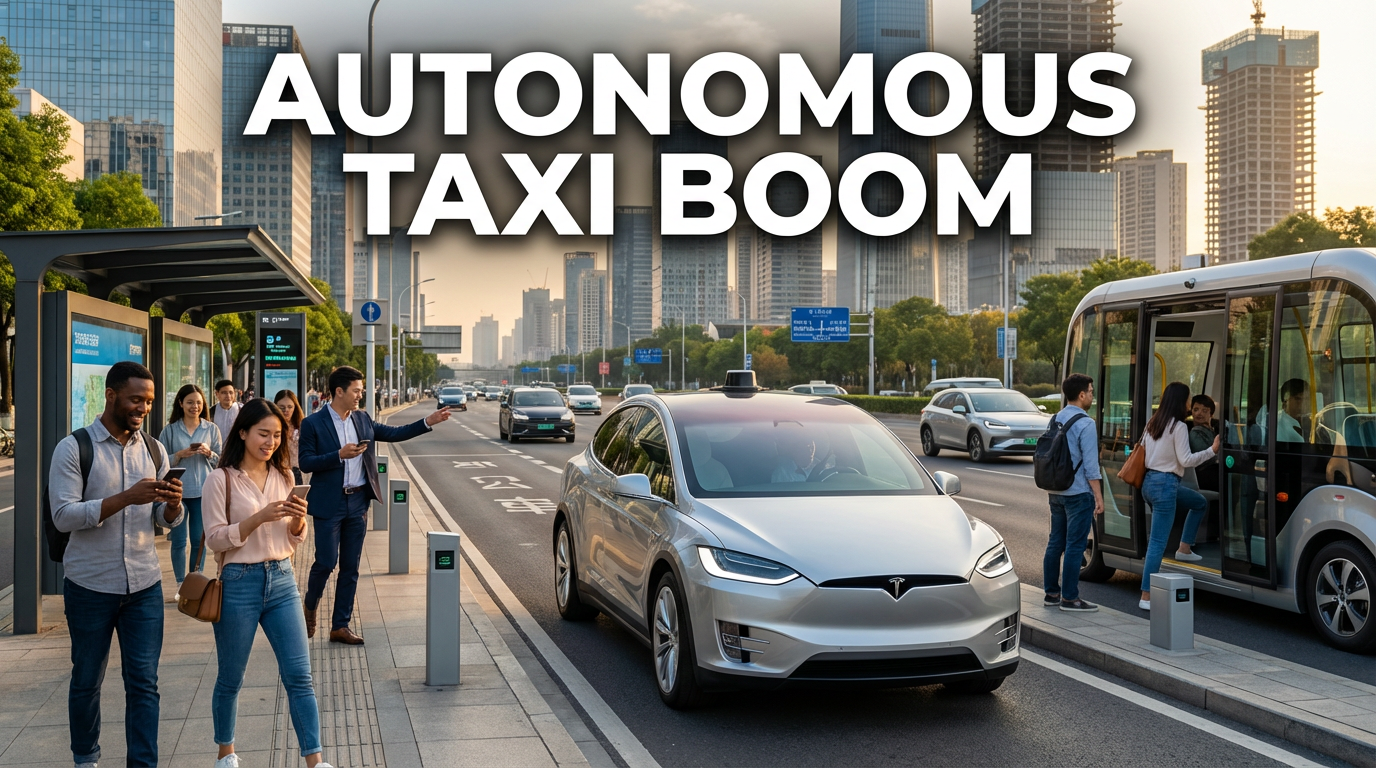
In the U.S., autonomous driving taxis (Waymo) were reported to have about 15 million paid passengers last year, and this year it is reported to be targeting more than 50 million users across 10 or more cities.
In other words, it’s a sign that autonomous driving is shifting from “a test technology” to “a mode of transportation that people use repeatedly.”
And players like Amazon’s Zoxx and Tesla’s robotaxis are also expanding.
This trend is less about just one company’s success and more about the big meaning that the market validation stage for autonomous driving demand has begun.
Europe and Japan are following too, but “data re-training” is the challenge
Waymo announced that it will start service in London this year, and testing is also underway in Japan.
However, Japan and Europe have different traffic environments from the U.S.
– Japan drives on the left – Different right-hand driving habits/sign systems
So it can’t be finished with only the data accumulated in the U.S.; it needs to additionally train on local data.
In other words, the core of overseas expansion isn’t “copying technology,” but an “operating system built on local data.”
In Korea, it’s already on the road: the stage where night taxis and autonomous buses build “field data”
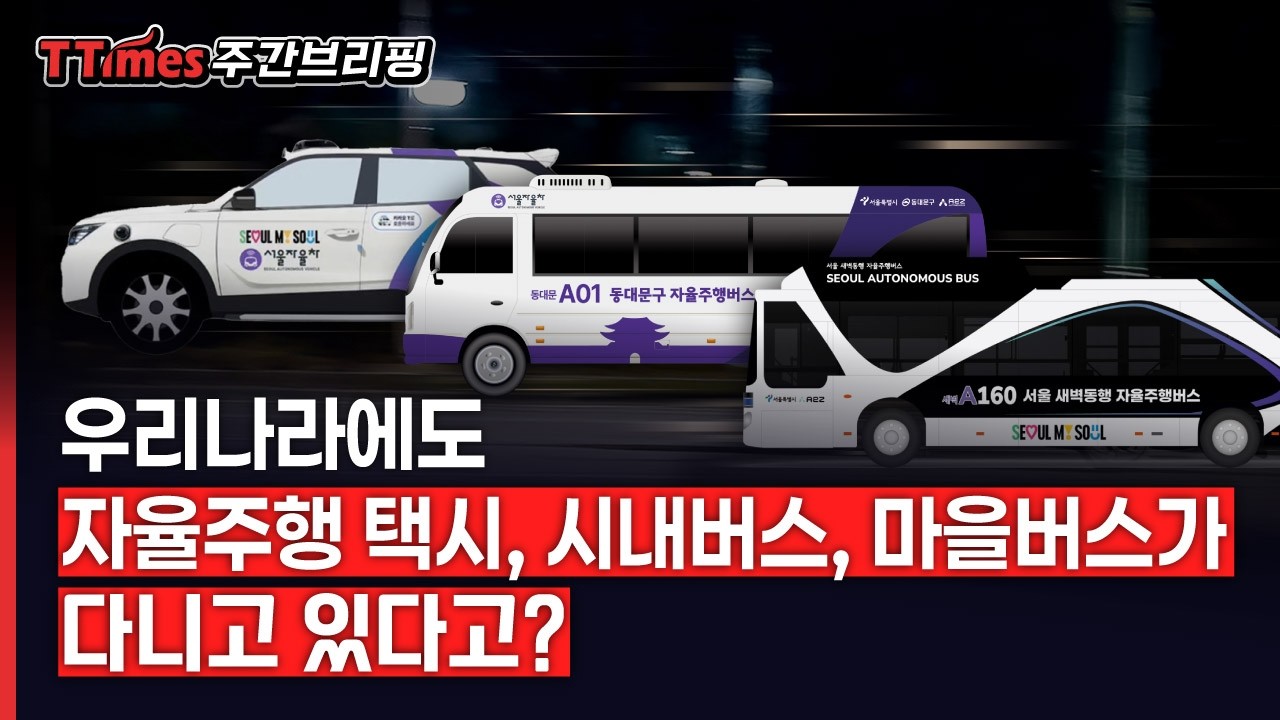
It used to be “news for someday,” but in Korea, autonomous driving taxis and city buses, village buses, and shuttle buses are already actually running.
1) Gangnam autonomous driving taxi at night: free → paid transition, and expansion of coverage is underway
After starting in 2024, Gangnam’s autonomous driving taxi at night is currently operated in a form where a “safety driver” sits in the driver’s seat and can respond to emergencies.
As the service moves beyond testing into paid operations, a plan was announced to increase the number of vehicles from the existing 3 to 7.
The important point here is that it’s not about “unmanned level 4,” but about accumulating operational quality, customer behavior, and data on unexpected situations through paid operations.
2) Autonomous buses: focus on routes (morning/commute/cleaning labor) to create “a service with a clear purpose”
In Korea, there seems to be a flow where autonomous buses are designed not just for promotion, but for specific time slots and purposes.
– Dongdaemun District, Seoul: Route A01ma (about a 15 km segment, roughly 23 stops)
– Along the axis from Dobong and Jongno, Seoul → Yeouido → Yeongdeungpo: Route A160 (aimed at moving early-morning workers; departing about 30 minutes earlier than the first bus)
These kinds of designs become stepping stones toward going to “public transportation that anyone can use.”
3) There are also village/shuttle buses: but evaluations differ due to level and road conditions
A Qinggyecheon–Blue House autonomous shuttle (about a 3–4 km segment) has reviews from users who say they feel the progress of the technology and that it is “smooth/comfortable/safe,” while
– issues with punctuality – repeated hard stops caused by insufficient object recognition
are also mentioned.
The data from a longer route operated in Dongjak District has a larger number of accumulated users and stronger positive feedback, so discussions are leading to expansion proposals such as increasing dispatch frequency and extending operating hours.
The real obstacle to “autonomous driving level 4”: law and regulations more than technology (remote control, accident liability, insurance)
In South Korea, the biggest bottleneck to moving toward level 4 “unmanned” isn’t only technology.
Based on the original flow, the core points are these four.
1) Remote control regulations (the issue of what is allowed beyond parking)
In South Korea, remote control is described as being limited in principle and only allowed when parking.
2) Accident liability and the entities responsible for operations management are not defined with precision
There are criticisms that if an accident occurs, there are not enough clear standards for who is responsible (manufacturer/software/platform operator/person responsible for operations management, etc.).
3) The insurance system must change to match “unmanned operations”
Since the operating entity and risk-sharing are changing, if the insurance design stays the same, it will be difficult for the industry to function.
4) Level 3 is also limited: allowed only on certain roads and in certain situations
Level 3 is often permitted in limited cases under the premise that the driver can continue to be involved.
In conclusion, even if technology improves quickly, if the regulatory framework and the structure of insurance and responsibility do not keep up, “true unmanned” will inevitably be delayed.
Kakao Mobility: why it’s expanding from a ride-hailing platform to “vehicles + operations”
Initially, Kakao Mobility’s role focused mainly on being a calling platform for vehicles from a specific company, but this time, as it moves into vehicle development and operations, the structure is changing.
Another important picture is that because the interests of the taxi industry (corporate taxis, individual taxis, and drivers/workers) collide, it’s not possible to “operate any vehicle with anyone.”
In the original text too, the reason for approaching from the standpoint of corporate taxi partnerships is explained.
– Corporate taxis have the “vehicles,” but there is a shortage of “driver supply”
– Individual taxis/drivers are concerned about market encroachment
So it appears that Kakao Mobility is aiming to lower transition costs by building a realistic collaboration structure.
Why manufacturers like Hyundai and Kia are getting bigger: electric vehicle supply + proof-of-concept data + hardware competitiveness
In the original text, there’s mention that Hyundai Motor participates in the Gwangju proof-of-concept city project to secure both vehicle supply and data.
Unlike the vehicle models Waymo previously used (e.g., modified Jaguars), the ability to continue with electric-vehicle supply such as the Ioniq is particularly meaningful.
Autonomous driving is about operating 24 hours a day, so rapid-charging compatibility and cost efficiency are important.
Also, there’s a viewpoint consolidated that “there are many startups for software, but there aren’t many manufacturers that are strong in large-scale production, quality, and manufacturing processes.”
This leads directly to the logic that OEMs can again take both “a money-making axis (revenue)” and “an executable axis (operations).”
2027 turning point: forcing through the “legal revision” issue while pushing Sejong City level 4 unmanned bus BRT
The “timing” that appears most strongly in the original text is 2027.
It’s a passage saying that the Ministry of Land, Infrastructure and Transport set a goal of full autonomous driving by 2027, and using that as a turning point, it hinted at legal revisions.
Especially, Sejong City is preparing level 4 unmanned autonomous driving buses BRT along with future convergence industry centers and tech parks, and
– vehicle purchases and modifications – building a control center – preparing a control system for unexpected situations (CSM)
are mentioned.
The real core point here is that the current Road Traffic Act limits the “scope of the driver” to people, and therefore cannot sufficiently include AI.
In other words, Sejong’s effort seems to be less about “let’s try running it first” and more about creating a structure that makes level 4 legally possible.
From what I’ve seen, there are only 3 things that will determine whether “true commercialization” happens in Korea in the future
Reinterpreting from my perspective, for level 4 to be commercialized and accelerate, these three must align at the same time.
1) Integration of public transportation (settling transfers/routes/aligning routes)
“Subway + bus + autonomous driving” should be recognized naturally as one unified route.
Even if you start by targeting late-night periods, blind spots, or specific time windows, it’s only truly successful once it attaches to people’s daily routes.
2) Responding to demand fluctuations (adaptively attaching even during temporary surges)
If people flock in the short term like at events, tourism periods, or unexpected demand, it’s hard to respond with fixed routes alone.
Autonomous driving can be designed to absorb new demand by creating “the needed route at the needed moment.”
3) Persuade the taxi conflict not by “taking away” but by creating “new demand”
The original text also summarizes that you need an approach that creates new mobility demand, not a “grab the bowl” method.
Especially, autonomous driving can make supply (vehicles/operations) flexible,
so it has strengths in maintaining mobility services even in areas/time slots with weak demand.
Conclusion from the AI trend perspective on this news: winning is “operationalization,” not just “automation”
Looking at this trend through an AI lens, autonomous driving isn’t only about algorithm performance—it is evolving into
an operational (Operation) system.
– Responding to unexpected situations (driving behavior/brake timing) – Control and remote support systems – Data collection → training → performance updates
All of this must come together for “paid usage” to increase.
So the key topics that matter in the market right now are grouped as follows.
Autonomous driving, robotaxis, level 4, mobility platforms, regulatory innovation
The “most important one line” that others don’t usually say (separate summary)
The deciding factor for autonomous driving isn’t “a car drives itself,” but rather the point at which a operating system that increases paid usage (law, responsibility, insurance, route integration) is put in place—then acceleration really begins.
Next action: what companies/office workers should check based on today’s news
1) Check whether “paid transition, expanding routes, control systems, and accident liability models” are mentioned—not just simple technology news.
2) Draw a division-of-roles map among manufacturers (EV supply), platforms (hailing/operations), and startups (control/software).
3) In Korea, instead of focusing only on level 4 commercialization, check whether data from level 3 and proof-of-concepts on specific roads connects to “businessing” (turning it into a business).
< Summary >
– Waymo’s paid rides are exploding, and it is continuing market validation through expansion this year (10+ cities, targeting 50 million people).
– In Korea, despite level 4 unmanned driving being bottlenecked by law/regulations (remote control, accident liability, insurance), the country is already accumulating field data with autonomous driving taxis (paid transition and vehicle expansion) and autonomous driving buses (route-purpose type).
– Kakao Mobility is reinforcing its “platform + vehicles” strategy by expanding from a calling platform into vehicle development and operations.
– Manufacturers like Hyundai Motor want to simultaneously take both hardware competitiveness and revenue momentum by securing electric vehicle supply and proof-of-concept data.
– Legal revisions, using 2027 as a turning point (including attempts with Sejong City level 4 BRT), could determine success or failure.
[Related article…]
The next stage of paid autonomous driving seen through Waymo robotaxi expansion
*Source: [ 티타임즈TV ]
– 일본, 유럽까지 자율주행 택시가 일상이 되고 있다