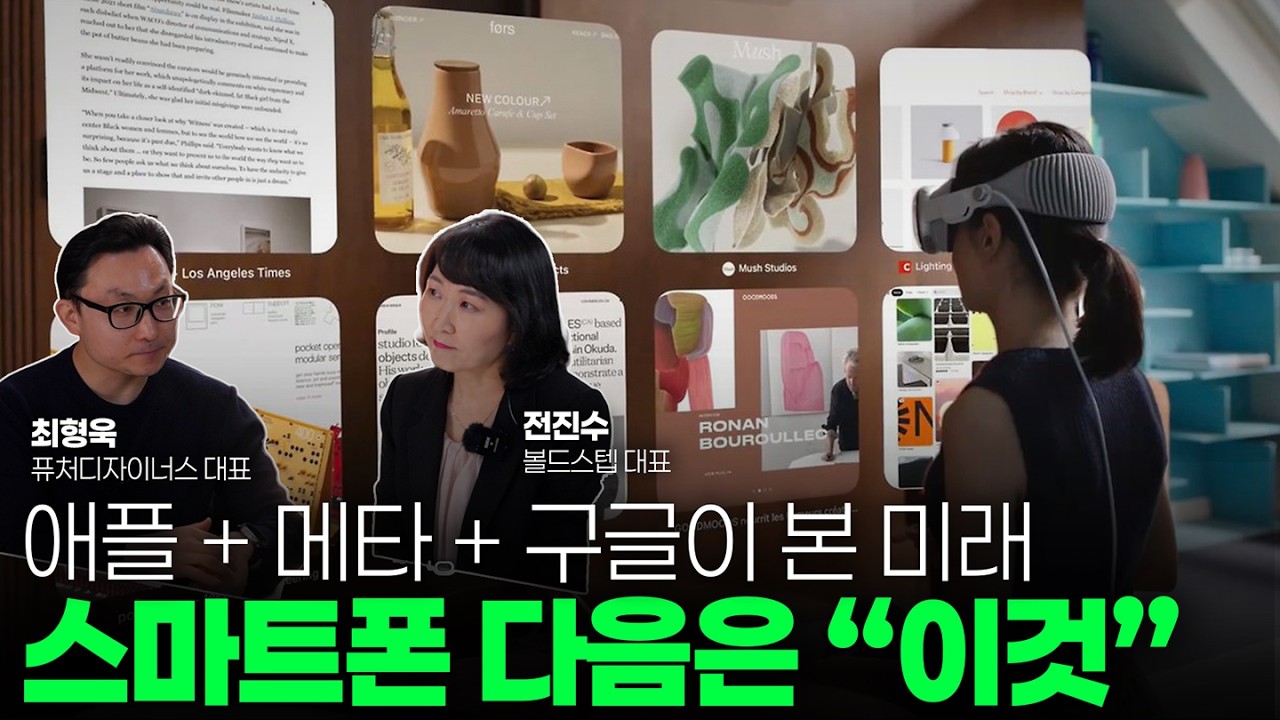
● Spatial Computing Set to Ignite the AI Catalyst Era
“Spatial Computing” changes the game after smartphones…News roundup of the “00 Computing era” where AI became the catalyst
In today’s post, the core point is three things. First, what spatial computing is (and how it differs from metaverse/AR·VR·MR) Second, why “Vision Pro·AI glasses” suddenly changed right now (why the signal came = advances in AI·GPU·reduced latency) Third, the “life scenarios” that will realistically change in the next few years, along with the remaining homework of privacy/security to be resolved
If you catch this flow all at once, you’ll immediately understand that “spatial computing” is not just a buzzword— it’s the next phase where AI combines and changes both real industries and consumer experiences at the same time.
1) What is spatial computing? From the “computer of a flat surface” to where “space itself” becomes the interface
■ Definition (one-sentence summary)
Spatial computing is a world where you step out of the flat world (monitors/phones), and the “real space where the user is” itself becomes the computer. In other words, space becomes the display, and everywhere in space becomes input.
■ How is it different from the metaverse?
A lot of people seem to get confused here. To sum it up, it’s easiest to think of it like this.
- Metaverse: Strongly characterized as “another world,” where you operate in a space separated from reality (or closer to being virtual)
- Spatial computing: A direction where digital information naturally interacts within the “real space you’re living in right now”
■ AR·VR·MR·XRT are connected as “one bundle,” but the key criterion is ‘distance from reality’
AR (augmented) / VR (virtual) / MR (mixed) are at different stages, but they’re connected. It helps to understand the difference as “how closely it’s attached to reality.”
2) Why people started to genuinely feel ‘spatial computers’ in full scale right now
This is where the real interesting part starts. AR·VR·MR were still coming up before too—so why did the “signal” rise so much this time?
■ (1) GPU + computing performance: evolving toward less latency and better synchronization (consistency/alignment)
The key is that graphics/compute performance (GPU) has surged, making it possible to actually implement “the experiences users want (fast and accurate rendering).”
- Previously, it was hard to precisely align “digital information that stands out”
- Now, it’s much easier to control because cameras/sensors can understand the surroundings almost in real time
- Resolution has also increased, reducing the sense of mismatch
■ (2) Advances in AI: “conversation/behavior” starts working before “display”
A particularly important shift happened in smart glasses. In the past, “showing (display)” was the core, but now generative AI can converse and respond sufficiently with nothing but voice, so the view that “a display might not be strictly necessary” has grown stronger.
- Devices from the Meta ecosystem send early signals of expansion centered on “conversation experiences”
- Users want the “answers/services they need,” not what’s on the screen
- So AI agents move to the center of the device experience
■ (3) ‘Vision Pro vs AI glasses’ differs in approach
You can summarize the strategic difference between the two camps like this.
- Headsets (Vision Pro-type): aiming to create precision with high resolution and consistency in space
- Smart glasses (lightweight approach): bringing wearability all day and practical usefulness centered on voice AI first
3) Explosion of content: AI rapidly creates 3D/world models/metahumans
For spatial computing to grow, you need “reasons to use it” (killer apps/killer content). And that’s where AI is changing the game extremely fast.
■ What generative AI changes: the entry barrier for making 3D objects collapses
- Create 3D objects with prompts
- Insert 2D images and convert them into 3D
- Build world models based on spatial photos (reconstruct space digitally)
■ Next phase of “there’s nothing for the metaverse to do”: making AI NPCs/metahumans real
One reason the metaverse hasn’t been widely adopted yet is that “even after entering, there weren’t enough targets to interact with (content).”
- With generative AI, it becomes possible to create human-like entities (metahumans)
- NPCs in games evolve toward carrying forward situation/memory/conversational context
- As a result, the value (“interactivity”) of spatial computers gets filled
4) The “life scenarios” that will change in the next few years (what everyday people will intuitively feel)
This section helps you grasp “how things will change in reality.” These are things with a high likelihood of being enabled by the combination of conversational AI and spatial computing.
■ Overseas travel: handle translation/navigation/info search “without a smartphone”
- View-by-taking-a-photo translation → instantly displayed on glasses/glass devices
- Audio-guide style experience at museums/historic sites → a conversational personal docent experience
- “Situation-tailored explanations” that continue into follow-up questions once interest arises
■ Daily consumption: from “checking the menu” to “verifying coupons/recommendations” based on your line of sight
- Store front/menu-related information pops up immediately
- While viewing happy hour/discounts/coupons, decide the next action (enter/order) faster
- Reduce how often you take out your smartphone and improve your quality of life
■ Point (the gateway to feeling it): people have already tried ‘AI voice experiences’
One important perspective came up. Because people already have experience using AI speakers and voice-based AI, they’ve internalized “convenience they can’t go back from.”
- Existing AI speakers had “answers/limitations that most of the time couldn’t match”
- After generative AI arrived, voice conversation accuracy and latency improved significantly
- So from a user’s standpoint, “using AI with your voice” has already become familiar
5) Device form factor: “glasses” are likely the ‘next’ like smartphones, but it won’t be a standalone winner
■ Next after smartphones = glasses, no matter what? However, the key is the “companion”
Smartphones are still a powerful platform. So glasses are likely to maximize efficiency not as a complete replacement right away, but through a combination with smartphones (companion).
- Because of the burden of communication modems/cloud connectivity, phones will still take on the role initially
- Glasses are lightweight, and all-day/always-on wearability is key
- In the long run, wearables can evolve further and take on independent roles too
■ Other form factors (pins/pens/rings/pendants) could also emerge
However, universally, as AI functions expand into “recording/summarizing/agents,” they can diversify into forms that make life-logging/input possible (microphones, sensors, writing, etc.).
6) Remaining homework: privacy and security can only be solved together by “technology + social acceptance”
Since spatial computing is likely to involve cameras/sensors being on all the time, privacy concerns are unavoidable.
■ Past failure factors: backlash against “secretly recording”
- The biggest barrier is the perception that you could be recorded without user consent
- Social trust needs to come before technological progress
■ Recent direction: visible LED indicators you can recognize, making actions during recording visible
- Design so an LED turns on during recording/capturing
- Regulations by country (sound/display, etc.) also influence this
■ Still not 100% yet: ongoing need for on-device processing + continued security updates
There are attempts to reduce leakage of sensitive information through on-device processing, but risks like hacking/security incidents don’t “disappear.” Ultimately, you need both technological improvements and the accumulation of user trust.
7) The “five most important conclusions” summarized separately only in this post
- The winning factor for spatial computing isn’t the display—it’s “interactions in space.”
- The reason the signal rose is that improvements in AI conversational abilities + GPU/consistency happened at the same time.
- The content bottleneck is being filled quickly by generative AI with 3D/worlds/NPCs (metahumans).
- The top value that everyday people will feel first is “immediacy,” such as translation/travel docents/order and recommendations.
- Privacy/security becomes mass-market only when it’s solved not just technically, but alongside social acceptance (LED indicators, a culture of consent).
Core keywords of this article from an SEO perspective (naturally reflected)
When understanding this flow, it’s good to keep these keywords in your mind together: spatial computing, generative AI, AI agents, XRT (AR/VR/MR family), next-generation devices.
< Summary >
- Spatial computing is a concept where “real-world space” becomes the display/input, not “a flat screen.”
- The metaverse is more about virtual worlds, while spatial computing interacts with digital information within reality.
- Advances in AI and GPU raise latency/consistency/real-world usability, making the “signal” grow.
- Generative AI makes it possible to mass-produce 3D/world models/metahumans and NPCs, reducing the content bottleneck.
- “Immediacy” experiences—like translation, travel docents, and store information—are likely to become the core of mainstream adoption.
- The final gate is privacy/security, which requires on-device processing/indicator devices/social acceptance together.
[Two related post entries]
- Market outlook for spatial computing and investment takeaways
- How generative AI is reshaping the device industry
*Source: [ 월텍남 – 월스트리트 테크남 ]
– 곧 모두가 체감할 “00”컴퓨팅의 시대가 옵니다.