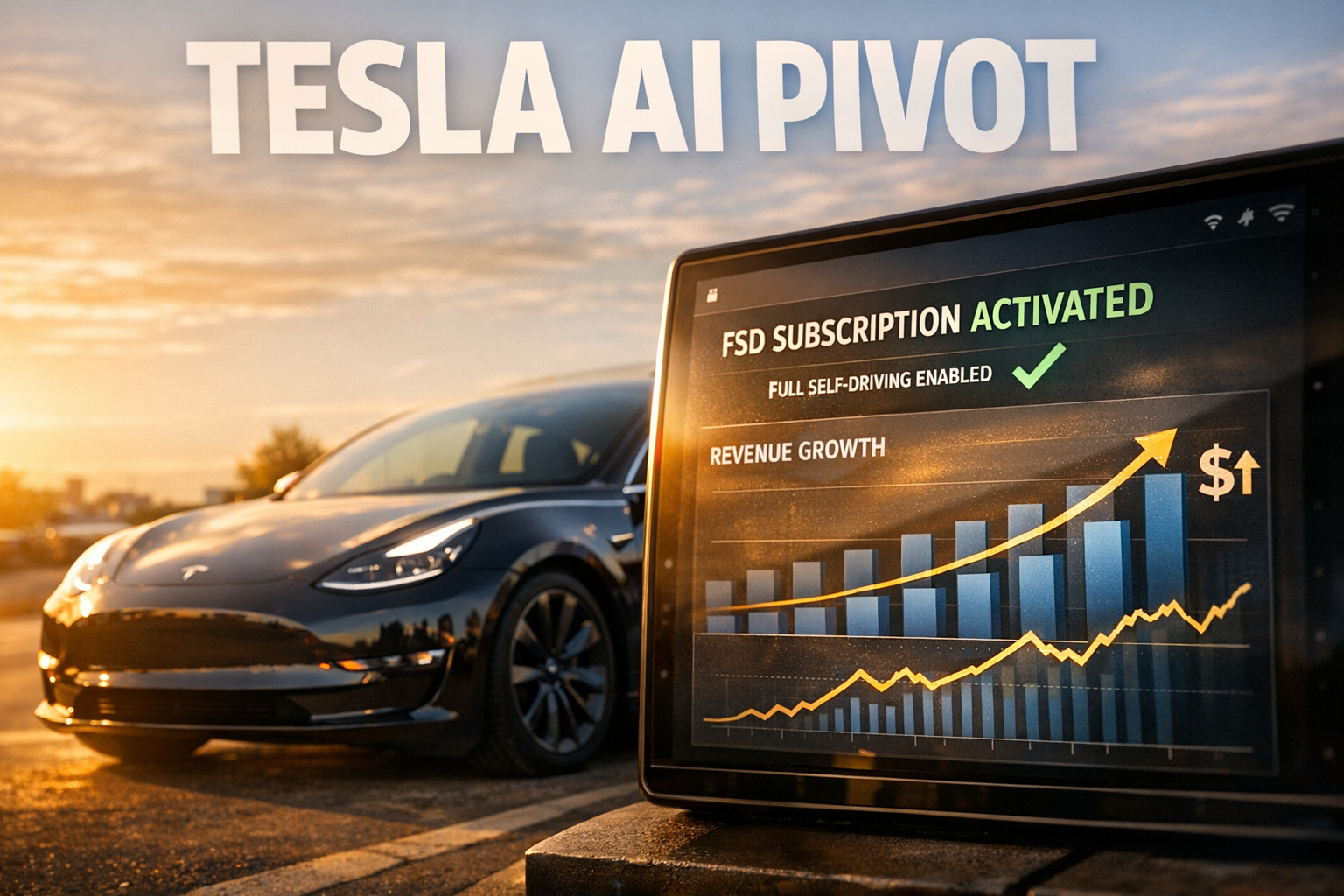
● Tesla Reversal, Margin Crash, Musk Signal
Potential Q1 Reversal Toward 370k Deliveries: Why Musk’s Retweet, Margin Compression, and Re-Rating Risk Must Be Analyzed Together
The current Tesla investment debate centers on three variables:1) Whether Q1 deliveries materially exceed market expectations.
2) Whether margin-compression narratives are overstated relative to underlying unit economics.
3) Whether Tesla can be valued as a software, energy, and AI platform rather than a pure automotive manufacturer.
This report links: the 377k delivery signal amplified by Musk; the strategic rationale behind 0% financing despite near-term profitability pressure; how FSD subscriptions could materially change valuation frameworks; and broader catalysts including expanded investment in Japan, Delaware court reassignment optics, oil-price volatility, and the Federal Reserve policy stance.
A key framing issue is whether Tesla is primarily “selling cars” or “building an installed base for recurring software and energy monetization.” This framing materially affects interpretation of deliveries, margins, and equity valuation.
1. Key Catalyst: Why a 377k Q1 Delivery Scenario Is Moving Markets
The most debated figure is 377,251 units, an investor-derived estimate that is more than 10k above the Street consensus of approximately 365k.
The figure gained traction because Elon Musk retweeted the estimate, which markets interpret as a demand-confidence signal ahead of the print.
Scenario framework:
- Bull case: High-370k deliveries could reduce demand-slowdown concerns.
- Base case: Mid-360k deliveries broadly match consensus; limited incremental impact.
- Bear case: Below 350k could re-intensify concerns about demand elasticity and the effectiveness of price actions.
This release is therefore viewed as both a demand read-through for the EV market and a sentiment catalyst for growth/technology equities.
2. Why “Margin Collapse” Narratives Persist: The Mechanics of 0% Financing
The primary bear argument is profitability pressure, with claims that 0% or very low-rate financing could reduce per-unit profitability by up to roughly $10,000 in economic value.
From a traditional OEM lens, this is directionally consistent: higher incentives and financing support compress reported automotive margins.
The central question is whether Tesla should be analyzed strictly as an OEM at the point of sale, or as a platform monetizing a longer customer lifecycle.
3. Tesla as an Installed-Base and Ecosystem Expansion Model
In a manufacturing model, the sale is the profit event. For Tesla, the sale can function as the start of lifecycle monetization.
Comparable framework:
- Razor = vehicle sale
- Blade = FSD subscription, software features, services, and charging ecosystem
Under this framework, financing support can be treated as customer acquisition cost (CAC), intended to expand the installed base that can generate multi-year software and services revenue (LTV-driven).
This approach aligns with platform and subscription models where lifecycle value is prioritized over upfront hardware margins.
4. Why FSD Subscriptions Matter: Structural Margin Mix Shift
FSD is a potential valuation driver rather than a simple upsell option.
A subscription model can create recurring revenue with software-like gross margins, potentially improving mix and reducing dependence on hardware margins.
Beyond subscription fees, increased FSD usage expands real-world driving data, which can improve model performance, supporting:
- Higher product competitiveness
- Potentially stronger subscription adoption
- Reinforcing data and learning-loop effects
This positions the fleet as a distributed AI data-collection network, structurally differentiated from traditional automakers.
5. BYD Profit Weakness as a Market Signal: Hardware-Only Economics Under Pressure
BYD’s profit decline is a relevant comparator in an environment characterized by price competition and market consolidation pressures.
In such cycles, firms relying primarily on hardware margins tend to experience greater profit volatility. Market resilience increasingly depends on the ability to transition from vehicle margin reliance to software, services, and energy monetization.
6. Macro Variables: Oil Prices and the Fed’s Hold Bias
Geopolitical risk has increased oil-price volatility. For EV demand, two macro variables are typically most important:
- Interest rates (financing affordability)
- Oil prices (relative operating-cost advantage)
Current configuration:
- Higher oil prices: Reinforces EV operating-cost attractiveness.
- Fed hold bias: Reduces risk of incremental financing-cost deterioration.
- Lower policy uncertainty: Can support sentiment toward growth and tech-adjacent equities.
Given Tesla’s dual identity as an EV bellwether and a tech-adjacent name, macro shifts can translate into outsized equity sensitivity.
7. Renewed Focus on FSD Video Evidence: Intent Prediction as an AI Capability Signal
Recent footage highlighting FSD decelerating in anticipation of pedestrian intent has regained attention, particularly when contrasted with weaker outcomes elsewhere.
The strategic relevance is intent prediction rather than object detection. High-performing autonomy requires probabilistic forecasting of behavior (pedestrians, cyclists, and atypical vehicle actions), not only lane or signal recognition.
This supports Tesla’s end-to-end neural network positioning and reinforces that FSD is both a product and a large-scale real-world AI training system.
8. Modular FSD Computer Patent: Implications for Lifecycle Monetization
A modular FSD computer architecture appears strategically material beyond repairability. If compute modules become upgradeable, it may enable stepwise transitions to future generations (e.g., AI5, AI6) without full-system redesign.
Potential implications:
- Post-sale hardware upgrade revenue streams
- Higher retention within the FSD ecosystem
- Potential support for residual values
- Expanded fleet eligibility for future robotaxi deployment, subject to regulatory and technical readiness
As the installed base scales toward multi-million units, upgradeability increases the likelihood of platform-style monetization across the fleet.
9. Expanded Investment in Japan: Strategic Interpretation
Musk’s comments on expanding service centers and accelerating Supercharger buildout in Japan are best interpreted as infrastructure-led market development rather than near-term unit-driven expansion.
Japan combines a large automotive market with comparatively slower EV adoption, driven by practical constraints and conservative consumer preferences. In this context, infrastructure reliability and service coverage function as demand enablers and durable barriers to entry.
Supply-chain considerations also matter, including strategic relationships such as Panasonic in batteries. Japan therefore serves as both a consumer market and a partnership node, with longer-term optionality in charging standards and autonomy deployment.
10. Delaware Judge Reassignment: Governance and Legal-Process Risk Optics
Delaware court developments, while procedural, influence investor perception of governance risk, legal uncertainty, and the costs of corporate structure decisions.
The reassignment reinforces the view that Musk-related cases can be shaped by broader institutional and political context, increasing perceived uncertainty. This backdrop has also renewed attention on corporate domicile shifts toward jurisdictions viewed as more predictable for management and boards.
11. Underappreciated Segment: Energy as a Second Growth Engine
Tesla’s energy storage business is increasingly material to the consolidated narrative. Utility-scale storage (e.g., Megapack) follows a different demand cycle than vehicles and can benefit from structural grid stabilization needs and renewable integration.
This diversification can reduce dependence on quarterly delivery volatility and supports a broader platform valuation discussion beyond automotive.
12. Five Metrics to Prioritize This Quarter
-
Reported deliveries
High-370k: upside to demand narrative; mid-360k: in-line; below 350k: renewed demand concern. -
Automotive gross margin
Quantifies the realized impact of pricing actions and financing support. -
Management emphasis on FSD and software
Conference call language on subscriptions, autonomy roadmap, and AI infrastructure is a key qualitative indicator. -
Energy storage performance
Confirms the scale and trajectory of the non-automotive growth engine. -
Inventory and production balance
Strong deliveries paired with rising inventory can alter demand interpretation.
13. Core Point Often Missed: Profit Sacrifice vs. Future Cash-Flow Capture
Headline focus on deliveries and margin percentages can miss the underlying strategy question: whether Tesla is “forgoing profit” or “buying future cash flows” by expanding the installed base.
If vehicles are treated as endpoints, incentives read as margin destruction. If vehicles are treated as platform nodes, incentives can be interpreted as CAC used to expand future software, charging, service, and data-driven monetization.
The market’s valuation debate increasingly depends on which frame dominates.
14. Conclusion: How to Read the Q1 Release
The delivery number will drive near-term sentiment, with ~377k potentially easing demand concerns. A weaker-than-expected margin print could renew criticism.
However, the more decision-relevant interpretation requires a combined view of:
- FSD subscription potential and software mix
- AI data accumulation and learning-loop advantages
- Upgradeable compute strategy
- Energy storage scaling
- Infrastructure-led market development
The central question is less “how many vehicles were sold” and more “how many incremental future subscribers and AI-enabled fleet nodes were added.”
< Summary >
The Q1 focal points are the possibility of ~377k deliveries and the margin debate. Musk’s retweet has been interpreted as a signal that demand may be stronger than prevailing concerns.
The broader investment framework increasingly depends on evaluating Tesla as a software, AI, and energy platform. While 0% financing can pressure near-term margins, it can also function as CAC to expand the installed base for FSD subscriptions and data generation.
BYD’s profit decline highlights the vulnerability of hardware-centric economics during price competition. Tesla’s differentiation rests on FSD, energy storage, and platform mechanisms such as modular compute upgrades.
This quarter is best assessed through the lens of future cash-flow structure and installed-base expansion rather than deliveries alone.
[Related Links…]
Tesla earnings and EV market restructuring: key investment checkpoints
https://NextGenInsight.net?s=Tesla
AI autonomy competitive dynamics: FSD and global tech equity implications
https://NextGenInsight.net?s=AI
*Source: [ 오늘의 테슬라 뉴스 ]
– 테슬라 1분기 37만 대 대반전? 머스크가 직접 인증한 숫자의 비밀과 ‘마진 폭락’ 비판에도 웃는 이유는?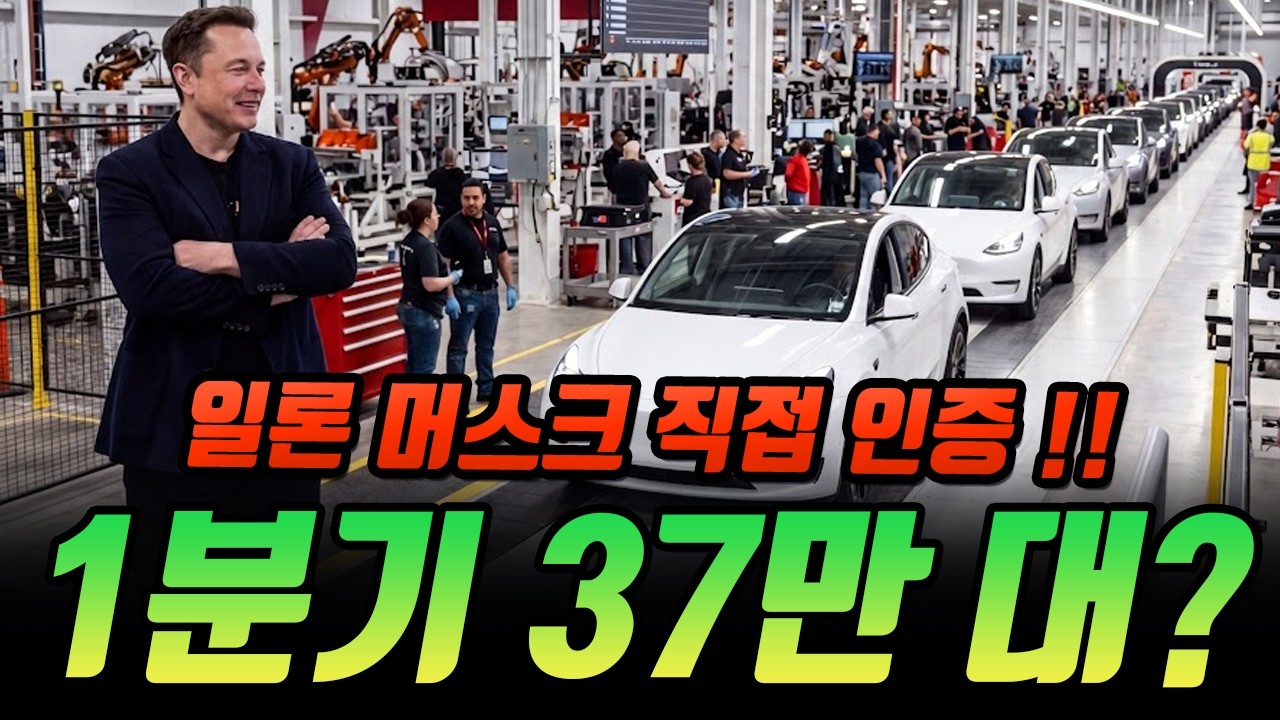
● Geopolitical Shock, Memory Crash, AI Boom
Strait of Hormuz Risk, Memory Semiconductor Cycle, and Autonomous Driving AI: Key Drivers Behind Current Market Volatility and What Long-Term Investors Should Monitor
The market is being driven by a convergence of (i) geopolitical risk, (ii) debate over AI infrastructure spending, and (iii) concerns about the memory semiconductor cycle.
This report summarizes: (1) why the Strait of Hormuz risk transmits quickly to global equities, (2) why early signals of memory price softening have translated into sharp semiconductor equity drawdowns, and (3) why long-term AI and autonomous driving growth drivers remain relevant despite near-term volatility.
Key framework: separation of price vs. intrinsic value; the role of AI data center capex and free cash flow; why the current AI-driven cycle may differ from prior memory cycles; and why real-world AI (notably autonomous driving) can influence market-wide valuation anchors.
1. Three Primary Issues Driving Today’s Market
1-1. Political messaging and Iran-related uncertainty: Strait of Hormuz risk reprices rapidly
Middle East geopolitical risk has re-emerged as a primary shock factor.
Escalatory messaging has been priced not as isolated rhetoric but as increased probability of:
- broader military escalation, and/or
- disruption to shipping through the Strait of Hormuz
The Strait of Hormuz is a critical global energy transit route. Instability can move, in short order: crude prices, freight rates, supply chains, and inflation expectations, transmitting to US, Asian, and European equity markets.
In a risk-sensitive tape, the change in perceived probability can matter more than confirmed outcomes. Uncertainty alone can raise the valuation discount rate and increase volatility.
1-2. Memory price softening: semiconductors absorbed the impact first
A second driver has been indications of memory price declines in certain segments, prompting renewed discussion of a potential cycle peak.
This contributed to sharp declines in memory-exposed equities, including Korean memory names and US-listed peers such as Micron.
A key point: the equity reaction has not been strictly tied to current-period earnings deterioration. Several companies reported solid results and guidance, yet their shares declined, reflecting the market’s tendency to discount forward-cycle risk (e.g., potential oversupply in 2027–2028).
1-3. AI hardware capex “overbuild” debate: are hyperscalers spending too much?
Concerns over AI investment intensity have increased.
Major hyperscalers (Amazon, Microsoft, Google, Meta, Oracle) are deploying substantial capital into AI data centers and related infrastructure (GPUs, memory, networking).
While revenue and operating cash flow trends remain strong, free cash flow has weakened in some cases due to accelerated reinvestment. Some market participants interpret this as a late-cycle or bubble signal.
An alternative interpretation is that the spending reflects strategic infrastructure preemption, based on expectations of productivity gains and new revenue pools from improved AI capability.
2. Memory Cyclicality Through the “Hog Cycle” Lens: Why Markets React So Sharply
2-1. Definition: the “hog cycle”
In classic economics, rising hog prices incentivize increased production. Because supply responds with a lag, the eventual surge in output can depress prices, triggering a recurring boom-bust pattern.
Semiconductors can exhibit similar dynamics: higher prices and margins incentivize capacity expansion, but fab build-out and ramp can take roughly two years. When new supply arrives concurrently, pricing can fall sharply and profitability can compress.
2-2. Why memory cycles are typically more volatile
Memory products are relatively standardized with limited differentiation, making price competition a dominant driver.
When demand is strong, profitability can expand materially; when supply exceeds demand even modestly, pricing can decline quickly. Investors have repeated experience with these cycles, increasing sensitivity to early price signals.
2-3. Will the current AI cycle end like prior memory upcycles?
Surface similarities exist: demand surge, aggressive capacity plans, and “peak” debate.
However, the current cycle may differ in a critical respect: AI represents a broader shift in which intelligence becomes a generalized production input across industries, rather than a narrower IT demand spike.
AI adoption spans software, search, advertising, manufacturing, biotech, defense, robotics, autos, finance, and education, potentially widening and deepening demand absorption relative to prior cycles.
3. Why Lower Memory Prices Are Not Necessarily Net-Negative for the AI Industry
3-1. Price declines can catalyze demand expansion
Memory and compute cost declines can reduce training and inference costs, lowering the threshold for commercialization. This can expand the set of AI use cases that become economically viable.
Implication: while near-term pricing pressure can be negative for specific semiconductor earnings and valuations, it may support broader AI ecosystem penetration over time.
3-2. Lower hardware costs can accelerate the diffusion of intelligence
The primary question is whether more organizations can deploy higher-performing AI at scale.
Falling hardware costs can support:
- more model training cycles,
- broader inference deployment, and
- greater investment in automation and productivity enhancements
From an industry perspective, lower infrastructure costs can imply higher adoption and a larger addressable market.
4. Hyperscaler Free Cash Flow Compression: Why It Should Not Be Treated Only as a Bubble Signal
4-1. Operating cash flow up, free cash flow down
A recurring pattern is improving operating cash flow alongside weaker free cash flow, primarily due to higher capital expenditures rather than weakening core operations.
4-2. Not merely “higher costs,” but infrastructure preemption
AI data center build-out differs from legacy server expansion. It functions as strategic infrastructure linked to: search share, cloud competitiveness, enterprise AI platforms, consumer services, developer ecosystems, advertising efficiency, and workflow automation.
Accordingly, elevated capex can be interpreted as competition for future market control rather than short-term inefficiency. FCF deterioration alone is insufficient to conclude that AI investment is intrinsically speculative.
5. Tesla and Real-World AI: Why Autonomous Driving Can Become a Market Inflection Point
5-1. Tesla as a real-world AI company, not only an EV manufacturer
AI discourse is frequently centered on data centers and semiconductors. A larger step-change occurs when AI operates in physical environments.
Autonomous driving is a leading example. Tesla has accumulated extensive real-world driving data and continues to iterate on FSD capabilities. While unsupervised autonomy remains debated, supervised systems are advancing practical utility by reducing driver workload and potentially improving safety outcomes.
5-2. If autonomy advances, chip demand can expand
Autonomous driving requires substantial compute across: in-vehicle inference, training data centers, simulation, vision models, real-time perception, and map-substitution techniques.
Progress in real-world AI can therefore incrementally increase demand for AI semiconductors, memory, networking, and data center capacity, potentially absorbing supply expansion faster than legacy cycle analogs suggest.
5-3. Version 14.3, next-generation releases, and market expectations
Version progress is not purely a software milestone; markets focus on whether capability converts into monetizable outcomes.
A confirmed transition from supervised to unsupervised autonomy could re-rate valuation frameworks across automotive, logistics, insurance, ride-hailing, last-mile delivery, and robotaxi ecosystems.
6. Core Investment Principle: Separating Price From Value
6-1. Price is today’s consensus; value is the discounted sum of future cash flows
Market price reflects short-term positioning and sentiment. Intrinsic value is driven by long-term cash flow generation.
When uncertainty rises (geopolitics, recession risk, oversupply risk), the gap between price and value can widen through a higher discount rate and risk premia.
6-2. Why stocks decline despite strong reported results
Recent memory equity declines illustrate that markets can discount future slowdowns even when current earnings and guidance remain strong.
6-3. Avoid overfitting daily noise
Not all volatility is information. Excessive focus on headlines can impair recognition of structural shifts. Long-horizon decision-making requires distinguishing fundamental change from short-term signal noise.
7. Long-Term Investor Positioning Considerations
7-1. Maintaining position size can be a valid strategy
Not all environments require incremental risk-taking. If fundamentals remain intact, avoiding forced selling can be a rational response.
7-2. If adding exposure, phase entries
Market bottoms are difficult to time. Where valuation discounts are judged attractive, phased accumulation can reduce timing risk and improve behavioral discipline.
7-3. If unable to add, prioritize cash flow resilience
Avoid forced leverage. Improving household or portfolio cash flow can be more important than immediate allocation changes, preserving optionality for future dislocations.
8. News-Style Summary
8-1. Immediate drivers of the drawdown
- Rising Middle East tensions increased Strait of Hormuz risk, pressuring oil, supply chains, and global equities.
- Early memory price adjustment signals weakened semiconductor risk appetite.
- AI data center “overbuild” concerns contributed to broader weakness in growth and technology equities.
8-2. Reasons the fundamental picture remains mixed rather than uniformly negative
- Memory price declines can support AI adoption via lower system costs, despite near-term headwinds for memory suppliers.
- Hyperscaler capex may reflect strategic infrastructure competition, not only speculative excess.
- Autonomous driving and real-world AI can expand AI infrastructure demand and broaden end-market pull-through.
9. Points Often Underemphasized in Mainstream Coverage
9-1. The dominant driver is not “earnings collapse,” but a higher discount rate
The current move is better characterized as valuation compression driven by uncertainty and risk premia rather than realized operating deterioration.
9-2. Treating memory price declines as industry breakdown can be incomplete
In AI, lower input costs can stimulate incremental demand. Semiconductor cycle risk and AI diffusion are not strictly one-directional.
9-3. Free cash flow weakness can represent transition costs
FCF compression may reflect the cost of establishing next-generation infrastructure, analogous to early-stage build-outs in prior industrial transitions.
9-4. Autonomous driving is an AI demand signal, not only an auto sector story
Autonomy links to semiconductors, cloud, data centers, robotics, insurance, logistics, and platform economics, with potential second-order effects on multiple valuation frameworks.
10. Conclusion: Focus on Structural Change Over Short-Term Fear
Near-term risks remain material: Strait of Hormuz uncertainty, memory cycle concerns, and ongoing debate over AI investment intensity.
However, the broader context is a potential shift in the global productivity frontier toward AI-enabled workflows and automation. Near-term pricing volatility does not, by itself, invalidate long-duration themes in semiconductors, AI infrastructure, and autonomous driving.
Priority for investors: assess whether fundamentals and long-term cash flow trajectories have changed, rather than reacting mechanically to short-term price moves.
< Summary >
- Geopolitical risk (Strait of Hormuz), memory pricing adjustments, and AI capex concerns jointly increased volatility.
- The drawdown appears driven more by higher uncertainty and valuation compression than by immediate earnings deterioration.
- Memory cycle risk remains, but AI-driven demand can be more elastic, with cost declines potentially expanding adoption.
- Hyperscaler capex and progress in real-world AI (including autonomous driving) support the view that structural AI growth drivers remain in place.
- Emphasis should remain on intrinsic value, forward cash flows, and structural industry shifts rather than short-term price action.
[Related Articles…]
- https://NextGenInsight.net?s=AI
- https://NextGenInsight.net?s=autonomous-driving
*Source: [ 허니잼의 테슬라와 일론 ]
– [주요 시장 뉴스] ‘돼지 사이클’과 호르무즈 해협에 휘청이는 시장, 이럴 때일수록 중요한 것은 가격과 가치의 분리
● US vs Korea Markets Shockwave, War Aftermath Repricing, AI Infra Winners
Reasons Korean Equities Could Outperform U.S. Equities; Key Post-War Inflection Points
The market’s three primary questions are as follows:
1) Will the Middle East conflict escalate into a financial crisis?
2) Could Korean equities be relatively stronger than U.S. equities?
3) After the conflict ends, which industries and corporate segments will attract capital?
This report focuses on why Korean equities may be re-rated, why U.S. equities face higher valuation sensitivity, and why Korea’s AI infrastructure, semiconductors, power equipment, and plant/EPC companies could be positioned as beneficiaries of post-war reconstruction and modernization.
1. Core takeaway: Low probability of a systemic financial crisis; Korea’s relative resilience may be underappreciated
Key current concerns include private credit deterioration, prolonged Middle East conflict, crude oil price spikes, and the risk of higher-for-longer interest rates.
While comparisons to 2008 are frequently cited, the current setup is structurally different. The main distinction is that risks are broadly identified and monitored. Unlike 2008, when uncertainty amplified shocks, today’s private credit and non-bank exposures are under active scrutiny by markets and regulators.
For systemic risk to escalate, rapid transmission to major banks would typically be required. At present, large financial institutions appear to be reducing exposures preemptively, which is a meaningful stabilizing signal.
2. Why private credit stress is less likely to become a crisis-level event
2-1. Redemption gates are not equivalent to a bank run
Redemption limits in private credit funds are a material negative signal, but they differ from deposit runs. Gating is a liquidity-management mechanism within funds rather than an immediate system-wide solvency collapse. Investor losses and illiquidity risks can increase, but direct linkage to global financial system failure is not implied.
2-2. Banks are increasingly defensive
The posture of large banks is important. More conservative credit and exposure management toward private credit managers reduces the transmission channel into the core banking system. This contrasts with the pre-2008 environment.
2-3. Policy response capacity is higher than in 2008
The Federal Reserve and regulators have accumulated significant crisis-management experience through the global financial crisis, the pandemic, regional banking stress, and real estate-related volatility. This does not eliminate shocks, but it reduces the probability of uncontrolled system-wide contagion.
3. The dominant variable is rates, not private credit
The principal market risk is a renewed rise in interest rates. Higher rates pressure private credit, commercial real estate, high-duration growth equities, and potentially overextended AI infrastructure investment narratives.
3-1. Rate-cut expectations were priced too aggressively
U.S. markets had priced substantial easing. Subsequent policy hold decisions effectively tightened financial conditions relative to those expectations.
3-2. If the conflict becomes an inflation shock, the regime changes
Oil prices matter more than the conflict itself. A sustained move toward approximately USD 150/bbl would likely reintroduce inflation pressure, supporting higher-for-longer policy and potentially raising the probability of additional tightening.
In such a scenario, U.S. equities may be more vulnerable due to higher starting valuations. Korean equities, with relatively lower valuations, may exhibit greater valuation buffering, although they would not be insulated.
4. Why Korea could compare favorably to the U.S.
This is primarily a function of market structure, valuation, policy catalysts, and industry linkage.
4-1. U.S. valuations are elevated; Korea remains discounted
U.S. performance has been concentrated in mega-cap AI beneficiaries, and substantial expectations appear priced in. Diminishing marginal price response to strong earnings suggests elevated consensus positioning.
Korea has seen rebounds but continues to trade with a structural discount. Within the AI theme, the U.S. is closer to “expectations priced,” while Korea is closer to “fundamentals not fully priced,” particularly in enabling supply chains.
4-2. Korea’s AI advantage is industrial and infrastructure-linked
AI deployment is constrained by semiconductors, power, cooling, networking, data centers, factory automation, industrial software, and telecom infrastructure. Korea is competitively positioned in several of these enabling segments, with established execution records. This increases the probability that demand translates into orders and earnings rather than remaining purely thematic.
4-3. Korea’s equity value-up framework remains a catalyst
Share buyback cancellations, shareholder return enhancement, and governance reform have gained visibility. If legislative and policy momentum continues, the structural discount applied to Korean equities could compress over time.
5. The largest post-war opportunity: Middle East reconstruction as infrastructure modernization, not only repair
A key underpriced angle is that capital tends to rotate toward reconstruction themes after periods of destruction. This cycle may involve not only physical rebuilding but also AI-era modernization.
5-1. Targeted assets extend beyond oil and gas
Damage and risk have not been limited to traditional energy assets. Exposure of data centers and digital infrastructure implies reconstruction demand may broaden to cloud nodes, networks, power systems, and cooling.
5-2. Reconstruction likely implies modernization
Rebuilding legacy facilities “as-is” is often inefficient. A modernization path may include higher-efficiency equipment, smart operations, AI-based demand forecasting, and energy management systems. Korea’s integrated capabilities across manufacturing data, process optimization, semiconductor compute, network operations, and EPC execution increase relevance.
5-3. Competitive edge: schedule discipline and integrated execution
For many regional clients, delivery reliability and schedule adherence are decisive. Korea has a strong reputation in fast execution, on-site responsiveness, and supply-chain coordination. Complex projects such as power, telecom, data centers, and plants benefit from integrated delivery capabilities.
6. Why AI data centers, grid infrastructure, and SMRs should be assessed as a single theme
AI capacity expansion is ultimately constrained by power availability and stability. Therefore, data center investment is increasingly linked to grid equipment, transmission and distribution, cooling, storage, and in some cases small modular reactors (SMRs).
6-1. Data centers are power-intensive
As AI data centers expand, power demand rises sharply. In a reconstruction phase, legacy urban restoration and new AI infrastructure may progress in parallel, accelerating demand for transformers, switchgear, cables, cooling equipment, and energy management systems. This is a direct linkage to Korea’s industrial supply base.
6-2. The case for distributed energy strengthens
Centralized generation alone may not match the speed of AI infrastructure buildout. This supports interest in SMRs, gas combined cycle, energy storage, and microgrids. Reconstruction provides a policy and economic rationale to adopt next-generation energy systems.
7. Korea’s AI strength is in bottleneck relief rather than consumer platforms
The U.S. leads in frontier models and platforms. However, scale depends on resolving bottlenecks: advanced packaging, memory, power semiconductors, manufacturing automation, network optimization, cooling, and edge/on-site processing. Korea is relatively strong in these constraints, and this positioning may be under-reflected in equity pricing.
8. Scenario framework for equity markets
8-1. Scenario A: Rapid conflict resolution
Risk appetite recovery may follow via oil stabilization, easing inflation concerns, and reduced rate pressure. Beyond a general risk-on rebound, attention may shift to reconstruction beneficiaries. In Korea, focus areas could include semiconductors, power equipment, plant/EPC, construction engineering, telecom infrastructure, and data center-related suppliers.
8-2. Scenario B: Prolonged but contained conflict
Markets may remain volatile without systemic breakdown. If oil remains elevated but manageable, Korea’s AI-linked beneficiaries and value-up policy momentum could provide downside support. U.S. upside may be capped by valuation sensitivity.
8-3. Scenario C: Oil sustained above USD 150; inflation re-accelerates
This is the most adverse macro setup. Higher-for-longer policy or renewed tightening risk could trigger broad equity drawdowns. Higher-duration, higher-valuation U.S. mega-cap exposures may face disproportionate compression. Korea would likely also weaken, but relatively lower starting valuations could moderate the magnitude.
9. Key investor checklist
- Private credit stress remains a risk factor, but current conditions suggest a lower probability of crisis-level contagion.
- The dominant risk is interest rates and oil-driven inflation dynamics.
- U.S. equities, with elevated AI-related valuations, may be more rate-sensitive.
- Korean equities retain valuation support and leverage to AI infrastructure, semiconductors, power equipment, and plant/EPC demand.
- Middle East reconstruction may extend to data centers, grids, energy modernization, and telecom infrastructure.
- Korea’s competitive advantages include delivery reliability, manufacturing depth, on-site execution, and integrated project capability.
- Value-up policies and buyback cancellations can support incremental re-rating.
10. Under-discussed point: Post-conflict capital rotation
The primary question is where capital reallocates after hostilities. The likely second-order effect is a shift toward reconstruction integrated with AI infrastructure.
Reconstruction demand may extend beyond construction and refinery repair to data centers, power grids, smart plants, telecom networks, and industrial AI. Korea’s enabling infrastructure role may be structurally important.
In summary: the U.S. dominates AI brands and platforms, while Korea is positioned in practical infrastructure and bottleneck resolution. In reconstruction-led capex cycles, spending often concentrates in the latter.
11. Portfolio interpretation framework
Binary positioning is not warranted. A scenario-based approach is more appropriate.
- If the conflict ends quickly, reconstruction expectations and risk-asset recovery may accelerate.
- If it persists, oil and rate sensitivity should be monitored more tightly.
- Under both paths, Korea’s industrial competitiveness linked to AI infrastructure across semiconductors, power, plant/EPC, and telecom may remain strategically relevant.
A key differentiation is between firms that market AI narratives and firms that supply critical enabling infrastructure for AI scaling.
< Summary >
Middle East conflict risks and private credit stress are relevant, but a 2008-style systemic crisis appears less likely under current monitoring and policy frameworks. The primary risks are interest rates and oil-driven inflation.
U.S. equities face higher valuation sensitivity, while Korean equities retain discount support and potential catalysts from value-up policies and AI infrastructure-linked industrial exposure.
Post-conflict reconstruction may represent an infrastructure modernization cycle encompassing data centers, power grids, energy efficiency upgrades, and smart industrial systems. Korea’s semiconductor, power, plant/EPC, telecom, and industrial AI supply chains may be positioned to participate.
[Related Articles…]
- https://NextGenInsight.net?s=KOSPI
- https://NextGenInsight.net?s=AI
*Source: [ 경제 읽어주는 남자(김광석TV) ]
– 미국 증시보다 한국 증시가 낫다? 전쟁 이후 판이 뒤집히는 이유 | 경읽남과 토론합시다 | 나탈리허 변호사_2편