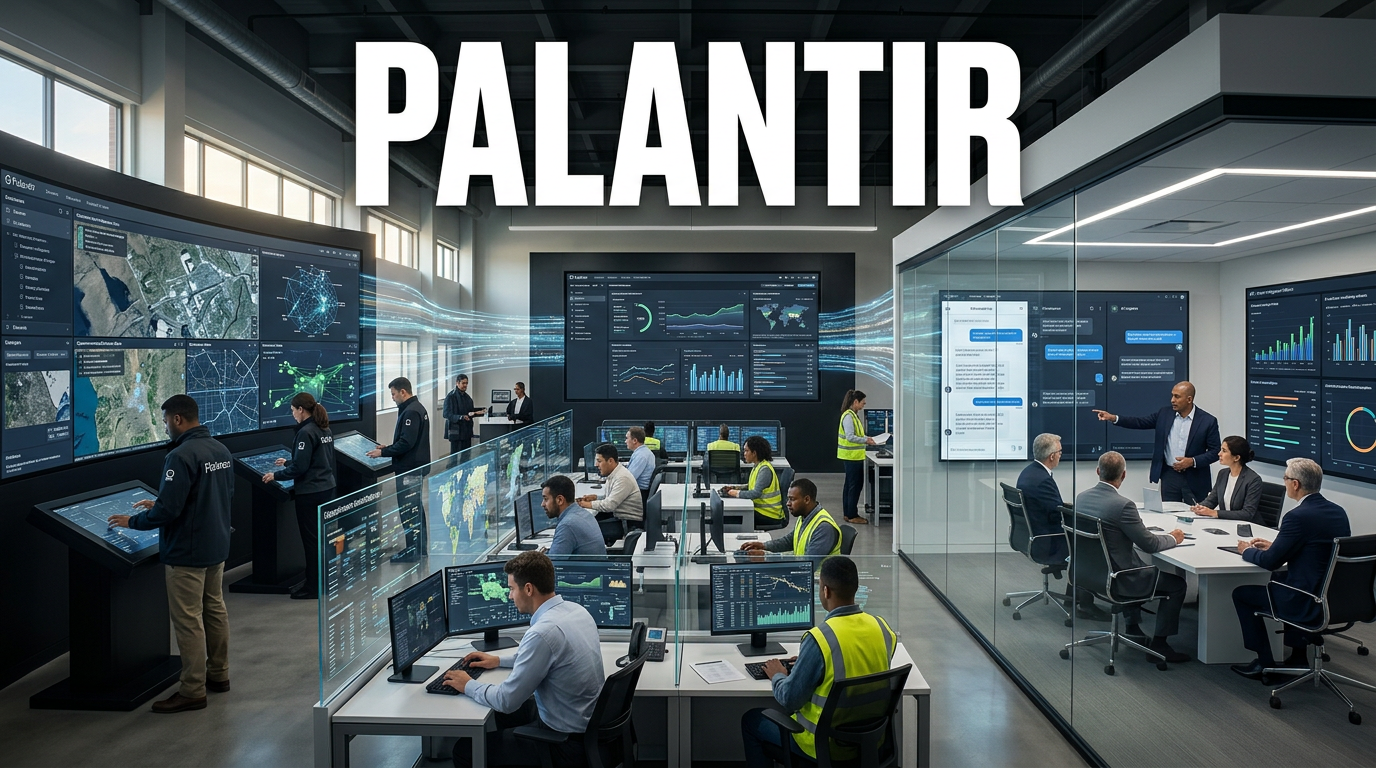
● Palantir Data Power Play
Palantir: 3 technical points (Gotham · Foundry · AIP) behind the “indispensable” claim, and an investment checklist
The core point you should take away right away in this article (a point that makes you read to the end)
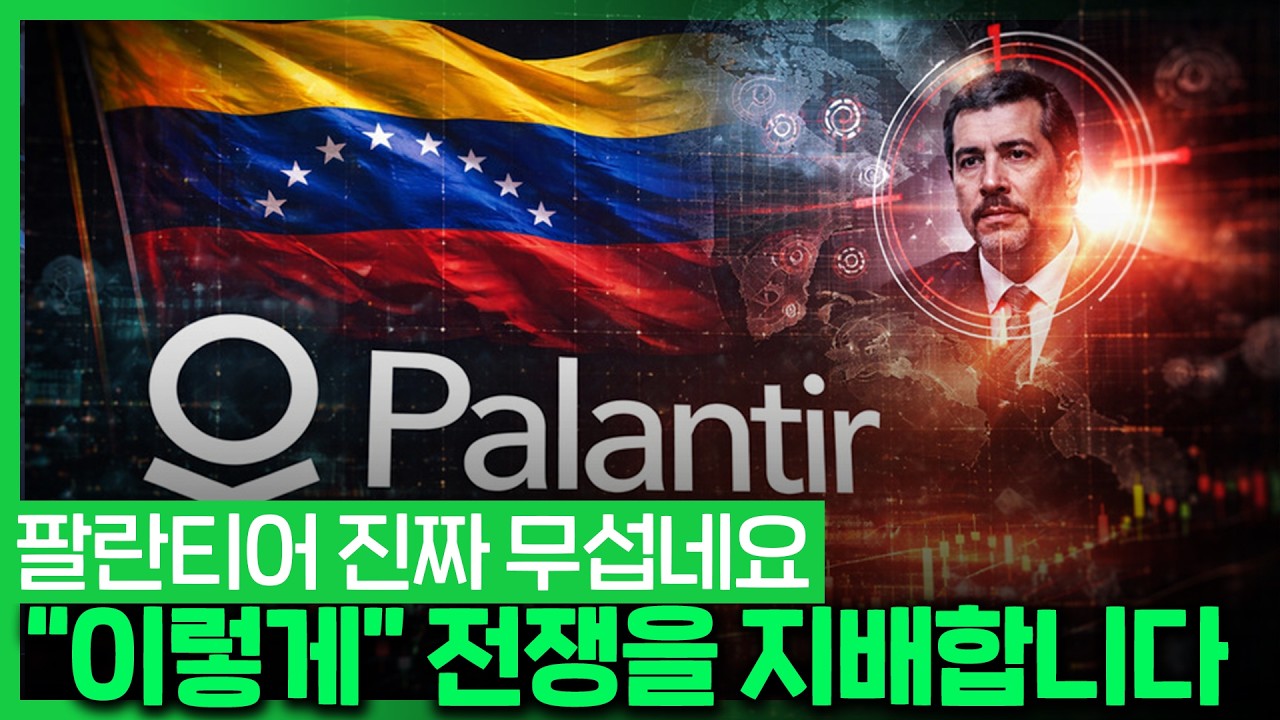
1) Don’t look at Palantir as just a “war stock.” The argument is that it dominates the “data-driven decision-making” market through the combination of government-use Gotham (Gotham) + private-use Foundry + the AI layer AIP.
2) In particular, Foundry changes the way companies handle data (a kind of data operating system). So it’s not presented as a simple AI tool, but as a competitive advantage where switching costs (lock-in) grow.
3) Even in the section where concern about “SaaS collapse” increases, Palantir is discussed alongside the view that the shock from a software ecosystem collapse could be relatively limited (a flywheel, a mission-critical data moat).
If you grasp these three, the flow explaining why people even say there’s “no company that can replace Palantir” becomes much clearer.
News summary: The frame for viewing Palantir is shifting
Among recent investors, Palantir is being re-evaluated as a platform company that simultaneously connects information warfare (data/information war) and private-sector data operations, rather than just “an AI war-related stock.”
The key is that the argument is: you’ll see the investment point only when you understand that the way the technology is explained isn’t a traditional “product introduction,” but a structure split into government (B2G) / private sector (B2B) / AI utilization (AIP).
1) Why is Palantir mentioned over and over? (Three starting points from an investment perspective)
The reasons for choosing Palantir presented in the original text are threefold.
- The trend where AI replaces the operations and analytics of existing industries
- The growing importance of data and information warfare in war/defense, which creates demand
- There was controversy about overvaluation, but with an adjustment period it becomes possible to consider entry
The important thing here is that it’s not saying “once the war issue is resolved, it’s over.” It also points out that there’s a structure in which Palantir operates on both the government and private sides.
2) War is now a “data battle,” not a “weapon battle”
The original text strongly frames the idea that the nature of war has changed since the Russia-Ukraine war.
- Past: infantry-style combat where humans fight directly
- Present: data warfare (information warfare), including drone warfare
- Key point: the process of controlling drones with AI and connecting from finding targets to carrying out strikes
In other words, Palantir is described not as a “stock tied to a war theme,” but as a platform that can be integrated into a pipeline where AI performs battle decision-making.
3) Palantir’s core technology set of three: Gotham · Foundry · AIP
3-1) Gotham: a platform for the government (B2G)
Gotham is described as a solution for government clients such as the Department of Defense and intelligence agencies.
- Target setting and surveillance: AI understands the situation in real time
- Attack/strike decisions get final approval from humans: the setup isn’t that AI automatically has full execution authority
- Setting the strike method: AI proposes the optimal solution considering available tactical assets (e.g., missiles)
This pipeline is where a “feeling” emerges that AI is getting deeper and deeper into decision-making—and where investors interpret it as a “technology gap.”
The original text also mentions concerns about AI advanced capabilities (the possibility of a dystopia). Along with that comes risk awareness like “Can humans truly keep control?”
3-2) Foundry: a private-sector (B2B) “data operating system”
Foundry isn’t described as a mere analytics tool; it’s described as changing the way a company handles its data itself.
- Ontology: beyond collecting and classifying data, it structures even “relationships (links)”
- Not an “appearance spreadsheet” like Excel/tables, but a map that connects complex relationships in the real world
- As a result: data becomes “meaningful decision-making information,” connecting through to execution
The original text summarizes this with an analogy: “Excel data may just be clumped numbers, but when you call the names, it becomes meaningful like turning into flowers.”
3-3) AIP: an AI utilization layer built on top of Foundry/Gotham
AIP ultimately says it changes the user experience from “data analytics that experts have to explain” to “a form where you ask AI and can execute immediately.”
- Instead of routing every step through data analysts one by one, ask AI to produce alternatives (A/B/C)
- Example: automatically identify which bottleneck components exist in the supply chain (SCM) and what should be prioritized to meet delivery schedules
- Can connect to follow-up actions as well, such as checking progress and automating email/notifications (automation)
The point that the original text particularly emphasizes is the experience of “AI handles complex things on its own.”
In addition, it also mentions that companies that find cloud data export burdensome can adopt an approach that processes internally (security/privacy). That plays a role in lowering adoption barriers too.
4) “Lock-in (switching costs)” is the moat: why Palantir is difficult to replace
The logic that makes Palantir look “close to irreplaceable” comes not only from “technical performance,” but from a structure where contracts grow.
- Flywheel: adoption → experience of results → word of mouth/attracting more customers → accumulation of data → model/performance improvement → expansion of contracts in a virtuous cycle
- Lock-in based on ontology: once you’ve built it, the cost to rebuild when moving to another tool becomes large
- Transition cost: since switching means costs, the likelihood of maintaining and expanding usage tends to grow
The original text also includes an intuitive expression like “subscriptions continue like Netflix.”
5) Even if there’s an argument about the “end of SaaS,” Palantir is seen differently
One of the main concerns being raised in the market these days is SaaS apocalypse.
The original text summarizes the argument like this.
- If enterprise software replaces tasks “like an app” with AI in a customized way, existing SaaS might not be necessary
- It also mentions examples where certain SaaS stocks in the U.S. experienced significant price adjustments
- Despite that, it presents the view that Palantir’s structure absorbs AI transitions well, so the impact could be limited
So it’s closer to the conclusion that “some SaaS/platforms survive,” rather than “SaaS ends.”
6) “Mission-critical AI” is hard to replace
The strongest moat phrasing in the original text is in this section.
- Mission-critical (defense/security level) areas hinge on data accessibility and trust/authority
- Government data/defense AI cannot be obtained by simply having a “company with good performance”
- Therefore, the argument is that the data and authority Palantir has built up make replacement difficult
This perspective reads as meaning “not only because the technology is good, but because the location where that technology attaches is different.” That’s why it connects all the way to “irreplaceable.”
7) Connecting it to investing: ultimately, in Part 2 you need to review the numbers
Instead of drawing a conclusion right away, the original text moves to the next step (Part 2).
- The technology/moat logic behind Palantir is strong, but
- For investment, you need to verify “buy/avoid” with numbers
- It’s structured to also examine whether it’s expensive or cheap, and viewpoints on entry timing and staged buying
So from the reader’s perspective, it’s more natural to first set the logic frame of “why Palantir,” and then in the next step confirm the implications of valuation, earnings visibility, revenue growth rate, and stock-price pullbacks.
If you extract only the “most important content” mentioned in the original text separately (a core summary that other places don’t talk about as much)
1) Palantir isn’t an “AI tool”; it’s a “government/private data operations structure.”
2) The moat is explained not only by performance, but by lock-in (switching costs) and the flywheel.
3) Even with fear of SaaS apocalypse, Palantir is closer to surviving through mission-critical data and ontology-based deployment.
4) “War issues” can be a catalyst, but the structure of Gotham–Foundry–AIP may serve as a foundation for long-term demand.
SEO keywords (five core terms naturally connected in this article)
U.S. stocks, AI stocks, Nasdaq outlook, technical analysis, staged buying
Main message to convey
When looking at Palantir, don’t stop at “war theme + stock price chart.” The message is to view together the data operations structure that connects Gotham (government) – Foundry (private sector) – AIP (utilization layer) and the moat logic of lock-in/flywheel/mission-critical.
With this frame in place, when judging price (valuation) and timing (correction window/technical positioning), you’ll be far less thrown off.
< Summary >
It’s difficult to view Palantir only as a war stock; it’s described as a “data operations platform” formed by combining government-use Gotham (B2G), private-sector-use Foundry (B2B), and the AI utilization layer AIP.
As war dynamics move from weapon warfare to data/information warfare, AI gets deeply embedded into the drone/target/strike decision pipeline—and Palantir is mentioned as part of that axis.
The argument is that Foundry’s ontology and AIP’s conversational utilization lower dependence on experts, and Palantir can also respond to security requirements from companies that face heavy burdens when exporting data out of the cloud.
The moat is explained through lock-in (switching costs) and the flywheel (performance → expansion → data accumulation → performance improvement), with emphasis on the view that mission-critical areas like defense are hard to replace.
Even if there’s fear of SaaS apocalypse, Palantir’s structure may absorb the AI transition well, limiting the impact; and the final investment judgment should follow the flow of reviewing the numbers (valuation and earnings/growth) in the next step.
[Related posts & links]
- The structure of Palantir growth seen through Foundry
- A strategy to respond to SaaS apocalypse from an AI stocks perspective
*Source: [ 월텍남 – 월스트리트 테크남 ]
– 팔란티어를 대체할 수 있는 기업은 없다고 봅니다..