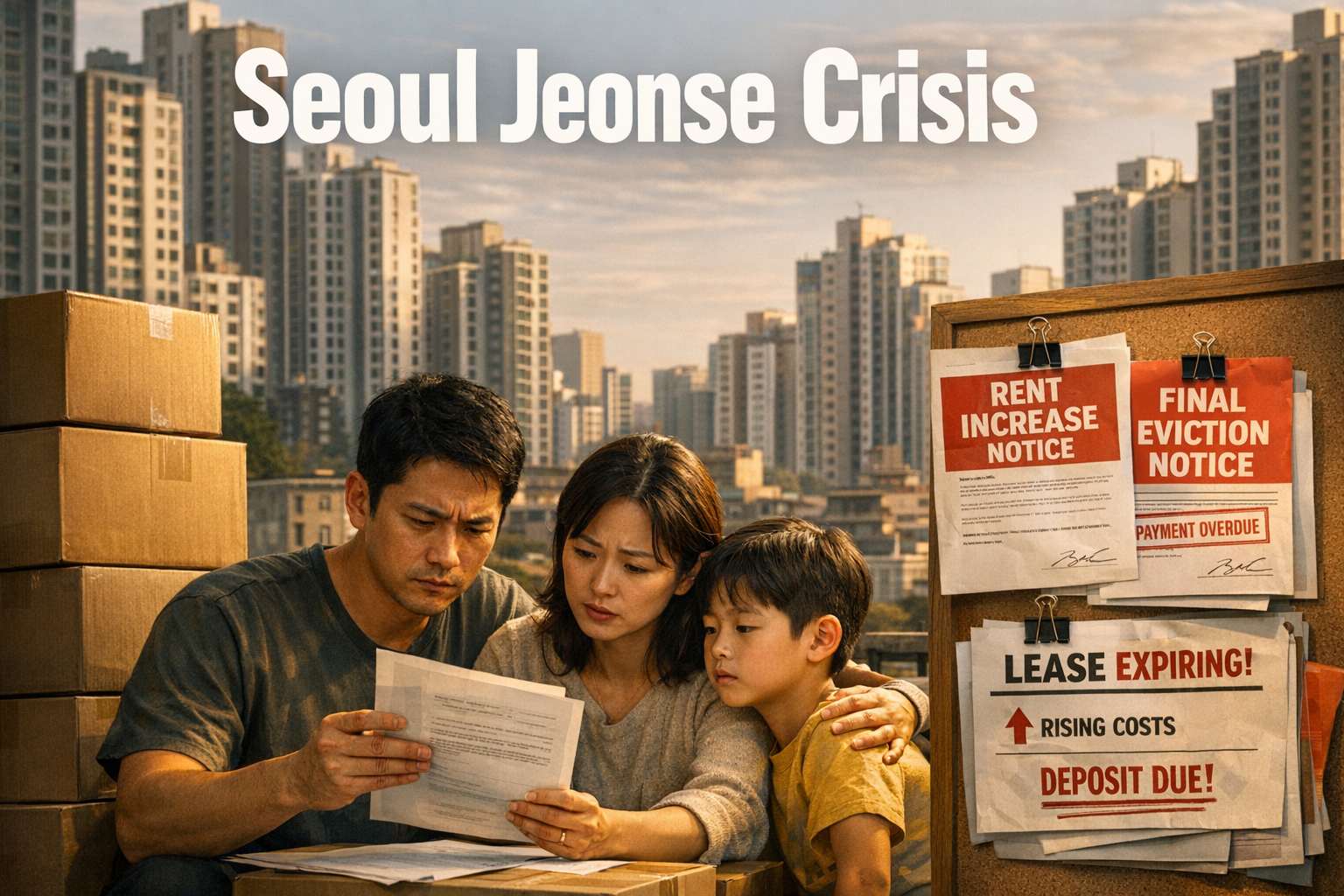
● Seoul Rent Shock, Supply Crash, 2025-2027 Crunch
Seoul’s Lease Market Shock: Why “It Hasn’t Even Started Yet” Matters
The core issue is not whether Seoul home prices rise or fall.
Three factors are critical:
1) Apartment completions in Seoul are projected to drop sharply in 2025–2027, shifting the market’s center of gravity from transactions to the lease and monthly-rent markets.
2) Credit restrictions and tax policy are suppressing not only transactions but also lease supply through structural incentives.
3) Middle East geopolitical risk and commodity supply disruptions may translate into construction delays, schedule slippage, and fewer completions, not merely higher prices.
This report summarizes current conditions and explains why the market is neither a broad-based downturn nor an upcycle, but a phase of regional and product-level dispersion; why lease-market stress may pose greater risk than transaction pricing; and which structural drivers are underweighted in mainstream coverage.
1. News-style summary: what is actually happening in Seoul housing
The market can be summarized as follows:
Transactions are constrained by regulation, while leases are becoming riskier due to tightening supply.
Headline price adjustments in select districts can obscure more material signals. Seoul’s 25 districts are not moving in one direction:
- Top-tier districts: falling transaction volume with pockets of price softening
- Mid-tier districts: broadly range-bound
- Lower-priced, mortgage-accessible segments: continued record-high prints in 일부 locations
The market is in a dispersion regime driven by mortgage accessibility, location quality, asset characteristics, and supply scarcity.
2. The supply cliff is already in motion
Supply is the central variable.
Seoul is often estimated to require roughly 40,000 units per year. Referenced figures indicate:
- 2025: ~20,000 units
- 2026: ~10,000 units
Direction matters more than the point estimates: the system is already on a declining supply path, and the shortfall is more likely to intensify than to normalize over the next 2–3 years.
In housing markets, constrained supply can pressure rents and prices with a lag. The effect tends to be amplified in high-demand, high-queue markets such as Seoul.
3. Why 2025–2027 may be riskier for the lease market
The primary risk cited is lease-market disruption.
When completions decline, owner-occupancy inflows fall, but so does the pool of units that would otherwise enter the lease and monthly-rent market. If total move-ins decline, lease listings typically decline mechanically.
With completion reductions already signaled for 2025–2027, lease supply contraction should be treated as largely pre-scheduled. Even without an immediate rent spike, structural upward pressure can accumulate.
4. Why public supply is unlikely to prevent lease-market stress
Most lease supply is provided by the private sector. The referenced structure indicates:
- Private rental supply: ~90%
- Public supply: ~10%
As a result, even if public rental expansion is announced, capacity to absorb near-term market shocks is limited. In a demand-intensive market with strong location preferences, reduced private rental listings can translate into rapid, tangible lease-market tightening.
5. How credit and tax policy are fragmenting the market
Recent policy direction can be viewed along two axes:
- Demand suppression
- Supply expansion
Given that supply expansion is difficult to deliver quickly, the practical toolkit concentrates on demand suppression. Credit controls have split the market:
- High-priced districts: more constrained by lending limits; participation shifts toward cash-heavy buyers
- Mortgage-eligible price bands: real demand concentrates, supporting prices and enabling new highs in select areas
Regulation does not compress the market uniformly; it can increase regional polarization by separating fundable from non-fundable segments.
6. Why Seoul cannot be analyzed using averages
Average-based interpretations risk misreading the market because dynamics differ materially across:
- Premium districts (e.g., Gangnam, Seocho, Songpa)
- High-preference districts (e.g., Mapo, Seongdong)
- Mid- and lower-tier districts
Premium areas may be more exposed to regulation and sentiment after larger prior run-ups. Meanwhile, within mid/lower segments, mortgage eligibility, concentrated end-user demand, and localized improvement expectations can produce different trajectories.
Under current policy conditions, the relevant unit of analysis is district, project, and unit type, not the city-wide average.
7. Middle East risk and oil shocks: transmission to Seoul supply
Construction depends on a broad range of petrochemical-linked inputs (coatings, windows, piping, insulation, plastics, adhesives, and finishing materials). Middle East instability or oil supply disruption may affect more than costs; it may impair procurement timing.
A key risk is schedule delay: a shortage of a single critical input can stall entire project timelines, leading to:
- Delayed move-ins
- Disrupted presale schedules
- Weaker redevelopment project economics
This can prolong supply tightness.
8. Why reconstruction and redevelopment may become more difficult
Redevelopment economics are highly sensitive to rates, construction costs, and owner contributions. With higher input costs and supply-chain instability, feasibility may deteriorate further.
Projects with limited capacity to absorb additional contributions, slow execution, or internal governance conflict are more prone to delay. Accordingly, planned supply may not convert into delivered supply on schedule. Metrics beyond permits—particularly starts and completions—become more decision-relevant.
9. The unintended lease-market impact of land transaction permit zones
Land transaction permit zones strengthen owner-occupancy requirements. While designed to reduce speculative demand, they can reduce rental supply.
Purchases of leased units often require vacancy and direct move-in, which can remove an existing rental unit from the market per completed transaction. Combined with falling completions, this can accelerate rental listing contraction. A transaction-suppression tool can therefore create a lease-supply side effect.
10. Addressing the argument: “If renters buy, doesn’t rental demand fall too?”
In Seoul, the adjustment is not symmetric because latent demand exists outside the city.
Households priced out into surrounding regions often continue to target re-entry into Seoul. Lease demand is therefore supported not only by existing residents but also by external “queue” demand. Even if some renters convert to ownership, incoming demand can refill the vacated lease position, limiting stabilization.
11. Why housing can remain tight even if Seoul’s population declines
Housing demand tracks household formation more than population. Rising one-person households, aging-related household splitting, and changes from marriage, divorce, and independence can increase household counts even with modest population declines.
Seoul exhibits rapid household fragmentation, making population-only interpretations unreliable for demand assessment.
12. Implications of Seoul’s lease-to-price ratio
Seoul’s lease-to-price ratio is lower than in non-core regions, but the key variable is the absolute deposit level.
With high sale prices, even a 40–50% ratio can imply very large deposits, widening the asset gap between households that can lease and those that can buy. As a result, reduced lease supply does not automatically convert into proportional purchase demand.
More likely channels include intensified lease stress, outward migration, and faster monthly-rent conversion, with sharper rent increases in preferred locations.
13. Seoul price outlook: a framework
A city-wide “up or down” call is not well supported. A dispersion framework is more consistent with observed drivers:
- Premium ultra-high-price districts: potential near-term softening under regulation and weaker sentiment
- Mortgage-eligible, end-user districts: greater price resilience and potential for new highs
- Supply-constrained preferred districts: rent increases may feed back into transaction demand
- Non-preferred or lower-quality stock: continued weakness regardless of regulation
Seoul should be analyzed as multiple sub-markets rather than a single market.
14. Practical checklist for end-users
For owner-occupier decisions, the key risk is not only further price declines but also lease-cost escalation. Items to monitor:
- Local completions pipeline over the next 2–3 years and the magnitude of the shortfall
- Mortgage availability at the targeted price point
- Lease-cost inflation risk if delaying purchase
- Feasibility of redevelopment timelines versus headline expectations
- Intra-Seoul dispersion by location and product quality
For non-owners, focusing solely on potential purchase-price declines can expose households to a rent shock. Decisions should be framed in terms of total housing cost.
15. Underweighted structural points
1) The primary risk is in leases and monthly rents, not transaction prices.
Completion declines translate directly into lower lease supply; stress may be felt first in rentals.
2) Regulation can reduce rental listings, not just suppress prices.
Owner-occupancy requirements can shrink lease supply.
3) Seoul demand must include external queue demand.
Latent inflows from surrounding regions and upward-mobility demand support rental absorption.
4) Planned supply is not delivered supply.
Announced volumes are insufficient; starts, execution, and completion risk matter, especially under cost and supply-chain stress.
5) This is a selection regime, not an averages regime.
Outcomes can differ by project and unit type even within the same district.
16. Conclusion: the key risk is the lagged impact of supply tightening
Near-term transaction weakness may appear as stabilization, but underlying constraints remain:
- Declining supply
- Fewer completions
- Contracting rental listings
- Policy bias toward demand suppression
- External variables that can delay construction and delivery
The next inflection point may emerge first in the lease market, with rental pressure potentially feeding back into transaction sentiment.
The dominant variable is not Seoul apartment transactions but rental supply contraction and sustained supply scarcity.
< Summary >
Seoul is in a dispersion phase rather than a uniform upcycle or downturn.
The principal risk is the lease and monthly-rent market.
Completion declines in 2025–2027 are set to reduce rental supply, and owner-occupancy constraints can further shrink available listings.
Middle East risk and commodity variables can increase delivery delays and construction disruption.
Forward assessment should prioritize location, price band, mortgage eligibility, and delivered supply over city-wide averages.
The primary risk is not the visible near-term adjustment but the cumulative, lagged effects of lease-market tightening and supply scarcity.
[Related Links…]
- https://NextGenInsight.net?s=lease
- https://NextGenInsight.net?s=supply
*Source: [ 경제 읽어주는 남자(김광석TV) ]
– 전세대란, 이제 시작일 뿐이다. 서울 부동산 더 위험해진 이유 | 경읽남과 토론합시다 | 김학렬 소장_1편
● US-Iran, China Purge, TSMC Shock
Why Investors Should Monitor US–Iran Talks, China’s PLA Purges, and TSMC Power Risk as a Single Macro Chain
This development should not be treated as a standalone Middle East headline. While it appears centered on US–Iran dynamics and regional conflict risk, it links directly to China’s domestic power instability, Taiwan security and infrastructure risk, semiconductor supply chains, and global macro conditions.
This report consolidates (i) why the US may approach the Iran file as a strategic time-management tool rather than a purely military issue, (ii) how China’s military purges can translate into higher Taiwan Strait risk through command-and-control degradation, and (iii) why potential disruptions to TSMC operations could transmit shocks to Korea’s equity market and the global supply chain.
It also highlights frequently overlooked points: (a) anomalies in China’s military command structure can be more destabilizing than observable actions, (b) Taiwan’s power grid is a critical weak link in semiconductor geopolitics, and (c) Korea is economically exposed despite outwardly stable optics.
1. One-sentence framing
US pressure on Iran, instability within China’s military leadership, and Taiwan’s power and security risk are not independent events; they are connected through geopolitical transmission channels that affect global supply chains and macro risk pricing.
The core nexus includes semiconductors, energy, USD-based financial conditions, and China’s domestic political stability.
2. News-style key points
US–Iran: Negotiation optics, strategic pressure in practice
The US approach to Iran should be viewed not only as conflict prevention but as a multi-layer strategy to keep Middle East tensions within a controllable range while constraining China and Russia indirectly.
Iran is linked to China through energy flows and diplomatic alignment, and regional instability feeds directly into oil prices and inflation expectations.
From a US perspective, maintaining a scalable pressure-and-relief framework may be more strategically flexible than fully resolving the issue.
Markets remain sensitive: oil volatility can delay rate-cut expectations and tighten global financial conditions.
China’s military: Repeated purges signal internal control friction
A decline in the number of active top-rank generals and repeated removals of senior officers are not routine personnel actions; they suggest stress in internal trust and command stability.
While purges can reflect tightened loyalty enforcement, they also imply persistent internal risk factors.
In such settings, external confrontation can become a tool for domestic consolidation, raising attention on Taiwan Strait risk.
Taiwan: Power and production infrastructure are the immediate constraints
Taiwan’s strategic protection value is closely tied to TSMC’s role as a systemic node in the global semiconductor supply chain.
TSMC continuity depends on power, water, logistics, cybersecurity, and deterrence functioning simultaneously.
Power shortage risk is material: even without kinetic conflict, grid instability or blockade threats can disrupt output, impacting a highly sensitive supply chain.
Korea: Direct industrial exposure despite calm market narrative
Korea is not insulated. While it leads in memory, TSMC dominates leading-edge foundry and ecosystem depth.
Any Taiwan production disruption may appear to offer limited substitution effects, but in practice it can disorder customer production plans, component schedules, and downstream industries (IT, autos).
This can transmit to exports, KOSPI earnings sensitivity, and KRW risk pricing.
3. Thematic analysis
3-1. Why the US may avoid “closing” the Iran issue
1) Middle East remains central to energy security. Even with higher US energy self-sufficiency, global oil prices affect inflation and financial conditions; price spikes are a US macro constraint.
2) Iran functions as a pressure point on China. China’s dependence on Middle East energy makes Iran-related tension an indirect lever.
3) Dual-track diplomacy preserves both legitimacy and deterrence. This framework influences US Treasuries, USD, gold, and risk-asset appetite.
3-2. Why China’s PLA purges are not a purely domestic issue
Frequent purges create three investable risk channels:
1) Command-and-control fragility: Promotion skew toward political loyalty can weaken operational competence.
2) Higher miscalculation risk: Commanders may prioritize political signaling over field-level judgment.
3) Lower predictability of external behavior: Internal stress can increase incentives for external hardline actions.
This is a key sensitivity point for investors.
3-3. Why a TSMC disruption is a global macro variable
TSMC is central to smartphones, AI accelerators, servers, and automotive semiconductors.
Disruption vectors include power shortages, maritime blockade pressure, missile threat, cyberattack, and port/logistics impairment.
Potential outcomes include delays in US megacap AI deployment schedules and disruptions to global datacenter expansion.
Given accelerating AI chip demand, supply disruption risk can affect the pace of the AI investment cycle, with implications for corporate earnings and global growth.
3-4. Why Taiwan’s power constraint matters more than commonly priced
Many risk narratives focus on military conflict; power infrastructure is often the more immediate and actionable vulnerability.
Advanced fabs are highly sensitive to voltage instability and outages; brief events can reduce yield and cause large production losses.
If confidence in Taiwan’s operational continuity weakens, the strategic calculus around protection and deterrence becomes more complex.
Taiwan’s value is not only territorial; it is contingent on uninterrupted industrial operations.
4. Macro transmission channels to monitor
Oil and inflation
Rising Middle East tension typically impacts oil first.Higher oil increases logistics costs, production costs, and CPI pressure, influencing central bank reaction functions and soft-landing probabilities.
Semiconductor supply chain and export cycle
Higher Taiwan risk raises uncertainty across the semiconductor chain.Korea, Japan, the US, and Europe can face synchronized impacts, affecting export outlooks, earnings, and capex plans.
Financial markets and safe-haven rotation
Geopolitical risk tends to strengthen demand for USD, gold, and US Treasuries.EM assets, KRW, and high-beta growth exposures may face valuation pressure.This is an asset-allocation issue, not only a short-term trade.
AI capex cycle and megacap investment
AI growth is constrained by reliable access to high-performance semiconductors.Taiwan risk can alter schedules and cost structures for Nvidia, AMD, Apple, Qualcomm, and hyperscalers.AI-cycle momentum is therefore partially anchored to geopolitics and supply resilience.
5. Under-discussed core point
The key risk is not “war or no war,” but “operational impairment”
Markets often focus on outbreak probability.The higher-probability shock is gray-zone disruption: expanded drills, blockade threats, grid instability, cyberattacks, and command vacuums triggered by internal purges.These can generate large industrial and market impacts without formal war.
PLA purges may indicate fragility, not strength
Visible control can mask reduced confidence.Persistent internal cohesion issues can raise external tension and increase risk premia.
TSMC is not a company; it is infrastructure for the global order
TSMC is a hub connecting US technological primacy, Taiwan security, Korea’s semiconductor positioning, global AI capex, and automotive electrification.TSMC risk should be treated as a systemic variable.
6. Korea: practical items to track
Industrial policy
Korea must sustain memory competitiveness while accelerating advanced packaging, foundry capacity, power infrastructure resilience, and materials/equipment localization.Supply-chain reconfiguration is ongoing; geopolitical risk is likely to recur as a macro variable.
Investor positioning
A narrow focus on defense or energy is insufficient.Monitor oil, USD strength, semiconductor supply risk, export-sensitive equities, FX, and US rates jointly.Given the heavy semiconductor weight in KOSPI, Taiwan risk is a direct sensitivity.
Corporate risk management
Manufacturers and IT firms should reassess Taiwan concentration risk across sourcing, inventory, logistics routing, and datacenter investment plans, not only component procurement.
7. Consolidated interpretation
The underlying structure is increasingly unstable: the US manages time and escalation in the Middle East, China seeks to contain internal insecurity, and Taiwan’s strategic value depends on uninterrupted semiconductor output.
Middle East tension influences oil and inflation; China’s military instability can elevate Taiwan Strait risk; Taiwan’s power and production constraints can disrupt semiconductors and the AI investment cycle.
Viewed jointly, these are not separate news items but a single risk map for the global economy. Markets may price gray-zone instability more aggressively than headline war scenarios.
< Summary >
- US pressure on Iran may function as a strategic tool for China containment and oil-price management, beyond a regional security issue.
- China’s military purges can signal both tighter control and elevated regime fragility.
- Taiwan risk is increasingly defined by the stability of power and production infrastructure supporting TSMC, not only kinetic conflict.
- These variables connect directly to semiconductor supply chains, the AI investment cycle, global growth, and Korea’s exports and equity sensitivity.
- The primary market risk is gray-zone disruption that impairs operations without formal war.
[Related]
- Semiconductor supply-chain restructuring and new opportunities for Korea’s exports: https://NextGenInsight.net?s=semiconductors
- How expanding AI investment affects the global economy and equity markets: https://NextGenInsight.net?s=AI
*Source: [ 달란트투자 ]
– “미국이 이걸 숨겼다” 이란 전쟁 협상은 함정. 곧 상상못할 끔찍한 일 터진다|강준영 교수 풀버전1