● Tokenomics Warfare
The “Token Economy” War that Shakes Big Tech Stock Prices: Who Produces “Tokens” Cheaper, in Greater Quantities, and More Efficiently?
One Line You Must Know Right Now (the core point in this article)
- The next battleground in the AI industry has shifted from “model performance” to token production (production volume) competition
- That the strategies of Amazon, Microsoft, Google, and NVIDIA are all converging on “who can provide more of better tokens”
- In particular, that Microsoft has embedded dollars/electricity (efficiency) as KPIs and pivoted toward becoming a “token production company”
- That producing “cheap but good tokens” requires data centers, training/inference hardware, electricity, and deployment (network) to all align
- That the real contest is not merely selling tokens, but building a structure where you make tokens consumed within your own ecosystem and earn money
Summarized Like the News: Why the Token Economy Determines Big Tech’s Stock Prices/Financial Results
- As AI usage increases, “tokens” are consumed in greater quantities.
- And tokens are not just a billing item; they are the computation amount continuously produced during the inference process that the AI uses to generate answers (output).
- So for big tech, how many tokens they can make—and how cheaply and efficiently they can provide them—becomes a financial results metric.
- Ultimately, the essence of competition among big tech has moved from “better AI” to “mass-producing better tokens (value for money/speed/quality).”
Token Production Competition: Changes Not “Users,” but “Companies’ Scorecards”
1) What token production technically means (concept clarification)
- Prompts (input) are also tokens, and the generated answers (output) produced during the model’s response process are also tokens.
- Pricing is typically set differently depending on input/output.
- The key point is that the act of creating output tokens = inference, and how efficiently you run that inference directly ties into the cost structure.
- So it becomes: “Using more tokens = running more inference more often = revenue/cost/efficiency all move together.”
2) Why “more usage is always better” isn’t the main thing anymore—why “cheap production + efficiency” matters more
- Token production is not only about the model being good.
- Even for the same task, depending on the model/method, the outcome differs: “success in one attempt (high cost)” vs “success through multiple tries (low cost).”
- In other words, token production competition is ultimately a game of value for money (unit cost) + speed (throughput) + success rate (re-try cost).
3) Agent coding / harness engineering: Where tokens truly explode
- AI coding (e.g., cloud code) creates a repetitive process of failing and then fixing, rather than “getting it perfect in one go.”
- Bugs also occur here.
- So token production continues: you capture issues as test cases, add more tests, and generate code again.
- To control this repeat loop, concepts like “harness engineering” (monitoring/guardrails) have become important.
- Conclusion: As agentic workflows grow, “token usage” increases structurally.
Strategy of the Big 3: Who Produces Tokens Better and Who Makes Them Consumed Better
Amazon (AWS): Already Secured the Core Engine of “Token Production”
- Amazon draws token demand through its own cloud code (developer tools) ecosystem.
- In addition, there is already an underlying structure where models/partner tokens that operate on the backend are produced via AWS.
- The more important point is that a “circle” is already in place: if developers worldwide use cloud code and continuously consume tokens, that activity itself becomes an ongoing flow of revenue.
- The core weapon here is the combination of data centers + training/inference hardware + partner ecosystem.
Hardware War (Inference): It Doesn’t End with NVIDIA Alone
- Inference costs determine the AI industry’s “sustainability.”
- Amazon has expanded by separating roles, such as Trainium for training and Inferentia for inference.
- And recently, there’s mention of collaborations (e.g., Cerebras) intended to enable faster speeds on the inference side.
- The key is that “running the same model faster and more cheaply” ultimately lowers the unit cost of token production and can encourage greater usage.
Google: Gemini All-In and a “Performance-Ecosystem Lock-In” Strategy, But Cost Burden Is a Risk
- Google aims for ecosystem lock-in by rapidly embedding Gemini across its product lineup (Chrome, Workspace, etc.).
- The problem is that the broader the “expansion,” the larger the costs become, and concerns arise that the monetization structure outside of advertising has not yet been fully sorted out.
- In other words, Google has strong “power to make tokens get used (inflow),” but the urgent task is how quickly it can lower token costs and convert them into revenue.
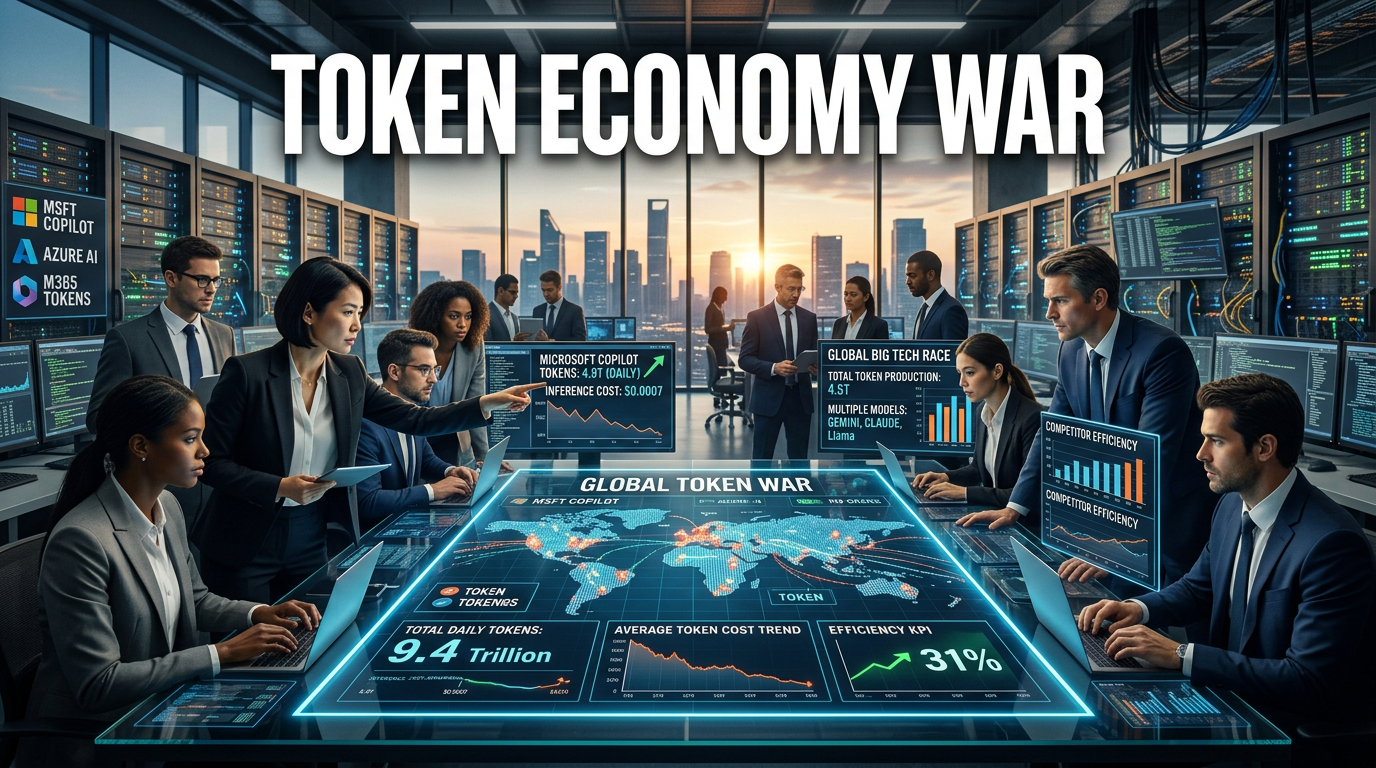
Microsoft: A Declaration to Become a “Token Production Company” + Winning with an Efficiency KPI (dollars/electricity)
- The direction Satya Nadella presented during earnings was strong.
- Microsoft’s core argument is to connect token production not to simple revenue, but to include the cost structure in KPIs like electricity per dollar (efficiency).
- The key interpretation point here is that Microsoft has embedded the reality that “it’s not just money—electricity as a resource sets the expansion limit” as a KPI.
- Also, Microsoft can drive token consumption within its own ecosystem.
- That means Copilot watches, summarizes, and helps execute across email/document/meeting/chat/work data, naturally increasing token usage.
- This differs in character from Amazon’s developer-centered token consumption flow.
Core Comparison: Not “Who Produces Tokens,” but “Who Makes Tokens Get Consumed in Its Own Ecosystem and Earns Money”
- Amazon: Strong by pulling developer token demand with cloud code, and by taking the production structure into AWS.
- Microsoft: By embedding Copilot into Office/Teams/workflows and expanding it into “agent work across entire job roles,” Microsoft is in a good position to connect tokens to “consumption-to-revenue.”
- Google: Fast expansion by planting Gemini across products, but variables remain in monetization and cost pressure (losses/discounts).
NVIDIA: Keep the Standards, But the Long-Term Variable Comes from “Cheaper Inference”
- NVIDIA still plays the standard role across training and inference.
- However, if other chips (inference accelerators) emerge as “cheaper and better,” there is a possibility that the inference cost structure will be shaken in the long run.
- Because of this, NVIDIA can’t ignore substitutes, and responses like acquisitions and its own processing units (e.g., LPU) follow.
- In the end, the contest develops not around “who completely replaces everything,” but around “who can capture which segments (training/inference/services) more cheaply and efficiently.”
Future Scenario: The “Order” of Token Pricing, Speed, and Monetization Decides the Winner
- At first, model performance improves and agents become effective.
- Then token production efficiency (inference speed/unit cost) amplifies demand.
- After that, the key becomes “how quickly you can turn token usage into revenue (subscription/licensing/service sales).”
- Microsoft is interpreted as already beginning the revenue connection with Copilot.
- There are views that Google is in a state where monetization and cost reduction are even more urgent.
“The Real Most Important Conclusion” that Isn’t Often Said Elsewhere (separate summary)
- The token economy is not a competition for “AI models,” but a competition for the “compute supply chain (electricity/data centers/inference chips) + work ecosystem (token consumption points).”
- That is, the winner is decided not by who has a smarter LLM, but by who can make more work happen faster with “cheaper tokens” and connect that process to its own revenue.
- Microsoft’s “electricity efficiency KPI” is not just a declaration—it’s a reference point in a resource war to build a scalable business model.
- Google’s biggest risk is a mismatch in timing: “all-in leads to fast expansion,” but the pressure from losses/discounts squeezes the cost structure.
- NVIDIA, rather than collapsing immediately, has no choice but to defend its portfolio between “maintaining standards vs falling inference costs.”
Investment / outlook perspective checklist (for readers’ practical use)
- Does this big tech have hardware/data centers/electricity infrastructure capable of producing tokens?
- Has this big tech created an ecosystem that makes tokens get consumed inside its own products?
- Is there a roadmap to lower inference costs in order to create “cheap tokens”?
- How quickly does monetization connect to subscription/licensing/service revenue?
- Compared with the competitor’s expansion speed (free/discount), how much is your company controlling costs?
Main content to convey (one-paragraph conclusion)
The token economy war ultimately comes down to “who can produce more, cheaper and better tokens, operate them more efficiently, and keep them running longer.” Amazon creates the circle of developer token demand with AWS and cloud code, and Microsoft, after internalizing token consumption across business with Copilot, adds an electricity-efficiency KPI to aim for scalability, while Google’s all-in with Gemini spreads quickly but leaves the cost/monetization timing as a variable. Meanwhile, NVIDIA may have a segment where standards remain, but competition to drive down inference costs is highly likely to continue.
< Summary >
- The center of AI competition is shifting from model performance to “token production competition (mass volume + low cost + efficiency).”
- Token production equals the computation amount that creates output tokens during the inference process, and it is the key to the cost structure.
- Amazon pulls token consumption through the AWS/cloud code ecosystem and lowers unit costs through inference hardware investment.
- Google’s Gemini all-in makes expansion fast, but risks remain around costs/losses and the timing of monetization.
- Microsoft declares itself a “token production company” and targets scalability with dollars/electricity efficiency KPIs.
- NVIDIA keeps its standard position, but it has no choice but to respond to downward inference-cost pressure (inference chips, acquisitions, etc.).
[Related articles…]
- Latest trends on the token economy and Big Tech strategies
- Inference cost war: Latest articles from the perspective of AI infrastructure (chips/data centers)
*Source: [ 티타임즈TV ]
– ‘토큰 이코노미’에 빅테크 주가가 달렸다 (30년 개발자 박종천)