● Tesla Intel Shockwave, Musk Chip Gamble, AI Power War
Intel–Musk Alliance: A Tesla Chip Fab Becomes Plausible? Five Key Points More Important Than the Share Price Decline
Tesla shares fell to the $346 level, but the more material development is the strategic shift implied by reported semiconductor manufacturing cooperation involving Intel. The issue extends beyond near-term EV demand and may signal early-stage integration across AI semiconductors, energy infrastructure, autonomy, robotics, and space-linked infrastructure.
1. Snapshot: Tesla Shares Down, Strategic Scope Expanding
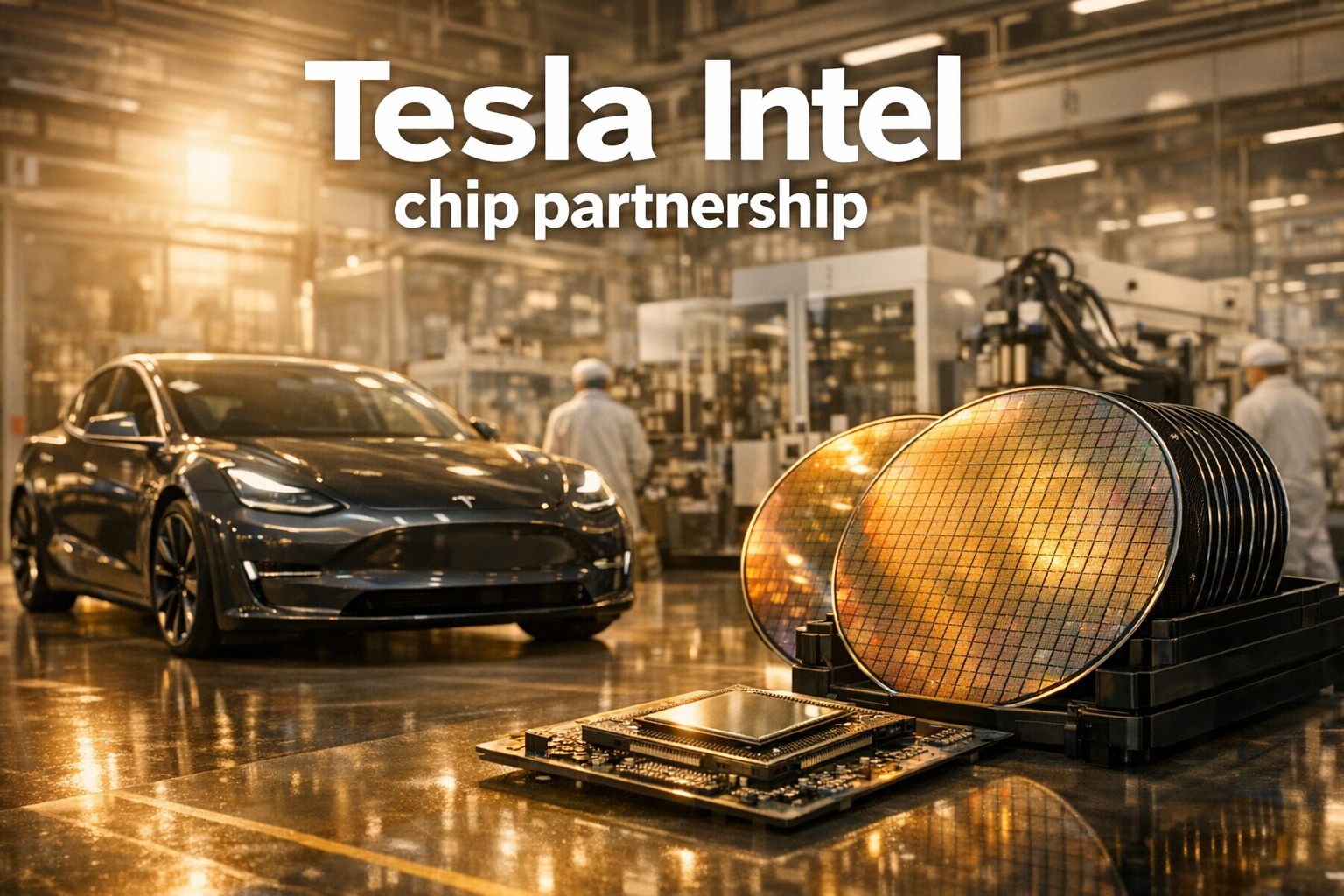
Tesla is facing downward pressure on Wall Street price targets following weak Q1 deliveries. The stock declined 1.75% to $346.65. While the headline narrative centers on EV demand and earnings risk, a parallel development is Intel’s reported participation as an official partner in a next-generation Tesla chip production initiative. This can be interpreted as a step toward Tesla positioning as an AI infrastructure player rather than only an automotive OEM.
2. Why the “Tesla Chip Fab” Topic Is Controversial
Market skepticism reflects the gap between chip design capability and operating an advanced semiconductor manufacturing operation. Tesla has experience in in-house chip design (e.g., autonomy and training silicon), but large-scale fabrication requires capital intensity, specialized talent, process maturity, yield management, packaging, and test capabilities. As a result, earlier commentary about building a chip plant was viewed as potentially overstated. Intel’s involvement materially changes perceived feasibility.
3. Strategic Significance of Intel’s Involvement: Shift From Solo Concept to Executable Structure
The core implication is not Tesla building end-to-end manufacturing alone, but leveraging a partner with foundry execution capability. The arrangement is consistent with Tesla driving design requirements and demand while Intel provides manufacturing capacity and know-how.
3-1. Intent to Increase Control Over Advanced Chip Supply Chains
As AI workloads scale, access to semiconductors becomes a gating factor for autonomy, humanoid robotics, data center expansion, and AI training. To scale FSD, Optimus, and training infrastructure, Tesla may seek to reduce external supply-chain dependency.
3-2. Potential Inflection Point for Intel
Intel has been working to re-establish competitiveness in AI and expand foundry relevance. Participation in Musk-adjacent ecosystems (Tesla, SpaceX, xAI) carries signaling value and could improve perception of Intel’s foundry roadmap. Intel’s share price reaction suggests the market viewed the association constructively.
3-3. Tesla’s Identity Is Broadening
If EVs, energy storage, AI silicon, robotics, autonomy, and space-linked data infrastructure converge, valuation frameworks may shift away from traditional auto-sector comparables toward platform and infrastructure analogs.
4. Why the Stock Fell Despite Strategic Headlines
Equity pricing is currently dominated by shorter-horizon variables rather than long-duration optionality. Key near-term drivers include:
- Weak Q1 deliveries
- Concerns about slowing EV demand
- Price-target reductions by institutions
- Macro variables (rates, oil, geopolitics)
- Higher volatility in AI-linked equities amid “overinvestment” concerns
The market appears to discount near-term execution and demand more heavily than longer-term infrastructure narratives.
5. Key Takeaways (7 Points)
5-1. The Negative Factors Are Largely Already Visible in Current Metrics
Delivery softness and margin pressure are known risks and have been incorporated into near-term sentiment.
5-2. The Potential Upside Is Not Yet Reflected in Financials
Chip supply-chain buildout, AI hardware scaling, robotics silicon demand, and compute availability remain largely non-financialized optionality.
5-3. Intel’s Participation Moves the Debate From “Concept” to “Execution Path”
A named manufacturing partner suggests progression beyond a purely aspirational announcement, although execution risk remains high.
5-4. Tesla’s Competitive Set May Expand Beyond Automakers
Over time, Tesla may face competition and benchmarking against AI infrastructure players (e.g., Nvidia, AMD, TSMC, hyperscalers) rather than only OEM peers.
5-5. The Binding Constraint for AI Scaling May Shift From Chips to Energy
Attention is increasingly focused on power supply, cooling, and grid capacity as limiting factors for data center and AI workload expansion.
5-6. Tesla Energy May Gain Strategic Relevance
Megapack-scale storage, grid balancing, and energy optimization capabilities can be reframed as enabling infrastructure for AI-driven load growth.
5-7. “Space Data Centers” Are Unproven but Strategically Coherent Within the Musk Ecosystem
While technically and economically speculative, the concept aligns with a long-term attempt to circumvent terrestrial grid, land, cooling, and regulatory constraints.
6. Why Energy Is Emerging as a Core AI Bottleneck
AI scaling requires substantial electricity and cooling. As training, inference, robotics control, and autonomy simulation expand, power demand can rise sharply. In some regions, data center power availability is already constrained. Within this context, distributed storage and grid-scale batteries may become increasingly strategic.
7. Space-Based Data Centers: Low Near-Term Probability, High Signaling Value
Terrestrial data centers face constraints tied to grid interconnects, site availability, heat rejection, and environmental regulation. Space concepts emphasize solar generation potential and thermal dissipation. The primary relevance today is strategic: viewing AI and space assets as components of a unified long-duration infrastructure roadmap rather than isolated projects.
8. Potential Convergence of SpaceX and Tesla Ecosystems
Some investors focus less on corporate combinations and more on functional convergence of assets:
- Tesla: AI, batteries, robotics, autonomy, energy
- SpaceX: launch, satellite networks, communications infrastructure, space-derived data assets
- xAI: model development and compute demand
If integrated operationally, this could create a more vertically aligned stack spanning silicon, energy storage, connectivity, data processing, and robotic deployment. This remains directional rather than definitive.
9. Bull vs. Bear Views: How Investment Interpretations Diverge
9-1. Bull Case
- EV demand slowdown may be cyclical
- FSD and Optimus are not yet fully monetized
- Semiconductor and data center strategy could support valuation re-rating
- Energy becomes a higher-value pillar in an AI infrastructure regime
- Longer-term potential for a combined AI–energy–connectivity platform
9-2. Bear Case
- Timing of EV demand recovery remains uncertain
- Margin pressure may persist
- A chip manufacturing initiative is capital-intensive with high execution risk
- Intel collaboration may not translate into scalable output
- Space data center concepts and integration scenarios are distant and speculative
The divergence largely reflects whether an investor prioritizes near-term earnings stability or long-duration platform optionality.
10. Central Point Often Missed: Tesla Is Reframing Its Corporate Narrative
The key issue is not the collaboration headline alone, but Tesla’s apparent effort to unify four pillars:
- Mobility: EVs and autonomy
- Execution: robotics (e.g., Optimus)
- Compute: AI chips and data centers
- Power: batteries and energy infrastructure
If satellite connectivity and space infrastructure are layered on top, Tesla can be analyzed as a broader digital-industrial infrastructure participant. The gap between market emphasis on near-term deliveries and management’s longer-term framing contributes to elevated volatility.
11. Investor Checklist Going Forward
- Whether Intel cooperation progresses from announcement to defined process and production roadmaps
- The growth rate of Tesla’s internal AI silicon demand driven by FSD and Optimus
- Whether Energy segment growth links credibly to data center power constraints
- The degree of technical integration among Tesla, SpaceX, and xAI initiatives
- Whether the long-term narrative remains intact independent of near-term EV demand cycles
12. Conclusion: The Decline Is Not the Full Story
Near-term price pressure reflects deliveries and price-target cuts. Intel partnership news suggests a potentially more credible path toward AI silicon and infrastructure expansion, though manufacturing and space-based infrastructure carry substantial execution risk. The more durable question is whether Tesla can translate an integrated AI–semiconductor–energy–autonomy–robotics strategy into measurable operational milestones.
< Summary >
Tesla shares declined on weak deliveries and reduced price targets, while Intel’s reported formal participation improves perceived feasibility of a chip production initiative. The strategic center of gravity shifts toward AI semiconductors, energy infrastructure, autonomy, robotics, and longer-duration space-linked concepts. Execution risk remains high, and investors should monitor concrete roadmaps, demand signals, and infrastructure constraints.
[Related Links…]
- https://NextGenInsight.net?s=tesla
- https://NextGenInsight.net?s=AI
*Source: [ 오늘의 테슬라 뉴스 ]
– 인텔, 머스크 손 잡았다! 테슬라 칩 공장 현실화… $346 하락에도 걱정 NO
● Apartment Boom, House Bust
Why Only Apartments Rose: The Real Inflection Points in Korean Real Estate (1986–2024) and the Factors That Diverged Seoul Apartments from Detached Homes
This report consolidates the core drivers behind:
- the structural outperformance of Seoul apartment prices,
- the relative underperformance of detached homes in the Seoul Capital Area from a wealth-compounding perspective despite perceived lifestyle advantages, and
- the key indicators to monitor when assessing policy impact and forward price dynamics.
1. Key Finding: Since 1986, the Largest Structural Gap Has Been Between Apartments and Non-Apartments
The central data point is straightforward:
- Apartment prices (1986–2024): approximately +473%
- Detached home prices (1986–2024): approximately +80%
This represents more than a price difference; it indicates where household wealth accumulation structurally concentrated.
- Apartments: persistent long-term upward trend
- Detached homes: nominal appreciation, materially lower slope
- Result: substantial wealth dispersion among one-home owners based on housing type
In practice, the differentiator was not homeownership itself, but the specific residential product owned.
2. Why Seoul Apartments Outperformed Detached Homes in Gyeonggi
2-1. First Trap: A Lower Purchase Price Does Not Necessarily Improve Net Outcomes
Seoul apartments are expensive, while detached homes in surrounding areas are often cheaper. A common trade-off is framed as:
- a smaller or older apartment in Seoul vs.
- a larger detached home farther out
The primary constraint is job-housing proximity. As commuting distance increases, total cost rises beyond direct transport expenses:
- time loss from commuting
- incremental fatigue and reduced daily capacity
- lower quality-of-life metrics
- higher health risk exposure over time
- reduced family time
- potential productivity deterioration
Illustration: at an assumed hourly wage of KRW 20,000, a 3-hour round-trip commute implies KRW 60,000/day in opportunity cost, which becomes material on an annual basis.
Conclusion: the “premium” embedded in Seoul apartments includes time savings and operational efficiency, not only address value.
2-2. Second Trap: Residential Satisfaction and Asset Appreciation Can Diverge
Detached homes may offer:
- larger space
- privacy
- customization potential
- higher subjective residential satisfaction
However, from an investment and balance-sheet perspective, the critical constraint is long-run appreciation. Over 1986–2024, detached homes did not exhibit apartment-like price momentum.
Inflation adjustment is also essential. Modest nominal gains can translate into weak real returns, particularly when compared with other asset classes and with higher-performing residential segments.
Key principle: assessing performance requires relative strength (real and versus alternatives), not nominal direction alone.
3. Why Apartments Became Structurally Strong: Product Evolution as the Core Driver
3-1. Apartments Were Not Initially a Premium Asset Class
Apartments were not always a preferred residential asset. Early apartment stock often had materially lower quality and lacked features now considered standard, indicating a different product category than today’s “premium” complexes.
3-2. Apartments Shifted from an Inferior Good to a Normal Good
A key economic framing is the transition from:
- Inferior goods: demand falls as income rises
- Normal goods: demand rises as income rises
Apartments shifted into a normal-good category as the product improved:
- improved parking capacity
- upgraded landscaping
- expanded community amenities
- enhanced security systems
- integrated large-complex living infrastructure
- intensified competition among branded developers
Apartments evolved from “housing units” into bundled living-service platforms. The product shift altered demand composition and supported sustained price premia.
3-3. Branding and Quality Competition Reinforced Price Premia
Developer branding and differentiation reduced commoditization. Pricing increasingly reflected a bundle of attributes:
- brand
- location
- complex scale
- design specifications
- community facilities
- school zoning effects
- transportation connectivity
As apartment quality improved over time, recurring premium justification strengthened. Detached homes retained individuality but underperformed in standardized, comparable product competition.
4. Why This Matters in the Current Policy Regime
Current headlines frequently cite:
- policy shifts
- reduced transaction volume
- price adjustments in core districts
- slowing apartment sales in Seoul
The key analytical distinction is between:
- policy-driven cyclical distortions, and
- structural trends driven by demand fundamentals
The report’s implication is that apartment strength is not explained solely by speculative psychology. It is linked to structural factors:
- job-housing proximity advantages
- residential efficiency
- product quality improvements
- urban form and densification
- concentrated lifestyle infrastructure
Policy can suppress activity in the short term, but where fundamental demand remains intact, re-acceleration risk persists.
5. Monitoring Framework: 5 Indicators to Prioritize
5-1. Track Transaction Volume Before Price
Housing markets often adjust first through liquidity and volume, then through slower price discovery.
5-2. Core-District Pullbacks Do Not Equal Citywide Breakdown
Symbolic districts matter, but market structure is segmented by:
- micro-location
- product type
- buyer cohort
5-3. Residential Utility Does Not Guarantee Wealth Compounding
Apartments often dominate on:
- liquidity
- concentrated demand
- standardized appraisal and comparability
5-4. Nominal Prices Create Optical Illusions Without Inflation Adjustment
Real purchasing-power outcomes must be evaluated alongside nominal changes.
5-5. The Core Variable Is the Urban “Value of Time”
Seoul apartment premia embed:
- time savings
- dense 생활권-type infrastructure (interpreted as high-density daily-life infrastructure)
- job access
6. Underemphasized but Material Points
6-1. Apartments Function as an Urban System, Not Just a Building
Purchasing an apartment typically includes access to a bundled system:
- transport
- education
- security
- convenience retail and services
- job accessibility
- community networks
Without this systems view, long-run apartment outperformance is difficult to explain.
6-2. The Weakness of Non-Apartments Is Standardization, Not Only Demand
Detached homes vary materially by:
- micro-location
- lot shape and constraints
- building condition
- redevelopment feasibility
- management and maintenance
Apartments are easier to compare, price, and transact. In asset markets, standardization supports liquidity and valuation transparency.
6-3. Korea’s Market Reflects Compressed Urbanization and Concentration
Rapid industrialization and urban concentration occurred simultaneously with:
- capital-region centralization
- education competition
- job clustering
This structure mechanically favors dense residential formats over dispersed detached housing.
6-4. Aggressive Policy Measures Struggle Against Structural Demand
Policy can freeze transactions temporarily, but concentrated employment and infrastructure anchor persistent demand. Both investment and owner-occupier decisions should prioritize structural demand nodes.
7. Forward-Looking Implication: Before Searching for “The Next Gangnam,” Identify the Conditions That Created It
Instead of asking where the next top-tier district is, assess whether a region accumulates the conditions that historically generated persistent premia:
- employment concentration
- education competitiveness
- transportation superiority
- accumulation of branded large complexes
- inflows of high-income households
- status as a symbolic asset
New supply alone is insufficient; premia require cumulative demand density and time-value advantages. Real estate outcomes reflect interaction among:
- location
- demand depth
- time-value
- policy
- interest rates
- demographic structure
8. Practical Investor Takeaways
- Seoul apartments and detached homes are both “housing,” but function as distinct financial products in asset markets.
- Job-housing proximity is an economic variable with measurable opportunity cost.
- Apartment outperformance is supported by structural fundamentals, not only speculative demand.
- Product quality upgrading altered demand composition and long-run pricing power.
- Long-horizon assessment should prioritize structural demand over short-term policy headlines.
- Separate nominal price changes from real value creation to avoid misallocation.
9. One-Line Conclusion
Apartments outperformed because they evolved into the most efficient urban asset format in Korea, with price divergence clearly expressed across 1986–2024; forward assessment should prioritize structural demand by housing type over short-term noise.
< Summary >
From 1986 to 2024, the defining feature of Korean real estate was the long-run return gap between apartments and detached homes.
Seoul apartments benefited from:
- job-housing proximity
- dense lifestyle infrastructure
- product quality improvement
- developer branding competition
- concentrated urban demand
Detached homes may deliver higher residential satisfaction for some households, but historically lagged in wealth compounding. Policy and cyclical corrections matter, but structural demand concentration remains the primary variable.
[Related Articles…]
-
https://NextGenInsight.net?s=Real%20Estate
Key Variables for the 2026 Real Estate Outlook -
https://NextGenInsight.net?s=AI
Asset-Market Shifts and Investment Trends in the AI Era
*Source: [ 경제 읽어주는 남자(김광석TV) ]
– 왜 아파트만 올랐을까. 1986년부터 2024년까지 드러난 충격의 차이 | 북리뷰 ‘대한민국 부동산의 역사’_1편
● Iran Truce Sparks Market Surge, Oil Plunges, AI Stocks Rally
A Two-Week Iran Ceasefire Drives a Sharp Rally in U.S. Equities and KOSPI, While Oil Sells Off; The Market’s Primary Focus Lies Elsewhere
This move is not adequately explained by a generic “de-escalation of war risk.”Key drivers are the potential reopening of the Strait of Hormuz, the resulting decline in crude oil and its disinflationary implications, shifts in U.S. rates and the U.S. dollar, and whether market leadership can rotate back to AI-related equities and semiconductors.
This episode illustrates how global markets reclassify news from “risk” to “opportunity,” with positioning often adjusting before full resolution.
1. Headline Summary: Why Markets Reacted More to a Ceasefire Than to Escalation Headlines
Markets responded to reports that a two-week ceasefire was accepted amid elevated Iran-related tensions.
- The Nasdaq retraced most of the prior decline, rising roughly 4.5%–5%.
- The KOSPI surged more than 5%.
- Large-cap Korean technology names (e.g., Samsung Electronics, SK Hynix) rebounded sharply, reflecting a rapid stabilization in risk sentiment.
The market focus was not “whether the war is over,” but whether:
- the risk of a Strait of Hormuz disruption eased immediately,
- energy supply shock risk diminished, and
- near-term spillovers to global growth were reduced.
2. The Most Material Variable: Potential Normalization of Strait of Hormuz Flows
The central issue is the Strait of Hormuz rather than the “two-week” language itself.The strait is a critical global oil transit corridor; disruption would likely lift crude prices and destabilize freight, commodities, and input costs.
Current price action implies markets are discounting a near-term reduction in the probability of a blockade scenario.As a result, crude oil sold off sharply, with reports indicating declines on the order of ~18%.
This matters because elevated oil prices can re-accelerate inflation expectations, weaken rate-cut expectations, and compress equity valuations. Conversely, fast oil stabilization can reduce the Federal Reserve’s policy constraint and improve conditions for growth and technology equities.
3. What the U.S. May Have Actually Conceded
Reported potential Iranian demands have been interpreted as aggressive (e.g., leverage over the strait, war-related compensation, sanctions relief, and nuclear-related conditions). Markets do not appear to be pricing a full acceptance of these terms.
A more practical interpretation is:
- near-term agreement prioritized preventing escalation and stabilizing transit,
- while sensitive issues were deferred to third-party mediation and working-level negotiations during the ceasefire window.
This suggests an interim “shock absorber” rather than a definitive settlement. Markets typically respond more to a pause in worst-case outcomes than to final diplomatic resolution.
4. Economic Interpretation of the Equity Rally: A Four-Step Chain
4-1. De-escalation of geopolitical tail risk
Reduced escalation probability improves risk appetite, with U.S. equities and the Nasdaq particularly sensitive to uncertainty shocks.
4-2. Oil price decline
Lower energy costs reduce margin pressure across manufacturing, logistics, and chemicals, improving near-term earnings expectations at the margin.
4-3. Inflation concern moderation
Oil stabilization can reduce CPI/PPI pressure and ease market anxiety over the U.S. rate path, supporting higher-duration growth equity valuations.
4-4. Potential return of leadership
Capital may rotate back toward semiconductors, AI-related equities, and mega-cap technology after war-related de-risking. The outsized rebound in Samsung Electronics and SK Hynix is consistent with this positioning dynamic.
5. What the KOSPI and Nasdaq Appear to Be Discounting
Markets discount forward. Current pricing reflects less the ceasefire itself and more the expectation that near-term global supply-chain disruption risk has declined.
- KOSPI sensitivity: FX, oil, and semiconductor export expectations. Concurrent oil declines and improved risk sentiment typically support foreign inflows and amplify index beta.
- Nasdaq sensitivity: the U.S. rate path and technology valuations. Lower inflation pressure and reduced geopolitical shock probability are supportive for AI infrastructure and semiconductor cycle expectations.
6. Material Risks Remain: Structural Limits of a Two-Week Ceasefire
The agreement may reflect an unstable balance; negotiating gaps remain wide and renewed incidents are plausible.However, once negotiations begin, markets often reduce the weight assigned to the conflict variable unless the situation threatens the global economic system.
A key conditional factor is whether the Strait of Hormuz remains operational and supply disruptions stay limited; under that scenario, markets may progressively discount geopolitical risk.
7. Six Variables Investors Should Monitor
7-1. Actual continuity of Strait of Hormuz transit
Operational shipping and logistics matter more than statements.
7-2. Further oil downside vs. renewed rebound
A renewed spike would quickly undermine the relief trade; stabilization remains equity-supportive.
7-3. Shifts in U.S. rate expectations
Lower oil reduces inflation pressure, potentially affecting the Fed’s reaction function and market-implied cuts.
7-4. U.S. dollar and FX dynamics
Improving risk sentiment can temper USD strength, supporting KRW and broader EM assets.
7-5. Foreign investor flows
Sustained foreign buying in semiconductors and large caps is a key signal for the durability of the KOSPI rebound.
7-6. Restoration of AI and semiconductor leadership
Markets ultimately revert to earnings and growth; leadership persistence in AI/semiconductors is a primary confirmation metric.
8. AI Trend: Industries to Reassess as Geopolitical Risk Fades
As headline risk retreats, attention typically shifts back to earnings capacity and structural growth, with AI remaining central.
8-1. Semiconductors
AI servers and data center expansion depend on high-performance chips. Memory, HBM, advanced infrastructure, and packaging-linked companies may see renewed attention. The rebound in Samsung Electronics and SK Hynix aligns with these structural expectations.
8-2. Optical communications
Data center scale-out increases the importance of interconnect speed and network efficiency, extending the demand cycle for optical components and networking equipment.
8-3. Aerospace and space
Increasingly framed as a long-duration growth segment, including commercial space, satellite data, and defense-communications convergence, with potential AI linkages across data and analytics.
8-4. Energy and chemical supply chains
This episode reinforces that energy supply stability is a competitiveness variable. Ammonia, fertilizers, chemical feedstocks, and transport-related segments can exhibit high geopolitical beta; diversification-oriented players may be differentiated.
9. Market Developments: Snapshot
- Reports of a two-week Iran-related ceasefire triggered an immediate global risk-on response.
- The Nasdaq rebounded sharply, retracing most of the prior decline.
- The KOSPI rose more than 5%, led by large-cap semiconductors.
- Expectations of improved Strait of Hormuz conditions coincided with a sharp crude oil decline.
- Lower oil reinforced disinflation expectations and reduced perceived U.S. rate pressure.
- Markets prioritized energy supply shock mitigation and a shift into negotiations over a definitive end to hostilities.
- Risk capital rotation back toward AI, semiconductors, and large-cap technology became more plausible.
10. Underappreciated Point: The Market’s Interpretive Frame Is Shifting
The key variable is not “ceasefire success.”More material is the evolving market framework:1) Markets increasingly focus on supply-chain and commodity-price persistence rather than geopolitics in isolation.
2) Reduced Strait of Hormuz risk lowers oil and inflation pressure, which feeds directly into U.S. rate expectations.
3) Even during geopolitical volatility, core positioning interest remained anchored to AI, semiconductors, and secular growth.
The rally may therefore reflect an early signal of leadership normalization toward growth, rather than a purely tactical geopolitical bounce.
11. Practical Approach for the Next Two Weeks
Given headline volatility, risk management should be checkpoint-driven rather than single-directional:
- Monitor for renewed oil spikes.
- Track whether USD strength reasserts.
- Evaluate whether semiconductor/AI strength is sustained via flows and breadth, not a single-session short-covering event.
- Confirm whether KOSPI gains are supported by foreign net buying.
If oil stabilizes, FX conditions normalize, and technology leadership persists, the move is more consistent with a broader risk-on rotation. If negotiations deteriorate quickly, volatility could reprice higher.
12. Conclusion: Markets Are Discounting Normalization Ahead of Resolution
A two-week ceasefire is not equivalent to durable peace. Markets, however, typically reprice once worst-case outcomes pause.The rally is consistent with the interaction of:
- improved Strait of Hormuz accessibility expectations,
- a sharp oil decline,
- reduced inflation pressure,
- easing rate-path anxiety, and
- renewed probability of AI/semiconductor leadership.
The primary question is less the duration of the ceasefire than whether the macro and earnings narrative can re-center on growth and execution.
< Summary >
- Reports of a two-week Iran-related ceasefire coincided with sharp rallies in U.S. equities and the KOSPI.
- Markets reacted more to Strait of Hormuz accessibility expectations and the oil sell-off than to “end of war” narratives.
- Lower oil supports disinflation and reduces perceived U.S. rate pressure.
- Semiconductor and AI-related equities saw renewed leadership potential.
- The ceasefire is interim in nature; volatility risk remains.
- Key variables: oil, FX, foreign flows, and persistence of AI/semiconductor relative strength.
[Related Posts…]
-
AI sector investment strategy and global technology outlook
https://NextGenInsight.net?s=AI -
How U.S. rate and FX moves affect Korean equities
https://NextGenInsight.net?s=gold-rate
*Source: [ Jun’s economy lab ]
– (속보)이란 휴전 2주간 합의, 내려놓은 미국, 증시급등