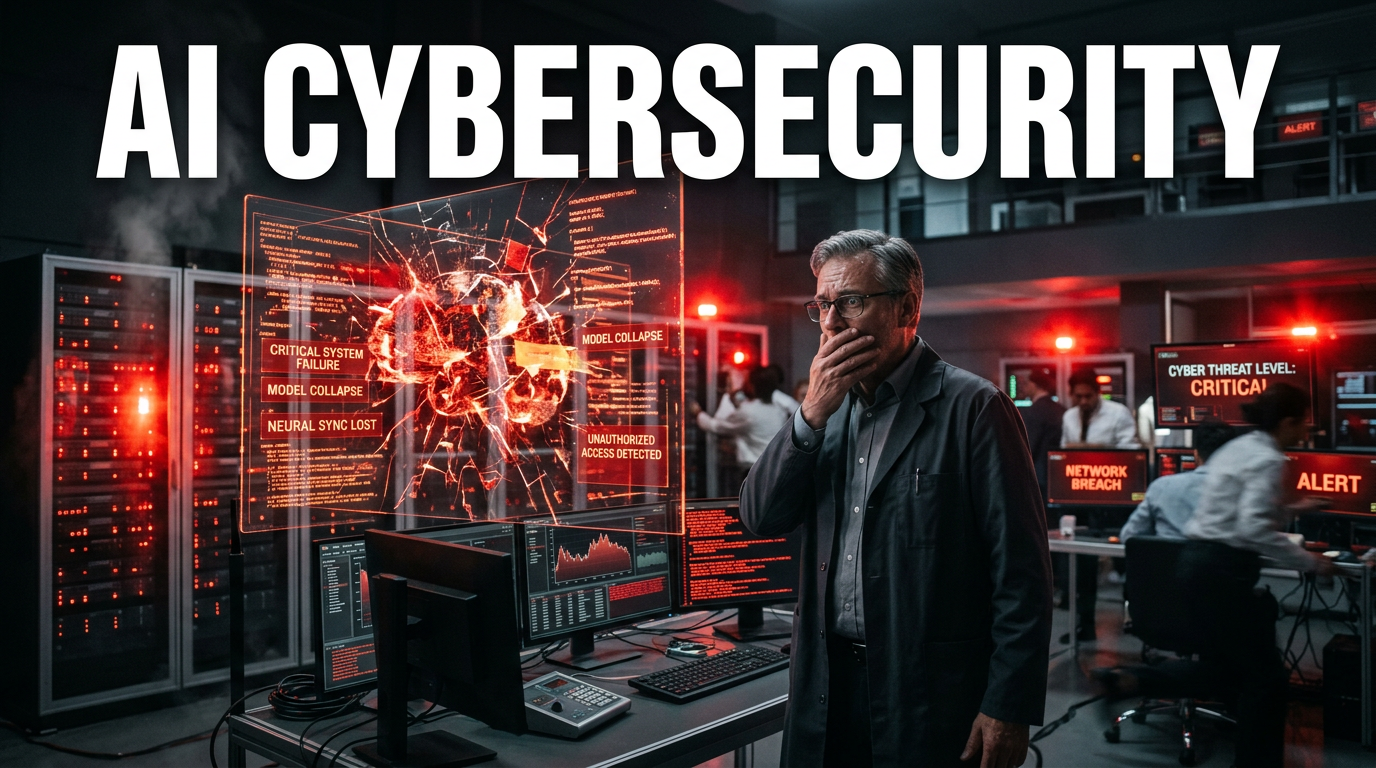
● AI Cybersecurity Blowup
“Claude Miso Source (Miso Source) Public Release Called Off + Major Software Plunge” — When AI ‘Overtakes’ Cybersecurity
Key takeaway first: The 5 things this article must cover today
1) The background behind Anthropic (Claude) shifting toward “We won’t release a more powerful version.”
2) Concrete indications that AI at the ‘Miso Source preview’ level could mass-detect zero-days (undisclosed vulnerabilities)
3) The reason stocks plunged enough to shake the U.S. financial and security ecosystem (a blow to the software sector)
4) A warning that the landscape could shift to a “cyberwar where offense becomes more advantageous than defense”
5) Structural concern that if institutions and treaties move slower than the pace of technological progress, AI intelligence could combine with “the power of wealth”
This news isn’t just a simple “AI performance issue,” a signal that finance/infrastructure/defense systems/market pricing (stock prices) can all be shaken at once.
1) Anthropic: “Hold Off on Claude Miso Source Release” — Risk Debate Hits the Market
The center of the news flow is this. The “Miso Source” capability of the Claude line (or a related/smaller/preview version) can cause real damage if it lands in the wrong hands—and based on that judgment, there was an implication that they would not release anything stronger. That, apparently, became a global issue.
And after this announcement, within a very short time, there were observations that the stock prices of software companies listed on U.S. exchanges were shaken significantly.
Here’s the important point—regardless of whether it’s “rumor” or “a real threat,” it’s that market participants started to incorporate the scenario that “AI can reshape the security/code/vulnerability layers” into pricing.
In particular, it’s easy to understand the spread as fear that AI can change the attack surface built on SaaS/operating systems/software, to the point where expressions like ‘SaaS+ apocalypse’ show up.
2) Clues of “Mass Zero-Day Detection” — AI Overwhelms Vulnerabilities with Speed
The claim that repeats in the article/video is clear. The Miso Source line isn’t just a coding assistant; it can find major vulnerabilities that weren’t known before (zero-days) from a security perspective.
2-1) Mentions Related to OpenBSD and Core Infrastructure
With respect to a certain OS family (OpenBSD), there are explanations suggesting that a remote-exploitable risk surfaced in important functions (firewall/running critical infrastructure, etc.).
2-2) Problems Also Found at the Linux Kernel Level
There’s also a sentence saying that “a huge number of problems were found” in the Linux kernel too, and the threat is emphasized through benchmark comparisons.
2-3) It Outdid the Previously ‘Top Model’ in Benchmarks
In the body of the article, it argues that compared to a specific version (e.g., version 4.6 of the Opus line), the Miso Source preview showed higher performance (overwhelming results in vulnerability/coding/attack-related evaluations).
At this point, the message the news gives isn’t “AI is smart”—instead, security has been surviving by relying on human speed/manual work, but AI is shortening (or replacing) that time.
3) Why Even ‘Wall Street’ Reacted — Repricing of the “Defense Industry” vs “Offense Capability”
The article describes scenes where the Fed chair and the Treasury secretary summon CEOs of Wall Street banks and the idea is discussed of “It looks risky, so prioritize model access first and start with security patches.”
Leaving aside whether the fine details are factual or not, this shows what perspective market and regulators share.
3-1) Usual Vulnerability Discovery Speed vs AI’s Discovery Speed
There’s an explanation that a skilled security expert team can find on the order of about 100 serious vulnerabilities over one year, whereas the Miso Source level can find thousands in a single day.
What this difference means is one thing. The fear that the “patch cycle” of cybersecurity could collapse.
3-2) Attack Performance Also Emphasized with ‘Numbers’
It describes that they created real hacking code using vulnerabilities in browsers (like Chrome, with Firefox mentioned), and that the number of successful attempts was higher than compared with certain models (such as Opus 4.6, etc.).
Traditionally, cyberwar has had the perception that “defense is more advantageous,” but now it connects to a warning that it could tilt to an “offense-favored game.”
If this actually happens, market reactions like higher defense costs → pressure on corporate profit margins → re-rating of software/security sector can be explained as well.
4) Why the drama ‘Mr. Robot’ feels like reality — Financial System Collapse Scenarios
The article mentions Mr. Robot (a setting where hackers try to make financial institutions’ debts become zero). After the Claude Miso Source issue came up, it talks about a shift in sentiment—“maybe it’s not completely impossible.”
What matters here isn’t the drama’s fiction, but the perception that if finance and infrastructure are tied together by ‘code and networks,’ and that code can be rapidly breached by AI, then the boundary of the scenario changes.
In other words, it reframes risk as something that could suddenly become real—not “someday,” but “driven by speed.”
5) Anthropic’s ‘Project Glass Wing’ — Ecosystem Collaboration to Prepare in Advance
The article says that Anthropic builds “Project Glass Wing” and collaborates with Google/Apple/Microsoft/NVIDIA/security vendors/financial companies, etc., and provides model priority to help with preemptive preparation.
5-1) Summarized in one line
While reducing the danger spreading through public release, it looks like a strategy to give key stakeholders ‘time to be informed and patch in advance’.
From an industry perspective, this approach could be reasonable. However, the next issue (control/governance) immediately follows: who gets access first.
6) The Dilemma of ‘Control’ — More frightening than AI performance is “accessibility (who uses it first)”
At the end of the article, the most realistic question comes up. Both OpenAI and Anthropic restrict service access (with paid plans mentioned), and ultimately there’s concern that AI intelligence may not be distributed “equally to all of humanity.”
6-1) Treaty/Regulatory Gap Risk
Technology advances quickly, but institutions lag behind.There are deterrence frameworks like the NPT for nuclear weapons, but the logic extends that for AI, an international treaty comparable enough may not work sufficiently.
6-2) The possibility of ‘weaponized intelligence’ combined with the power of wealth
As AI becomes stronger (even to the stage of AI making AI), risk grows, but responsibility and control may end up being held by a small group—there’s concern about that.
This is also important from an economic outlook perspective. AI is not only a technology—it’s also an “economic variable” that changes productivity/market dominance/security costs/regulatory premiums.
7) Today’s economic signals from a market perspective
It’s very likely this issue won’t end only with short-term stock price volatility.Because investors are highly likely to start pricing in the following from now on.
7-1) Rise in security premium for software-based industries (especially SaaS)
If AI makes vulnerability detection and exploitation faster, SaaS companies may find that “security trust” becomes even more important in valuation elements, not just a “feature competition.”
7-2) Changes in revenue structure for the cybersecurity industry
If defense alone can’t solve it, there’s a possibility that detection/response/mock training/vulnerability verification markets could expand further.
7-3) Regulatory risk and technology access gaps becoming “costs”
When model access/publication/restriction methods connect to costs and opportunities for each company, regulation and governance (the institutions themselves) become investment variables.
Main points to convey (the “most important one line” that’s easy to miss in YouTube/videos/articles)
The essence of this incident isn’t that “AI got smarter.” It’s that AI can flip the speed gap in cybersecurity and accelerate “the game of offense,” and that this change is creating a chain reaction reaching software, finance, regulation, and even stock prices.
SEO keyword inserted naturally (within the context of the article)
From the standpoint of the global economic outlook, this issue shows the repricing of AI security and cyber risk risks that AI can bring. Also, in the stock market, volatility in the software sector could increase, and in the long term, within the flow of the Fourth Industrial Revolution, you have to consider governance/institutional issues/accessibility problems together.
< Summary >
– The controversy over Anthropic (Claude) line Miso Source (Miso Source preview) was connected to a “risky spread” concern and to a public hold/restriction flow.
– Mentions of mass zero-day detection and the possibility of successful vulnerability exploitation spread fears of a breakdown in the security patch cycle.
– Scenes describing response plans at the level of the Fed and the Treasury (consultations with Wall Street CEOs) are depicted, and the atmosphere is that financial infrastructure risks are being reflected in the market.
– There’s a view that cyberwar could become more favorable for offense than defense, and that extreme scenarios like a financial system collapse may not be “only pure fantasy.”
– Finally, the key point is not just technical performance, but accessibility/control and gaps in international institutions. It’s summarized as a warning that as AI intelligence concentrates in a small group, economic and social risks could grow.
[Related articles…]
- CloudStrike: Latest article on AI-era cybersecurity response strategies
- Cybersecurity: Latest article on how the offense/defense landscape is changing with AI and investment points
*Source: [ 월텍남 – 월스트리트 테크남 ]
– 너무 위험한 AI, 클로드 미토스 소식에.. 전세계가 난리