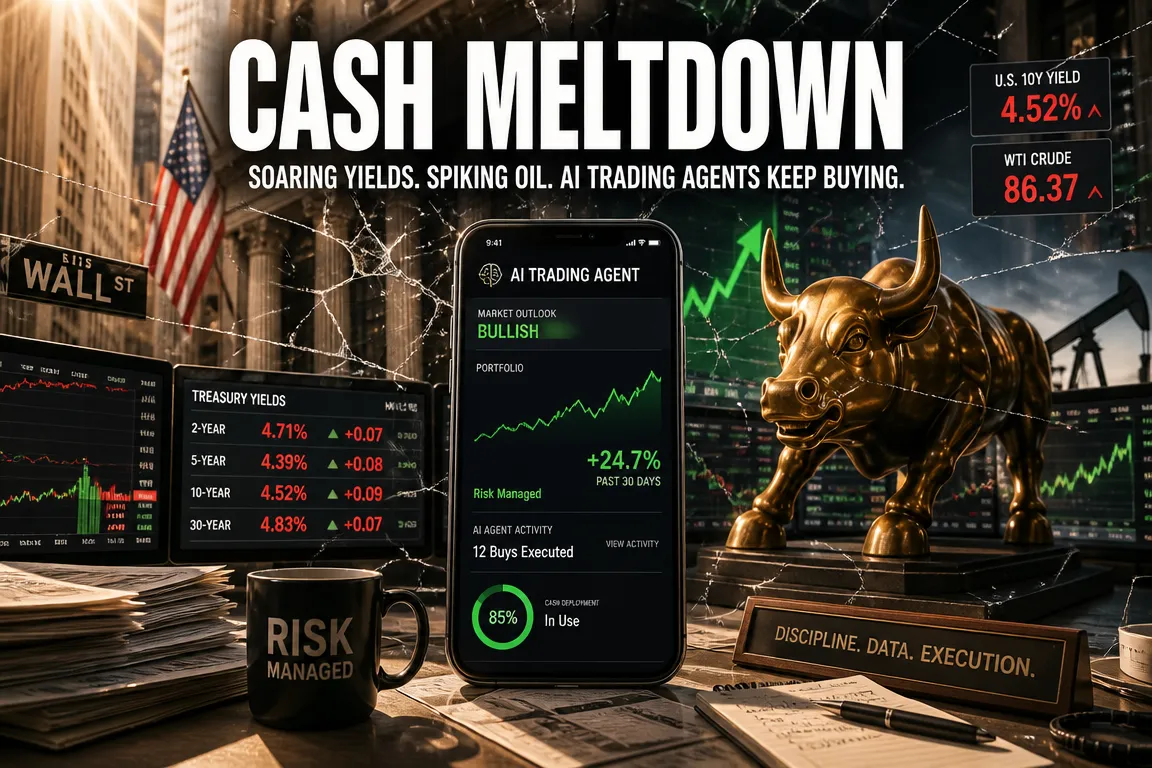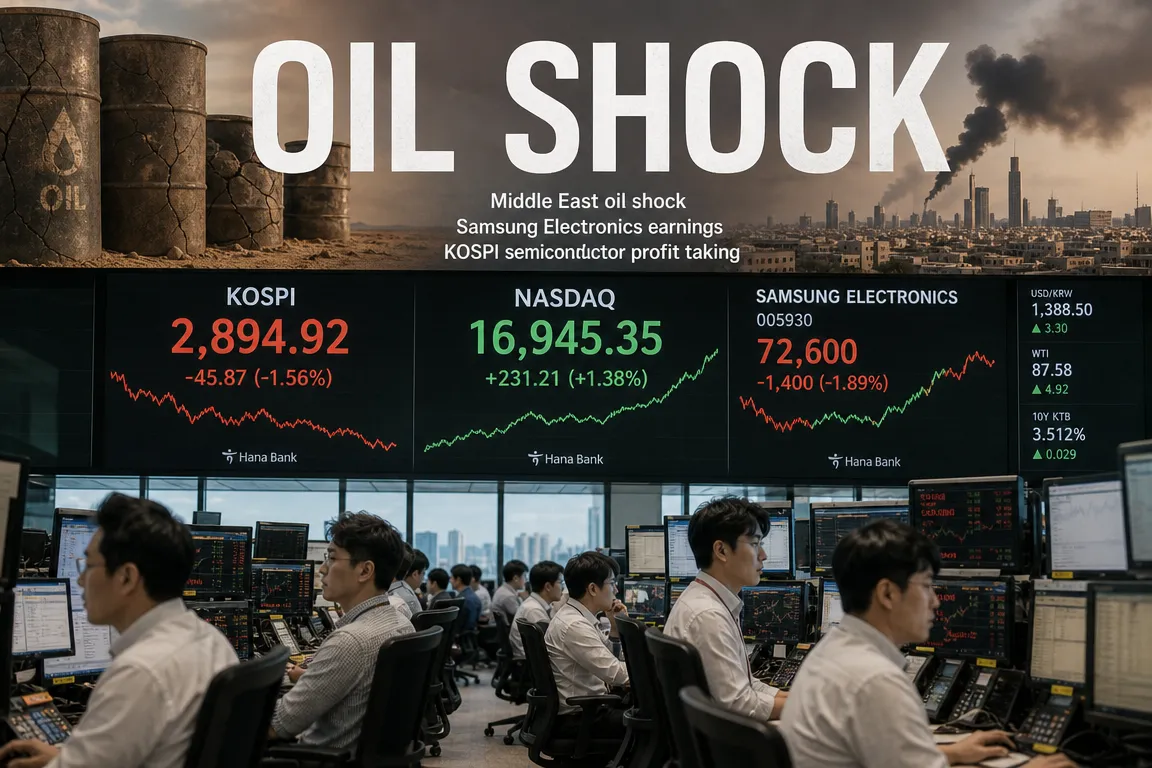
● Market Shock, AI Surge, Oil Drop
Two Key Traps Behind the Equity Surge: Strait of Hormuz, Iran Negotiations, and the AI Rally
Market pricing increasingly reflects a “risk-off is over” narrative.The Nasdaq has risen for 10 consecutive sessions, the S&P 500 has largely recovered prior losses, crude oil has declined sharply, and AI-related equities have strengthened, supporting risk appetite.
This move is not a simple rebound; multiple structural drivers are interacting.This report summarizes: why geopolitical risk is being discounted, why the Strait of Hormuz and Iran negotiations remain core macro variables, why the latest inflation prints should not be extrapolated mechanically, and how accelerating AI demand is affecting equities and industry structure.
Additional focus areas often underemphasized in mainstream coverage:the rationale and market impact of the US “reverse blockade” approach; why a low PPI print can amplify next-month volatility; and why the shift from AI subscriptions to usage-based pricing matters for Big Tech earnings.
1. Market Snapshot: Why Risk Assets Strengthened
US equities advanced broadly:Nasdaq +1.88%,S&P 500 +1.12%,Dow +0.63%.
The Nasdaq extended its 10-session winning streak, and the S&P 500 has largely retraced the drawdown associated with the conflict shock.
Korean equities followed a similar pattern, with the KOSPI recovering toward prior highs.
A sharp decline in international crude supported the market’s interpretation that the worst-case geopolitical scenario is being avoided.This reflects a simultaneous interaction of five pillars: portfolio positioning, US equities, inflation expectations, global growth assumptions, and AI-linked leadership.
2. Primary Driver #1: Negotiation Expectations Outweighed Escalation Risk
A key catalyst has been the market’s perception that Middle East tensions are shifting toward a negotiation framework rather than sustained escalation.Risk assets benefited from rising expectations of an extended ceasefire or renewed talks.
- Initial conflict headlines drove a risk-off response
- Subsequent US-Iran ceasefire developments improved sentiment
- As deadlines approach, markets have leaned toward renewed negotiations rather than immediate escalation
- Comments from the Trump camp increased expectations of talks resuming “within two days”
Markets are reacting less to definitive resolution and more to the reduced probability of near-term worst outcomes, consistent with forward-looking asset pricing.
3. Iran Negotiations: Nuclear Program and the Israel Constraint
The central negotiation axis remains Iran’s nuclear program.
The US is seeking a prolonged suspension of nuclear-related activities.Iran has signaled potential openness to time-bound limitations, which markets interpret positively as evidence of continued engagement.
A key constraint is Israel, which maintains a more hardline posture, including demands for complete removal of enriched uranium.Security leadership messaging that the “mission is not finished” implies that progress in US-Iran discussions could still face sudden disruption.
4. Lebanon and Hezbollah: Why Geopolitical Risk Is Not Fully Resolved
Israel-Lebanon dialogue has progressed, but the situation remains structurally complex.
Hezbollah, a powerful armed actor with close ties to Iran, remains a core security concern for Israel.Lebanon’s government has limited practical control over Hezbollah, reducing the probability that formal talks translate into durable de-escalation.
Overall, current developments are better characterized as risk containment than resolution.
5. Key Market Mechanism: The US “Reverse Strait of Hormuz Blockade” Concept
A critical development has been the US approach: not only deterring a potential Iranian blockade of the Strait of Hormuz, but increasing pressure by targeting Iran’s maritime export routes.
Despite appearing escalatory, markets largely interpreted this as leverage intended to compel negotiations:
- Iran’s core cash flow is oil exports
- Exports depend heavily on maritime logistics
- Disruption of these routes could rapidly weaken Iran’s FX inflows
- This may increase incentives to negotiate rather than retaliate militarily
The macro linkage runs through energy: the Strait of Hormuz is a critical global oil transit corridor, and disruptions feed directly into energy prices, inflation, rate expectations, and equity valuation multiples.
6. Trap #1: Political Negotiations Are Non-Linear and Event-Driven
Negotiation optimism is a major support for equities, but it is also a primary risk.Political outcomes are difficult to model, particularly with overlapping actors (US, Iran, Israel, Lebanon) and domestic political calendars.
Headlines around ceasefire expirations or negotiation setbacks can quickly reprice volatility.The current rally appears to reflect “no worsening” rather than a fully resolved geopolitical regime shift.
7. Primary Driver #2: PPI Downside Surprise Reduced Inflation Anxiety
The second support has been inflation data.The Producer Price Index (PPI) printed below expectations, both year-over-year and month-over-month.
This strengthened the view that the Federal Reserve may not need to accelerate tightening.Lower inflation pressure reduces duration risk and is generally supportive for growth and technology equities.
The Nasdaq and AI-related leaders responded strongly given their higher sensitivity to discount-rate expectations.
8. Trap #2: A Low PPI Print May Not Confirm Durable Disinflation
Interpreting the latest PPI as a definitive disinflation signal may be premature for three reasons:
- Inflation transmission operates with lags
- Energy price increases may feed into next month’s prints more fully
- Survey and collection timing may have preceded the most recent gasoline surge
If subsequent CPI/PPI prints re-accelerate, markets could reverse current rate optimism rapidly.The key risk is not the current data point, but how it anchors expectations ahead of the next release.
9. Major US Bank Earnings: Why Markets Stabilized
Large US banks contributed to improved sentiment.The core message was that, despite geopolitical uncertainty, the US economy remains relatively resilient.
This matters because the principal market risk is transmission from geopolitical stress into real activity and corporate earnings.Stability in banking commentary supports the interpretation that consumption, credit, and business activity have not deteriorated materially.
10. AI Trend: The Dominant Structural Growth Narrative
AI remains a central support for risk appetite, helping markets absorb geopolitical shocks more quickly.AI demand is being characterized as stronger than expected, with faster enterprise adoption, intensifying model competition, and rising compute infrastructure investment.
This is propagating across the value chain:
- Semiconductors: HBM and AI server demand expansion
- Power infrastructure: data-center electricity consumption growth
- Optical networking: accelerating high-speed interconnect demand
- Cloud: rising training and inference cost intensity
- Software: broader deployment of generative AI in enterprises
In Korea, semiconductor exposures have led.In the US, infrastructure, power, and optical networking names have also strengthened as the AI theme connects more directly to earnings pathways.
11. AI Monetization Shift: From Flat Subscriptions to Usage-Based Pricing
AI service pricing is shifting from fixed monthly subscriptions toward usage-based billing.High-usage enterprise customers pay more, while lower-usage customers pay less.
This represents a transition from experimentation to monetization.If adoption scales under usage-based models, Big Tech can reposition AI from a cost center to a higher-margin infrastructure-like revenue stream, which markets tend to discount forward.
12. Portfolio Interpretation: Constructive Tape, Elevated Risk of Overconfidence
The current setup is supported by negotiation expectations, lower near-term inflation pressure, resilient US economic signals, and ongoing AI-driven growth leadership.
However, strong markets are not necessarily low-risk markets.Pricing has already recovered rapidly and embeds meaningful optimism despite unresolved tail risks.A balanced approach is warranted:
- If leverage is elevated, consider partial de-risking
- In sharp rallies, rebuild some cash buffer
- Avoid headline-driven overtrading, but monitor key dates and negotiation signals
- Maintain AI exposure with valuation discipline
- Treat next month’s CPI/PPI as a primary directional checkpoint
13. News-Style Key Takeaways
- US indices advanced; Nasdaq extended a 10-session rally
- Crude oil declined, easing near-term geopolitical premium
- US-Iran negotiation expectations were a major driver
- Israel’s hardline stance remains a latent risk
- US maritime pressure targets Iran’s export cash flow and logistics
- PPI downside surprise reduced inflation anxiety; tech outperformed
- Risk of next-month inflation re-acceleration remains material
- US bank earnings indicated economic resilience
- AI demand supports broad risk appetite
- AI pricing model shifts signal deeper monetization potential
14. Underemphasized Points With High Relevance
- The US “reverse blockade” is not merely military posturing; it is a financial and logistics pressure tool aimed at Iran’s export cash flow.
Markets interpreted it more as negotiation leverage than a signal of imminent full-scale escalation. - The Strait of Hormuz is not a localized headline risk; it is a direct macro variable for global inflation and rates.
Energy-price volatility can shift rate expectations and force equity multiple repricing. - A low PPI print can reduce near-term pressure while increasing the probability of disappointment next month if energy pass-through appears with a lag.
If expectations move too far ahead of realized data, the reversal can be sharper. - The AI rally is increasingly tied to an earnings-linked chain across power, semiconductors, networks, and monetization models.
This is moving beyond a single-theme trade toward a broader industrial reallocation. - A primary risk is not the existence of negative catalysts, but the market’s belief that the risk regime has fully normalized.
Maintaining optionality via risk controls is more important when complacency rises.
15. Conclusion: Constructive Momentum, Ongoing Need for Risk Management
Equities are being supported by negotiation optimism, oil stabilization, a softer PPI print, steady bank commentary, and sustained AI growth expectations.
However, it is premature to treat the rally as a fully secure regime change.Middle East negotiations can destabilize quickly; inflation may re-emerge in upcoming prints; and current price levels already reflect substantial optimism.
Priority indicators for global and US equity investors include Strait of Hormuz developments, the trajectory of Iran negotiations, the next CPI/PPI releases, and measurable AI demand signals.
< Summary >
Equities surged on ceasefire/negotiation expectations, a softer PPI print, and strong AI demand.Two core traps remain: (1) geopolitical risk can reprice abruptly due to Iran-Israel dynamics; (2) the PPI downside surprise may be temporary, leaving room for inflation to re-accelerate next month.
Momentum is constructive, but markets have already priced in significant optimism.A strategy that respects trend while maintaining liquidity and risk controls is appropriate.AI remains a structural growth axis, and the shift toward usage-based pricing increases the relevance of AI exposure for medium- to long-term earnings sensitivity.
[Related Articles…]
- Post-AI Demand Surge: Key Investment Angles Across Semiconductors, Power, and Cloud
- How Strait of Hormuz Risk Transmits to Oil, Equities, and Inflation
*Source: [ 내일은 투자왕 – 김단테 ]
– 증시 폭등? 두가지 함정이 있습니다.
● IMF Shock, World Economy Slashed, Korea Holds, Inflation Surges, Recession Risk Rises
IMF Outlook After the Middle East War: Consolidated Global Macro Summary for 2026
Global growth, Korea outlook, inflation, recession signals, and key market implications
This IMF update is not a routine revision. It reflects a weaker recovery trajectory, higher inflation persistence, and a more complex risk mix in which markets may become more sensitive to energy, supply chains, and AI monetization assumptions than to war headlines alone.
1. IMF Core Message: “The Global Economy Is Being Tested Again”
In the April 2026 World Economic Outlook update, the IMF characterizes the shock from the Middle East war as a renewed stress test for the global economy, with elevated uncertainty and downside risks driven by energy, inflation expectations, and financial market fragility.
2. IMF 2026 Headline Forecasts
2-1. Global Growth
- 2026 global GDP growth: 3.1%
- Revision vs. January: -0.2 percentage points (from 3.3%)
Key implication: the revision suggests not only lower growth, but reduced probability of an upside re-acceleration path.
2-2. Advanced Economies
- 2026 growth: 1.8% (unchanged vs. January)
2-3. Emerging Market and Developing Economies
- 2026 growth: 3.9%
- Revision vs. January: -0.3 percentage points
Rationale: higher sensitivity to energy-import exposure, external shocks, and regional spillovers.
2-4. Global Inflation
- 2026 global inflation: 4.4%
- Revision vs. January: +0.6 percentage points
Breakdown:
- Advanced economies: 2.8%
- Emerging markets: 5.5%
- Korea: 2.5%
Key implication: a stronger stagflation-type configuration (lower growth, higher inflation).
3. Drivers of the More Cautious Baseline
3-1. Energy Price Channel
The most direct transmission is higher oil and gas prices, lifting transport and input costs and compressing margins, particularly for energy importers.
3-2. Inflation Expectations Channel
Rising inflation expectations can entrench price dynamics via wages, pass-through behavior, and consumption patterns, limiting central banks’ ability to ease policy.
3-3. Financial Risk-Off Channel
Prolonged conflict can trigger:
- USD strength
- capital outflows from emerging markets
- wider credit spreads
- higher equity volatility
Downside risks can be amplified by sentiment and positioning rather than macro data alone.
4. 2026 Outlook by Major Economy
4-1. United States: 2.3% (from 2.4%)
- Downside impact is comparatively contained due to partial energy exporter characteristics.
- Slowing momentum remains likely given restrictive financial conditions and softer demand.
4-2. Euro Area: 1.1% (down 0.2 percentage points)
- One of the most vulnerable advanced regions due to accumulated energy-cost pressure and weaker industrial competitiveness.
- Low baseline growth magnifies the practical impact of small forecast downgrades.
4-3. Japan: 0.7% (unchanged)
- Fiscal support and domestic conditions offset part of the external shock.
4-4. China: 4.4% (from 4.5%)
- Structural deceleration persists amid property stress, local government debt, weak domestic demand, and softer external demand.
4-5. Korea: 1.9% (unchanged)
- Slightly above the advanced-economy average (1.8%), but not indicative of strong underlying acceleration.
- Stability is consistent with partial policy cushioning rather than organic momentum.
5. Korea: Key Investor-Relevant Takeaways
5-1. Interpretation of the 1.9% Growth Profile
A stable headline number can coexist with divergence between reported GDP and on-the-ground conditions, including:
- uneven export performance across sectors
- weak domestic demand
- pressure on small businesses
5-2. Role of Supplemental Fiscal Measures
Temporary fiscal support can reduce downside growth risks following supply shocks, but investors should monitor:
- fiscal sustainability
- inflation sensitivity
- policy efficiency and targeting
5-3. Inflation at 2.5%
While not far above typical policy objectives, downside comfort is limited if energy and food components raise perceived cost-of-living inflation, complicating the growth-inflation trade-off.
6. IMF Downside Scenarios: More Critical Than the Baseline
The baseline assumes that even if conflict persists for several weeks, energy production and exports progressively normalize from mid-2026.
6-1. Adverse Scenario
- Average spot oil price index near USD 100/bbl
- Global growth could fall to ~2.5%
6-2. Severe Scenario
- Average oil near USD 110/bbl with prolonged disruption
- Global growth could fall to ~2.0%
Implication: conditions would shift from “slowdown” toward broader recession risk discussion.
7. Key Downside Risks Highlighted by the IMF
7-1. Renewed Supply Chain Disruptions
Extended conflict increases logistics and trade frictions, raising inventory costs and encouraging more conservative production planning.
7-2. Repricing of AI Monetization Expectations
The IMF flags that a reassessment of AI profitability could trigger financial market corrections. Equity valuations increasingly reflect AI-driven productivity assumptions; if monetization proves slower or returns disappoint relative to investment intensity, risk assets may reprice.
7-3. Expansion of Protectionism
Conflict environments raise incentives to restrict strategic goods, commodities, and food exports, increasing inefficiency and posing particular risk to export-oriented economies.
8. Upside Factors Identified by the IMF
8-1. Easing of Trade Tensions
Reduced protectionism and geopolitical stress could improve investment sentiment and global trade volumes.
8-2. Earlier-Than-Expected Productivity Gains From AI
AI remains a structural upside lever if deployment translates rapidly into measurable productivity gains.
9. Policy Priorities Emphasized by the IMF
9-1. Monetary Policy
- Maintain inflation stabilization as the primary objective.
- Avoid premature easing where commodity exposure and inflation expectations remain unanchored.
- Apply differentiated responses by country based on inflation dynamics and exposure.
9-2. Financial Market and FX Stability
- Where volatility becomes excessive, temporary stabilization measures (including market intervention or capital flow management tools) may be considered.
9-3. Fiscal Policy
- Preserve fiscal credibility while providing temporary, well-targeted support to vulnerable households.
9-4. Structural Reform
- Continue reforms in labor markets, regulation, and technology to lift productivity in a low-growth environment.
9-5. International Cooperation
- Strengthen coordination to support trade and supply-chain resilience; fragmentation increases costs and reduces growth potential.
10. News-Style Key Summary
10-1. Headline
- IMF cuts 2026 global growth to 3.1% due to the Middle East war shock.
10-2. Core Drivers
- higher energy prices
- rising inflation expectations
- broader financial risk-off behavior
10-3. 2026 Growth Forecasts (Selected)
- United States: 2.3%
- Euro area: 1.1%
- Japan: 0.7%
- China: 4.4%
- Korea: 1.9%
10-4. Inflation
- Global: 4.4%
- Korea: 2.5%
10-5. Downside Risk
- Prolonged conflict could reduce global growth to ~2.5% or ~2.0%, depending on oil prices and disruption duration.
10-6. Policy Focus
- inflation-first central banking posture
- targeted and temporary fiscal support
- structural reforms
- stronger international coordination
11. Under-Emphasized but Material Interpretations
11-1. The Key Issue Is the Loss of Upside Recovery Optionality
The downgrade is less about the magnitude (-0.2 percentage points) than about reduced likelihood of a stronger recovery path.
11-2. Real Economy and Financial Markets May Decouple
Risk assets can be driven by liquidity expectations, rate paths, fiscal support, and AI narratives even as real activity slows; macro inference should separate real-economy dynamics from market pricing.
11-3. AI Is Both a Structural Upside Lever and a Potential Risk-Off Trigger
AI is not only a growth driver; it is also a valuation and positioning factor that can amplify volatility if monetization assumptions are repriced.
11-4. Korea’s 1.9% Profile Is Better Framed as “Defensive Stability”
The unchanged forecast is consistent with policy cushioning and reduced downside, not necessarily improving fundamentals.
12. Five Variables to Monitor
12-1. Oil Price Level
- Thresholds around USD 100 and USD 110 function as scenario pivots for global growth.
12-2. Conflict Duration
- Determines whether shocks remain transitory or become supply-impairing.
12-3. Pace of Supply Chain Normalization
- Timing of energy and logistics recovery will shape the growth path.
12-4. Speed of AI Monetization
- Differentiates productivity-driven upside from valuation-led drawdown risk.
12-5. Fiscal-Monetary Policy Mix
- Balancing disinflation with recession avoidance remains the central constraint.
13. Conclusion
The IMF framework implies a macro regime characterized by simultaneous low growth, persistent inflation pressure, elevated geopolitical risk, supply-side fragility, and AI-related valuation sensitivity. For Korea, headline stability does not eliminate vulnerability to external deterioration. The primary analytical task is to assess the assumptions supporting baseline forecasts and the conditions under which downside scenarios become dominant.
< Summary >
- IMF lowers 2026 global growth to 3.1% due to the Middle East war shock.
- Key channels: energy prices, inflation expectations, risk-off financial conditions.
- 2026 growth: US 2.3%, Euro area 1.1%, Japan 0.7%, China 4.4%, Korea 1.9%.
- 2026 inflation: global 4.4%; Korea 2.5%.
- If the conflict persists and oil rises, global growth could slow to ~2.5% or ~2.0%.
- Central interpretation: reduced upside recovery optionality and the emergence of AI monetization repricing as a material financial-market risk.
- Korea’s 1.9% is best viewed as policy-supported defense rather than broad-based acceleration.
[Related Articles…]
- IMF global outlook and implications for Korea (key summary): https://NextGenInsight.net?s=IMF
- AI productivity shift and global macro impact (latest analysis): https://NextGenInsight.net?s=AI
*Source: [ 경제 읽어주는 남자(김광석TV) ]
– [속보] IMF의 중동전쟁 이후의 경제전망 : “세계경제 시험대에 놓여” [즉시분석]
● PPI Dip, Middle East Heat, AI Surge
US Inflation, Middle East Risk, and the AI Rally: Why the Market Is Not Panicking, and What Risks Actually Matter
Today’s takeaways are fourfold:
1) March US Producer Price Index (PPI) came in below expectations, but interpreting this as clear inflation stabilization is premature.
2) Despite persistent Middle East geopolitical risk, global equities—especially the Nasdaq and AI-linked names—remain resilient.
3) Developments such as Amazon’s Globalstar transaction, the Novo Nordisk–OpenAI collaboration, and Oracle’s strength reinforce the shift from “AI as narrative” to “AI as earnings and cash flow.”
4) Equity headlines emphasize price gains, but the more consequential combination is: higher-for-longer rates + private credit risk + early signs of consumer softening.
This report summarizes the key points across US equities, rates, inflation, crude oil, AI, and implications for Korea-based investors.
1. Market Snapshot: Why Equities Rise Amid Negative Headlines
US equities opened broadly stronger:
- Nasdaq up around ~1%
- S&P 500 higher
- Dow and Russell 2000 also positive
Notably, even with ongoing Middle East tension and crude oil uncertainty, buying interest in technology remains intact.
This suggests markets are placing greater weight on earnings and growth visibility than on geopolitical headlines. The current environment is less a broad risk-off regime and more a regime of capital concentration into the strongest sectors.
Key observed positioning:
- Geopolitical risk is monitored
- Earnings and cash flow are prioritized
- Capital concentrates in AI, semiconductors, cloud, and infrastructure-linked equities
2. Why the March PPI “Non-Event” May Not Signal Inflation Relief
2-1. The headline looked constructive
March PPI printed below consensus:
- Consensus: ~+1.1% YoY
- Actual: ~+0.5% YoY
Core PPI also came in softer, supporting an initial “less urgent hawkish Fed” interpretation.
2-2. The interpretation is the key risk
The softer print may reflect temporary or timing-related factors rather than durable disinflation:
- Certain services components weakened
- Logistics, freight, and air cargo rates softened
- Post-conflict ordering hesitation reduced near-term demand
- Recent oil price increases may not be fully reflected yet
- Hedging and legacy contracts may have delayed pass-through
Conclusion: the March PPI may not fully capture current input-cost pressure.
2-3. April and May PPI matter more
Energy typically feeds into producer and consumer prices with a lag. If crude remains elevated and geopolitical risk persists, April–May inflation data could re-accelerate.
Working interpretation: not “inflation resolved,” but “impact deferred.”
2-4. Implications for the Fed and rates
The Fed already faces constraints on near-term easing. If upcoming CPI/PPI prints reflect energy pass-through, rate-cut expectations may be reduced further; in an adverse scenario, additional tightening rhetoric could re-emerge.
Rates sensitivity remains high; the next two inflation cycles could be decisive for policy expectations.
3. Middle East Risk and Crude Oil: Why Markets Appear Composed
3-1. Headlines are volatile; pricing is less so
Despite repeated references to Iran, the Strait of Hormuz, Red Sea disruption, and Israel–Lebanon dynamics, market pricing has been relatively orderly:
- WTI moved around the mid-90s (intraday) and then stabilized
- Brent similarly avoided uncontrolled upside
This implies one or more of the following market beliefs:
- The worst-case scenario is not the base case
- Physical supply disruption may be limited
- Major actors may act to contain escalation
- A meaningful portion of risk premium is already priced
3-2. Why complacency remains risky
Even without a full closure scenario, increased transit risk can raise insurance, freight, and embedded risk premiums. Current oil pricing may reflect an unstable equilibrium rather than a durable resolution.
3-3. Korea: humanitarian support to Iran and market relevance
Korea’s decision to provide USD 500,000 in humanitarian support to Iran can be interpreted as an external-relations signal in addition to aid.
Given Korea’s high energy import dependence, prolonged Middle East tension can affect:
- commodity import costs
- trade balance
- domestic inflation
- FX and domestic rates
For Korea-based investors, this should be monitored as a cross-asset linkage: crude oil → FX → import prices → rates → equities.
4. Amazon’s Globalstar Transaction (USD 90 per share): Satellite Internet Competition Expands
4-1. Core significance
This should not be treated as a generic telecom M&A headline. It aligns with the broader contest in LEO satellite networks and space-based communications infrastructure, following demonstrated commercial viability in the sector.
4-2. Strategic rationale
Amazon operates a top-tier global cloud platform (AWS). In an AI-driven economy, competitiveness depends not only on data centers but also on connectivity reach and reliability. Satellite networks support:
- connectivity in underserved regions
- defense and disaster-response communications
- autonomy, logistics, maritime connectivity
- global expansion of edge computing
Interpretation: infrastructure positioning for AI-era connectivity, not merely a telecom asset purchase.
4-3. Investment implications (ecosystem view)
Market focus may broaden to:
- satellite communications equipment providers
- launch services and space supply chain
- LEO satellite manufacturing
- defense AI and communications security
- cloud–network convergence infrastructure
AI beneficiaries extend beyond software into power, chips, data centers, and global networks.
5. Novo Nordisk–OpenAI Partnership: AI in Drug Discovery Moves Toward Commercial Impact
5-1. Why it matters
The announcement signals generative AI moving beyond productivity use cases into core value creation within biotech and pharmaceuticals.
5-2. Where AI changes the process
AI can compress early-stage discovery and improve decision-making across:
- candidate identification
- protein structure analysis
- clinical success probability estimation
- literature and patent intelligence
- experiment prioritization and optimization
5-3. What markets may be underwriting
Two implications stand out:
- OpenAI’s trajectory toward verticalized, industry-specific platforms
- Novo Nordisk’s potential to accelerate pipeline development beyond current blockbuster franchises
Investor focus increasingly shifts from model quality alone to measurable outcomes: revenue expansion and cost reduction within specific industries.
6. Oracle’s Strength: AI Is Showing Up in Revenue, Not Just Narrative
Oracle’s outperformance reflects the view that cloud and AI acceleration demand is translating into realized revenue growth.
Market framework shift:
- Prior: “Does the company have an AI story?”
- Now: “Is AI demand visible in reported results?”
AI deployment at enterprise scale requires databases, cloud infrastructure, security, and operational tooling. AI-linked winners may broaden beyond semiconductors to enterprise software and cloud infrastructure providers.
7. JPMorgan: Strong Results, Muted Stock Response
7-1. Earnings were strong
JPMorgan delivered solid 1Q performance, supported by elevated trading revenue and stronger fee lines amid higher volatility. M&A advisory fees also improved, consistent with some reopening of corporate activity.
7-2. Market focus: net interest income (NII)
The restrained equity reaction reflects weaker-than-expected NII outlook. In a higher-for-longer environment, deposit migration to higher-yield products increases funding costs and compresses margins.
7-3. The more material warning: private credit
Management commentary again highlighted private credit. The market has expanded significantly, and many borrowers may be more vulnerable under:
- prolonged high rates
- slowing growth
- renewed input-cost pressure
Risk may remain latent until stress emerges. The key message is not headline profitability, but accumulating credit risk beneath stable surface indicators.
8. Airline Merger Speculation: The Loyalty Program as the Financial Engine
Speculation around United Airlines and American Airlines is relevant beyond route consolidation. In US airlines, loyalty programs function as cash-generating financial structures through mileage sales to card issuers:
- upfront cash receipt
- deferred service delivery
- partial breakage (unused points)
- strong customer lock-in
The strategic value of consolidation may therefore include increased negotiating leverage in loyalty economics.
For investors, a broader lesson applies: evaluate companies for prepaid ecosystems, points-based liabilities, membership moats, and cash-advance business models—not only the visible core service.
9. CarMax Weakness: Consumer Stress Signals in the US Middle Segment
9-1. Outcome diverged from intuitive demand substitution
Despite high new-car prices, CarMax results underwhelmed:
- volumes below expectations
- margin compression
9-2. Primary drivers
- used-car financing rates are elevated
- parts and servicing costs pressure profitability
- weaker new-car sales reduce supply of high-quality used inventory
Consumers face affordability constraints in both new and used vehicles due to financing costs.
9-3. Why this matters
Autos are closer to a necessity than a discretionary purchase in the US. Softness here can transmit to broader consumption indicators. The macro picture increasingly resembles a bifurcated structure: strong mega-cap tech and asset prices versus pressured household purchasing power.
10. Why Tech and AI Equities Remain Strong
10-1. Institutional positioning has improved
Large institutions have shifted toward a more constructive stance on US equities, driven by:
- geopolitical risk perceived as manageable in market terms
- earnings strength, especially among AI-linked firms
10-2. Earnings growth is offsetting valuation concerns
While valuations appear elevated, earnings revisions in semis, AI servers, power infrastructure, and data center ecosystems have been moving higher, partially mitigating valuation pressure.
10-3. AI is evolving from theme to industrial structure
Market analysis is increasingly decomposed across the full AI stack:
- semiconductors
- HBM memory
- cloud
- data centers
- power grid and generation
- cooling systems
- networking
- industrial software
- AI in bio/healthcare
AI is being treated less as isolated stock catalysts and more as a multi-sector restructuring force.
11. Under-Discussed, High-Importance Points
11-1. Soft PPI may be timing distortion rather than durable relief
Cost pressures may surface more clearly in 2Q as energy and logistics dynamics pass through.
11-2. Equity strength is not equivalent to broad economic strength
Nasdaq leadership contrasts with consumer-linked weakness, consistent with sector concentration rather than uniform expansion.
11-3. The key tail risk may be credit, not geopolitics
Private credit is less visible than geopolitical headlines, but higher-for-longer rates plus slowing demand can raise default risk.
11-4. The AI rally is increasingly about infrastructure control
Across Amazon/Globalstar, Oracle, and Novo Nordisk/OpenAI, the common thread is infrastructure, distribution, data access, and real-use adoption—not only model innovation.
11-5. Korea-based investors should monitor crude oil and FX more tightly
Unlike the US, Korea is not energy self-sufficient. Middle East shocks can transmit more directly via crude oil, USD/KRW, import prices, and domestic inflation/rates.
12. Strategy Checklist for Korea-Based Investors
- US inflation: April and May data are more informative than March
- A renewed oil spike can quickly reprice rate expectations
- AI exposures may remain strong, but leadership may concentrate in companies with earnings confirmation
- Additional consumer-softening signals can increase volatility in cyclicals and domestic-demand equities
- Track shipping routes and freight/insurance costs, not only daily geopolitical headlines
Current conditions resemble selective strength: sustained leadership in specific sectors while weaker areas deteriorate more quietly.
13. Issue-by-Issue News-Style Summary
US inflation
March PPI was below expectations and supported near-term relief, but the full impact of elevated crude prices may appear with a lag; inflation risk is not resolved.
Fed and rates
Rate-cut expectations appear deferred rather than reinforced. A firm inflation print could shift expectations toward a more hawkish path.
Crude oil and Middle East
Despite strategic chokepoint risks, crude avoided uncontrolled upside; supply-chain risk remains active.
US equities
Nasdaq and the S&P 500 rose on tech leadership. Markets appear to be prioritizing earnings and AI growth over geopolitical risk.
Amazon
The Globalstar transaction indicates intensifying competition in satellite communications and space-linked connectivity. The strategic lens is AI-era connectivity infrastructure.
Novo Nordisk–OpenAI
Signals practical deployment of AI to accelerate drug discovery productivity and potentially improve pipeline economics.
JPMorgan
Strong earnings were offset by softer NII trajectory and heightened attention to private credit as a potential systemic risk vector.
CarMax
Used-car weakness suggests rising financing burdens and emerging pressure on the US consumer.
< Summary >
March PPI was softer than expected, but may reflect delayed energy pass-through rather than a definitive inflation downshift.
Middle East risk persists, yet US equities remain supported by AI- and technology-led earnings resilience.
Amazon’s Globalstar transaction aligns with satellite connectivity and AI infrastructure expansion; Novo Nordisk–OpenAI highlights AI commercialization in biotech.
JPMorgan’s results were strong, but private credit risk appears more consequential; CarMax weakness points to consumer strain.
Core message: index-level strength is coexisting with internal economic divergence.
*Source: [ Maeil Business Newspaper ]
– 韓정부, 이란에 50만 달러 인도적 지원ㅣ아마존, 글로벌스타 주당 90달러에 매입ㅣ노보노, 오픈AI와 파트너십 “신약 개발 속도”ㅣ홍키자의 매일뉴욕