● Hormuz Shock, Bitcoin Toll, Dollar Crackup
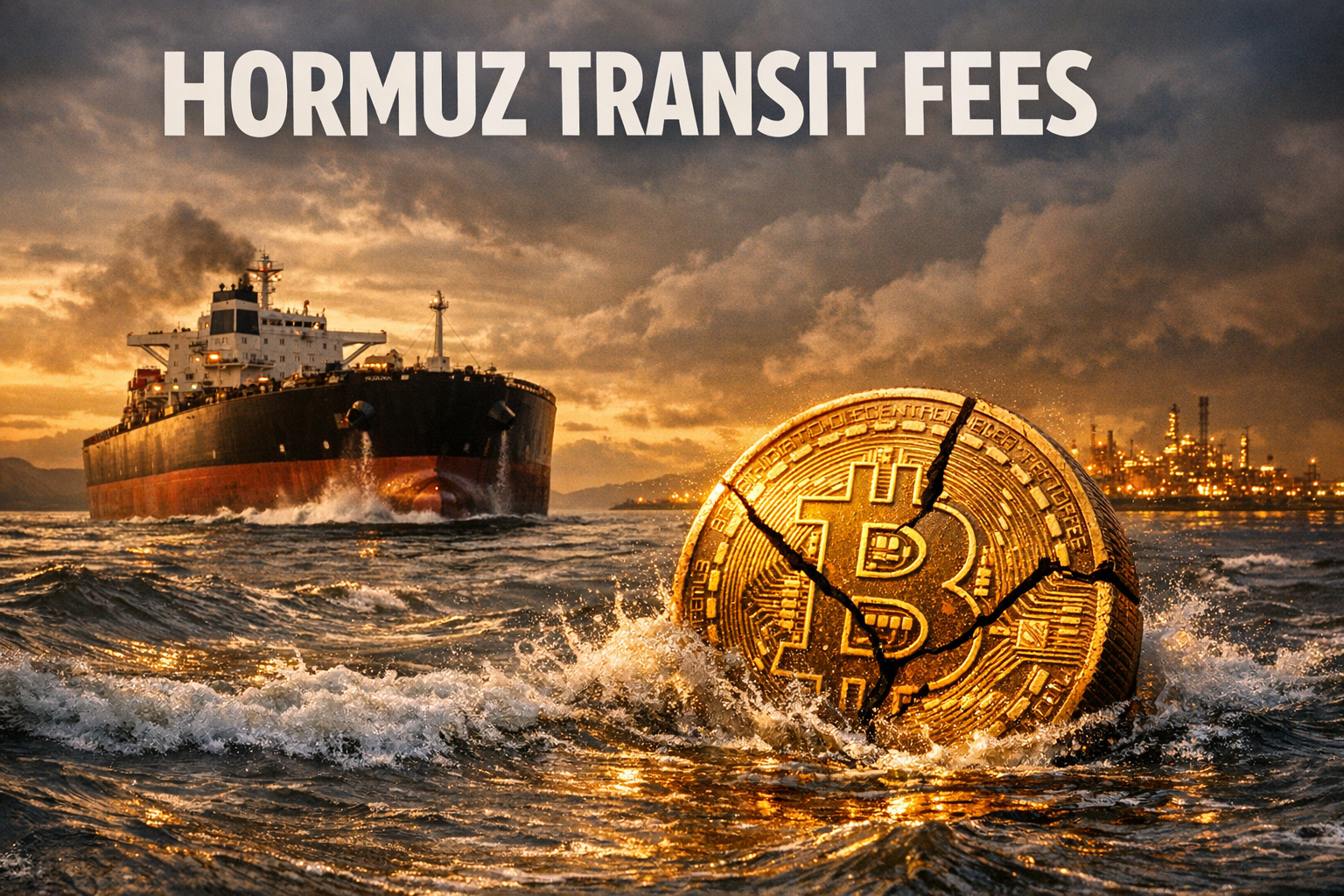
Why Strait of Hormuz Transit Fees Could Shift Toward Bitcoin, and the Real Pressure Point Behind a Weaker Dollar Regime
This issue extends beyond a Middle East conflict or the Strait of Hormuz.
The core points are:
1) Why Iran is considering digital settlement instruments such as Bitcoin and stablecoins instead of the U.S. dollar.
2) How this shift could transmit shocks to global oil prices, inflation, sovereign yields, and broader capital markets.
3) Why an apparent “transit fee” dispute is structurally linked to dollar hegemony, SWIFT-based sanctions, U.S. Treasury demand, RMB settlement networks, and broader Bitcoin adoption.
The key variable is not the payment instrument itself, but the erosion of confidence in legacy monetary rails and the emergence of sanctions-evasion financial pathways.
1. One-sentence summary
Discussion of accepting Bitcoin or stablecoins for Strait of Hormuz transit fees should be viewed less as an experiment and more as a sanctions-constrained state seeking a survivable settlement mechanism outside dollar-centric rails. The signal is potentially relevant to future trade settlement patterns and currency-power competition.
2. Why Bitcoin or stablecoins
2-1. Effective collapse of confidence in Iran’s domestic currency
Iran has experienced persistently high inflation in recent years, with annual inflation above 40% and, at times, commentary pointing to perceived pressures above 60%. Under such conditions, the rial loses utility as a store of value. For recurring fees, accepting settlement in a rapidly depreciating currency reduces real receipts. The starting point is not technology preference, but domestic monetary dysfunction.
2-2. The dollar remains dominant, but is operationally inaccessible
Dollar settlement typically relies on the SWIFT-linked banking system. For a sanctioned jurisdiction, dollar flows increase exposure to tracing, blocking, asset freezes, and secondary-sanctions risk. This dynamic reflects not a loss of dollar strength, but an increase in the dollar’s political and compliance embeddedness.
2-3. Bitcoin for censorship resistance; stablecoins for operational usability
Bitcoin’s primary advantage is censorship resistance and limited direct issuer control, but its price volatility can be impractical for large, recurring settlement flows.
Stablecoins offer improved settlement stability via fiat pegs and are often more usable for trade settlement, cross-border transfers, and netting. However, they introduce issuer and regulatory chokepoints, including the possibility of blacklisting or freezing, as demonstrated in prior cases. For Iran, this can replicate control risk in a new format.
3. Why the U.S. may prefer stablecoins
3-1. Stablecoins as incremental demand for U.S. Treasuries
Major stablecoin issuers hold substantial reserves in short-dated U.S. Treasuries. Expanded stablecoin issuance can mechanically increase demand for U.S. government debt. In a period characterized by large fiscal deficits, elevated issuance needs, and higher rate sensitivity, this demand channel is strategically relevant. If high-volume recurring transactions settle in USD stablecoins, the U.S. can expand its financial demand base without direct fiscal outlays.
3-2. Stablecoins as a digital-era distribution network for the dollar
Historically, dollar dominance scaled through bank accounts, correspondent banking, and trade finance. Stablecoins can extend dollar usage via mobile-first, digital settlement networks. Wider stablecoin adoption implies wider dollar usage, reformatting rather than replacing the dollar.
This also intersects with AI-driven financial surveillance and compliance. As blockchain analytics, real-time cross-border settlement infrastructure, and AI-based monitoring converge, currency power becomes increasingly linked to data networks and enforcement capacity.
4. Why some analyses assign higher probability to Bitcoin
4-1. Incentives to avoid monitoring and control
For sanctioned actors, stablecoins’ convenience is offset by issuer and regulator intervention risk. Exiting SWIFT but re-entering an issuer-controlled enforcement perimeter can be strategically unattractive. Bitcoin, despite volatility, lacks a centralized issuer that can unilaterally halt settlement. A plausible negotiation dynamic is: the U.S. promotes stablecoin settlement; sanctions-avoidance actors prefer Bitcoin.
4-2. Incentives to reduce exposure to international scrutiny
While public blockchains are traceable, monitoring outcomes depend on transaction architecture. If the transit fee framework becomes legally contentious and politically monitored, incentives rise for settlement mechanisms perceived as less directly controllable.
5. Why the transit-fee debate is structurally material
5-1. Precedent risk for other chokepoints
If transit fees are introduced and tacitly accepted, other strategic passages could seek similar arrangements (e.g., Malacca, Turkish Straits, major shipping lanes, potentially even selected air corridors). Establishing the first fee regime is difficult; increasing fees after precedent is set is easier. This implies structurally higher global logistics costs.
5-2. Freight-driven inflation can outlast oil spikes
Market focus typically centers on crude price moves during Middle East stress. The more persistent risk is simultaneous increases in freight rates, marine insurance, rerouting costs, and settlement-risk premia. These channels can create longer-lived inflationary pressure that propagates beyond energy into food, commodities, intermediate goods, and consumer goods.
6. Practical impacts on major importers, including Korea
6-1. Accelerated diversification of crude sourcing
If risk persists, import-dependent economies (Korea, Japan, Europe, India) face stronger incentives to reduce Middle East concentration. Korea’s refinery configuration has historically been more reliant on Middle Eastern heavier grades, limiting short-term substitution. Over time, policy direction may favor diversification, refinery reconfiguration, and increased intake from alternative suppliers.
6-2. Stronger pressure to expand imports of U.S. energy
This is not only an energy issue; it intersects with trade policy, tariffs, and geopolitics. The U.S. has repeatedly encouraged allies to reduce trade imbalances by increasing U.S. energy imports. Elevated Middle East risk can increase the relative attractiveness of U.S. crude and LNG, potentially supporting U.S. export objectives. Korea’s U.S. crude share has already increased versus prior years, and this trend could strengthen.
7. What markets may fear most
7-1. If the inflation path shifts, the rate path shifts
The key risk is a change in the inflation trajectory rather than a one-off shock. If conflict conditions persist and transit-fee-type structural costs emerge, markets may revise assumptions that inflation will normalize. This can weaken expectations for policy easing. Higher-for-longer rates combined with lower growth expectations increases stagflation-type stress.
7-2. Sovereign yields and risk assets can weaken concurrently
If crude rises, inflation re-accelerates, easing is delayed, and fiscal burdens expand, sovereign yields may remain elevated. This increases discount-rate pressure across growth equities, technology, EM assets, and credit. The event functions less as a pure energy shock and more as a global discount-rate shock.
8. Implications for Bitcoin and stablecoin markets
8-1. Bitcoin may gain a “sanctions-evasion reserve asset” narrative
Beyond ETF flows and cyclical crypto narratives, geopolitical stress can strengthen Bitcoin’s framing as a settlement bypass tool for sanctioned or politically constrained actors. The narrative shift may be as important as near-term price effects.
8-2. Stablecoins may tighten linkage to U.S. financial markets
If stablecoins become embedded in real settlement rails, issuance growth becomes structurally supported. This expands short-dated Treasury demand and positions USD stablecoins as a functional layer of global settlement. With further regulatory clarification, stablecoins can migrate from a crypto-market accessory to a component of mainstream financial infrastructure.
9. News-style key takeaways
1) Drivers of the settlement debate
Iran faces domestic currency erosion and SWIFT-related constraints, reducing trust in legacy monetary rails.
2) U.S. incentives
The U.S. has incentives to promote USD stablecoins to expand Treasury demand and extend the dollar’s digital distribution.
3) Iran’s incentives
Due to freeze/blacklist risk, Iran may prefer Bitcoin over issuer-controlled stablecoins.
4) Global spillovers
If transit fees are implemented, higher freight rates, insurance costs, and settlement-risk premia could raise structural inflation pressure.
5) Structural adjustment
Major importers, including Korea, may face stronger pressure to diversify crude sourcing, expand U.S. energy imports, and reconfigure supply chains.
6) Market impact
Sustained oil and inflation pressure can delay rate cuts and increase capital-market volatility.
10. The most important point often missed
10-1. The key is not “Bitcoin vs. stablecoin”
The key question is whether sanctioned states can build durable transaction systems outside the dollar banking perimeter. If successful, similar approaches may proliferate across other sanctioned or conflict regions.
10-2. Less “end of the dollar,” more “bifurcation of dollar-era networks”
A more plausible outcome is a dual structure:
- A U.S.-influenced, compliance-enforced USD stablecoin network
- A parallel set of avoidance-oriented networks using Bitcoin, RMB settlement, and alternative rails
10-3. Stablecoins are directly linked to U.S. fiscal dynamics
Stablecoin expansion can translate into incremental Treasury demand, clarifying why U.S. policy may simultaneously regulate and support the sector. Stablecoins increasingly represent a fiscal, rates, dollar-power, and financial-security issue rather than a narrow technology trend.
11. Monitoring checklist
1) Whether transit-fee implementation becomes formally recognized in negotiations.
2) Whether settlement tilts toward Bitcoin, USD stablecoins, or RMB-based networks.
3) Whether U.S. legislative and regulatory timelines for stablecoin frameworks accelerate.
4) Whether China expands influence via CIPS and RMB settlement.
5) Whether freight and insurance costs persist longer than crude price moves.
6) Whether major importers (including Korea) initiate tangible crude-sourcing and refinery reconfiguration actions.
7) The extent of forecast revisions to growth and inflation by major institutions (IMF, OECD, World Bank).
12. Conclusion (restated)
The Strait of Hormuz transit-fee debate is superficially an extension of regional conflict, but structurally reflects sanctioned actors testing alternative trade-settlement mechanisms using Bitcoin, stablecoins, and RMB rails. If sustained, the adjustment can propagate across five vectors: energy security, currency power, settlement infrastructure, supply chains, and capital-market volatility. The issue is best understood as a re-routing of global financial plumbing rather than a standalone crypto headline.
< Summary >
The debate over accepting Bitcoin or stablecoins for Strait of Hormuz transit fees is not merely a payment-method change; it reflects sanctioned actors seeking alternative settlement regimes outside the dollar banking system. Iran’s drivers include domestic currency erosion and SWIFT-related constraints, while U.S. incentives include extending digital dollar reach and expanding U.S. Treasury demand through stablecoin reserves. Iran may favor Bitcoin to reduce issuer and regulatory control risk. If operationalized, the mechanism could raise not only crude prices but also freight costs, inflation, rates, supply-chain strategies, and structural bifurcation between compliance-oriented dollar networks and avoidance-oriented non-dollar networks.
[Related]
Strait of Hormuz risk and key takeaways for global oil-price outlook
https://NextGenInsight.net?s=Hormuz
How stablecoin adoption affects U.S. Treasuries and dollar power
https://NextGenInsight.net?s=Stablecoin
*Source: [ 경제 읽어주는 남자(김광석TV) ]
– 호르무즈 통행료, 비트코인으로 기운다. 달러 체제 흔들리는 진짜 이유 | 클로즈업 | 칠판강의_호르무즈 [3편]
● SpaceX Boom, ETF Surge
Entering the Space Industry’s Growth Phase: Why NewSpace ETFs Are Gaining Investor Attention
Artificial intelligence, semiconductors, interest rates, global supply chains, and space are among the most closely watched market themes. Practical implementation, however, remains challenging because “space” exposure differs materially by subsector (Old Space vs. NewSpace), by revenue source (defense-led vs. space-led), and by ETF construction (holdings, weights, and concentration).
This report summarizes: (i) why the US space and aerospace industry is re-emerging as a priority theme, (ii) why 2026 is viewed as a potential inflection point, (iii) how a potential SpaceX listing could affect sector liquidity, and (iv) why a pure-play, NewSpace-focused ETF approach may become increasingly relevant.
1. Key Developments: Why the US Space Sector Is Re-accelerating
The renewed focus is supported by multiple reinforcing factors:
- Government policy support
- Private-sector technological progress
- Commercialization and monetization pathways
- Capital markets catalysts
Market perception has shifted from “strategic but difficult to monetize” to “commercially scalable with expanding addressable markets.”
1-1. Government Opens the Market; Private Capital Scales It
The US continues to position space as a strategic national industry, supported by:
- Increased Space Force and related budget allocations
- Regulatory and licensing facilitation for launches
- Intensifying lunar and deep-space initiatives
- Strategic competition with China in space capabilities
Strategic designation typically improves visibility on funding, approvals, R&D support, and private capital formation, which can support sustained multi-year growth.
1-2. Distinguishing Old Space vs. NewSpace Is Material for Investors
Within the space theme, Old Space and NewSpace represent different risk/return profiles:
- Old Space: Traditional aerospace and defense; government-driven programs; relatively stable cash flows
- NewSpace: Commercial launch, satellite broadband, earth-observation and satellite data, space infrastructure, and space-enabled services; higher operating leverage and growth sensitivity
Old Space tends to align with stability; NewSpace with growth.
2. Is Space a Monetizable Industry? Increasingly, Yes
Commercial monetization is already underway, with multiple pathways likely to expand over time.
2-1. Starlink as a Proof Point for Recurring Revenue Models
SpaceX’s Starlink demonstrates that satellite broadband is a scaled, revenue-generating business rather than a conceptual technology. Subscriber growth and revenue scale have helped reframe the sector from long-dated R&D to cash-flow-generating infrastructure and services.
2-2. Space-Based Data Centers: A Potential Extension of the AI Infrastructure Stack
A less widely covered angle is space-based data infrastructure. Terrestrial data centers face structural constraints including:
- Power availability
- Cooling cost and complexity
- Site and permitting limitations
As AI compute demand grows, data-processing infrastructure becomes increasingly strategic. Space-based infrastructure is being discussed as a long-term alternative with potential advantages in scalability and thermal management. This links the space theme to AI, cloud infrastructure, semiconductor demand, and hyperscaler capex cycles.
2-3. Expansion Into Pharma and Biotech
Microgravity conditions may enable differentiated manufacturing and research outcomes, including protein crystallization and drug discovery applications. This suggests space could extend beyond communications and defense into:
- Pharmaceuticals
- Biotechnology
- Advanced materials
The “space economy” is therefore better framed as an enabling platform with cross-industry productivity effects rather than a single narrow sector.
3. Why 2026 Is Viewed as a Potential Inflection Point
A key market focus is the possibility of a SpaceX IPO, with 2026 often referenced as a potential window.
3-1. A SpaceX IPO Would Be a Sector-Level Capital Markets Catalyst
SpaceX is private but widely viewed as a category-defining company with significant implied valuation. If listed, the event could:
- Re-rate sector valuations via benchmark formation
- Increase institutional and retail participation
- Improve liquidity across adjacent supply chains and peers
Historically, flagship listings have served as catalysts for broader ecosystem repricing.
3-2. A SpaceX Listing Could Reshape ETF Construction and Performance Dispersion
If SpaceX becomes eligible for public market indices, ETFs would need to determine inclusion timing and target weights. In concentrated, leader-centric strategies, speed and sizing of inclusion can materially influence relative performance.
The SOL US Space & Aerospace TOP10 ETF is described as being structured to allow up to a 25% weight allocation to SpaceX upon a potential listing.
4. How Existing Aerospace/Space ETFs May Differ
ETF names are less informative than portfolio composition.
4-1. Many “Space” ETFs Carry High Defense Exposure
A substantial share of aerospace-themed ETFs have meaningful weights in traditional defense primes. These holdings can offer stable demand driven by government procurement, but may have limited sensitivity to commercial NewSpace revenue growth if space is not a primary earnings driver.
4-2. Pure-Play Space Exposure Requires NewSpace-Weighted Construction
Investors seeking direct exposure to space-economy growth typically need higher allocations to companies that generate material revenue from space-enabled services. Key diligence items include:
- Revenue mix and segment disclosure
- Business model linkage to space commercialization
- Top holdings concentration and weighting rules
5. Four Required Checks Before Investing in a Space ETF
5-1. Separate Old Space From NewSpace Exposure
Confirm whether the ETF is primarily traditional aerospace/defense or commercially oriented space infrastructure and services.
5-2. Identify Which NewSpace Subsectors Dominate
NewSpace exposure can vary across:
- Satellite broadband and communications
- Earth observation and data analytics
- Reusable launch and launch services
- Space infrastructure and enabling platforms
Subsector mismatch can lead to unintended factor and theme exposure.
5-3. Verify Weighting Method: Equal-Weight vs. Leader-Concentrated
- Equal-weight: Reduces single-name risk but can dilute leader-driven returns
- Leader-concentrated: Higher volatility but stronger linkage to category winners
In early-stage growth industries, concentration may more directly track the performance of dominant platforms.
5-4. Assess Responsiveness to Post-Listing and Index Events
For sectors with key private incumbents, evaluate how the ETF intends to incorporate newly listed leaders and under what constraints.
6. SOL US Space & Aerospace TOP10 ETF: Stated Characteristics
The ETF is positioned as:
- NewSpace-focused
- Leader-concentrated
- A compressed portfolio approach (Top 10)
6-1. Concentration on Core Companies
Rather than broad diversification, the structure aims to increase sensitivity to sector growth by focusing on a limited set of core companies, reducing dilution of high-conviction exposures.
6-2. Referenced Focus Universe
The cited focus includes:
- Commercial launch services
- Satellite communications
- Satellite data and analytics
- Companies linked to SpaceX equity exposure
Examples referenced include Rocket Lab, AST SpaceMobile, EchoStar, and Planet Labs.
7. Underemphasized Investor-Relevant Points
7-1. Space as AI-Adjacent Infrastructure, Not a Competing Theme
Space is increasingly framed as an extension of AI infrastructure through:
- Satellite data inputs for models and automation
- Communications backbones
- Potential space-based compute and storage infrastructure
This positions space as a complementary layer to the AI ecosystem.
7-2. The Market Will Prioritize Sustainable Cash Flows Over Launch Headlines
As the sector scales, valuation sensitivity is expected to shift from technical milestones to:
- Recurring revenue stability
- Unit economics and margins
- Contract durability and churn metrics
- Capex discipline and financing costs
Selection dispersion across NewSpace companies may increase as fundamentals differentiate.
7-3. ETFs as a Tool to Reduce Information Asymmetry
For non-US investors, monitoring individual US space companies can be constrained by limited access to operational data, contract pipelines, launch cadence, and financing conditions. A rules-based ETF with explicit exposure design can reduce single-name risk while maintaining thematic participation.
8. Investor Interpretation: Where the Space Theme Sits in the Cycle
The sector appears to be transitioning from proof-of-concept and technology validation toward commercialization and capital markets expansion. This phase can involve elevated volatility but also periodic repricing as investability improves.
A disciplined approach emphasizes:
- Space-derived revenue intensity
- NewSpace vs. defense exposure
- Concentration and leader inclusion rules
- Ability to incorporate newly listed category leaders, including SpaceX
9. One-Line Conclusion
Space is increasingly an operating commercial industry centered on satellite broadband and data infrastructure; investors should prioritize NewSpace purity and leader-weighting design rather than relying on aerospace/space labeling.
< Summary >
- The US space sector is entering a stronger growth phase supported by policy, private innovation, and maturing monetization models.
- The central investable theme is NewSpace (satellite communications, data, and launch services) rather than defense-heavy Old Space.
- Starlink provides evidence that space can generate scaled recurring revenues; space-based data infrastructure and biotech applications represent additional optionality.
- A potential SpaceX IPO, often discussed around 2026, could serve as a re-rating and liquidity catalyst for the broader ecosystem.
- Space ETF selection should be based on holdings, space revenue exposure, concentration methodology, and future SpaceX inclusion capacity.
- SOL US Space & Aerospace TOP10 ETF is positioned as NewSpace-focused with a concentrated, leader-oriented allocation framework.
[Related Articles…]
- Space investment strategy and key NewSpace considerations: https://NextGenInsight.net?s=space
- US future-industry trends through ETFs: https://NextGenInsight.net?s=ETF
*Source: [ Jun’s economy lab ]
– 우주산업 황금기, 뉴스페이스에 투자하자! SOL 미국우주항공TOP10 ETF가 나왔습니다 (SOL 미국우주항공TOP10 ETF)
● Tax Refunds, Oil Shock, Alliance Rift, Bitcoin Quantum Risk
Why Larger Tax Refunds Still Felt Like a Squeeze: US Consumption Slowdown, Alliance Friction, and Bitcoin’s Quantum Security Risk
Three issues are decisive in this cycle:
1) The US tax-refund season is not translating into stronger consumption; incremental refunds are being absorbed by higher crude oil and gasoline prices.
2) Policy coordination between the US and allies is weakening, increasing global macro uncertainty.
3) For Bitcoin, a more structural risk than price volatility is emerging: security regime transition in the era of quantum computing.
This report consolidates the implications for US consumption dynamics, inflation versus rate-cut expectations, how Middle East risk transmits into equities, how alliance erosion affects FX and supply chains, and what Bitcoin security upgrades could mean for investment strategy.
1. US tax-refund season: refunds rose, but household sentiment deteriorated
In the US, the period around April 15 functions as the peak of the tax-filing season.
Unlike systems where withholding is largely reconciled automatically, many US households (employees, freelancers, and investors) file directly, making refund expectations more market-relevant.
Key data:
- As of early April, the average refund was USD 3,462, up 11.1% YoY.
- The increase was approximately USD 350, materially below the level implied by policy messaging (frequently framed as USD 1,000+ in additional benefit per household).
2. Why expectations diverged from realized refunds
The gap reflects distributional and structural features of US taxation:
- The US tax burden includes federal tax plus state and local layers.
- SALT-related changes can disproportionately benefit higher-income households with larger deductible state/local tax bases.
- For median wage earners and much of the middle-income cohort, the realized improvement was limited.
Net effect: headline policy signaling exceeded the cash-flow impact for a broad share of households.
3. Fuel prices absorbed refunds: why this is a direct risk to US consumption
With Iran-related geopolitical tensions and broader Middle East risk, US gasoline prices have moved toward/above USD 4 per gallon.
Given high US dependence on private vehicle transportation, gasoline inflation quickly transmits into:
- higher recurring household expenses,
- lower real disposable income,
- reduced discretionary spending capacity.
Consequently, refunds that would typically support spending on dining, retail, travel, appliances, and e-commerce are being redirected to energy outlays.
This matters because US GDP is consumption-led, and tax refunds are often treated as a seasonal catalyst; in this cycle, refunds appear more defensive (cost offset) than expansionary.
4. Likely equity impact: which sectors are most exposed
If the pattern persists, the first-order pressure is likely on consumer-sensitive segments:
- value-oriented consumer goods
- brick-and-mortar retail
- select leisure/travel segments
- discretionary-demand businesses
Relatively more resilient areas may include:
- energy
- staples with strong pricing power
- platform businesses with effective cost pass-through mechanisms
Key point for investors: the level of refunds is less informative than the spending destination of refunds.
5. If inflation proves sticky, what happens to rate-cut expectations
Higher oil prices are a conventional inflation impulse. While the Fed emphasizes core inflation over transitory energy moves, sustained fuel increases can spill over into:
- transportation costs,
- broad-based goods/services pricing,
- inflation expectations.
This raises the probability of delayed rate cuts, shifting the market narrative from:
- “refunds support demand, inflation cools, easing begins”to:
- “refunds offset fuel costs, oil supports inflation, policy stays restrictive longer”
A longer high-rate regime is generally unfavorable for long-duration growth equities due to higher discount rates applied to future cash flows.
6. News-style recap: tax-refund theme
- Average US refunds rose YoY but underperformed expectations.
- Benefits from tax changes appear more concentrated in higher-income cohorts.
- Oil and gasoline increases are absorbing incremental refunds.
- Higher risk of US consumption softening; greater earnings pressure for retail/discretionary.
- Re-acceleration risk to inflation may weaken rate-cut expectations.
7. US–alliance friction: why it is more material than a political headline
At IMF/World Bank meetings in Washington, US officials signaled willingness to tolerate short-term economic pain in support of security objectives.
Allies are less aligned with that trade-off. UK pushback has been explicit, implying not only disagreement but erosion in the underlying coordination framework.
8. How alliance friction transmits into markets
Alliance weakening tends to create persistent market effects via four channels:
1) FX volatility
- Divergent domestic priorities can lead to misaligned policy paths and recurring USD strength or regional currency weakness.
2) Supply-chain risk
- Energy, shipping, defense, semiconductors, and critical minerals face higher cost and procurement uncertainty when coordination weakens.
3) Lower growth trajectories
- Reduced growth forecasts (e.g., the UK) illustrate how war- and energy-driven shocks can impair real activity.
4) Narrower central-bank policy space
- If growth slows while inflation remains elevated, central banks have limited ability to cut rates.
This reinforces the market’s least-favored mix: slower growth with persistent inflation pressure.
9. Key risk in prevailing market narratives
A simplified view that de-escalation automatically enables rate cuts is not well supported.
Even if conflict intensity eases, lagged effects may persist:
- elevated energy prices and pass-through,
- delayed supply-chain normalization,
- higher insurance and freight costs,
- residual cross-country policy mistrust.
Investors may need more granular differentiation across countries, sectors, and balance-sheet quality.
10. Portfolio characteristics favored in this regime
A selective defensive bias may be more appropriate than broad risk-on positioning. Potentially advantaged features:
- energy self-sufficiency or structural benefit from higher energy prices
- strong pricing power
- essential-demand business models
- stable cash flows and low leverage
- advanced supply-chain diversification
More vulnerable exposures:
- limited ability to pass through costs,
- high demand elasticity,
- leverage-dependent growth models
11. News-style recap: alliance-friction theme
- The US emphasized security priorities over short-term economic costs.
- The UK and other allies objected to perceived cost externalization.
- Weaker coordination increases FX and supply-chain volatility and adds inflation pressure.
- Higher probability of slower growth with continued inflation.
- Greater focus warranted on higher-for-longer outcomes than imminent easing.
12. Bitcoin: security regime transition may matter more than near-term price action
Quantum computing represents a potential structural threat to current cryptographic assumptions. Bitcoin is not exempt.
Concerns center on wallet address exposure and private-key security under sufficiently capable quantum attack scenarios.
As a result, discussions are advancing toward migration to quantum-resistant security frameworks.
13. Why this is investable and operationally relevant
Bitcoin is often treated as a long-term store-of-value asset. However, if a security upgrade becomes necessary, passive holding may introduce operational risk.
A plausible scenario:
- holders may need to move funds from legacy addresses to quantum-resistant formats.
This is not a routine software update; it intersects with Bitcoin’s core properties:
- self-custody,
- censorship resistance,
- strong property-rights framing.
14. Central debate: network security vs. property-rights constraints
The dispute is structural:
- Pro-upgrade enforcement view: preventing large-scale theft and preserving system credibility may justify temporary constraints.
- Property-rights view: freezing or restricting unmigrated coins conflicts with Bitcoin’s governance ethos and ownership principles.
This functions as a strategic governance inflection point for Bitcoin’s long-term identity.
15. Practical considerations for individual investors
1) Custody matters
- Exchange custody: major venues may implement technical mitigations, but platform-specific policy must be monitored.
- Self-custody: holders must track proposals and consensus processes more closely.
2) Migration readiness
- Potential need for new address generation and asset transfer execution.
3) Long-horizon positioning
- A “buy-and-forget” approach may be less robust if technical actions are required.
4) Timeline sensitivity
- 2029 is frequently cited as a potential milestone, though commercialization timelines remain uncertain; markets may price earlier preparation.
16. Core takeaway on the quantum theme
The primary risk is not an imminent collapse scenario, but a regime shift: Bitcoin may require user action to maintain security as technology changes.
This has second-order implications for:
- institutional custody,
- exchange infrastructure,
- wallet providers,
- security-focused startups.
17. News-style recap: Bitcoin quantum-risk theme
- Quantum computing could undermine existing Bitcoin cryptographic assumptions.
- Migration to quantum-resistant frameworks is under active discussion.
- Self-custody holders may need to execute transfers in future upgrade paths.
- Tension is rising between network security and strict property-rights principles.
- Security infrastructure quality may become more salient than price alone over time.
18. The common thread across all three themes
These are not isolated headlines; they are linked through market transmission mechanisms:
1) US consumption risk is not merely refund disappointment; energy-driven real-income erosion can compress demand and earnings expectations.
2) Alliance erosion is not purely diplomatic; it weakens the cooperation needed for inflation control and supply-chain stabilization.
3) Bitcoin illustrates how technical-system durability can become a first-order financial variable.
The market focus is shifting from headline figures to:
- where cash flows actually go,
- how durable policy coordination is,
- whether core technical systems remain secure.
19. Near-term investor checklist
- Confirm whether US consumption indicators are softening.
- Track whether crude oil and retail gasoline prices retreat from peak levels.
- Reassess the probability of extended Fed policy restraint.
- Monitor whether allied-policy disputes propagate into FX and supply-chain disruptions.
- Follow whether Bitcoin security-upgrade discussions convert into implementable roadmaps.
20. One-line conclusion
Refunds did not materially support consumption, oil is reintroducing inflation pressure, alliance friction is weakening global economic resilience, and Bitcoin is entering a phase where the security architecture itself becomes a key investment variable.
US tax refunds increased YoY but fell short of expectations; the incremental benefit is being absorbed by higher gasoline costs.
This raises the likelihood of softer US consumption, increases earnings pressure for retail/discretionary sectors, and supports concerns about persistent inflation.
At the same time, US–ally friction adds stress to FX, supply chains, and growth expectations, potentially weakening the case for near-term rate cuts.
Bitcoin is moving into an era of quantum-related security transition; long-term investors may need to monitor technical infrastructure and upgrade pathways, not only price.
[Related Articles…]
- How a crude oil surge impacts US consumption and equities
- Bitcoin quantum-computing risk and long-term investor checklist
*Source: [ Maeil Business Newspaper ]
– [이나연 특파원 첫 LIVE 방송] 기름값이 삼킨 세금 환급과 흔들리는 동맹 | 이나연 특파원