● Spacex IPO Frenzy, 2T Valuation Overpriced Risk
SpaceX IPO corporate valuation at $2 trillion: 7 checklist checkpoints for judging whether it’s truly “too expensive” and therefore riskier
Key takeaway first: Why even though $2 trillion looks “plausible,” “expensive” still remains for investors
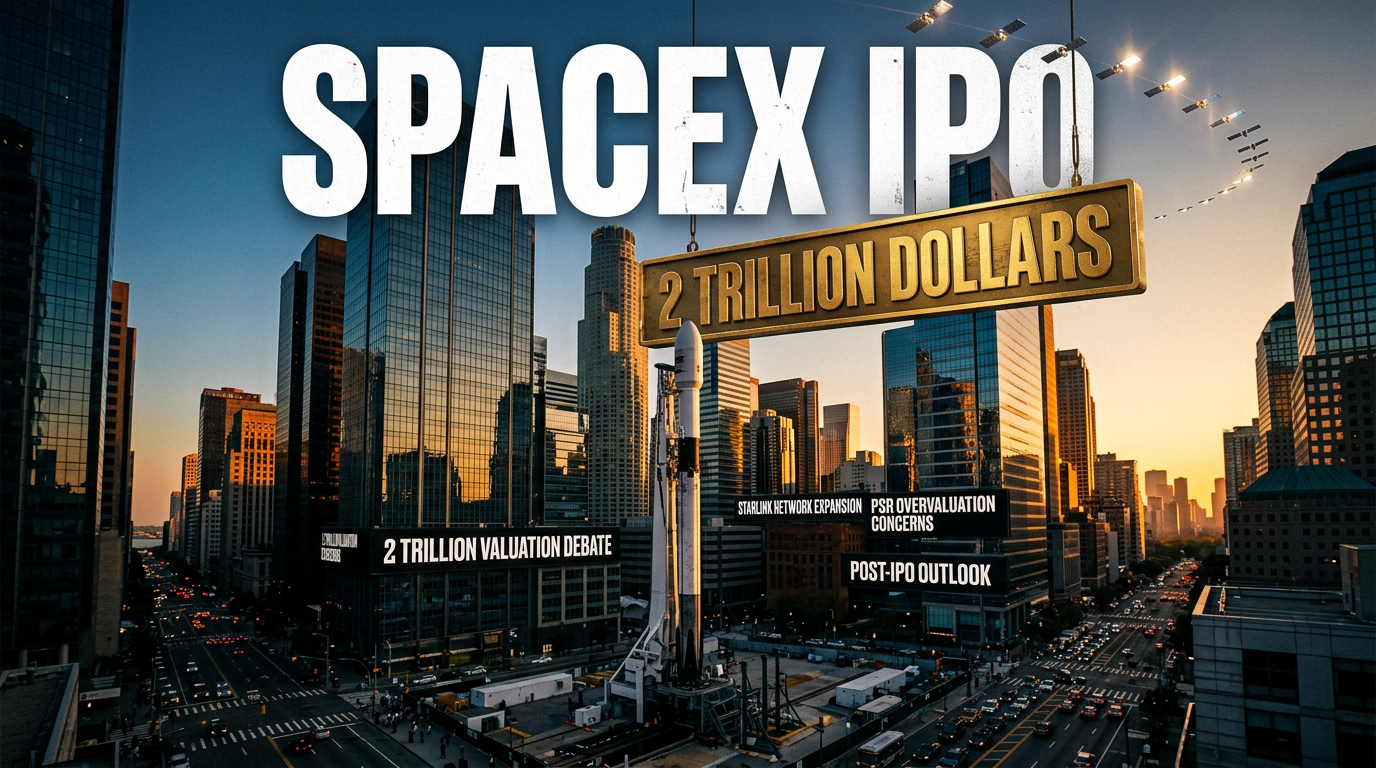
As SpaceX approaches its IPO and corporate valuation is being discussed at $2 trillion (about KRW 3,000 trillion), market sentiment is splitting into two major camps.
I understand that the price rises due to expectations for the “big trend in the space industry,”
but based on PSR (price-to-sales ratio), doubts about overvaluation are also growing at the same time.
So this article will focus on one thing only.
I’ll summarize, like news, why SpaceX valuation is a “possible story” (moat/growth/synergy) and at the same time why short-term overheating can occur (valuation/supply-demand/Musk risk/post-IPO flow).
And at the end, I’ll also package a “entry criteria checklist” readers can use right away.
(For reference, within the body, I’ll naturally connect today’s must-know keywords: AI infrastructure, satellite communications, rocket launches, corporate valuation (valuation), and investment timing.)
1) Where the $2 trillion SpaceX valuation controversy starts: “$1 trillion earlier this year → $2 trillion recently”
- In articles/market observations, SpaceX’s corporate valuation is
- Early this year: around $1 trillion (KRW 1,500 trillion)
- Later: upgraded to around $1.5 trillion
- Recently: suddenly being discussed up to $2 trillion
- In this process, the emotions investors feel are simple.
- “Isn’t it up too fast and too big?”
- “Even so, is there a strong enough reason to justify that price?”
What’s important here isn’t the ‘numbers’ themselves, but whether the actual performance drivers and revenue structure that lift those numbers truly exist.
2) It’s not a “rocket company,” it’s a “communications (satellite) company”: the core of the moat is Starlink
If you view SpaceX merely as a rocket-launch company, its value can be underestimated.
The center of this argument is this.
SpaceX’s real business pillar is communications, and the moat for that communications comes from Starlink (satellite communications).
Starlink growth rate
- Subscriber count expanding rapidly
- Based on market estimates
- Subscriber count by end of 2025: roughly around 10 million mentioned
- Additional growth expected even in 2026
Revenue size and margins
- Starlink revenue: estimated at roughly $20 billion (mentioned in the article)
- Margin: discussed as 50% or higher (based on article figures)
- In other words, the setup—“satellite communications growing quickly and profitability also high”—becomes material for a valuation premium.
Rocket launch share is relatively small
- A viewpoint being discussed is that rocket launches are about 20% of total synergy (mentioned in the article)
- Ultimately, the market is strongly inclined to pay a higher price not for “launch pricing,” but for “communications subscribers/service cash flow.”
3) ‘Launch + communications + AI’ synergy takes hold: connecting to data centers/AI infrastructure
The point here isn’t simple addition—it’s a “structure that expands revenue pathways.”
Tesla-style analogy: laying down the platform together with the core components like you’re embedding them in a transparent shroud
In the article, SpaceX’s rocket/satellite/network interlocking was described as “as if you embed the core components corresponding to a transparent sunroof.”
That is, it’s not separate technologies operating independently; it’s an interpretation that they expand into one integrated ecosystem.
Meaning of the XAI acquisition: bringing AI not as a ‘future,’ but as ‘infrastructure’
- The article mentions that SpaceX acquired XAI (mentioned in the article)
- The reasons cited are
- Not so much the AI technology itself as
- A goal to connect the construction of data centers/AI infrastructure with the space communications ecosystem
If this connection works, the market forms one more desired picture.
It gains justification to be viewed as an “expandable business” where simple satellite communications revenue flows through to AI infrastructure demand.
4) What valuation calculations tell you: PSR at 80x means “expensive” is the default
Now this is the core part of investment judgment.
The numerical flow assumed in the article is as follows.
From a PSR (price-to-sales ratio) perspective
- Total revenue estimate for 2026: about $25 billion
- If you plug the $2 trillion valuation directly in
- PSR comes out to about 80x (mentioned in the article)
- Even versus competing/peer companies (e.g., Rocket Lab), it’s still high
- Around 50–60x is mentioned
In conclusion, the calculation is clear.
Valuation itself is expensive.
However, the next items explain why the market would still “buy even if it’s expensive.”
5) The logic of a “premium that stays even when expensive”: expectations created by Musk (Tesla case)
The representative argument presented in the article is this.
Even though Tesla was extremely expensive at one point by PER standards, the viewpoint is that the market had reasons to keep granting a premium “despite that.”
Conditions for the premium
- Elon Musk’s vision functions as a “story of business success”
- When it succeeds, the profit potential is judged to be enormous
- So, expectations for future cash flows—not just simple numbers—get reflected in the price
In other words, it’s interpreted that SpaceX is on the same track.
However, there are realistic caveats attached here.
That premium can wobble until success is proven.
6) Supply-demand dynamics at listing (IPO) can amplify the bubble: ETF special provisions + institutional inflows
For a heavyweight like SpaceX, the listing event itself can influence supply-demand.
There are two points mentioned in the article.
Observations that ETF money could flow in quickly
- Nasdaq-tracking ETFs like QQQ usually introduce inclusion funds slowly
- But this time,
- special provisions are being discussed that could speed up ETF fund deployment after SpaceX lists
- Moreover
- You must hold exposure to the Nasdaq
- You must hold exposure to a space/aviation ETF
- The more related ETFs there are in the market, the more “simultaneously required” the demand becomes.
With this combination, prices can jump more in the short term.
So if the expectations before listing overlap with the supply-demand immediately after listing, the bubble can grow.
Conversely, there’s also the issue of lock-up (mandatory holding) expiration
- Lock-ups commonly restrict selling for a certain period after IPO (e.g., 6 months)
- But not all investors may be stuck in lock-ups
- At the moment the lock-up ends
- a flow can also appear where “the good expectations fade quickly.”
7) Musk risk: an “owner variable” that creates stock price volatility separate from technology/business risk
This is also the part people are most uneasy about in this article.
Just like the Tesla case, if Musk statements or issues shake the stock price significantly, investors feel burdened.
Why it looks like a ‘risk’
- Short-term stock price trends are influenced strongly not only by performance but also by news/sentiment
- The more the structure gives the owner strong influence, the more volatility can increase
In the article, the conclusion is close to this.
- Musk risk is difficult to avoid
- But for long-term investors who believe in Musk’s vision, it actually becomes a “prerequisite”
Depending on investor personality, the conclusion may differ here.
8) “Entry criteria” organized for investors: a fight between short-term overheating vs long-term growth
The real operational perspective emphasized in the article can be summarized like this.
Financial perspective conclusion: PSR/EBITDA suggests it’s ‘expensive’
- PSR: discussed as around 80–100x
- EBITDA also being discussed at high multiples
- So you need the premise that it’s not a “cheap stock.”
If growth rates hold up, it may look ‘less expensive’ over time
- If you assume the annual growth rate stays high (e.g., around 70–80%)
- Then over time, the PSR multiple can fall and become rationalized
- The core point is whether growth continues.
Even typical scenarios like a 30–40% correction right after listing may be possible
- After IPO, short-term overheating → taking profits → correction patterns often appear
- If a correction actually happens
- a staged buying strategy could be realistic
- Conversely, if there’s no correction and it keeps rising
- late-chasing buy-ins could become risky.
The most important one-line takeaway
SpaceX has a strong “technology moat (future),” but because of the listing event (supply-demand/sentiment), the short-term price is likely to be expensive.
That’s why you need to separate the ultra-long/long-term view from the short-term trading view.
9) Instead of direct investment, can indirect investment through a space ETF also be a strategy?
The article raises a question like this.
“When SpaceX lists, will a space ETF rise too?”
The answer isn’t a complete yes/no certainty, but the view is that it’s possible as a strategy.
Why a space/aviation ETF could move together
- A heavyweight listing can create a sector-wide re-rating effect
- Even just the SpaceX issue alone
- scenes where space/aviation-related stocks rise together could occur
- Therefore, indirect investment is discussed from the perspective of “reducing direct risk while getting sector exposure.”
10) The market’s strongest imagined scenario: could SpaceX combine with Tesla?
The article also includes scenarios that feel close to fantasy.
- “SpaceX will do an acquisition/merger with Tesla”
- “If they merge into one, the market cap could even exceed Apple”
However, this isn’t confirmed—it’s closer to a “narrative about possibility,” and
in investment decisions, you should separately check evidence/timeline/probability.
Even so, when stories like this emerge, the market tends to assign a higher premium to the “best-case scenario.”
5 of the most important takeaways from this article—things not covered well elsewhere
- SpaceX’s essence is not rockets, but a satellite communications (Starlink) moat
- The viewpoint that launch revenue share is relatively small changes the logic behind valuation
- A PSR of 80x leads to the conclusion of “it’s expensive”
- The justification logic depends on continued growth + expected premium rather than current results
- ETF special provisions + mandatory inclusion across many ETFs = supply-demand after listing can amplify the bubble
- Lock-up (selling restriction) release timing can become a trigger for a correction
- Musk risk is not a technology/business risk but a ‘stock volatility risk’
- In other words, the owner variable is the key factor that splits investment strategy (long-term vs short-term)
Main points to convey (investor perspective conclusion)
SpaceX’s corporate valuation of $2 trillion isn’t exactly “groundless fantasy,” but rather,
- Starlink’s growth and high margins
- synergy that flows from rocket-to-communications-to-AI infrastructure
- the Musk premium (market behavior shown by Tesla)
There are clearly parts that can be explained by this combination.
But at the same time,
- On a PSR basis, the conclusion still leans toward overvaluation
- Short-term overheating could grow due to supply-demand from the listing event (ETF special provisions/opening up to heavyweights)
- Short-term volatility could be amplified due to lock-up release and owner variables
Because of this, you should approach by separating the long-term view and the short-term view.
Finally, when deciding “Should I enter now?”
the key standard is likely to be whether the growth rate can keep holding up (whether the assumption of 70–80% growth continuing becomes realistic) + a staged approach that accounts for the possibility of a post-listing correction.
< Summary >
- SpaceX’s $2 trillion valuation is underpinned by synergy flowing from Starlink’s fast growth and high margins into AI infrastructure.
- However, under the 2026 revenue assumptions, the PSR calculates to about 80x, so “it is expensive” is basically correct.
- Even so, the market may reflect “expectations of success” into the price like the Musk premium.
- ETF inclusion special provisions and demand across multiple ETFs can amplify a bubble right after listing, and the timing of lock-up release can become a trigger for a correction.
- Musk risk is a stock volatility risk rather than a technology/business risk, so you should decide your investment horizon (long-term vs short-term) first.
- If the direct entry burden is large, indirect investment such as a space/aviation ETF can be an alternative.
[Related articles…]
- Latest article on Starlink growth and satellite communications market outlook
- Latest article on how to judge PSR overvaluation and post-IPO stock price trends
*Source: [ 월텍남 – 월스트리트 테크남 ]
– 스페이스X 기업가치 2조 달러? IPO 전에 반드시 확인하세요