● Tesla Rebound, Oil Shock, BYD Slump
Reasons to Reassess Tesla: Crude Oil Spike, European Sales Rebound, and BYD Deceleration
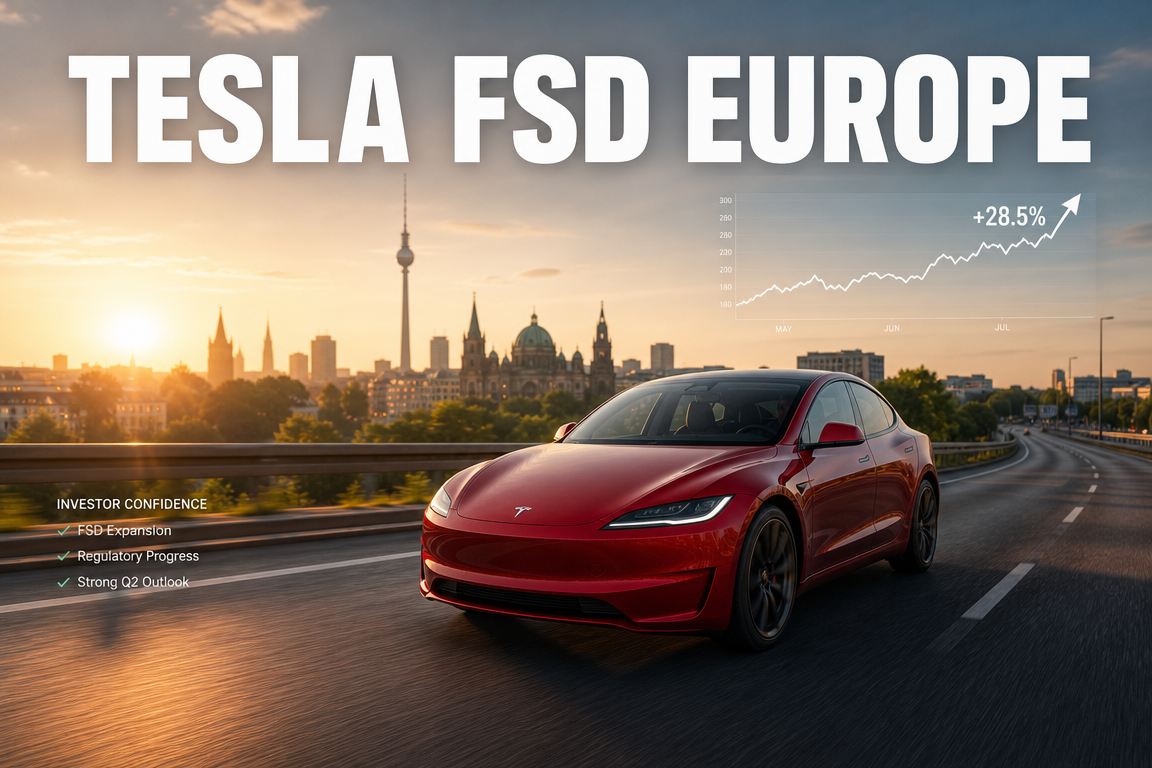
This development is not limited to Tesla’s share price approaching $400. The current move reflects overlapping factors: a renewed rise in global crude oil prices, shifting European EV demand, BYD’s eight-month sales slowdown, and a reassessment of Tesla’s autonomy and AI strategy.
Many reports focus only on the outcome—“Tesla is selling again in Europe.” The more material questions are: what drove the shift in consumer behavior, whether the rebound is cyclical or structural, and what it signals for the EV market and the global macro outlook.
This report summarizes the drivers behind Europe’s sales rebound, the implications of BYD’s decline for industry positioning, and whether Tesla should be evaluated primarily as an automaker or as an AI-enabled platform company.
1. Key Developments at a Glance
- Tesla shares closed at $390.82, up for a second consecutive session.
- April Tesla sales in Europe increased sharply: France +112%, Denmark +102%, Netherlands +23% (YoY).
- BYD April total sales declined -15.5% YoY, marking an eighth consecutive monthly decline.
- Higher oil prices and Europe’s energy-cost burden are supporting renewed EV demand.
- Expectations for European approval of Tesla FSD are contributing to a re-rating of software profitability.
While the surface narrative reads as “Tesla positive, BYD negative,” the underlying picture points to concurrent shifts in consumer spending priorities and competitive dynamics.
2. Why Tesla Sales Surged Again in Europe
2-1. The Data Indicates a Meaningful Inflection
April YoY Tesla sales growth in key European markets:
- France: +112%
- Denmark: +102%
- Netherlands: +23%
These figures stand out given Tesla’s weaker performance across Europe during 2024–2025, often attributed to negative consumer sentiment tied to Elon Musk’s public and political profile. The recent reversal suggests additional drivers are now dominant.
2-2. Primary Driver: Fuel Prices and Energy Costs
A practical catalyst is the energy-cost environment. Elevated crude prices—supported by Middle East geopolitical risk and concerns around the Strait of Hormuz—translate into higher perceived ownership costs for internal combustion vehicles in Europe.
As fuel prices rise, consumer decisions tend to shift from brand preference toward operating-cost optimization. In this framework, EV demand can strengthen even if brand sentiment is mixed.
2-3. European EV Demand Is Shifting From Values to Economics
European EV purchase decisions appear to be moving from “environmental/innovation signaling” toward total cost of ownership (TCO): fuel/charging costs, maintenance, and residual value.
This shift can benefit Tesla due to:
- High brand recognition
- Relatively mature charging ecosystem and user experience
- Integrated software stack and perceived product reliability at scale
When consumers prioritize near-term cost reduction, market share often consolidates toward familiar, validated options.
2-4. Secondary Driver: Anticipation of FSD Approval in Europe
Expectations around Full Self-Driving (FSD) in Europe have increased following preliminary progress with the Dutch vehicle authority (RDW) and subsequent EU-level approval pathways.
Strategic relevance:
- FSD expansion supports a higher-margin software/subscription revenue model.
- European approval could shift investor framing from “vehicle unit sales” toward “vehicle-based AI services,” with valuation implications.
3. BYD’s Eight-Month Decline: Why It Matters More Than a Single Weak Print
3-1. The Slowdown May Indicate Structural Pressure
BYD reported April sales of approximately 321,000 units, down -15.5% YoY. The more material point is duration: eight consecutive months of YoY declines.
This pattern is consistent with intensifying competitive pressure and a more challenging profitability backdrop, particularly in China’s mass-market segments.
3-2. China’s EV Price War Is Compressing Margins, Including for Leaders
China remains the largest EV market but is also the most price-competitive. The trade-off is structural:
- Cutting prices may defend volume but weakens margins.
- Holding price risks share losses.
Even with scale and cost advantages, sustaining profitability becomes more difficult as the market deepens into low-price competition, compounded by subsidy normalization.
3-3. Overseas Growth Remains a Countertrend
BYD’s overseas sales reportedly rose +35% YoY in April. This implies a strategic pivot:
- As domestic growth and pricing deteriorate, BYD may intensify its push into Europe and other export markets.
As a result, BYD’s domestic weakness should not be interpreted as reduced competitive risk in Europe; it may increase the probability of aggressive pricing and volume strategies abroad.
4. Europe’s Tesla Rebound: Intrinsic Strength or Macro-Driven?
4-1. Both Factors Are Material
The rebound is not fully explained by Tesla’s product competitiveness alone, nor solely by macro conditions. A more defensible interpretation is:
- Macro conditions stimulated incremental EV demand, and Tesla captured a meaningful portion of that demand due to its established market position.
4-2. Macro Tailwinds Are Clear
- Higher oil prices improve EV relative economics.
- European consumers are increasingly sensitive to fuel and energy costs.
- Energy insecurity is being treated as a medium-term risk, not a transient shock.
These conditions support the broader EV category rather than Tesla specifically.
4-3. Tesla’s Company-Specific Advantages Still Matter
Key strengths relevant to conversion of category demand into brand sales:
- Brand awareness
- Software-centric product perception
- Charging convenience
- FSD optionality
- Positioning as a mainstream default choice
Fuel-cost pressure does not automatically translate into purchases for all EV brands; brand selection remains decisive.
4-4. Competitive Pressure Remains Elevated
Local OEMs and Chinese brands continue to build presence across Europe. If BYD accelerates its export strategy, the European market could shift toward more intense price and margin competition. The current rebound does not confirm a return to sustained dominance.
5. Why Tesla Shares Are Approaching $400 Again
5-1. The Market Is Pricing Both Near-Term Data and Long-Duration Optionality
Key contributors cited by the market:
- European sales recovery signals
- BYD deceleration narrative
- Broader U.S. equity strength
- Semi ramp expectations
- Reassessment of FSD and robotics optionality
Near-term sensitivity remains tied to deliveries, regional mix, and automotive margins.
5-2. Tesla Is Not Being Valued Solely as an Automaker
A key framing:
- Near-term performance is driven by vehicle economics, while valuation premium is linked to AI, autonomy, and robotics.
Understanding share price behavior requires separating current cash-generation from long-duration platform optionality.
6. Tesla: Automaker or AI Company?
6-1. The Binary Framing Is Increasingly Inadequate
Tesla operates as both an automaker and an AI-driven platform. A more precise view is a company using AI as a core operating layer to sell vehicles and, potentially, robots.
6-2. Vehicles Drive Current Cash Flow; AI and Robotics Drive Investment
Most revenue and cash generation remain automotive. However, capital and operating investment are concentrated in:
- AI training infrastructure
- Custom silicon and compute
- Autonomy software
- Cybercab/robotaxi initiatives
- Optimus and robotics development
This differs from traditional OEM capital allocation, which is typically centered on manufacturing capacity expansion and model proliferation.
6-3. Capital Allocation May Become the Primary Medium-Term Signal
For short-horizon investors, deliveries and margins remain decisive. For medium- to long-horizon investors, the key variable is whether spending translates into scalable AI/autonomy and robotics capabilities that warrant non-OEM valuation frameworks.
7. Underemphasized but Material Takeaways
7-1. The European Rebound Appears Driven More by Cost-of-Living Pressure Than Brand Sentiment
Consumer behavior is increasingly constrained by operating costs. EV interest under these conditions can persist longer than sentiment-driven demand.
7-2. EV Competition Is Shifting From Sticker Price to Operating Cost and Software Value
Consumers are incorporating fuel/charging, maintenance, and software functionality into purchase decisions. This favors companies with integrated ecosystems and monetizable software roadmaps.
7-3. The Greater Risk Is Not BYD’s Decline, but Potential Intensification of Its Export Push
Domestic pressure may lead BYD to compete more aggressively abroad, increasing the likelihood of European price compression.
7-4. The Primary Valuation Framework for Tesla May Be Transitioning
While automotive results still drive near-term volatility, AI infrastructure execution, FSD commercialization, robotaxi progress, and Optimus milestones are increasingly positioned to influence the equity narrative.
8. Forward Indicators to Monitor
8-1. Duration of Elevated Global Oil Prices
Sustained high oil prices could support European EV demand. Rapid oil normalization may reduce the magnitude of the current tailwind.
8-2. Timing of FSD Approval in Europe
This is not a feature update; it is a potential pathway to recurring software revenue in a major market. Regulatory progress could affect market perception of long-term margins.
8-3. BYD’s European Strategy
A stronger export push could shift the European competitive set toward intensified pricing and margin competition.
8-4. Tesla Execution in AI and Robotics
To sustain a premium valuation, evidence of measurable progress beyond automotive—robotaxi economics, software uptake, robotics deployment, and AI infrastructure productivity—will be increasingly important.
9. Integrated View: Tesla May Be in a “Reclassification” Phase
The current environment extends beyond a sales rebound. Europe’s energy-cost pressure is supporting EV demand, BYD’s domestic constraints may increase its export aggressiveness, and Tesla is simultaneously benefiting from improving delivery signals and AI-driven valuation optionality.
This supports the interpretation that the market is progressively reclassifying Tesla from a pure automaker toward an AI-enabled mobility and robotics platform, with Europe’s sales data serving as an early confirmatory datapoint for near-term demand resilience.
10. Investor-Focused Summary (News Format)
- Tesla posted a sharp rebound in April sales across key European markets, improving near-term demand expectations.
- The primary driver appears to be energy and fuel-cost pressure rather than a reversal in brand sentiment.
- Anticipated progress on FSD approval in Europe is contributing to a re-rating of potential software margins.
- BYD’s eight-month decline signals domestic competitive intensity, while raising the probability of more aggressive overseas expansion.
- Tesla’s equity move reflects a combination of near-term automotive signals and longer-duration AI/robotics optionality.
< Summary >
Tesla’s recent upside is not solely a price rebound.
The key driver behind the European sales surge is rising fuel costs and cost-of-living pressure rather than improved sentiment toward management.
BYD’s eight-month decline highlights intensifying competition in China, while potentially increasing the likelihood of more aggressive pricing and volume strategies in Europe.
Tesla continues to generate cash flow primarily from vehicles, while autonomy, AI, and robotics increasingly shape valuation framing. The market appears to be shifting toward evaluating Tesla as an AI-enabled mobility and robotics platform rather than a conventional OEM.
[Related Articles…]
- Tesla Europe sales rebound and EV market restructuring analysis: https://NextGenInsight.net?s=Tesla
- Implications of BYD’s sales deceleration for global EV competition: https://NextGenInsight.net?s=BYD
*Source: [ 오늘의 테슬라 뉴스 ]
– 머스크가 싫어도 기름값 오르면 테슬라 산다 — 유럽 +112% BYD 8개월 하락, $390 지금 어떻게?
● Inheritance Bombshell, Family Feud, Legal Trap, Will Shock
A Single Misplaced Seal Can Be Final: Why Inheritance Disputes Break Families and How to Respond
This report consolidates the structural drivers of inheritance conflict and the principal legal and operational risks across wills, forced heirship shares, limited acceptance, inheritance waiver, nonmarital children’s succession rights, and inheritance partition agreements. It emphasizes high-impact failure points that are frequently understated in mass media, including the legal effect of signatures/seals, debt succession risk, will validity disputes involving cognitive impairment, and common breakdowns in family “agreements” that lack documentary support.
In an environment where wealth management, tax planning, inheritance tax, gifting, and legal risk are increasingly intertwined, inheritance should be treated as a financial and governance issue with material implications for household balance sheets and family continuity.
1. Key Briefing: Inheritance Can Trigger Breakdown of the Family System
Inheritance disputes are rarely limited to asset allocation. Conflicts typically arise when perceived favoritism, unequal sacrifice, and accumulated grievances become coupled with distribution outcomes. While the law evaluates rights and evidence, family members often frame the issue in terms of emotion, memory, and perceived injustice. Litigation frequently becomes a loss-minimization process rather than a value-creation process, with documented spillovers into health outcomes and permanent relationship rupture.
2. Why Inheritance Escalates into Conflict
2-1. The Legal Framework and the Family Narrative Diverge
Typical family claims:
- “I provided care for longer.”
- “He already received more during life.”
- “I was discriminated against as a daughter.”
- “That person harmed the family.”
Core legal questions:
- Identification of statutory heirs
- Prior lifetime transfers and their treatment
- Whether forced heirship shares were infringed
- Will validity
- Whether an inheritance partition agreement was validly formed
Evidence, not recollection, determines outcomes. Wider gaps between these frames correlate with prolonged disputes.
2-2. “Trust-Based” Arrangements Are High Risk
Common statements:
- “He said he would sell later and split the proceeds.”
- “She said to put it in her name first.”
- “They said caregiving would be recognized.”
These commitments are often undocumented. Once a formal agreement is executed, courts prioritize the written instrument; later assertions about oral promises have limited probative value.
2-3. Inheritance Aggregates Historical Grievances
Latent conflicts often surface after the decedent’s death:
- Childhood discrimination
- Unequal support among siblings
- Perceived favoritism
- Unequal caregiving burdens
- Remarriage, nonmarital children, undisclosed family relationships
These are frequently expressed through the mechanics of asset partition.
3. Highest-Risk Point: A Single Signature/Seal Can Be Irreversible
3-1. Do Not Execute an Inheritance Partition Agreement Without Full Review
A validly concluded inheritance partition agreement is difficult to unwind. Claims such as:
- “I did not read it carefully.”
- “I trusted my family.”
- “I expected a later adjustment.”
are generally insufficient. Invalidity or rescission typically requires strong proof of fraud, duress, forgery, or unauthorized representation.
3-2. The Legal Weight of a Signature/Seal Is Substantial
A document bearing a person’s seal/signature and meeting formal requirements is generally presumed authentic. The party alleging misuse or non-authorship bears the burden of proof. Informal custody of seals within the family creates enforceable risk if later proof is unavailable.
3-3. Practical Controls
- Do not sign under time pressure or social coercion.
- Reject “sign now, discuss later.”
- Embed any conditions and commitments directly into the written agreement.
- Obtain legal review where language is ambiguous.
4. Nonmarital Children: Equal Succession Rights in Law
4-1. Statutory Principle
Children born outside marriage, if legally recognized as children of the decedent, generally hold succession rights equivalent to children born within marriage.
4-2. Structural Conflict Drivers
Both sides often perceive victimhood: marital-family heirs may focus on betrayal and harm; nonmarital heirs may focus on exclusion and concealment. The decedent is absent, leaving the surviving family to absorb the conflict.
4-3. A Will May Not Fully Resolve the Issue
Even with a will allocating most assets to a specific heir, other heirs may pursue forced heirship share claims. A will is influential but not always dispute-proof.
5. Wills: Resolution Tool or Litigation Trigger
5-1. Baseline Effectiveness
A properly executed will is generally respected and can reduce negotiation friction, particularly when allocation of real estate, deposits, and specified assets is clear.
5-2. Why Will Litigation Is Common
Primary drivers:1) Capacity at the time of execution
2) Forced heirship share claims
Late-stage drafting during illness or early cognitive decline increases the probability of challenges alleging incapacity or undue influence.
5-3. Dementia and Capacity: Core Dispute Mechanics
A dementia diagnosis does not automatically invalidate a will. Validity may be sustained if execution occurred during a lucid interval with sufficient capacity. The practical issue is evidentiary: who can objectively prove capacity at execution.
5-4. Execution Risk Controls
- Draft with specificity and clarity.
- Record the rationale for unequal distributions.
- Stress-test allocations against forced heirship share exposure.
- Consider notarized will formats with higher formal reliability.
- Preserve objective evidence (e.g., recorded statements) documenting voluntary intent and rationale.
6. First 3 Actions After a Parent’s Death
6-1. Prioritize Funeral Administration; Retain Cost Evidence
Avoid initiating inheritance negotiations during funeral proceedings. Preserve invoices and receipts for later accounting and tax handling.
6-2. After Death Registration, Rapidly Map Assets and Liabilities
Use the government one-stop “peace-of-mind inheritance” inquiry process to identify major assets and debts. The operational priority is a consolidated net position, not headline asset value.
6-3. If Liabilities Dominate, Evaluate Limited Acceptance or Waiver
If debt may exceed assets, heirs should promptly consider limited acceptance or inheritance waiver. The decision window is typically 3 months from the date the heir became aware of the inheritance opening; missed deadlines can convert contingent risk into personal financial exposure.
7. Debt Succession: Material Financial Risk
7-1. Debts Transfer With Assets
Succession generally includes both rights and obligations.
7-2. Waiver vs. Limited Acceptance
- Inheritance waiver: rejects succession entirely.
- Limited acceptance: accepts succession but limits debt repayment to the value of inherited assets (e.g., assets 100m, liabilities 10bn; liability exposure capped at 100m under proper limited acceptance).
7-3. Household Finance Implications
Delayed assessment can impair cash flow and destabilize personal portfolios. Higher risk cases include self-employment, personal guarantees, private lending, and unpaid obligations.
8. Sibling Disputes: High Incidence in Ordinary Families
8-1. Caregiver Claims vs. Prior Transfers
Two common collision points:
- The child who provided day-to-day care asserts greater entitlement.
- Other siblings assert that one party already received substantial lifetime benefits.
8-2. Contribution Share vs. Special Benefit Accounting
Legal concepts often central to allocation:
- Contribution share for extraordinary support in asset formation/maintenance
- Special benefit treatment for lifetime gifts or transfers to a particular heir
Misunderstanding these frameworks frequently escalates negotiations into moral accusations and negotiation collapse.
9. Preparation While Parents Are Alive
9-1. Consolidate an Asset/Liability Inventory
If heirs lack visibility into deposits, real estate, insurance, loans, tax arrears, and business-related debts, post-death reconstruction becomes time-constrained and error-prone.
9-2. Execute Wills While Healthy
Late drafting increases capacity challenges and dispute probability. Early planning is also generally more tax-efficient.
9-3. If Distributions Are Unequal, Document the Rationale
Justifications may include caregiving, long-term nursing support, business support, or economic vulnerability. Absent a credible rationale, disputes become more likely.
9-4. Where Serious Misconduct Exists, Preserve Records
In the context of evolving disqualification discussions, credible documentation of severe abuse or coercive conduct may be relevant. Without records, claims can be contested posthumously.
10. Forced Heirship Shares: Central Dispute Vector Even With a Will
Forced heirship shares provide a minimum protected portion for certain heirs. Concentrated allocations can trigger forced heirship share restitution claims. Effective inheritance design must jointly assess gifting history, forced heirship exposure, asset valuations (notably real estate), and inheritance tax constraints.
11. Core Documentation for Asset Tracing
11-1. One-Stop “Peace-of-Mind Inheritance” Inquiry
Useful for identifying major financial assets, liabilities, and certain administrative records.
11-2. Detailed Local Tax Itemized Assessment Certificate
Material for reconstructing historical asset ownership. Longer lookback issuance can help detect disposals suggesting lifetime gifting, relevant to forced heirship share analysis.
11-3. Real Estate Registry and Transfer Flow Review
Tracking title changes can clarify prior transfers and concentration risk. In practice, inheritance disputes are evidence-driven.
12. Why Inheritance Litigation Is Structurally Costly
Cases often extend beyond 1 year and can run 2–3+ years. Parties are exposed to repeated adversarial filings, historical grievance reactivation, and sustained stress, with documented deterioration in health and permanent relationship impairment. From a risk-management standpoint, the objective is dispute prevention and containment rather than litigation optimization.
13. Underemphasized High-Impact Points
13-1. The Primary Risk Is Prolonged Family Silence
Delaying planning increases the probability that capacity, undue influence, and unequal transfer issues converge simultaneously.
13-2. Inheritance Is Often Treated as Recognition Allocation
Disputes frequently reflect perceived parental evaluation rather than pure financial distribution.
13-3. Conflict Intensity Correlates With Real Estate Price Cycles
Rising property values can transform previously manageable allocations into high-stakes disputes, linking inheritance risk to macro asset-price dynamics.
13-4. Gifts and Inheritance Must Be Analyzed as a Single System
Lifetime transfers often determine post-death litigation posture. Gift tax, inheritance tax, forced heirship shares, and transaction records should be assessed jointly.
14. Operational Checklist
14-1. Heir Checklist
- Avoid asset negotiations during funeral proceedings.
- Use the one-stop inheritance inquiry after death registration.
- Assess liabilities before focusing on assets.
- Evaluate limited acceptance or waiver within 3 months.
- Do not sign partition agreements immediately.
- Convert oral commitments into written terms.
- Identify evidence of lifetime transfers via records.
14-2. Parent Checklist
- Prepare a will while healthy.
- If allocations differ, document specific reasons.
- Validate the plan against forced heirship share exposure.
- Maintain a basic asset/liability inventory.
- Preserve objective intent evidence if necessary.
- Recognize that highly concentrated allocations elevate dispute probability.
15. Conclusion
Inheritance risk begins before death. Without early communication and documentation, families may incur the highest costs in relationship loss, health impacts, and prolonged legal exposure rather than in taxes alone.
< Summary >
- The primary drivers of inheritance disputes are recognition and accumulated grievances, not only asset value.
- Executing an inheritance partition agreement without review is difficult to reverse.
- Nonmarital children may have equal succession rights if legally recognized.
- Wills can reduce disputes but remain exposed to capacity and forced heirship share challenges.
- Debts transfer through succession; liabilities must be assessed early.
- Limited acceptance and inheritance waiver require action within 3 months.
- The most effective approach is dispute avoidance through early planning, documentation, and integrated gift/inheritance design.
[Related…]
- Inheritance dispute guide (latest): https://NextGenInsight.net?s=inheritance
- Pre-will checklist: https://NextGenInsight.net?s=will
*Source: [ 경제 읽어주는 남자(김광석TV) ]
– [풀버전] 도장 한 번 잘못 찍으면 끝입니다… 변호사가 말하는 상속이 가족을 무너뜨리는 진짜 이유 | 경읽남과 토론합시다 | 채애리 변호사