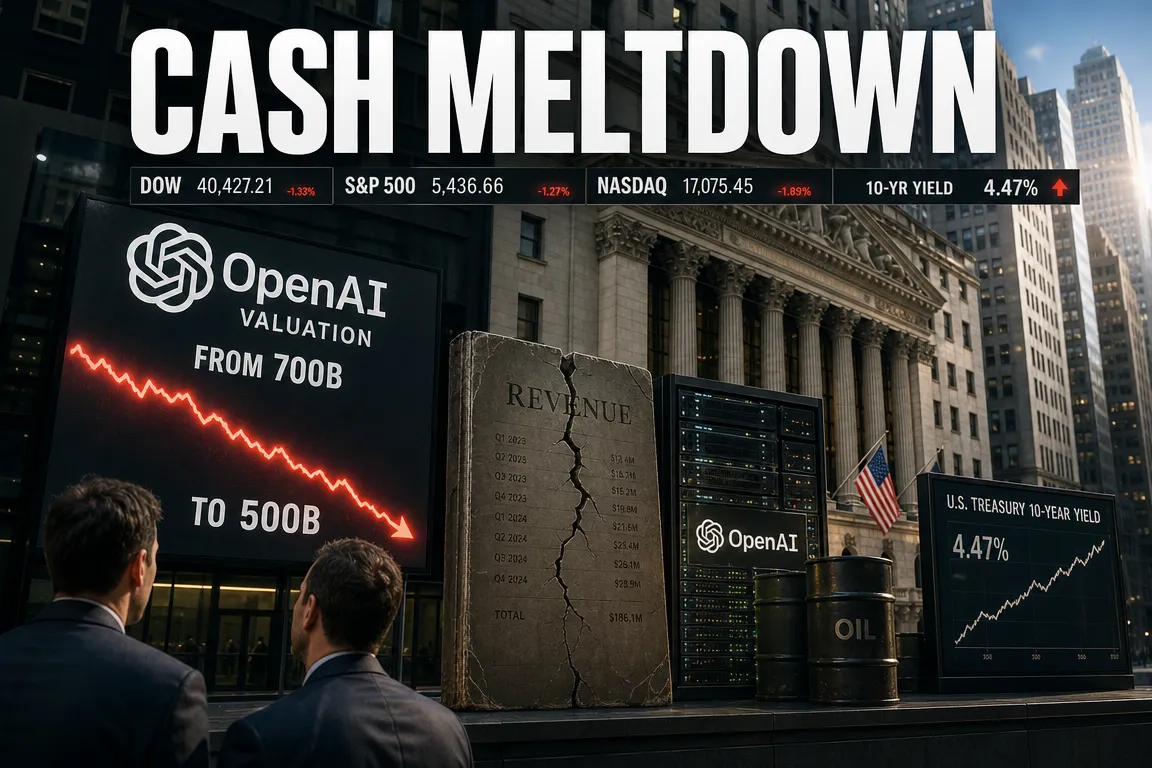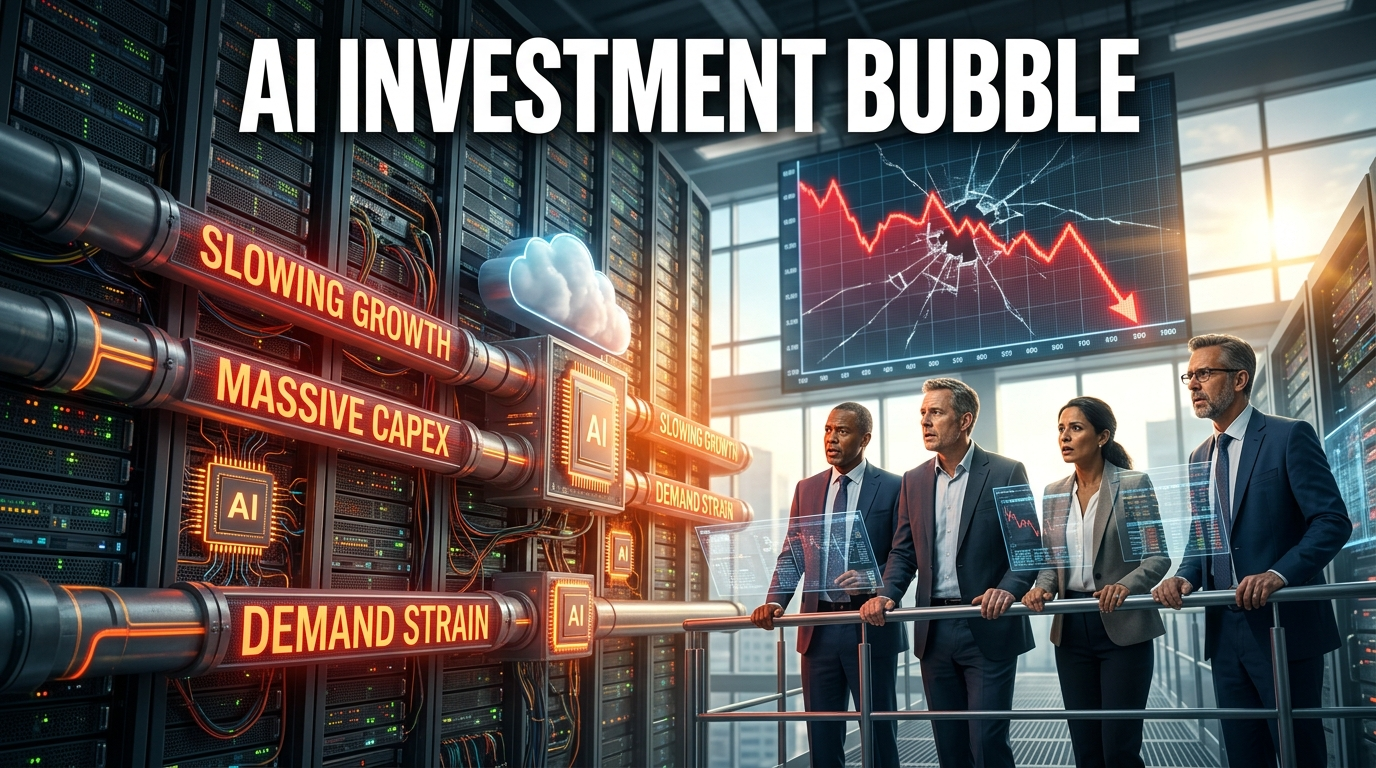
● AI Bubble Anxiety Drives Big Tech Earnings Boom
“$1000 Trillion AI Investment per Year” Becomes Reality…Why Google and Amazon’s Results Are Thriving, and the Main Debate Is Spreading into an “AI Bubble”
3 Points to Check Right Now (Key Takeaways that Must Be Included in This Article)
- The Big Tech Four’s earnings are “generally good,” but the reason the stock reaction diverges lies in cloud growth rates and CAPEX (investment) burdens
- Why Google (Alphabet) and Amazon were especially strong: rapid growth in generative AI revenue + increase in backlog + signals of “AI demand exceeding supply”
- The “AI bubble” at the center of the controversy should be judged not as a simple bubble argument, but by how the pace of investment (= CAPEX) pressures cash flow (FCF) and valuation
News Headline: Two Big Tech Firms Hit New Highs, Two Fall Short…The Background Is the Difference Between “Making Money from AI” vs “Spending Money on AI”
- Alphabet (Google): Sharp rise after-hours + adjusted EPS (earnings per share) expectations far exceeded
- Amazon: Upward stock momentum maintained after earnings release + both adjusted EPS and revenue exceeded estimates
- Common ground: cloud was strong, and metrics related to generative AI improved in tandem
- Differences:
- Google and Amazon show a pattern of “demand overwhelming supply”
- Meta and Microsoft have a more mixed perception of how the market “feels” the return relative to investment, making the evaluation more demanding
Core News 1) Alphabet (Google): “Earnings Spoke in Numbers, and the Future Was Unlocked by Cloud”
1) EPS Was “Double” the Estimate…But the Real Reason Also Included “Unrealized Gains on Investment Equity Valuation”
- EPS of 5.11, well above market expectations (in the 2s)
- This part isn’t interpreted as a mere accounting event; it’s seen as Google’s investment capabilities being reflected in the results
- The key explanation is that Google strengthened the numbers by recognizing unrealized valuation gains from equity investments it already held in private companies
2) Growth Accelerates Again…22% Growth, the Highest Since 2022
- As company size grows, growth slowdown is generally expected
- But this time, the pattern is growth actually speeding up
- The market responded to the signal that it “grew through the base effect”
3) The Most Important Metric: Google Cloud Grew by 63%
- Google Cloud growth rate is 63%
- Comparison context (global cloud competitive landscape):
- Microsoft Cloud: references to growth in the 40% range
- Amazon Web Services (AWS): references to growth in the 20% range
- The point isn’t the number itself so much as the sense that AI infrastructure demand is concentrating in one direction, creating a growth gap
4) Generative AI Revenue: Up 800% Year over Year
- Gem AI/generative product revenue surged by about 800%
- Many B2B (enterprise) customers are moving toward using generative AI “immediately,” directly within development and operations
- In other words, it’s a signal that AI is entering as a “work tool,” not just a “demo”
5) Backlog (future revenue conversion potential): $46 Billion
- Backlog is large and trending upward
- It works as evidence that it’s likely to convert into revenue in the near future
- A repeated tone emerges: “We want to sell more AI servers, but we lack computing resources”
6) A Point the Market Can’t Ignore: Ads Held Up Too
- There were concerns about “cannibalization,” where AI summaries appear first in search and ads could weaken
- Yet ad revenue continued additional growth
- The more important interpretation: even if AI changes the search experience, the ad revenue model hasn’t been completely lost
7) Why the Stock Held Up Even with CAPEX Expansion
- The announcement came that investment would expand (CAPEX increased), but the stock didn’t break down
- The reason is simple: it looked more likely that investment (= cost) would be offset by a greater possibility that excess demand would lead to revenue
8) From a “Full-Stack AI” perspective: The power of combining your own chips + models + services
- Google secured competitiveness in compute infrastructure with its own chips (e.g., the TPU line)
- On top of that, models (Gemini AI) and services like search/office/cloud are tightly connected
- The evaluation is that it’s not just that AI is in vogue—it’s defending with an in-house ecosystem
Core News 2) Amazon: “AWS Growth Accelerated, and Changes in OpenAI Accessibility Pulled Demand Even More”
1) Adjusted EPS Beat Expectations…And the Reason Was Also Unrealized Valuation Gains from an Anthropic Stake
- Adjusted EPS came in well above expectations
- Unrealized valuation gains from Anthropic were cited as a factor
- In the end, both Google and Amazon had aspects where their investment portfolios lent strength to the reported earnings numbers
2) Revenue Also Exceeded Expectations (about 17% mentioned)
- This wasn’t just an accounting event; core business revenue followed through
- It gave the market a moment to accept that “investment doesn’t just mean spending more and that’s the end”
3) AWS Growth Rate: 28%…The “growth slope” turns upward again
- The growth rate for the previous quarter was already good, but this time the trend goes even higher
- The interpretation that “customers that need to build AI infrastructure keep increasing” is dominant
- At the same time, because AWS has a high market share, the growth rate works more meaningfully
4) Bedrock (foundation stack) spending grew 170%
- Providing OpenAI and Anthropic models through AWS caused customer spending to surge
- The key is that a platform change holding the models connected demand to AWS
- In other words, the use of generative AI ultimately boils down to where it’s hosted, and AWS becomes the hub in that flow
5) Termination of the OpenAI exclusive contract → A structure where Amazon benefits
- Previously, it felt like OpenAI was offered mainly through a specific cloud provider
- Now, a situation has formed where Amazon can also offer OpenAI models as services
- As a result, the customer path strengthens: “to use OpenAI, you move to the cloud”
6) CAPEX expansion…This time it’s evaluated as “investment-demand alignment” rather than “risk”
- Even after expanding investment, the stock didn’t swing dramatically
- Because earnings were better, and the message that demand is creating supply shortages came along with it
7) Amazon’s Risk: Pressure on FCF (free cash flow)
- If CAPEX is large, FCF inevitably could fall
- Amazon has structurally heavy burdens because it invests simultaneously in logistics/robots/data centers
- However, this time the market reaction appears to have been resolved toward the view that “it’s not the worst case”
8) Enterprise expansion + own chips + satellites/autonomous driving—aiming for “AI full-stack infrastructure”
- Own semiconductors (for data centers), external sales/supply intake, model integration
- Satellites (interpreted as data-center/expanding connectivity infrastructure)
- New businesses like autonomous driving/robots are also grouped and evaluated as part of expanding “AI infrastructure”
Why the “AI bubble” controversy got bigger: Not so much a bubble, but a “problem of investment pace vs valuation”
1) Where the debate started: AI investment scales up by the order of $1000 trillion per year
- When the investment scale becomes too large, the market automatically becomes afraid
- “overheated spending”
- “a structure that keeps sucking cash out”
- “will it ever stop someday?”
- But the key is that the claim is not about “why they’re spending money” being technology demos—it’s that AI demand exceeds supply
2) The logic of “AI investment can’t be stopped”: Productivity value is bigger than the labor-market tradeoff
- The view that AI can replace or assist in roles such as software development and white-collar jobs
- Therefore, a framework appears that productivity benefits outweigh the AI investment cost
- If this logic is correct, it should be seen not as a bubble but as a structural transition (change in work methods)
3) Still, why the market feels uncomfortable: the bigger the CAPEX, the more “FCF pressure + PER/EV metric burden” follows
- What the stock ultimately calculates is the “present value of future earnings”
- That is, when CAPEX converts well into revenue, the upside opens up
- If the conversion speed is slow or uncertain, a discount occurs in multiples (valuation)
4) Ultimately: Whether it’s a bubble or not is decided not by “investment persistence,” but by the “speed of investment-to-revenue conversion”
- The evidence in this news flow is quite strong that “the conversion speed is faster than expected”
- Especially, the cloud growth rate keeps appearing repeatedly as that basis
So what became most important from an investment perspective right now (organized separately)
- Cloud growth rate: the fastest indicator that turns AI investment into “real revenue”
- Directionality of CAPEX: check whether it leads to “excess demand (insufficient computing resources),” not just spending
- Speed of generative AI revenue: whether enterprise customers pay money for it, not just demos
- FCF (free cash flow) pressure: essential to monitor as investment size grows
- Valuation needs a perspective shift from “growth × cloud” to “growth × cloud / CAPEX”
Main message to convey (one-line conclusion)
- The message that these Big Tech earnings are sending isn’t “AI continues no matter what,” but “we’re currently in a period where investment burdens are being offset by ‘revenue conversion’ because AI demand is overwhelming supply.”
- And in that process, the stock will likely end up being driven by cloud growth rates and CAPEX conversion efficiency.
< Summary >
- Alphabet and Amazon’s earnings significantly beat market expectations, driving a strong stock uptrend
- The common core factors are cloud growth (Alphabet 63%, AWS 28% mentioned) and a surge in generative AI revenue, along with excess demand caused by insufficient computing resources
- The “AI bubble” debate grows not from the investment scale itself, but from how much CAPEX pressures FCF and valuation
- Whether it’s a bubble or not ultimately needs to be judged by the “speed of investment-to-revenue conversion,” and these earnings provide evidence that the conversion is faster than expected
[Rewatch related article…]
- AI investment surge and the key variable that separates stock performance: CAPEX
- How cloud growth rates prove generative AI performance
*Source: [ 월텍남 – 월스트리트 테크남 ]
– 1년에 1000조 AI투자..”AI버블 붕괴”논란 나오는 이유 ㄷㄷ…