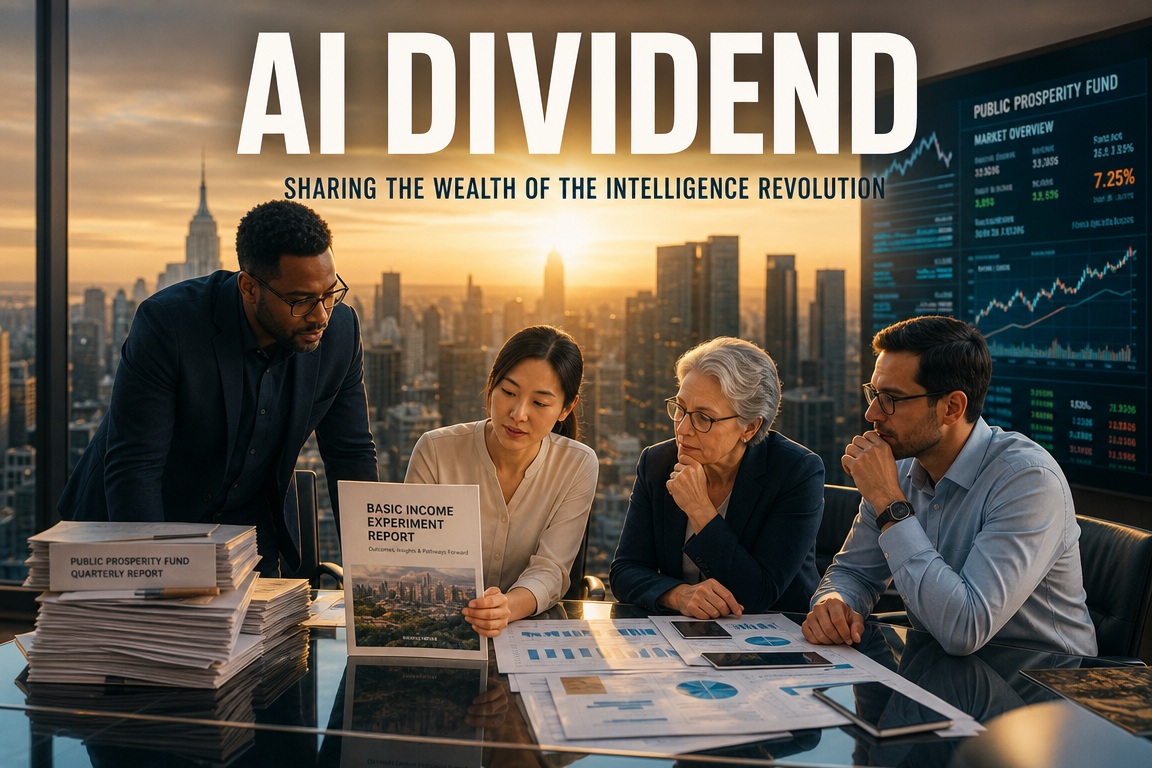

● AI Dividend vs Basic Income
Sam Altman’s 87.5 Billion Won Basic Income Experiment Reveals the Real Lesson: “What Mattered More Than Money Was the Structure”
OpenAI’s Sam Altman has completed a large-scale basic income experiment in which he directly invested 8.75 billion won.
To put it simply, cash did improve people’s lives a little, but the changes were not as dramatic as many had expected.
This result offers important clues for looking at the global economic outlook, income distribution in the AI era, basic income experiments, changes in spending among low-income Americans, and AI-driven economic growth together.
In particular, the more important question is not “How much will life change if you just give people money?” but rather “In the AI era, what is the best way to share opportunity and assets?”
1. What Was This Experiment?
From 2020 to 2023, Sam Altman conducted a basic income experiment targeting low-income residents in Texas and Illinois.
Participants were 1,000 people, each receiving $1,000 per month, or about 1.46 million won.
The comparison group of 2,000 people received only $50 per month.
The total budget was $60 million, or about 87.5 billion won.
The core purpose of this experiment was simple.
It aimed to see how regular cash payments would affect consumption, labor, health, and overall life satisfaction.
2. The Results Were More Quiet Than Expected
The first change observed was spending.
People who received cash spent, on average, about $310 more.
The main categories of increased spending were food, housing, and transportation.
In other words, when money came in, people used it first to cover essential living expenses rather than luxury items.
Meanwhile, working hours fell by only an average of 1.3 hours per week.
Contrary to expectations that people would work less and enjoy life more, labor participation did not change much.
Even more surprisingly, there was no clear improvement in mental health, physical health, or quality of life.
Cash did change lives somewhat, but it did not create structural change.
3. Why Did This Happen?
The core takeaway from this experiment is simple.
People are not necessarily unhappy just because they lack money; they are more deeply affected by unstable housing, high living costs, and uncertainty about the future.
Cash can relieve immediate pressure, but it cannot replace long-term safety nets and opportunity structures.
That is why basic income is difficult to turn into a “universal solution.”
In particular, in environments with high inflation, housing burdens, and medical costs, the perceived effect of regular cash payments can be limited.
This also connects to recent U.S. monetary policy, inflation, and slower consumer spending.
4. Why Sam Altman Changed His Mind
Altman partially revised his previous stance after seeing these results.
He said he no longer believes in basic income as strongly as before.
The key takeaway is that “simple cash transfers alone cannot solve the problems society truly needs to address.”
In the AI era, the form of labor is changing, and capital concentration may become even more severe.
In such a situation, what matters is not a few cash transfers, but how the new wealth created is shared and who gets to participate in it.
In other words, the more fundamental issue may be ownership and participation rights rather than distribution alone.
5. In the AI Era, What Matters More Than Money Is Opportunity
This experiment is interesting not only from an economic perspective, but because it is closely tied to AI trends.
As generative AI, automation, robots, and data infrastructure spread, productivity could rise dramatically.
But if the benefits are concentrated only among a small number of companies and investors, social inequality could grow even wider.
That is why Altman is showing interest not just in direct cash payments, but in models such as AI computing resources, AI growth revenue, and public asset funds.
Simply put, his thinking is that “sharing the growth generated by AI through a structural stake for citizens” is more sustainable than “giving out money once.”
6. OpenAI’s Message: The Public Asset Fund Model
OpenAI has recently proposed the concept of a public asset fund in which all citizens share in the benefits of AI growth.
This model is far more future-oriented than traditional welfare.
That is because it allows society as a whole to share in the excess profits created by AI.
If this approach becomes a reality, it could create not just simple cash welfare, but a long-term structure for wealth distribution and participation.
Ultimately, the key word in the AI era is not “distribution” but “designing the structure of distribution.”
7. Why This News Matters Economically
This experiment is not just a welfare story.
From the perspective of the global economic outlook, it shows what governments around the world will need to think about in the future.
First, in an inflationary era, the effectiveness of cash support may be limited.
Second, unless structural costs such as housing and healthcare are reduced, the improvement people feel will be small.
Third, as AI automation spreads, asset sharing, education investment, and labor transition support will matter more than simple transfers.
In short, the welfare of the next era will depend less on “how much we give” and more on “what people can access.”
8. The Most Important Point That Other Articles Often Miss
Many people interpret this experiment simply as “basic income does not work.”
But the more important point is different.
This result is not a failure of basic income, but rather a case that reveals the limits of cash-centered welfare.
What people really want is not just more spending power, but control over their future.
In other words, stable housing, better job transition opportunities, access to healthcare, educational opportunities, and the right to share in the wealth created by AI matter more.
The core point here is that “money is only a tool.”
Even with money, if the structure is unstable, quality of life will not improve much.
By contrast, if the structure is well designed, life can become more stable even without a lot of cash.
9. AI and Economic Trends to Watch Going Forward
Looking at this trend, the following keywords are likely to become more important in the future.
AI dividends are a way of returning AI industry profits to society.
Public asset funds are models that manage AI and automation profits as shared assets.
Labor transition education helps workers acquire new skills to replace disappearing jobs.
Digital capital ownership refers to a concept in which the benefits of data, models, and computing infrastructure are shared with citizens.
Productivity-based growth means linking the efficiency created by AI to real wages and spending power.
10. In Summary, What This Experiment Tells Us
Sam Altman’s 87.5 billion won basic income experiment showed that cash payments certainly matter.
At the same time, it also confirmed that cash alone is difficult to turn into a fundamental improvement in quality of life.
In the AI era, more important than simple assistance are opportunity, ownership, participation rights, and a structure for sharing the gains from growth.
Future economic policy must shift from “how much should we give?” to “how can we prosper together?”
That is the biggest message left by this experiment.
< Summary >
Sam Altman’s basic income experiment showed that cash payments increased spending, but had limited effects on work reduction and quality of life.
The core takeaway is not that basic income failed, but that in the AI era, asset sharing and opportunity structures matter more than simple cash.
Going forward, AI dividends, public asset funds, and labor transition support are likely to become more important economic keywords.
[Related Articles…]
Why Public Asset Funds Are Emerging as a New Welfare Solution in the AI Era
What Basic Income Experiments Taught Us: Structure Matters More Than Cash
*Source: KNN NEWS