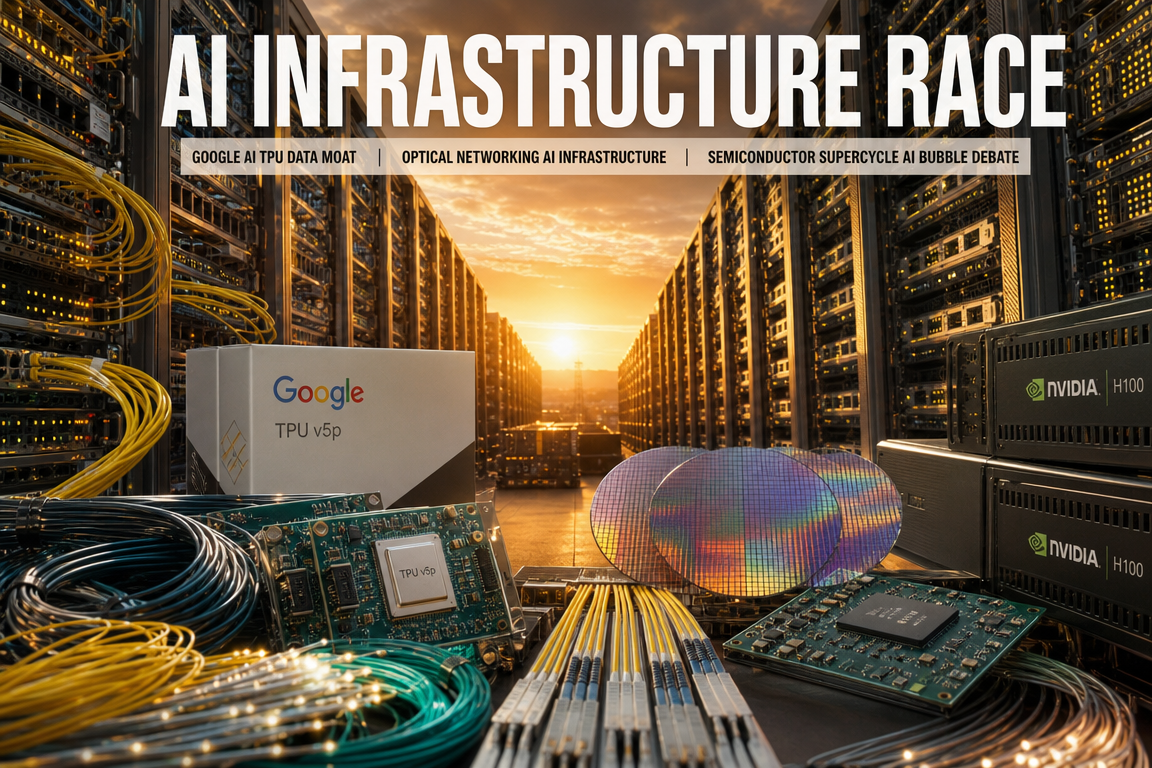
● Google AI Dominance, TPU, Data, Optical Boom
Will Google Be the Ultimate Winner in AI? Investment Takeaways Across the Google Value Chain: Earnings, TPU, Data, and Optical Networking
This report explains why market attention is rotating back toward Google as a core AI platform, and how to evaluate Alphabet not only as a single equity but also through adjacent beneficiaries across semiconductors, optical networking, data centers, and AI service platforms.
1. News Briefing: Why Google Is Back in Focus
Market leadership in AI has been perceived as centered on OpenAI, Nvidia, and Microsoft, but investor focus has increasingly shifted back toward Google. The primary driver is execution: Google is demonstrating measurable revenue and profit contribution from AI-related initiatives, supported by durable cash flows from Search and Advertising. This cash generation enables concurrent investment across AI infrastructure, custom silicon, cloud, model development, and product distribution. In equity markets, platform control across the AI stack can command a higher premium than standalone technical capability.
2. Three Structural Reasons Google Is Competitive in AI
2-1. Advantage in the Agentic AI Era Through Deep Platform Integration
The industry trajectory is shifting from chat interfaces to agentic AI that can manage schedules, connect information, execute tasks, and support decision-making. This requires (1) persistent user context and (2) fast linkage of real-world behavioral signals. Google benefits from an integrated product surface (Gmail, Calendar, YouTube, Search, Maps, Chrome, Android) that provides broad, continuous context. Competitive outcomes may depend less on model benchmarks and more on access to real usage context and execution channels.
2-2. Reduced Dependence on Nvidia via Proprietary Hardware (TPU)
Compute availability and cost remain binding constraints in AI scaling. Google designs and deploys Tensor Processing Units (TPUs), enabling tighter control over supply, cost, performance, and power efficiency. This is directly relevant to margins: custom accelerators can reduce reliance on externally priced GPUs and improve data center operating economics. For investors, the key question is whether AI-related capital expenditure can translate into sustainable profitability; proprietary silicon is a practical lever toward that objective.
2-3. Data Advantage: Scale and Quality
AI performance and productization depend on data, particularly data that is real-time, personalizable, and connected to actual behavior. Google’s ecosystem provides persistent flows across search intent, video engagement, location, scheduling, browsing, and app usage at massive scale. This asset is difficult to replicate quickly and may be structurally advantaged versus models relying more heavily on static datasets and web crawling.
3. Why Google Is Viewed as a Full-Stack AI Company
AI exposure can be segmented into applications, foundation models, cloud, inference infrastructure, AI hardware, and real-time data platforms. Many companies control only one or two layers. Google controls most layers simultaneously: Gemini (models), Google Cloud (distribution and enterprise consumption), TPU (accelerators), Android/Chrome (system-level access), and YouTube/Search (consumer demand and monetization). For investors, this diversification across layers can reduce dependence on a single product cycle.
4. Why TPU Is a Central Investment Variable (Not a Standalone Chip Story)
4-1. Implications of the 8th-Generation TPU Launch
Google introduced its 8th-generation TPU with clearer separation between training-optimized and inference-optimized configurations. This aligns with an industry shift: value creation is increasingly concentrated in inference at scale (serving billions of queries and interactions), not only in training large models. Inference-optimized silicon can improve latency and unit economics in production deployments.
4-2. Not a “Nvidia Replacement” Thesis; a Unit-Economics Thesis
TPU should be evaluated primarily through cost structure and profitability rather than symbolic displacement of Nvidia. As AI adoption expands, market differentiation is likely to shift toward who can deliver services at lower cost with defensible margins. Custom accelerators and power efficiency improvements can materially affect operating leverage and free cash flow trajectory.
5. Data Moat via Android, Chrome, and YouTube: Network Effects in Context
Google’s competitive position is driven by cross-product connectivity rather than a single application. Android and Chrome function as gateways to digital behavior, while YouTube provides large-scale video-based engagement and monetization. Gemini can connect Calendar, Mail, Docs, and Search into workflow-oriented assistance. This supports a shift from conversational AI to operational automation with execution capability.
6. Five Value-Chain Pillars to Monitor Alongside Alphabet
6-1. AI Service Platform
Alphabet is the primary beneficiary through Gemini, Search, YouTube, Cloud, and Android integration.
6-2. TPU and AI Semiconductor Design/Manufacturing
Companies linked to custom AI silicon scale-up include Broadcom, Marvell, TSMC, and MediaTek. As Google expands custom accelerators and related infrastructure, suppliers in manufacturing, custom silicon enablement, networking silicon, and packaging may benefit. Broadcom is frequently viewed as a key partner in Google’s AI infrastructure buildout.
6-3. Optical Communications and Optical Networking
Network throughput increasingly limits AI system performance. As clusters scale, demand rises for high-speed interconnects across chips, servers, switches, and data centers. Potential beneficiaries include optical transceivers, lasers, optical components, and long-haul networking vendors. Examples often cited include Lumentum, Ciena, and Zhongji Innolight. Rising AI capex typically increases east-west traffic and backbone requirements, elevating optical’s strategic importance.
6-4. Data Center Infrastructure
Key exposure includes power efficiency, cooling, servers, switching, and high-speed connectivity. AI competition is also an infrastructure competition; sustained capex supports revenue visibility for enabling vendors.
6-5. Real-Time Data Touchpoints
Google remains central, but broader exposure may extend to mobile ecosystems, browsers, devices, sensors, and personalization platforms. Agentic AI requires continuous ingestion of real-world signals.
7. Why Optical Networking Is a Core AI Infrastructure Theme
AI data centers require low-latency movement of large datasets, not only compute. Electrical interconnects face scaling constraints at higher bandwidth and distance, driving adoption of photonics-based transmission. Even with leading accelerators (TPU/GPU), slow interconnect reduces system-level utilization. The investment implication is that the market may shift from “best chip” to “best-connected cluster.”
8. Why Broadcom Matters: An Underappreciated Lever in Google’s AI Expansion
Broadcom’s relevance is tied to implementing custom AI infrastructure and mitigating internal network bottlenecks via switching silicon and optical-related technologies. As AI infrastructure efficiency becomes a competitive variable, these components can gain strategic and valuation relevance beyond traditional semiconductor cycles.
9. Portfolio Implications of a Google Value-Chain Framework
9-1. Reduced Single-Name Concentration Risk
Alphabet-specific risks include regulation, ad-cycle sensitivity, cloud competition, and the pace of AI monetization. A value-chain approach can distribute exposure across direct and adjacent beneficiaries.
9-2. Broader Capture of AI Monetization Pools
AI economics accrue across chips, networking, data centers, and platforms, not only model developers. Market leadership can rotate across layers; diversified exposure may better track the full capex-to-revenue pathway.
9-3. Structural Growth Alignment
Agentic AI is a multi-year transition intersecting search, advertising, cloud, and enterprise automation. A structural lens may be more durable than reacting to short-term model headline comparisons.
10. Key Points Often Underweighted in Mainstream Coverage
10-1. The Core Battleground Is Inference Economics, Not Model Benchmarks
Investor outcomes may depend more on the cost to serve at scale than on marginal benchmark leadership. TPU and data center optimization directly influence per-query/per-task profitability.
10-2. Google’s Advantage Is Cash Flow Capacity Funding AI at Scale
Advertising is not only legacy revenue; it is a funding engine that can sustain high AI investment without structurally impairing balance-sheet flexibility relative to less profitable peers.
10-3. Optical Networking Should Be Evaluated Concurrently with Semiconductors
As server counts rise, network congestion can emerge as the next bottleneck. Optical vendors’ bookings and guidance can function as real-time indicators of hyperscaler AI deployment intensity.
10-4. Agentic AI Is Less About Replacing Search and More About Controlling the Execution Layer
The strategic question is whether Google can evolve from an information gateway to an operating layer that manages and executes digital activity across Android, Chrome, Gmail, Maps, and YouTube. Successful execution would extend monetization beyond search share alone.
11. Investor Checklist Going Forward
First, track Alphabet earnings with emphasis on Cloud momentum and AI monetization indicators, not only Advertising performance.
Second, evaluate whether TPU deployment improves capex efficiency and supports margin durability.
Third, monitor orders and forward guidance from optical networking and network equipment suppliers as validation of realized infrastructure spend.
Fourth, recognize that macro volatility may persist, while AI-driven digital transformation remains a structural trend.
12. Conclusion
Google is positioned as a full-stack AI company with applications, foundation models, cloud distribution, proprietary accelerators, real-time data, and global consumer touchpoints. The investment case is increasingly tied to scalable inference economics, AI monetization, and infrastructure efficiency. A value-chain approach may include Alphabet alongside select beneficiaries in custom silicon, optical networking, and data center infrastructure.
< Summary >
Google is increasingly characterized as a full-stack AI company rather than a pure search business. Key advantages include agentic AI distribution channels, real-time data access, TPU-based compute control, and cloud infrastructure. Primary investment variables are inference unit economics, AI monetization progress, and value-chain expansion into optical networking. A broader framework may include Alphabet as well as enabling firms such as Broadcom, Lumentum, and Ciena. Industry competition may shift from model performance to cost efficiency and large-scale commercialization.
[Related Links…]
- Google AI strategy and value-chain restructuring: https://NextGenInsight.net?s=Google
- Why optical networking is rising within AI infrastructure capex: https://NextGenInsight.net?s=Optical%20Networking
*Source: [ 소수몽키 ]
– 결국 구글이 AI 최종 승자? 구글 관련주 한방에 투자하는 법
● AI-Bubble, Semiconductor, Supercycle, Peakout
Was There Ever a Semiconductor Supercycle? A Consolidated View of the AI Bubble Debate, Data Center Capex Cycles, and H2 Correction Signals
The three key points are as follows:
First, the term “semiconductor supercycle” repeatedly reappears, but the market has historically behaved more like a supply-driven cycle.
Second, AI semiconductors and data center build-outs are creating incremental demand, but the structure is not one of unlimited, linear expansion.
Third, in the second half, three variables may simultaneously pressure equity markets and semiconductor outlooks: memory price peak-out, renewed AI bubble debate, and inflation-driven macro tightening risk.
This report connects Samsung Electronics, SK hynix, HBM, DRAM, NAND, data centers, the AI bubble discussion, and rates/liquidity into an investor-oriented summary. A central premise is that even when demand rises, cycles are primarily determined by supply.
1. Key News Briefing: Primary Message from the Discussion
The central conclusion was that the “supercycle” framing should be treated with caution.
The core argument was explicit: semiconductor cycles are formed more by supply than by demand.
Accordingly, even if AI-driven demand and data center capacity expand, interpreting sharp memory price and equity moves as a long-duration “supercycle” may be overstated.
This view referenced prior episodes: during a data center upcycle roughly eight years ago, similar claims that “memory cycles have ended” proved premature, with pricing reversing materially within roughly six months.
2. Why the “Semiconductor Supercycle” Narrative May Be Misleading
2-1. Demand Can Rise Without Eliminating the Cycle
Semiconductor demand is increasing across AI servers, on-device AI, defense modernization, and cloud infrastructure.
However, demand growth and cycle amplitude are not equivalent.
Bit growth has been trending lower over time; demand can support volumes, but it has not been the primary driver of large price and profit swings.
The main determinant of pricing, earnings, and equity sensitivity remains whether supply is tight or excessive.
2-2. The Industry Cycle Historically Starts with Supply
Semiconductors are capex-intensive.
Capacity additions typically translate into oversupply with a 1–2 year lag; conversely, reduced supply or lower utilization can lift prices and create the appearance of a sustained boom.
In the current market, supply management may increasingly occur through utilization cuts on existing lines rather than only new fab builds, which can support pricing even when end-demand is not accelerating proportionally.
2-3. Risk of Misreading Memory Price Increases as Structural Growth
Rising DRAM and NAND prices are often labeled a “supercycle.”
The discussion emphasized that recent increases may reflect supply reductions, inventory normalization, and richer product mix rather than pure demand acceleration.
HBM is a high-growth segment, but it is not sufficient on its own to explain or stabilize the full memory cycle and sector earnings over a long horizon.
3. AI Demand Is Strong; Why the Bubble Debate Persists
3-1. Data Center Build-Outs and AI Chip Demand Are Real
Global data center construction is accelerating as hyperscalers raise capex to expand training and inference infrastructure.
Incremental demand could broaden further via smartphones, appliances, automotive, and robotics.
Geopolitical risk and evolving warfare requirements are also supporting demand for defense-related semiconductors.
3-2. Monetization and Payback Models Remain Less Visible
The core of the AI bubble debate is capital recovery.
Historically, data center investment expanded established revenue pools (cloud services, search, e-commerce, advertising, streaming).
In contrast, current AI infrastructure spending is partly justified by expected future monetization, while near-term payback is less clearly defined.
Current monetization paths include subscriptions, API usage fees, cloud rental, and enterprise solutions; the question is whether cash-flow generation can match the scale and pace of capex.
3-3. Data Center Investment Is Also Cyclical
A stylized pattern was noted: approximately three years of aggressive investment followed by roughly three years focused on payback and efficiency.
Under this framework, the AI data center capex surge that intensified in 2024 could face a moderation phase around 2026.
This implies potential rate-of-change risk rather than an end to AI demand.
4. Samsung Electronics and SK hynix: What to Monitor
4-1. Variable #1 for Equity Performance: Memory Price Peak-Out
The most immediate driver is memory pricing, particularly the timing of a peak and subsequent reversal in DRAM and NAND.
Memory earnings are highly price-levered: profits can expand quickly when prices rise, and compress rapidly when prices decline.
The key question is not whether conditions are “good” or “bad,” but whether peak-out has begun.
The discussion leaned toward a potential inflection within the year, with timing uncertainty extending into next year.
4-2. Variable #2: Shifts in AI Bubble Perception
Independent of fundamentals, a change in the market narrative around “excessive AI investment” could compress thematic multiples across U.S. mega-cap tech and related Korean AI semiconductor exposures.
In a de-rating phase, strong companies can still see near-term valuation pressure.
Given both companies’ positioning in HBM and AI server memory, valuation sensitivity to sentiment remains a key risk.
4-3. FX Tailwinds May Be Less Supportive
Korean semiconductor exporters are sensitive to FX.
A strong USD typically boosts KRW-reported results, but if geopolitical risks ease or USD strength fades, FX support may diminish.
The combined tailwind of rising memory prices and favorable FX may not persist uniformly.
5. Macro Signals to Watch for H2 Correction Risk
5-1. Liquidity Remains, but Its Source Has Shifted
The environment is neither purely restrictive nor fully accommodative.
Market behavior is not driven solely by rate-cut expectations; fiscal spending on defense, energy transition, industrial policy, and stimulus can add liquidity through alternative channels.
This can support risk assets despite elevated policy rates.
5-2. Primary Risk: Re-acceleration of Inflation
The key downside macro risk is inflation moving back outside central bank comfort zones.
If inflation re-accelerates in the U.S. or Korea, rate cuts could be delayed and the probability of renewed tightening rhetoric could rise.
Highly appreciated leadership sectors, including semiconductors, AI, and broader growth equities, would likely be most sensitive.
5-3. Three Practical Checkpoints
First, monitor whether memory pricing peaks and turns.
Second, track whether hyperscaler capex guidance for next year accelerates or moderates.
Third, watch whether global inflation trends alter the policy-rate path.
Concurrent deterioration across these factors could shift semiconductor sentiment rapidly.
6. News-Style Summary: Semiconductor Outlook by Category
6-1. Positive Factors
- High-value memory demand centered on AI servers and HBM remains strong.
- Data center expansion, on-device AI, and defense modernization are generating new demand vectors.
- Samsung Electronics and SK hynix are positioned as core beneficiaries within global memory supply chains.
- Fiscal expansion and industrial policy in major economies may be supportive for the sector.
6-2. Negative Factors
- Memory price gains may be driven by supply management rather than demand acceleration.
- The data center capex cycle may moderate around 2026.
- Monetization uncertainty increases the probability of renewed AI bubble narratives.
- If inflation re-accelerates, policy repricing could pressure growth equities broadly.
6-3. Investor Checklist
- Track quarterly DRAM, NAND, and HBM pricing trends.
- Monitor hyperscaler capex guidance and AI investment plans.
- Review utilization rates, inventories, and ASP trends for Samsung Electronics and SK hynix.
- Track U.S. CPI, PCE, Treasury yields, and the dollar index in parallel.
7. Commonly Underemphasized Point
Do not equate “AI demand growth” with “a long-duration semiconductor supercycle.”
AI is expanding semiconductor demand, but demand alone is insufficient to sustain prolonged, outsized pricing and equity uptrends.
Sustained upside typically requires alignment across supply discipline, capex payback visibility, balance-sheet capacity to maintain investment, and a supportive macro-liquidity backdrop.
The critical question is not whether AI is transformative, but whether AI-driven revenue and cash flow can justify the current scale of investment.
8. Final Interpretation: Prioritize Structure Over Narrative
Semiconductors remain strategically important over the long term, supported by AI, cloud, defense, on-device computing, automation, and robotics.
However, structural demand does not eliminate cyclicality.
The current market reflects a combination of growth narrative, supply management, liquidity dynamics, and AI expectations.
In H2, the more relevant questions may be whether pricing has peaked, whether capex momentum is sustainable, and whether macro conditions remain supportive.
An approach that distinguishes demand trends from supply-driven cycle mechanics is likely to be more resilient than either unconditional optimism or broad pessimism.
< Summary >
The semiconductor “supercycle” narrative warrants reassessment.
AI and data center demand are strong, but the cycle remains primarily supply-driven.
Key variables for Samsung Electronics and SK hynix include memory price peak-out, shifts in AI bubble perceptions, and inflation re-acceleration risk.
For H2 and beyond, monitor DRAM/NAND/HBM pricing, hyperscaler capex, and macro indicators in tandem.
The essential point is that “AI demand growth” should not be treated as synonymous with a “long-term supercycle.”
[Related Articles…]
- https://NextGenInsight.net?s=semiconductors
- https://NextGenInsight.net?s=AI
*Source: [ 경제 읽어주는 남자(김광석TV) ]
– 반도체 슈퍼사이클은 허상인가? AI 버블과 하반기 조정 신호 | 경읽남과 토론합시다 | 이주완 박사 [2편]