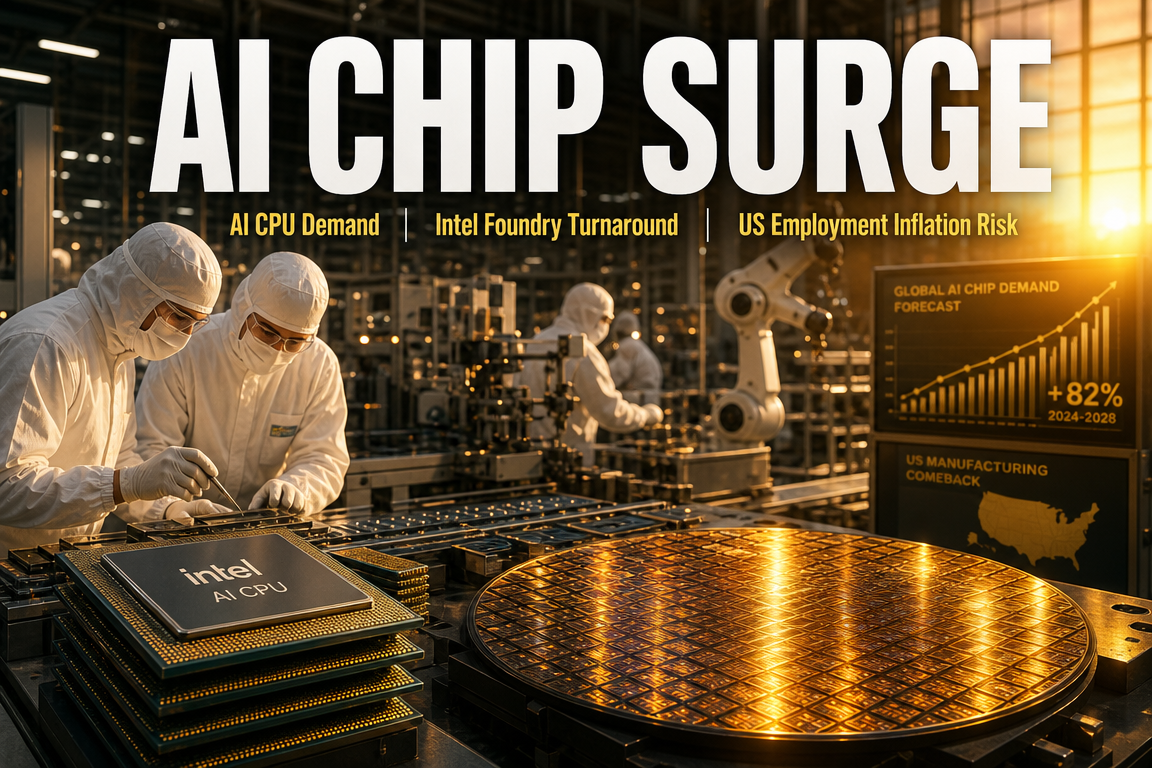
● Intel AI Rebound, CPU Surge, Foundry Turnaround
Can Intel Become a New AI Bellwether?
Reassessing the CPU Era, Data Center Demand, and the Foundry Turnaround Potential
The rationale for monitoring Intel is straightforward: AI capital allocation is expanding beyond GPUs toward CPUs, data centers, semiconductor supply chains, and foundry competitiveness.
This report summarizes: why Intel has regained attention, why agentic AI can increase CPU demand, where Intel generates earnings versus where risk concentrates, the key linkages to AMD, TSMC, Apple, and Tesla, and the variable the market may still be underpricing.
1. Why Intel Is Regaining Market Attention
Intel has drawn renewed investor focus over the past month, primarily due to a reassessment of CPU importance within AI data centers.
Historically, AI workloads were viewed as GPU-dominant given the parallel compute requirements for training and inference. Market framing has begun to shift as agentic AI expands beyond response generation toward task execution, increasing the importance of control flow, branching, and system-level processing where CPUs remain structurally advantaged.
In practical terms:
- GPUs optimize high-throughput computation.
- CPUs optimize flexible orchestration across heterogeneous workloads.
As AI systems increasingly perform end-to-end work rather than producing text outputs, CPU relevance in the data center can increase.
2. Why Agentic AI Matters for Intel
Agentic AI differs from conventional generative AI by decomposing goals into multi-step actions and executing workflows.
Illustrative workflow:
- Access card transaction history on a website
- Download a spreadsheet file
- Extract and organize required fields
- Paste into a separate file
- Perform classification and edits
This shifts AI toward longer-duration, system-interactive compute consumption, with higher orchestration requirements. As a result, the CPU layer in data centers may gain incremental importance.
This is not only a product-cycle change; it represents a broader transition in digital operations and affects the semiconductor value chain. Investor focus is widening from GPU concentration toward CPU and infrastructure components.
3. Intel’s Business Model: A Practical Framework
Intel can be analyzed across three core segments.
3-1. Current Cash Flow Base: Client Computing Group
This segment covers PC and notebook CPUs. It remains a major revenue contributor with comparatively resilient margins.
Key constraint: limited structural growth, as the PC market is mature. This segment supports near-term cash generation but is unlikely to be the sole driver of a sustained valuation re-rating.
3-2. Primary Source of Market Expectations: Data Center & AI
This segment includes server CPUs and data center products and has recently shown stronger growth. The referenced figures indicate:
- YoY growth: 22%
- Meaningful share of total revenue
Implication: as AI data centers expand, Intel’s addressable revenue pool in server CPUs can be larger than implied by GPU-centric narratives. Long-term supply arrangements, if realized, would further support the interpretation that demand is not purely cyclical.
Near-term upside sensitivity remains closely tied to data center CPU demand durability.
3-3. Highest Risk, Highest Optionality: Intel Foundry
Foundry manufacturing produces chips designed by external customers. The market leader is TSMC, with Samsung also competing.
Intel is scaling its foundry strategy, but current limitations include:
- Low mix of external customers
- Heavy reliance on internal volumes
- Material losses
Referenced operating margin: -45%.
While the near-term financial burden is significant, successful stabilization could deliver outsized operating leverage. Consequently, current losses function both as a risk factor and as a potential re-rating catalyst if execution improves.
4. How to Read Intel’s Financial Profile
Intel is not well assessed via a single-direction narrative. Segment-level separation is required:
- PC CPUs: modest growth, meaningful cash generation
- Data center: improving growth profile
- Foundry: large losses, high embedded option value
This structure makes Intel resemble a turnaround equity where valuation can change materially if industry structure and execution outcomes improve.
5. Bull Case Drivers (News-Style Summary)
5-1. AI Infrastructure Spend Expands the CPU Narrative
As AI shifts from generation to execution, CPU importance may rise. This would represent a meaningful change in semiconductor demand composition.
5-2. Data Center Revenue Growth Is Visible
The company is showing measurable growth in server-related revenue, supporting the view that the thesis is not purely speculative.
5-3. Growing Need to Diversify Away from TSMC
Strategic interest in supply-chain diversification may increase the value of alternative manufacturing capacity.
5-4. Apple and Tesla Engagement Signals Strategic Relevance
Even absent confirmed large-scale revenue impact, being evaluated by major technology platforms can be interpreted as an improvement in perceived credibility.
5-5. U.S. Policy Support Premium
Semiconductor supply-chain resilience has become a national strategic priority. Domestic advanced manufacturing investment can provide Intel with policy-driven support and strategic optionality.
6. Key Reasons for Caution
6-1. CPU Demand Uplift Could Be Overstated
Agentic AI may increase CPU usage, but the magnitude and timing remain uncertain. If the uplift is smaller than expected, the investment case weakens.
6-2. Competitive Pressure From AMD
Market expansion does not guarantee Intel share gains. If share erosion continues, re-rating potential may be constrained.
6-3. Foundry Yield and Execution Risk
Manufacturing is execution-sensitive. Yield instability can quickly invalidate expectations. Intel’s historical delays at advanced nodes remain a reference point for investor skepticism.
The foundry outcome depends less on stated technology roadmaps and more on operational execution: stable production and customer-acceptable yields.
7. Why Apple and Tesla Headlines Should Not Be Interpreted Superficially
The primary significance is not the headline itself but the strategic signal.
7-1. Apple: Supply-Chain Reliability Signaling
If Intel is meaningfully considered, it indicates positioning as a potential strategic alternative rather than a peripheral option. This matters for perceived foundry credibility.
7-2. Tesla: Platform-Driven Optionality
Tesla is closely linked to AI, robotics, autonomy, and data center demand. In addition, related entities can expand semiconductor demand across adjacent domains. Any durable integration into this ecosystem could increase long-duration optionality.
8. Under-Discussed Core Points
8-1. Intel Is Not a GPU Proxy; It Is an AI Infrastructure Reconfiguration Candidate
Intel should not be framed as a direct substitute for the dominant GPU vendor. The more relevant angle is exposure to CPU, servers, supply-chain diversification, and domestic manufacturing as AI infrastructure becomes more complex.
8-2. Intel Functions as a Hybrid Asset: Earnings + Policy + Optionality
- Client CPUs: cash-flow and earnings profile
- Domestic manufacturing strategy: policy-sensitive profile
- Foundry: large option value contingent on execution
This blend complicates valuation but also creates asymmetric outcomes.
8-3. The Market May Price Foundry Yield Stabilization More Than CPU Demand
Data center CPU growth is supportive, but a durable multiple expansion is more likely to depend on manufacturing competitiveness and execution progress.
8-4. Organizational Execution May Be the Hardest Constraint
TSMC’s advantage is not only process technology but also operating discipline, rapid problem resolution, and manufacturing culture. Intel’s ability to close this gap is a central determinant of foundry competitiveness.
9. Can Intel Become a New AI Bellwether?
Potential exists, but the requirements are demanding. Intel is not currently the category-defining leader. However, its positioning offers leverage to multiple themes: CPU re-rating, data center growth, U.S. industrial policy, and foundry optionality.
Conditions required for a sustained re-rating:
- Data center CPU growth proves durable rather than transitory
- Share position versus AMD stabilizes
- Foundry yields and external customer wins become measurable
- Improvement is validated by operating results, not only policy expectations
Failure on any key condition can compress expectations quickly. If conditions align, Intel could transition from a cyclical rebound narrative toward a longer-duration growth classification.
10. Investor Checklist: Key Metrics to Monitor
- Data center segment revenue growth rate
- Server CPU share trends
- Expansion of external foundry customer mix
- Updates on leading-node yields (18A, 14A)
- Progress toward binding contracts with major technology customers (including Apple and Tesla)
- Pace of U.S. government support and capex deployment
- Trajectory of operating margin improvement
Intel remains a high-complexity investment with multiple moving checkpoints. Short-term price strength does not resolve execution risk, and execution risk limits unconditional optimism.
11. One-Sentence Summary
Intel is a candidate for a material re-rating if CPUs and foundries regain strategic importance in the AI era, but outcomes depend primarily on manufacturing execution and share defense.
< Summary >
Intel is attracting renewed attention as agentic AI increases the perceived importance of CPUs within data centers.
Its operating structure can be framed as:
- Cash generation from PC CPUs
- Growth exposure via data center products
- Potential upside optionality through foundry, despite current losses
Key supports include data center momentum, U.S. policy tailwinds, supply-chain diversification needs, and the signaling effect of potential engagement by major platforms.
Core risks include overstated CPU uplift, competitive pressure from AMD, and foundry yield uncertainty.
The decisive factor is foundry execution rather than the CPU narrative alone. Intel should be evaluated as a strategic variable in semiconductor supply-chain reconfiguration rather than a simple AI theme equity.
[Related Articles…]
- AI Semiconductor Investment Strategy: Data Center Demand and Key Variables in U.S. Equities (NextGenInsight.net?s=AI)
- Foundry Competition Reignites: Strategic Battlegrounds for TSMC, Samsung, and Intel (NextGenInsight.net?s=foundry)
*Source: [ 내일은 투자왕 – 김단테 ]
– 인텔은 새로운 AI 대장주가 될 수 있을까?
● Jobs-Strong,-Rates-High,-Oil-Shock-Risk
Deep Dive on US Employment Data: Middle East Risk, Unemployment Shock Risk, and the Fed’s Rate Path
This US labor report was not a single-data-point event. The unemployment rate, nonfarm payrolls, and wage growth all directly influenced expectations for the Federal Reserve’s policy rate. In parallel, the Middle East conflict introduced higher oil prices, renewed inflation risk, and elevated market volatility.
This report consolidates:
- Key outcomes from the US labor release
- Why Fed rate-cut expectations weakened further
- How Middle East risk may transmit into US inflation and labor conditions
- The next critical data and catalysts investors should monitor
A key conclusion: the market risk is less about employment weakening and more about inflation re-accelerating while labor remains resilient.
1. Key Results at a Glance
US labor conditions appeared more resilient than expected.
- Unemployment rate: 4.3%
- Nonfarm payrolls: approx. +115,000
- Wage growth: rebounded month-over-month
There was no “unemployment shock.” Several components met or exceeded expectations. Despite external geopolitical pressure, labor-market deterioration was not evident.
2. What 4.3% Unemployment Signaled
An unemployment rate of 4.3% is generally consistent with a stable labor market. In many frameworks, deterioration becomes more evident above roughly 4.5%.
Holding at 4.3% reduced the Fed’s urgency to cut rates on growth-protection grounds. A stable labor market weakens the argument for rapid easing.
As a result, the figure supported economic resilience while simultaneously pushing rate-cut expectations further out.
3. Why Nonfarm Payrolls Mattered More
Nonfarm payroll growth is a core indicator of labor-market momentum and macro resilience. The reported increase was interpreted as firmer than the market had positioned for, given concerns about:
- Middle East risk
- Prolonged restrictive rates
- Rising corporate cost pressures
The outcome suggested the US economy is not rapidly transitioning into recession. For equities, firm hiring can be supportive for growth; for monetary policy, it implies the Fed can keep rates higher for longer.
4. Wage Growth Rebound: The Most Market-Sensitive Component
The wage-growth rebound indicated continued tightness in labor supply-demand dynamics. Faster wage growth can feed into services inflation and broaden price pressures.
This is particularly adverse for the Fed if paired with higher energy prices, as it increases the risk of persistent inflation. The wage signal was therefore read as a potential disruption to the disinflation path.
5. Fed Interpretation
The Fed’s dual mandate:
- Maximum employment
- Price stability
This release suggested maximum employment remains intact, shifting policy focus toward inflation outcomes. With labor holding up, the Fed has less incentive to accelerate cuts and more room to maintain a restrictive stance if inflation proves sticky.
Market-implied easing expectations weakened accordingly.
6. Why the Middle East Conflict Must Be Viewed Alongside Labor Data
Geopolitical risk has been feeding directly into oil prices. Higher oil can lift:
- Energy costs
- Transportation costs
- Input costs
- Commodity-linked prices
- Food and services prices
This is the inflation transmission mechanism. To date, the shock has been more concentrated in energy; broad-based inflation effects are not yet fully confirmed. However, if disruption persists into May, June, and July, the probability of spillover into broader price categories increases.
7. The Primary Focus Shifts from Employment to CPI and PCE
While labor data were firm, investor focus is moving to inflation releases because, absent labor deterioration, policy reaction is more likely to be determined by inflation dynamics.
Key indicators:
- US CPI (Consumer Price Index)
- US PCE (Personal Consumption Expenditures Price Index)
CPI tends to move market sentiment quickly; PCE is more central to Fed decision-making. Recent inflation data already showed signs of re-acceleration. The key question is whether the rise remains energy-driven or spreads into core and services inflation.
Confirmation of broader inflation pressure would further delay rate cuts and could reopen discussion of additional tightening risk.
8. Market Reaction: Key Takeaways
Post-release market implications:
- US labor conditions remain firm
- No unemployment shock
- Wage re-acceleration raised inflation concerns
- Fed rate-cut expectations weakened
- Upward pressure on Treasury yields and the USD may increase
- Near-term headwinds for risk assets may intensify
Stronger data were not necessarily “market-friendly” because the current regime often interprets resilient growth as higher-for-longer rates.
9. Implications for Korea: Macro and Asset Markets
This report has spillovers into Korea via FX, inflation, and policy constraints.
9-1. KRW-USD FX Pressure
A higher-for-longer Fed stance can support USD strength, increasing upward pressure on KRW-USD. A weaker KRW raises import prices and complicates domestic inflation management.
9-2. Bank of Korea Policy Becomes More Constrained
If the Fed cannot cut, the Bank of Korea faces limits on easing due to:
- Wider rate differentials
- Capital outflow risk
- FX volatility
Rising oil and commodity prices would add to CPI pressure, likely delaying domestic rate-cut expectations.
9-3. Near-Term Headwinds for Korean Equities and Growth Stocks
Delayed Fed easing increases valuation pressure on global growth and technology stocks. Energy, defense, and certain commodity-linked sectors may see relative support, conditional on oil prices and geopolitical duration.
10. The Underemphasized Core Point
The main issue was not “strong employment” itself. The key is that resilient employment allows the Fed to prioritize inflation more aggressively.
Causal chain:
- Labor does not break
- The Fed focuses more on inflation than growth support
- Middle East risk lifts oil prices
- Energy inflation can spill into broader categories
- Rate-cut expectations move further out
- Market risk shifts from labor shock to inflation shock
The most adverse combination is resilient employment alongside renewed inflation pressure.
11. Upcoming Catalysts to Monitor
Likely sequencing for market focus:
- US CPI release
- US PCE release
- Escalation risk in the Middle East
- Oil price trajectory
- Shifts in Fed communication
- Bank of Korea policy stance
If non-energy inflation pressures broaden, global macro expectations for the second half of the year may shift more conservatively, with higher volatility risk.
12. Bottom Line
This labor report can be summarized as: growth is holding up, which increases the probability that rate pressure persists for longer.
There was no unemployment shock. Payroll growth remained resilient, and wage growth moved in a direction that reinforces inflation concerns. Rate-cut expectations weakened, and the duration of restrictive policy could extend if inflation re-accelerates.
With the Middle East conflict, oil prices, and potential inflation spillovers, the risk of higher market volatility increases. Investors should evaluate labor, inflation, geopolitics, energy prices, and central-bank reaction functions as a single integrated framework.
< Summary >
US employment data were more resilient than expected. Unemployment held at 4.3%, while payrolls and wage growth reinforced a repricing toward delayed easing.
The key is not an unemployment shock, but that resilient labor conditions enable the Fed to focus more heavily on inflation risks.
Primary forward variables: US CPI, US PCE, oil prices, and the duration of Middle East geopolitical stress. If energy-driven inflation spreads, rate cuts may be delayed further and market volatility may rise.
[Related Posts…]
- US Employment Data and Fed Policy Shifts: Key Takeaways (https://NextGenInsight.net?s=employment)
- How a Sharp Rise in Oil Prices Impacts Global Inflation (https://NextGenInsight.net?s=oil)
*Source: [ 경제 읽어주는 남자(김광석TV) ]
– [LIVE] 미국 고용지표 심층분석 : 중동전쟁 발 ‘실업률 쇼크’ 나올까? [즉시분석]