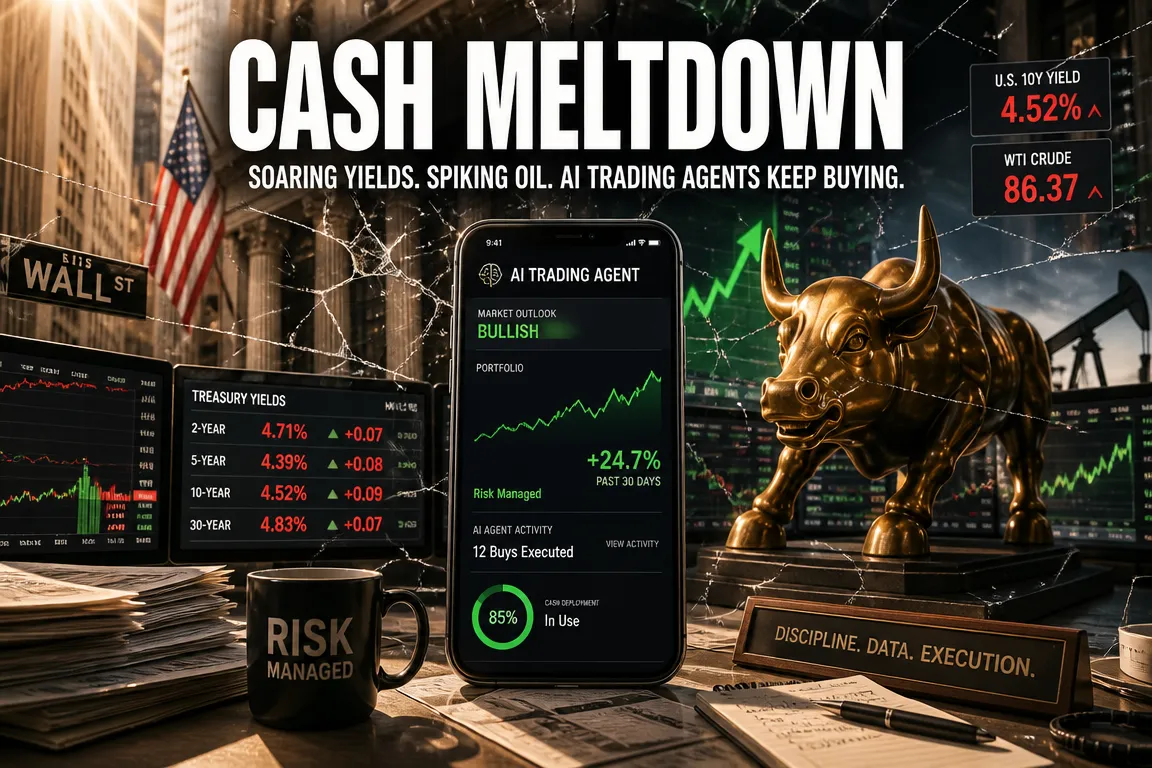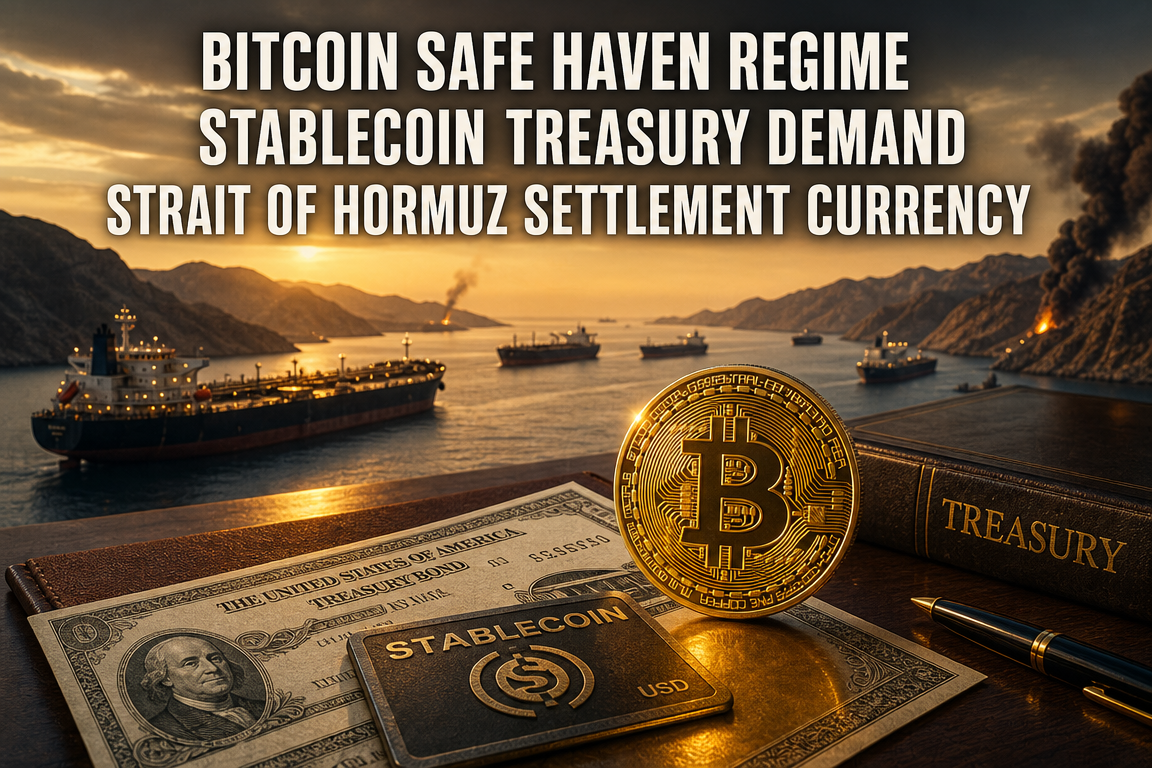
● Gold-Shaken, Bitcoin-Surges, Stablecoins-Rise
Gold Is Volatile; Why Bitcoin and Stablecoins Have Gained Strategic Importance: Key Points in Post–Middle East War Asset-Market Repricing
This is not solely about a Bitcoin outlook or gold prices.
It addresses:
- why the traditional safe-haven playbook weakened after the Middle East conflict,
- why markets reacted faster to Bitcoin and stablecoins than to gold,
- and how this may extend into global macro dynamics: dollar hegemony, U.S. Treasury demand, energy-settlement power, and the emerging digital payments order.
Key topics include:
- the Strait of Hormuz transit-fee and settlement-currency implications,
- the mechanism by which stablecoins function as a structural source of U.S. Treasury demand,
- conditions under which Bitcoin can trade as a quasi–safe haven rather than a pure risk asset,
- and why weakening international law and free-trade norms may accelerate digital-asset adoption.
1. Core takeaway: not the end of gold, but the traditional rule set has weakened
The long-standing assumption that wars automatically lift gold while Bitcoin declines is no longer reliable.
Recent market action included periods where gold corrected while Bitcoin remained relatively resilient.
This does not imply Bitcoin has become a full safe haven. It indicates a shift in investor perception: Bitcoin is increasingly treated as more than a purely speculative asset.
When correlations among USD, U.S. Treasuries, gold, and equities become unstable, Bitcoin has intermittently acted as an alternative refuge for certain flows.
2. News-style recap: what changed in asset markets after the Middle East conflict
2-1. Why Bitcoin showed relative strength during wartime conditions
Three drivers were emphasized:
First, Bitcoin had already absorbed a major drawdown earlier than many risk assets, reducing incremental downside pressure and enabling a rebound.
Second, flows were stronger than expected:
- U.S. spot ETF inflows
- Corporate accumulation with a treasury-strategy profile (DAT-like buyers)
Persistent large buyers tend to increase price elasticity in Bitcoin markets.
Third, war-related payment uncertainty reinforced the Bitcoin narrative:
- Strait of Hormuz transit fees
- Iranian rial instability
- Sanctions evasion and alternative settlement considerations
These factors reframed Bitcoin as a cross-border store-of-value option rather than solely an investment vehicle.
2-2. Why gold did not behave as a consistently dominant safe haven
Gold has had clear structural support in recent years:
- Central-bank buying
- Erosion of confidence in the dollar
- Higher geopolitical risk premia
However, even under elevated conflict risk, gold did not move in a uniformly defensive pattern.
A key interpretation is that, amid constrained liquidity, investors are increasingly allocating via “priority selection” rather than buying all hedges simultaneously.
In practice, investors now compare gold, USD, Bitcoin, semiconductors, and U.S. mega-cap technology for relative return potential and liquidity characteristics.
2-3. Is Bitcoin a risk asset or a safe haven?
In most regimes, Bitcoin trades as a risk asset.
Under specific conditions, it can behave like a safe-haven substitute, particularly in “sell America” episodes where confidence in U.S.-linked assets broadly weakens.
In risk-on growth regimes, Bitcoin often tracks Nasdaq-like behavior. When credibility of the USD-centric financial system is questioned, Bitcoin’s alternative-asset profile can resemble gold’s.
This dual-regime behavior is central to current positioning uncertainty.
3. Why Iran and the Strait of Hormuz can elevate Bitcoin and stablecoins
3-1. The Strait of Hormuz transit-fee issue is not a minor headline
A key claim is that, regardless of the war’s tactical end state, the long-term probability of some form of Strait of Hormuz transit fee is elevated.
Rationale:
- Iran’s need for post-war reconstruction funding
- A structure in which the U.S. can indirectly accept or co-manage such arrangements may be politically feasible
Direct U.S. cash transfers for reconstruction are viewed as unlikely; alternative mechanisms (transit fees, asset unfreezing, partial sanctions relief) are more plausible.
Markets may be pricing not only the conflict trajectory but also the post-conflict design of monetary flows.
3-2. Settlement currency for transit fees: CNY, stablecoins, or Bitcoin
The settlement currency is a strategic signal of future monetary order and power.
- CNY: plausible given existing China–Iran oil trade practices
- Stablecoins: potentially most attractive from a U.S. strategic perspective
- Bitcoin: may be preferred by Iran to reduce freeze/confiscation risk and mitigate sanctions constraints
Stablecoins matter because they represent a digital extension of the dollar. More specifically, stablecoin issuance structurally increases demand for U.S. Treasuries, particularly short-dated bills.
Accordingly, U.S. support for stablecoin expansion can be viewed not only as fintech policy but as a Treasury-demand and fiscal-financing strategy.
4. The stablecoin competition: the core variable is U.S. Treasuries
4-1. Stablecoins function less like “digital dollars” and more like a private Treasury-demand channel
Stablecoins are often framed as payment convenience. From a policy and market-structure perspective, the more material point is reserve composition.
Issuers typically hold significant U.S. Treasury inventories as reserves. As stablecoin supply grows, U.S. Treasury demand rises via private-sector balance sheets.
This is less a payments upgrade than a redesign of dollar hegemony for mobile and platform-based finance.
Therefore, U.S. legislative momentum on stablecoins may be driven more by maintaining Treasury-market absorption and dollar influence than by general crypto-industry promotion.
4-2. Why policy optimism alone is insufficient to explain Bitcoin’s recent moves
Regulatory clarity on:
- stablecoin rules,
- agency jurisdiction (SEC vs. CFTC),
- and market-structure standards
is relevant but not sufficient as a standalone explanation.
The stronger explanatory set emphasized:
- flows and buyer identity,
- macro uncertainty,
- alternative-currency narratives
Bitcoin price assessment, therefore, requires monitoring both legislative trajectory and the drivers of migration away from legacy currency systems.
5. Iranian rial stress and the crypto economy: why stablecoins can be more practical than Bitcoin locally
Iran is presented as a representative case: when currency depreciation and inflation accelerate, demand shifts from “investment” to “survival” finance.
In daily commerce, USD-pegged stablecoins are often more usable than Bitcoin due to lower volatility:
- wage-like payments
- local circulation
- informal settlement
- basic value preservation
A simplified framing:
- Bitcoin: store-of-value narrative
- Stablecoins: payments and transactional utility
In crisis environments, they can be complementary rather than strictly competitive.
6. The key market variable: “selective allocation” under liquidity constraints
A practical point: valuations are elevated and system liquidity may be insufficient to lift all assets simultaneously.
In such regimes, capital concentrates in assets with clearer catalysts:
- AI-linked semiconductors
- large-cap technology with visible earnings
- products with persistent ETF-driven flow support
Bitcoin lacks earnings prints; its upside case is more dependent on flows and narratives. As a result, Bitcoin can lag on sessions when equity indices rally, without necessarily indicating structural weakness.
7. Why weaker international law and free-trade norms can accelerate digital assets
7-1. Fracturing global order can translate into fracturing monetary order
The prior global framework assumed:
- relatively stable sovereignty
- coherent domestic monetary systems
- a separation between international settlement and local payments
Current conditions increasingly feature:
- reduced authority of international law
- sanctions as financial weaponization
- higher cross-border capital mobility
- real-time exposure to stronger external currencies
This environment reduces the effectiveness of exclusive reliance on domestic fiat systems and creates openings for stablecoins and Bitcoin.
7-2. If USD stablecoins penetrate local payments, what changes?
A material shift occurs if dollars move beyond international settlement into local retail and platform payments via stablecoins.
Use cases:
- cross-border platform revenue settlement
- freelancer payments
- remittances
- e-commerce settlement
This can erode local currency usage, especially in smaller currency blocs.
The implication is not primarily technological; it directly affects monetary sovereignty, asset allocation, and FX stability.
8. AI, war, and why this should be assessed through a Fourth Industrial Revolution lens
A secondary axis is the convergence of AI and warfare.
Recent conflicts illustrate war becoming:
- cheaper
- more distributed
- more data-centric
Drones, AI-enabled analytics, and asymmetric capabilities are altering military equilibrium.
Two investment-relevant implications:
- Defense modernization may become a structural theme.
- As legacy sovereignty and rule-based systems weaken, network-native digital assets can gain relative strategic importance.
AI trends, global macro outlook, and crypto adoption are increasingly interlinked rather than separable.
9. Under-discussed but high-impact points
The surface narrative focuses on “Bitcoin up vs. gold down.” The higher-level drivers are:
9-1. Bitcoin strength reflects system-level currency distrust more than policy optimism
Legislation alone is insufficient. Demand is influenced by:
- domestic currency instability
- sanctions risk
- fatigue with the USD-centric framework
9-2. Stablecoins are not only a crypto-industry topic; they are part of U.S. fiscal strategy
Stablecoin scale expands a structural base of U.S. Treasury demand.
9-3. Strait of Hormuz transit-fee settlement currency is a test case for the future of energy settlement
CNY vs. stablecoins vs. Bitcoin is a signal of direction for sanctions workarounds, oil settlement, and digital-currency power.
9-4. Bitcoin is not a universal safe haven; it can be treated as one only in system-stress regimes
Bitcoin may underperform in many risk events, yet gain relative appeal when the financial system itself is questioned.
9-5. USD stablecoin expansion can pressure non-reserve currency countries, including Korea, over the long run
If digital dollars penetrate local payments, monetary policy transmission, asset markets, and FX stability can face additional constraints.
10. Monitoring checklist for investors and macro-focused readers
- Persistence of spot Bitcoin ETF inflows
- Continuation of corporate Bitcoin accumulation (DAT-like behavior)
- U.S. stablecoin legislation outcomes, including whether yield-bearing features are permitted
- Whether Strait of Hormuz transit-fee discussions become an explicit negotiation item
- Whether CNY, stablecoins, or Bitcoin are publicly referenced in Middle East oil settlement contexts
- Re-shifts in correlation among USD, gold, U.S. Treasuries, and Bitcoin
- Strengthening capital rotation toward AI and defense themes
11. One-line conclusion
The current regime is not a simple “gold vs. Bitcoin” cycle. The core issue is which money, on which networks, and against which collateral structure global trade and settlement will operate post-conflict.
Gold remains relevant, but a gold-only safe-haven framework is weakening. Gold, Bitcoin, stablecoins, U.S. Treasuries, and energy settlement infrastructure should be analyzed as a single connected system.
< Summary >
Post–Middle East conflict, markets are moving away from the traditional safe-haven formula.
Gold remains important, while Bitcoin has begun to function as a conditional safe-haven proxy in specific regimes.
Bitcoin strength is explained more by flows, currency instability, and alternative-settlement narratives than by policy expectations alone.
Stablecoins are emerging less as a payments novelty and more as a structural mechanism supporting U.S. Treasury demand.
The Strait of Hormuz transit-fee and settlement-currency question is a symbolic convergence point between energy power and digital-currency power.
As international law and free-trade norms weaken, the strategic relevance of Bitcoin and stablecoins may increase.
[Related Links…]
-
Stablecoins: How Expansion Impacts U.S. Treasuries and FX Markets
https://NextGenInsight.net?s=stablecoin -
Bitcoin Outlook and Scenarios for Global Asset-Market Restructuring
https://NextGenInsight.net?s=bitcoin
*Source: [ 경제 읽어주는 남자(김광석TV) ]
– [풀버전] 안전자산 ‘금’ 공식은 왜 깨졌나? 전쟁 이후 비트코인·스테이블코인이 뜨는 이유 | 경읽남과 토론합시다 | 김동환 대표