● Wall Street Shock, PPI Spike, AI Rally, China Hope
The Puzzle Behind the U.S. Equity Rally: The Real Drivers Amid a PPI Shock, U.S.-China Summit Expectations, and the AI Rally
This move requires more than a simple “stocks rose” explanation.
On the surface, it was a Nasdaq-led advance driven by mega-cap technology names such as Nvidia, Tesla, Meta, and Amazon. Underneath, however, a sharp upside surprise in the Producer Price Index (PPI), rising U.S. Treasury yields, expectations for a U.S.-China leaders’ meeting, and expanding AI infrastructure demand were all interacting simultaneously.
The central question is why equities advanced despite unfavorable inflation data.
This report summarizes the drivers of the U.S. equity move, why PPI can be more consequential than CPI, the warning signals from the bond market, why Nvidia-led AI equities remained resilient, and the key structural point often underemphasized in mainstream coverage.
1. Market Snapshot: Indices Rose, but Market Breadth Was Weak
The key issue is not that indices rose, but what drove the gains.
- Nasdaq: up roughly 1%+
- S&P 500: higher
- Dow: relatively weaker
- Russell 2000: flat to modestly changed
This was a concentrated rally led by a small set of mega-cap technology stocks rather than broad participation.
Heatmap leadership was dominated by Nvidia, Tesla, Apple, Meta, Alphabet, and Amazon, while many other constituents lagged or declined.
Such tape often results in a divergence between index performance and portfolio-level experience.
A narrow rally can be interpreted as a medium-term caution signal, particularly if leadership becomes unstable.
2. Key Variable #1: PPI Printed Far Above Expectations
The session’s “puzzle” was largely explained by the PPI surprise.
PPI measures inflation pressures at the producer level. Higher input costs for manufacturers and businesses can be passed through to consumer prices with a lag.
Market concern was driven by the magnitude of the upside surprise rather than a marginal beat.
- Headline PPI: materially above consensus
- Core PPI: materially above consensus
- Year-over-year measures: at levels viewed as inflationary risk
In standard risk-asset frameworks, this is negative for equities because persistent inflation can delay rate-cut expectations and raise the discount rate applied to growth stocks.
3. Why PPI Matters: Potential Pass-Through to CPI Over the Next Several Months
PPI is often treated as a leading indicator for downstream consumer inflation.
When restaurants and service providers face higher food, energy, and logistics costs, price increases are frequently passed to consumers over time.
Accordingly, this PPI upside surprise should be viewed as a multi-month variable that can reprice inflation expectations, especially after a period of market complacency following softer CPI readings.
4. Why Equities Rose Anyway: The Market Prioritized Earnings and Forward Growth
Despite inflation pressure, equity pricing reflected stronger weight on corporate earnings durability and forward growth expectations, concentrated in AI-exposed mega caps that dominate index capitalization.
Three factors were most relevant:
4-1. Continued Confidence in Mega-Cap Earnings Quality
Investors acknowledged inflation and rates as headwinds, but continued to assign premium valuations to large technology platforms with strong free-cash-flow generation and perceived AI-driven earnings optionality.
- AI-related revenue expectations
- Cloud demand and data-center expansion
- Advertising cycle improvement
- Productivity enhancement narratives
4-2. Strong Buy-the-Dip Flows After the Prior Day’s Decline
After prior volatility, inflows into semiconductor-linked ETFs and high-beta exposures indicated substantial sidelined capital and systematic dip-buying behavior concentrated in AI.
This structure can reduce index downside on negative macro prints because demand reappears quickly on drawdowns.
4-3. U.S.-China Leaders’ Meeting Expectations Added a Tactical Premium
Select mega caps with significant China exposure (including Nvidia, Tesla, and Apple) benefited from expectations of improved bilateral tone, potential regulatory easing, and renewed commercial engagement.
Historically, summit-related optimism has periodically supported names tied to cross-border demand and supply chains, although market impact often depends on subsequent policy or contractual follow-through.
5. Key Variable #2: The Bond Market Did Not Confirm Risk-On
Equity strength contrasted with a more cautious signal from rates.
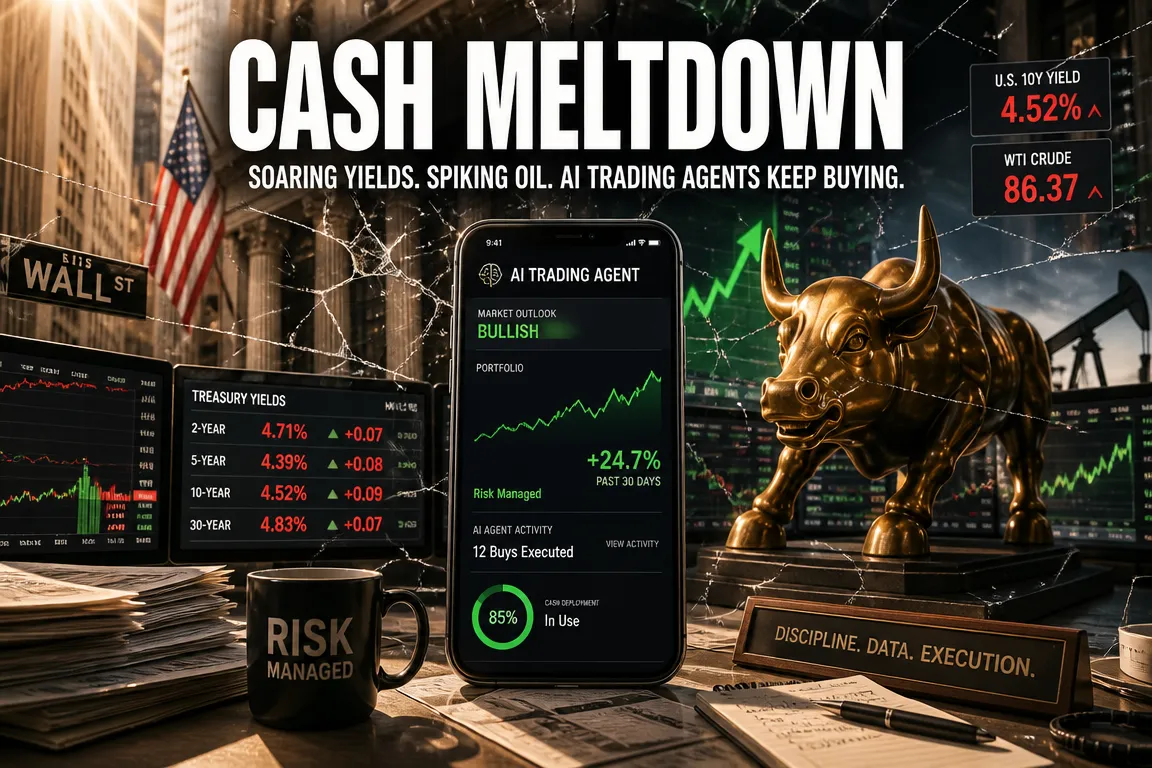
U.S. Treasury yields rose following CPI and remained elevated after PPI, with the 10-year yield moving higher.
This suggests the rates market continued to price inflation persistence and policy risk rather than validating a benign disinflation narrative.
- Equities: pricing AI earnings momentum and event optimism
- Bonds: pricing inflation risk, higher-for-longer probabilities, and term-premium pressure
The divergence between equities and bonds remains a key fragility in the current setup.
6. Why AI Equities Remained Strong: Demand Indicators Continue to Support the Theme
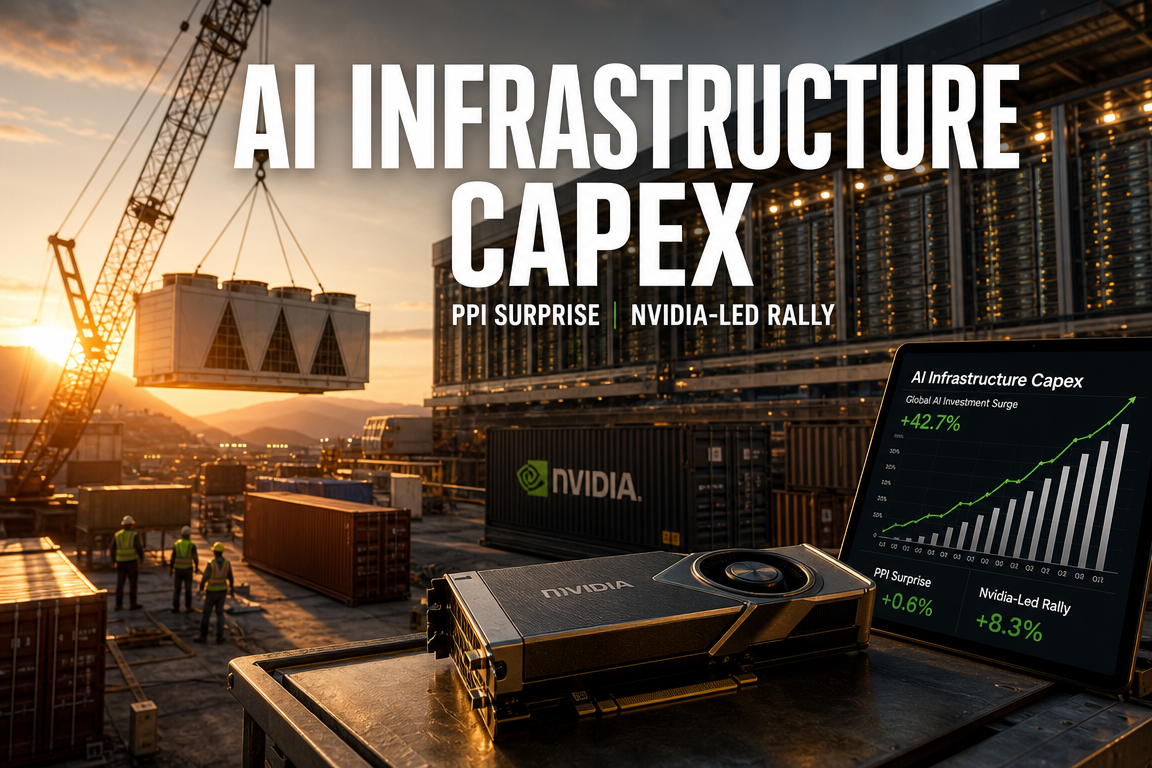
AI-linked resilience reflects measurable demand signals rather than purely thematic positioning, particularly in GPUs and data-center capex.
To deploy generative AI at scale, enterprises continue to procure high-performance GPUs, servers, networking equipment, and power infrastructure. Elevated utilization and pricing across compute capacity can reinforce the view that demand remains structural.
- Tight GPU supply and/or constrained capacity
- Ongoing expansion in data-center capital spending
- Hyperscaler competition in AI investment
- Enterprise productivity expectations
- Acceleration in commercialization and deployment
These factors have supported valuations across semiconductors, cloud platforms, and server infrastructure.
7. Issue Checklist: Key Takeaways by Category
7-1. Inflation
- PPI materially exceeded expectations
- Increased risk of CPI re-acceleration via pass-through
- Higher probability of delayed or reduced rate-cut expectations
7-2. Equities
- Nasdaq and S&P 500 advanced
- Gains were concentrated in a small group of mega-cap leaders
- Overall market breadth suggests underlying momentum may be weaker than headline indices imply
7-3. Bonds
- U.S. Treasury yields rose
- Rates markets continued to price inflation risk more aggressively
- Interpretation gap widened between equities and bonds
7-4. Event Risk
- U.S.-China summit expectations provided support for select names
- China-exposed mega caps captured a sentiment premium
- Headline risk remains high if outcomes fail to translate into policy or commercial actions
7-5. AI Trend
- GPU demand and compute pricing remained firm
- Data-center investment continued to expand
- AI-related earnings expectations continued to underpin valuations
8. Most Underemphasized Point: Index Distortion from Mega-Cap Concentration
The rally was less a function of broadly improving fundamentals and more a reflection of index structure, where a handful of mega-cap AI and technology names can materially move headline benchmarks.
- Constructive interpretation: capital is concentrating in companies perceived to have the strongest earnings durability
- Risk interpretation: if leadership weakens, index-level downside can accelerate due to concentration
If yields remain elevated while AI equities hold, it signals strong thematic conviction. However, if rate pressure begins to outweigh earnings optimism, the same leadership concentration can amplify drawdowns.
The session is best characterized as a collision between worsening inflation signals and AI-driven optimism.
9. Signals to Monitor
- Next CPI and core CPI trajectory
- Direction and level of the U.S. 10-year Treasury yield
- Semiconductor earnings and guidance, including Nvidia
- Post-summit policy actions, contracts, or regulatory developments
- Data-center capex plans and GPU supply/demand indicators
- Whether leadership broadens to small caps and cyclicals
Leadership broadening is critical. Without broader participation, the gap between index strength and underlying market health can persist or widen.
10. Conclusion: A Market Defined by Cross-Currents
Current conditions do not support a single clean narrative. Producer-level inflation signaled renewed pressure, while AI demand and mega-cap earnings expectations continued to support equity pricing. Geopolitical event expectations added a further layer of complexity.
The appropriate framing is not “why did it rise,” but which forces drove the move and how durable those forces may be.
This advance is more consistent with mega-cap AI leadership temporarily offsetting macro headwinds than with a fully broad-based risk-on regime.
The next inflection is likely to depend on whether inflation resumes disinflationary progress or whether rising yields compress growth-equity valuations.
A complete read-through requires monitoring five pillars in parallel: inflation, U.S. equities, the Federal Reserve policy path, AI semiconductors, and U.S. Treasury yields.
< Summary >
The U.S. equity rally was driven by complex cross-currents rather than a single positive catalyst.
PPI materially exceeded expectations, increasing inflation persistence risk, while Treasury yields rose in response. Despite this, the Nasdaq and mega-cap technology names advanced on AI earnings expectations, dip-buying flows, and summit-related optimism.
Market breadth remained narrow, with a small set of mega caps lifting indices. Inflation risk was not resolved; it was partially obscured by AI-driven optimism and index concentration.
[Related]
- Comprehensive Review: How Expanding AI Infrastructure Investment Impacts U.S. Equities
- PPI vs. CPI: Why the Distinction Matters More in the Current Global Macro Regime
*Source: [ 내일은 투자왕 – 김단테 ]
– 수수께끼같은 주가 상승
● AI-Infrastructure Boom, Nvidia, Google, Amazon Surge
Explosive Demand at Anthropic and the Core of the AI Infrastructure Arms Race: A Consolidated View Across NVIDIA, Google, Amazon, and CPU-Linked Equities
This cycle is not merely “AI is positive.”
The market’s primary variable is shifting from which firm has the best model to which firm can secure computing capacity and data centers first.
This report explains why Anthropic’s CEO comments on demand acceleration matter for global equities and U.S. equity positioning, why the SpaceX/xAI agreement is strategically indicative, why the benefits extend beyond NVIDIA to Google, Amazon, Broadcom, Marvell, and smaller data-center operators, and why the market is underpricing the implications of a CPU renaissance and software restructuring risk.
A key point: the binding constraint is increasingly power, cloud capacity, and inference infrastructure, not model quality.
1. Key Development This Week: Anthropic Signals Demand Outpacing Supply; Market Refocuses on AI Infrastructure
Anthropic’s CEO indicated AI demand is materially stronger than expected. What had been viewed as an aggressive scenario (roughly 10x annual growth) is now described as being exceeded on a run-rate basis.
Core message: investment is rising not due to a lack of demand, but because demand is high enough to create compute shortages. This is relevant because it suggests AI capex expansion is tied to observable usage and enterprise adoption rather than solely expectations.
- Rising AI model utilization
- Expanded enterprise AI agent deployments
- Rapid growth in inference demand
- Intensifying cloud and data-center bottlenecks
- Spillover benefits beyond GPUs to CPUs, power, and optical networking
Market interpretation has shifted from debating “bubble vs. non-bubble” toward the practical reality that near-term compute supply is not keeping pace with demand.
2. The SpaceX/xAI Agreement: Why the Market Reacted Disproportionately
The event is symbolically important because Anthropic effectively secured material data-center capacity connected to xAI-side infrastructure.
This is not a standard collaboration announcement; it indicates that top-tier AI players are prioritizing securing any visible compute capacity.
Key implications:
- For Anthropic: immediate need for servers and GPUs to meet rising inference demand
- For Musk-related infrastructure: improved utilization and potential cash-flow stabilization for underutilized assets
- For the market: confirmation that AI competition is increasingly an infrastructure land-grab rather than purely a model race
Monetization of underutilized data-center assets via leasing/contracting suggests similar structures may proliferate. This expands the investable set beyond hyperscalers to repurposed infrastructure operators and suppliers:
- Former crypto-mining infrastructure operators transitioning to AI compute
- Small and mid-sized data-center operators
- Power, cooling, and optical networking suppliers
3. Primary Beneficiary: Why NVIDIA Is Positioned to Benefit Across Outcomes
NVIDIA remains the most direct beneficiary. Whether OpenAI, Anthropic, xAI, Google, Amazon, or Meta gains share, aggregate GPU and platform demand tends to rise.
NVIDIA functions as a “picks-and-shovels” provider to the AI buildout rather than a bet on any single application winner.
Given the scale of GPU deployments discussed in the market and Anthropic’s need to continuously expand capacity, AI semiconductor demand may persist longer and remain stronger than prior consensus.
Investor considerations:
- Structural upside is less dependent on specific AI application winners
- As valuation sensitivity increases, attention typically broadens to adjacent supply-chain beneficiaries
Accordingly, market leadership has been expanding from NVIDIA into Broadcom, Marvell, power equipment, optical networking, cooling, and data-center REITs/operators.
4. Why Google and Amazon Also Screen Strongly: Anthropic as a Large Cloud Customer
Anthropic is not only a model developer; it is also a large cloud consumption driver for Google and Amazon.
The economic linkage is often underemphasized:
- Anthropic growth increases cloud usage
- Higher cloud usage supports Google Cloud and AWS revenue
- Rising utilization also supports internal silicon demand
- Incremental benefits extend to optical interconnect, networking, memory, and storage
For Google and Amazon investors, Anthropic expansion can improve visibility into cloud growth and capex monetization logic. Equity markets often reflect this linkage as AI service growth translates into improved infrastructure revenue durability.
5. The AI Agent Shift: Why CPUs Are Re-Entering the Critical Path
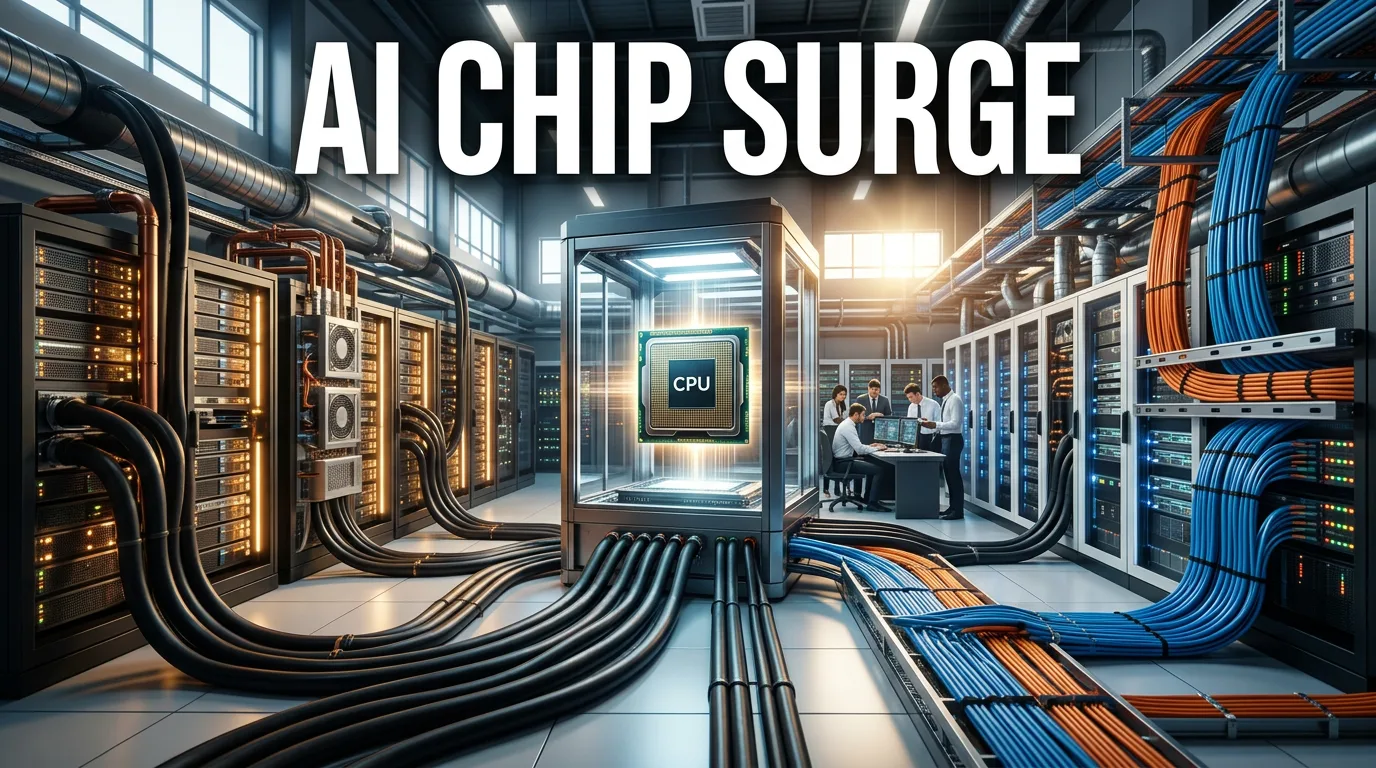
A market underappreciated pivot is the increasing importance of CPUs as AI systems move from single-turn Q&A toward multi-step agentic workflows: tool calling, orchestration, and concurrent task execution.
In this architecture, CPUs can shift from auxiliary components to key system-control and workload-management elements.
- GPU: large-scale parallel compute for training and inference acceleration
- CPU: scheduling, orchestration, system control, and agentic multitasking support
- Conclusion: broader AI agent deployment increases demand for both GPUs and CPUs
This framing supports renewed investor attention to AMD, Intel, Arm, and Qualcomm. Arm is often viewed as strategically leveraged to edge devices (phones, automotive, robotics). Qualcomm is also being re-evaluated in the context of on-device AI platforms.
6. Why This May Be Adverse for Parts of Software
Anthropic’s CEO also highlighted downside risk for certain software companies, including potential disruption to business models rather than only multiple compression.
As AI agents become more capable, portions of legacy SaaS that are primarily repetitive workflows, basic automation, or information aggregation may lose differentiation.
Higher-risk characteristics:
- Features that can be embedded directly into LLM platforms
- Single-function SaaS offerings
- Subscription models with limited pricing power
- Slow AI integration and product iteration
- Weak proprietary data advantage or workflow lock-in
Conversely, companies that convert products into agentic workflows and use AI to expand utility may be better positioned. Investors may need to separate “AI beneficiaries” from “AI displacement risk” within software.
7. Small/Mid Data Centers and Crypto-Mining Conversions: A Relevant Second-Order Theme
An important spillover is the re-rating of smaller data-center assets, including conversion of former crypto-mining sites into AI compute facilities using existing power, land, and cooling infrastructure.
This reflects urgency in capacity buildout:
- Hyperscale additions alone may be insufficient to meet demand
- Mining sites often already have power and site readiness
- Conversion can support inference and compute workloads
- Hyperscalers may accept less favorable terms to compress time-to-capacity
In practical terms: in a shortage environment, deployable capacity can command a premium. U.S. equity markets have responded by reassessing neo-cloud providers, conversion-driven infrastructure firms, and companies with power-accessible sites.
8. AI Infrastructure Capex: No Clear Peak Signals Yet
A central market question is whether hyperscaler AI capex is overextended. Based on currently visible indicators, there is limited evidence of a near-term peak. Demand commentary pointing to persistent shortages supports the view that buildouts may continue.
Market sensitivities:
- If hyperscalers reduce capex, AI infrastructure equities could re-rate quickly
- Current constraints appear more aligned with insufficient compute than excess investment
- Therefore, the near-term balance of evidence favors continuation over retrenchment
This matters macroeconomically because AI infrastructure spending is a broad capex cycle tied to power, semiconductors, networking, industrial equipment, construction, cooling systems, and real estate.
9. Undercovered Core Point: The Bottleneck Is Shifting to Physical Infrastructure
Common coverage focuses on “Anthropic momentum,” “NVIDIA strength,” and “data centers.” The more material development is that the bottleneck is moving from software to physical infrastructure.
Four key takeaways:
- First, AI competition is shifting from model performance to compute acquisition
- Second, inference demand is lifting the value of data-center capacity
- Third, beneficiaries are broadening from GPUs to CPUs, optical, power, and cooling
- Fourth, parts of software may face restructuring risk rather than upside
The third and fourth points appear less fully priced. The CPU re-acceleration is linked to architectural changes in agentic systems. Software reordering can also influence productivity, margins, and labor dynamics at the macro level.
10. Investment Framework
Current market structure can be summarized as:
AI demand is stronger than expected; constraints are compute and data centers; and benefits are spreading from NVIDIA across the supply chain.
Focus areas by group:
10-1. Top-Tier Direct Beneficiaries
- NVIDIA
- AMD
- Amazon
These names have direct linkage to AI models, cloud, semiconductors, and inference growth.
10-2. Supply-Chain Broadening Beneficiaries
- Broadcom
- Marvell
- Optical networking vendors
- Power equipment and cooling infrastructure providers
A single incremental data center drives demand across multiple component layers.
10-3. CPU and Device Expansion Beneficiaries
- Intel
- AMD
- Arm
- Qualcomm
As agentic AI extends into PCs, smartphones, vehicles, and robotics, relevance may increase.
10-4. High-Volatility Thematic Segment
- Small and mid-sized data-center operators
- Conversion-driven infrastructure firms (including former mining operators)
- AI infrastructure REITs and specialized operators
Return potential is higher, but volatility and financing sensitivity are typically elevated.
11. The Central Investor Questions
The primary questions are increasingly operational rather than model-centric:
- Who can secure power and servers fastest
- Who can absorb inference demand with reliability
- Who sits at the center of cloud and semiconductor ecosystems
- Who improves productivity via AI adoption, and who faces displacement risk
Under this framing, Anthropic’s demand commentary is a signal that AI has moved from expectation to usage-driven scaling, reinforcing the strategic role of AI infrastructure in equity markets and the broader economy.
12. One-Line Conclusion
Anthropic’s demand acceleration is less a single-company growth story than evidence of a market-wide shift in constraints toward compute, data centers, and power, expanding the investable opportunity set from AI applications to the full infrastructure stack.
< Summary >
Anthropic’s CEO indicated AI demand is materially stronger than expected. The core shift is from model competition to compute acquisition. The SpaceX/xAI agreement underscores the rising strategic value of data centers and inference infrastructure. NVIDIA benefits across competitive outcomes, while Google and Amazon can benefit via cloud consumption tied to Anthropic’s scale. As AI agents proliferate, CPUs (Arm, Qualcomm, Intel, AMD) regain strategic importance. Conversely, portions of the software universe may face feature absorption and business-model pressure. The key market themes are AI, U.S. equities, data centers, semiconductors, and cloud.
[Related Articles…]
- AI infrastructure capex expansion and the next beneficiary sectors in U.S. equities (NextGenInsight.net?s=AI)
- Semiconductor supercycle re-acceleration: how data-center demand is reshaping positioning (NextGenInsight.net?s=Semiconductors)
*Source: [ 소수몽키 ]
– 앤트로픽도 당황할 정도? AI 미친 수요 폭발의 수혜주들