● YouTube Dominates Platform Economy
The core signal hidden in YouTube’s footer text: the platform is still moving around “search, advertising, and the creator economy”
What may look like a simple footer phrase on YouTube,
actually contains clues that reveal at once
the global platform economy,
the digital advertising market,
the creator economy,
the AI-based recommendation system,
and big tech regulatory risk.
On the surface, it looks like copyright, terms, and policy guidance,
but if you dig beneath it,
it clearly shows where the world’s economic outlook and AI trends are heading.
In particular, this content is not just a “YouTube notice,”
but helps read how
online advertising,
platform monetization,
data-driven growth,
the content industry,
and AI recommendation algorithms
will be reorganized going forward.
1. The core takeaway from the news: YouTube is no longer just a video service, but a massive economic platform
In YouTube’s lower menu,
items such as
“Creators,” “Advertising,” “Developers,” and “Policy and safety” appear together.
This arrangement is not accidental.
It means YouTube is not merely a video upload site,
but a complex digital platform where advertisers, creators, viewers, and developers are all connected at once.
In other words,
YouTube’s essence is not the content itself, but
a structure that collects traffic, sells ads, retains creators, and maintains order through policy.
This structure aligns exactly with
the most important keyword in the global economy today:
the platform economy.
Corporate value is no longer determined by products alone,
but by how many users a company attracts,
how long it keeps them engaged,
and how precisely it uses that data.
YouTube is a representative example of this trend.
2. The real point from an economic perspective: the advertising market is still the engine of platform growth
The “Advertising” item shown in YouTube’s footer
itself demonstrates that online advertising is the core of YouTube’s ecosystem.
When looking at the current global economic cycle,
companies do not completely cut advertising even when consumer spending weakens.
Why? Because advertising is not just promotion,
but a direct investment for
revenue defense,
brand maintenance,
and new customer acquisition.
In particular, platforms like YouTube,
which accumulate viewing time and interest data,
can provide far more precise targeting than traditional media.
This means that even in a slowdown,
platforms that offer accurate targeted advertising
are relatively likely to maintain stronger performance.
So from an investment perspective as well,
what matters now is not just sales scale, but
ad efficiency,
user retention time,
and the conversion rate driven by AI recommendations.
This is something you should definitely keep in mind
when assessing the future of the global economy.
3. The essence of the AI trend: YouTube’s recommendation system is essentially a representative example of “AI for the masses”
Although it is not visible on the surface,
YouTube’s core competitive advantage is not the search box but
the recommendation algorithm.
This is exactly what shows the direction of the AI trend very well.
AI today is evolving beyond simply writing text or generating images,
toward predicting user intent
and recommending the next action.
YouTube has long been a representative service
that has implemented in reality
“AI that decides what to watch.”
In other words,
if you understand YouTube,
you can also read the future AI market.
The key is not generative AI alone.
The AI that actually makes money is
recommendation-based AI that predicts user behavior
to increase ad revenue and retention time.
This point is extremely important.
Many people look at AI only through the lens of chatbots,
but in real industry settings,
recommendation, classification, prediction, and personalization generate more value.
YouTube is precisely that model.
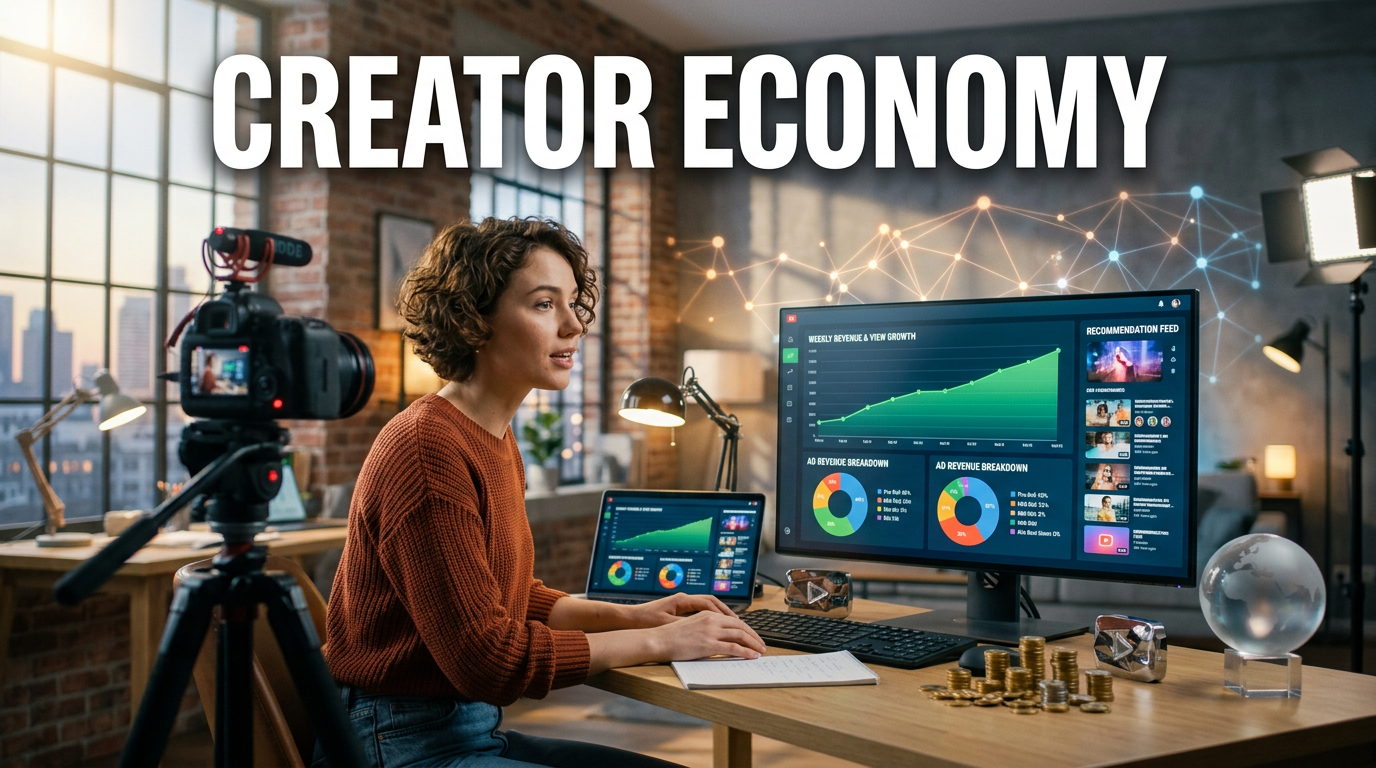
4. The change in the creator economy: individuals are becoming companies in practice
The existence of a separate “Creators” menu means
YouTube does not view creators as mere users.
Today, individual creators are
no longer just people uploading videos, but
closer to content businesses.
Ad revenue,
sponsorships,
memberships,
live support,
and brand collaborations
are creating increasingly complex monetization structures.
This is bringing major changes to the entire content industry.
In the past, broadcasters, media companies, and production firms were the center.
Now, individuals often respond faster
and capture more specific needs.
What matters here is that
a creator’s success is shifting from pure talent to
data literacy,
content optimization skills,
and AI usage capability.
From now on,
the person who knows not just how to make a good video,
but how to make it discoverable, will have the advantage.
This is not only true for YouTube,
but for the direction of the entire digital economy.
5. Why regulation and policy matter: for big tech, risk management is as important as growth
YouTube’s footer contains
dense wording about copyright, terms, privacy, and policy and safety.
This is not just a legal notice.
For big tech companies today,
the most important factor is not only growth speed, but
regulatory responsiveness.
Around the world,
privacy protection,
copyright,
youth protection,
algorithm transparency,
and platform accountability issues continue to grow.
As AI becomes more deeply embedded in content recommendation and generation,
these issues become even more complex.
Because now the questions are becoming increasingly important:
why did AI recommend this content,
who owns the rights to AI-generated content,
and how far should the platform’s responsibility extend?
In other words,
future platform competitiveness will include not just technical capability, but
policy design capability
and a compliance system.
This is also a point investors should not overlook.
6. The most important thing that other news often fails to say: YouTube is the distribution infrastructure of the AI era
Most people describe YouTube
only as a “video platform” or “advertising platform.”
But the real core point is elsewhere.
In the AI era, YouTube serves as
the path through which content reaches people,
that is, distribution infrastructure.
Why is this important?
Because even if AI becomes incredibly powerful,
in the end it must be shown to people,
clicked,
and consumed to generate money.
AI changes production,
but platforms like YouTube dominate distribution.
So the winners going forward will not simply be companies that make AI well,
but companies that know
who distributes AI-generated outputs best,
who keeps people consuming them longer,
and who converts them into higher ad rates.
From this perspective,
YouTube is not just a platform, but
something like the logistics network of the AI economy.
This point is relatively underreported in other YouTube videos or news,
so it is worth remembering.
7. Connecting this to the global economic outlook: companies that combine platforms and AI are likely to become stronger
Right now, the global economy is being shaped by
interest rates, inflation, slower consumption, and geopolitical risks all at once.
In this environment,
companies that can improve efficiency through data and technology
have the advantage over traditional industries.
Among them,
companies that have both a platform and AI
are likely to have both resilience and growth potential.
The reason is simple.
- They have many users.
- They have a lot of data.
- Their recommendation accuracy is high.
- Their ad efficiency is strong.
- Their scalability relative to cost is large.
This structure helps them withstand downturns better,
and rebound faster in recovery periods.
So when reading economic news going forward,
do not just look at interest rates or GDP.
You also need to look at what data assets a platform has,
and how it monetizes AI.
8. Practical checkpoints for blog readers: the core indicators to watch now
① Advertising revenue trend
A platform’s performance is very closely tied to the advertising cycle.
You should check whether ad pricing is holding up,
and how the mix between brand advertising and performance advertising is changing.
② User dwell time
Dwell time is essentially revenue.
It is also an indicator of how powerful the AI recommendation engine is.
③ Creator monetization structure
The more diversified the non-ad revenue streams are, the more stable the platform becomes.
Memberships, shopping, live streams, and affiliate links matter.
④ Regulatory issues
As privacy, copyright, and AI transparency issues grow,
the platform’s cost structure will also change.
⑤ Level of AI-based personalization
Whoever provides the more precise recommendations
will shape both user experience and revenue.
By watching these five items,
you can read the future of YouTube
and other companies with strong network effects.
Summary
YouTube’s footer text is not just a notice, but
a key signal showing the platform economy,
online advertising,
creator economy,
AI recommendation algorithms,
and big tech regulation.
The core point is that
YouTube is not just a video service,
but the distribution infrastructure of the AI era
and an economic platform where advertising and data are combined.
From now on,
what will matter more than the ability to create content
is the ability to make it discoverable,
monetize it,
and respond to regulation.
[Related articles…]
- Why platform companies become stronger when the global advertising market weakens
- The new winners in the digital economy shaped by AI recommendation algorithms
*Source: https://share.google/GcAKcENgcYSHFTcom