
● AI Job Shock
Sharp Decline in Employment in Professional Services: Is AI Really to Blame? Slowing Job Growth, Weaker Hiring of Entry-Level Professionals, AI Employment Shock, Service Industry Changes, and the Outlook for the Korean Economy, All at Once
Key Takeaways at a Glance
Last month’s increase in employed people fell to the smallest level in 16 months.
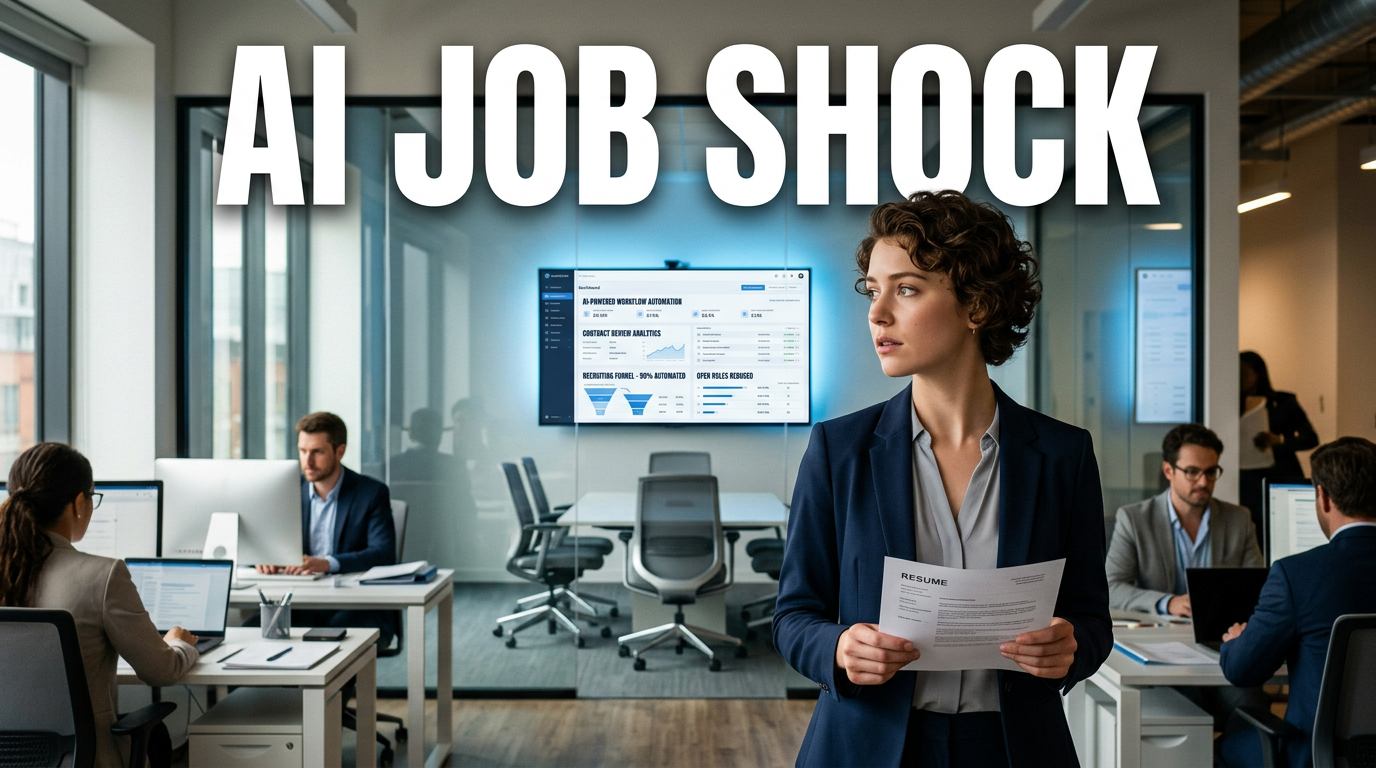
In particular, employment in the professional, scientific, and technical services sector fell sharply, leading the market to interpret this as a sign that AI may have begun affecting hiring in professional occupations.
Fields such as accounting, tax, legal services, and consulting are considered industries that are quickly affected by AI and automation technologies due to the nature of their work.
On top of that, the fallout from the conflict in the Middle East, external uncertainty, and concerns over a global economic slowdown are all combining to weaken the overall resilience of Korea’s labor market.
In this article, we will go beyond a simple explanation of employment data and systematically explore why professional hiring is weakening now, how AI is changing jobs, and where the Korean economy and industrial structure may be headed next in a news-style format.
1. The Labor Market Last Month: What Do the Numbers Show?
According to national data, last month’s increase in employed people fell to the lowest level in 16 months.
This does not necessarily mean that overall employment has collapsed, but rather that the pace of recovery is slowing.
The increase in employed people is one of the indicators that reveals economic trends the fastest, so this figure is being read not just as a statistic, but as a signal that could shake market sentiment.
Especially when employment in the service sector weakens, it often leads to weaker domestic consumption, lower corporate investment, and reduced hiring willingness.
2. The Most Noticeable Change: A Sharp Drop in Employment in Professional, Scientific, and Technical Services
The most notable part of this employment data is that the number of employed people in the professional, scientific, and technical services sector recorded the largest decline since 2013.
This sector is not a simple service industry, but one that relies on highly skilled human capital, so once it weakens, the impact on the broader labor market is significant.
Jobs such as accounting, tax, legal services, consulting, and research and development support used to rely heavily on human judgment, document preparation, and repeated review.
But now, with generative AI, document automation, and data analysis tools being introduced rapidly, the repetitive tasks traditionally assigned to entry-level workers are decreasing.
In other words, rather than jobs disappearing entirely, the threshold for passing the first gate of entry-level hiring is rising.
3. Why Is AI Shaking Professional Hiring First?
Many people think AI will first affect manufacturing or simple office jobs, but in reality, it is shaking the lower end of professional work more quickly.
The reason is clear.
First, a significant portion of professional work consists of tasks such as document summarization, draft writing, comparison of materials, and regulatory searches, all of which AI can quickly replace.
Second, from the company’s perspective, when labor costs rise, AI adoption becomes an immediate cost-cutting strategy.
Third, it helps reduce the time and cost of training new employees while still maintaining a certain level of work quality.
Ultimately, AI is not eliminating professional occupations themselves, but restructuring the workflow within them.
So the phenomenon we are seeing now is closer to a “restructuring of professional hiring” than the “disappearance of professional jobs.”
4. Why the Change Comes First in Accounting, Tax, Legal Services, and Consulting
These industries all have a lot of text-based work.
They also rely on standardized rules and repeated review, which are areas where AI is especially strong.
Accounting and tax work are centered on numbers and regulations, legal services on case law and document review, and consulting on material organization and market analysis.
These tasks are likely to shift into a structure where AI quickly produces drafts and humans handle final judgment and accountability.
As a result, companies are moving away from hiring large numbers of entry-level workers and instead operating with fewer people who can produce more output.
This change has a direct impact on young people entering the labor market.
5. The Warning Raised by the Bank of Korea Report
Earlier, the Bank of Korea analyzed that a significant portion of job losses among people under 30 occurred in AI-exposed industries.
This means that the issue is not just that technology is trending, but that traces of its impact are already appearing in labor market data.
Young workers are affected first because they are often assigned tasks with high AI substitution potential at the beginning of their careers.
In contrast, workers with more experience are relatively more protected through final decision-making, customer-facing work, and responsibility-bearing roles.
In other words, AI employment shock does not spread randomly; it appears differently by generation, job type, and industry.
6. In the AI Era, Employment Shock Comes First as Hiring Reduction, Not Layoffs
When people think about AI eliminating jobs, they often imagine large-scale layoffs.
But in practice, what appears first on the ground is usually a reduction in new hiring.
Companies tend to respond more cautiously to new hiring rather than immediately cutting existing staff.
As a result, employment growth slows in the statistics, youth unemployment becomes more severe, and the preference for experienced workers grows stronger.
This is the structural change that appears first when AI enters the labor market.
7. Why Are the Fallout from the Middle East Conflict and the Global Economic Slowdown Being Seen Together?
This employment slowdown cannot be explained by AI alone.
The fallout from the conflict in the Middle East can shake energy prices, shipping, logistics, and corporate sentiment.
In addition, if the economic trends in the U.S. and China fail to recover strongly, Korea’s exports and manufacturing investment will also come under pressure.
In other words, Korea’s labor market is currently receiving two shocks at the same time: structural change driven by AI and external variables.
At times like this, it should be seen not as a simple economic slowdown, but as a phase of industrial restructuring.
8. What Matters Most Now Is: Which Jobs Are Declining, and Which Are Growing?
When looking at this issue, the key point is not the total number of employed people, but the quality and structure of jobs.
In sectors strongly affected by AI, roles such as document processing, basic analysis, and research assistance are declining.
On the other hand, fields that can boost productivity through AI—such as AI planning, data governance, security, cloud, automation design, and industry-specific AI adoption consulting—are likely to grow.
In other words, the labor market is not simply shrinking; it is shifting.
If this trend is not understood, it can be mistaken for a simple unemployment issue, but in reality it is a problem of job reallocation.
9. How Companies Are Changing Their Hiring Strategies Right Now
Companies are now asking not “How many people should we hire?” but “How far can we automate with AI, and where should people be deployed?”
As a result, entry-level hiring is shrinking, while demand for experienced workers and multitasking talent is rising.
Another important trend is that instead of hiring one full-time employee, outsourcing and project-based collaboration are increasing.
These changes are reflected later in employment statistics, but the sense of job insecurity becomes much stronger much earlier.
That is why the hiring difficulties young people feel today are driven less by the simple business cycle and more by structural change.
10. The Most Important Point That Other News Stories Often Miss
The most important point is that AI is not only creating job losses, but also changing the path into careers.
In the past, entry-level workers learned on the job by handling repetitive tasks, and through that process they grew into specialists.
But if AI takes over repetitive tasks first, there is less real work for new hires to learn from.
This is a much more serious problem than a simple decline in hiring.
Why? Because it could thin out the future talent pool for professional occupations.
In other words, the current employment shock should be seen not just as a short-term numerical issue, but as a crack in the long-term talent development system.
11. Economic Indicators and Industry Signals to Watch Going Forward
Going forward, it will be important to look not only at total employment, but also at industry-by-industry employment changes, youth unemployment, the service sector economy, and the number of corporate job postings.
It will also become important to watch wage gaps between industries that adopt AI quickly and those that do not.
In the stock market, AI infrastructure, cloud, semiconductors, data centers, and security-related stocks are likely to remain in the spotlight.
On the other hand, traditional professional service industries that depend heavily on labor may struggle to recover hiring without productivity innovation.
This trend is also a very important point when looking at the outlook for the Korean economy.
12. In Summary, the Market Is in a Phase Where “AI Shock + External Variables + Hiring Conservatism” Overlap
The essence of this news is not simply that employment fell in one month.
The key point is that AI is changing the workflow inside professional occupations, that the impact is first appearing in youth hiring, and that external uncertainty is adding to it.
So what is needed now is not optimism or pessimism, but a clear understanding of the direction of change.
Employment is not simply shrinking; it is being restructured.
And the speed of that restructuring is much faster than many people think.
[Related Articles…]
The slowdown in the semiconductor industry and how AI demand is reshaping global supply chains
Labor market changes and youth employment difficulties: what are the job strategies in the AI era?
< Summary >
A sharp drop in employment in the professional, scientific, and technical services sector is showing that AI is beginning to have a serious impact on hiring in professional occupations.
In particular, entry-level hiring is weakening quickly in fields such as accounting, tax, legal services, and consulting, where repetitive document work is common.
As the Bank of Korea analysis suggests, AI-exposed industries are also linked to job losses among people in their 20s.
Going forward, the bigger issue may be not layoffs, but hiring reductions and changes in the path into careers.
Ultimately, the core point now is the structural change in employment created by AI shock, external uncertainty, and industrial restructuring working together.
*Source: MBCNEWS