● Nvidia-Slashed, Sandisk-Soared, AI-Shakeup
Rationale for Shorting Nvidia While Building a Core Position in SanDisk: The Signal Highlighted by a Wall Street AI-Focused Investor
This portfolio indicates a differentiated view within the AI value chain: identifying where expectations appear extended and where market pricing may remain incomplete.
Key takeaways:1) AI’s center of gravity is shifting from training to inference and service back-end infrastructure.
2) A cautious stance on large-cap semiconductors broadly, while maintaining high-conviction longs in specific storage, power, and data-center infrastructure names.
3) While market attention remains concentrated on headline AI beneficiaries (e.g., Nvidia, Broadcom, AMD), critical bottlenecks may increasingly sit in storage and power infrastructure.
This report summarizes: (i) why sector-level hedges were implemented across U.S. semiconductors, (ii) why SanDisk was positioned as a core long, and (iii) the implications for global macro conditions, AI semiconductors, data centers, and digital infrastructure.
1. Why the portfolio drew market attention
The significance is not performance alone. A prominent, technology-literate AI investor maintained a structurally bullish AI thesis while establishing short/hedge exposures across U.S. semiconductors, including Nvidia.
Rather than expressing a single-direction “AI beta” view, the construction suggests:
- Hedging the sector while isolating structural bottlenecks for long exposure.
- A view that “AI as a theme” can persist, while returns across AI-linked equities may diverge materially.
2. Investor profile: why the market assigns credibility
The investor is viewed as atypical due to a combination of technical proximity and a coherent macro-to-supply-chain framing.
Background highlights:
- Born in Germany
- Entered Columbia University at 15
- Graduated with highest honors at 19
- Studied economics, mathematics, and statistics
- Economics research at Oxford
- Investment-related experience at FTX
- Experience with OpenAI’s Superalignment team
- Subsequently founded an AI-focused investment firm
Market relevance: the approach integrates AI research direction, compute bottlenecks, power availability, security, semiconductor supply chains, and U.S.–China strategic competition into a unified investment framework.
3. Important constraint: 13F data are not real-time
13F filings disclose quarter-end holdings with an approximate 45-day reporting lag. For option-heavy strategies, positions may have changed materially before disclosure. The filing is best interpreted as a point-in-time expression of views, not a current-position guarantee.
4. Portfolio summary: simultaneous high-conviction longs and explicit hedges
The portfolio reflects a relative-strength framework:
- High-conviction long exposure to selected bottleneck beneficiaries
- Put-option overlays to manage valuation and sector concentration risk
- Volatility positioning in select names
Notable positioning:
- High interest: SanDisk, Bloom Energy, exposure linked to CoreWeave, Core Scientific, Iris Energy
- Hedge/short bias via puts: SMH ETF, Nvidia, Oracle, Broadcom, AMD, ASML, Intel
- Two-sided positioning: Micron and TSMC via both calls and puts
Core message: “AI demand can persist, but headline beneficiaries may not outperform uniformly from current valuations.”
5. Why short Nvidia: valuation and concentration hedging rather than an anti-AI view
The positioning is consistent with risk management against elevated expectations and crowded positioning.
5-1. SMH puts: sector-wide semiconductor risk control
SMH is a major semiconductor ETF with concentrated exposure to large-cap names (e.g., Nvidia, TSMC, Broadcom, AMD, Intel, Micron). Puts on SMH indicate concern about broad sector drawdowns, not solely single-name risk.
5-2. Strong company vs. attractive price
A favorable long-term competitive outlook does not imply uninterrupted upside at any price. Where expectations are heavily discounted, modest disappointment or macro tightening can drive outsized volatility—especially in high-duration growth equities exposed to rates, liquidity, and capex cycles.
5-3. Long/short: relative value within the AI stack
The portfolio suggests AI can remain structurally supported while leadership rotates toward bottleneck layers—particularly storage, power, and data-center infrastructure—relative to mega-cap semiconductor beneficiaries.
6. Why SanDisk: the portfolio’s central long theme
The single-name expression most associated with the portfolio is SanDisk, implying a focus on storage as a key constraint as AI moves into scaled deployment.
6-1. Business relevance
SanDisk is associated with consumer storage (USB, SD cards, SSDs), but the investment relevance is data-center SSD exposure. As AI usage scales, the ability to store, retrieve, and manage large datasets becomes increasingly critical.
6-2. Drivers of strong price action
Potential drivers cited by the portfolio’s construction:
- Low base and higher beta from smaller market capitalization
- Improving NAND/SSD cycle expectations
- Rapid growth in AI data-center storage demand
- “Pure-play” characteristics that attract thematic flows
Large diversified memory names may exhibit lower equity torque; smaller pure-plays can re-rate more aggressively when a theme accelerates.
6-3. Importance of “pure-play” exposure
For investors seeking direct exposure to NAND/SSD dynamics, pure-play profiles can command a premium during thematic rotations because the linkage to the target factor is more explicit than in broadly diversified conglomerates.
7. Why storage is re-emerging as a core AI infrastructure lever
The primary shift is not model quality alone, but increasing real-world usage at scale.
7-1. From training to inference and production back-ends
Early cycles emphasized training, benefiting GPUs, high-bandwidth memory, and networking. As inference and deployment scale, back-end data management becomes a larger determinant of system performance and cost.
7-2. AI service back-ends are storage-intensive
Modern generative AI workloads extend beyond text:
- PDF ingestion
- Image analysis
- Code repositories
- Enterprise document connectors
- Conversation history retention
- Long-term memory features
- Agent task logging
These use cases increase storage needs and favor SSD adoption in performance-sensitive environments.
7-3. Agentic AI increases persistent data creation
As AI systems execute workflows (read files, retain context, call tools, write outputs, store logs), data volume and persistence requirements rise, strengthening the case for scalable storage infrastructure.
7-4. SSD as a cost-effective memory adjunct
Not all data can reside in expensive DRAM due to cost and capacity limits. In certain workloads, NAND-based storage functions as an auxiliary tier, elevating the strategic relevance of SSD/NAND cycles.
8. Signal: storage and power may gain importance relative to compute
Equity narratives remain GPU-centric, but system-level constraints increasingly span:
- Compute
- Memory
- Storage
- Power
- Cooling
- Optical interconnects
- Data-center operations
This portfolio implies incremental emphasis on storage and power as emerging bottlenecks.
9. Related longs: why Bloom Energy, CoreWeave exposure, Core Scientific, and Iris Energy matter
SanDisk appears as one component of a broader infrastructure thesis.
9-1. Bloom Energy: positioning for power constraints
AI data-center expansion intensifies electricity demand. Distributed generation and backup power solutions may gain relevance as grid constraints tighten.
9-2. CoreWeave: “neo-cloud” beneficiary
AI-specialized cloud providers may absorb incremental training and inference demand where general-purpose hyperscalers face capacity or allocation constraints.
9-3. Core Scientific and Iris Energy: conversion-to-data-center exposure
Assets originally aligned with crypto infrastructure may be repurposed for AI data-center use, leveraging existing capabilities in power procurement, sites, cooling, and operations.
10. Reduction in Lumentum: what it suggests
A decreased allocation to optical components may indicate prioritization rather than a negative fundamental reassessment. The portfolio implies that, at the margin, storage and power may present more direct bottleneck exposure in the current phase.
11. Two-sided positioning in Micron and TSMC: volatility and event risk
Simultaneous calls and puts suggest a strategy oriented toward volatility around catalysts (earnings, cycle data, guidance), acknowledging both upside exposure and drawdown risk.
- TSMC: central to AI supply but exposed to supply-chain and geopolitical variables.
- Micron: levered to memory cycle dynamics and AI demand, with inherent cyclical volatility.
12. Macro context
This positioning aligns with broader market conditions rather than single-name narratives.
12-1. Rates and liquidity
If U.S. rates remain elevated or cuts are delayed, high-valuation growth equities can face valuation compression despite strong secular demand.
12-2. Concentration risk in U.S. equities
High index concentration increases vulnerability to sector-level drawdowns, incentivizing professional investors to maintain hedges even when constructive on the theme.
12-3. U.S.–China competition and supply-chain realignment
AI increasingly intersects with national strategy. Semiconductors, memory, power infrastructure, data security, and cloud sovereignty are likely to remain policy-sensitive, requiring a supply-chain and geopolitical lens.
13. Key points (news-style)
1) AI-focused investor strengthens hedges across large-cap semiconductors
Put positions in major semiconductor names and the SMH ETF indicate preparation for sector volatility.
2) SanDisk identified as a flagship long
The thesis emphasizes AI-driven SSD/NAND demand, low base effects, and pure-play exposure.
3) Investment focus shifts from GPUs toward storage and power bottlenecks
As inference and service back-ends scale, storage and power constraints gain investment relevance.
4) Relative-value structure via long/short construction
The portfolio favors bottleneck segments while reducing exposure to broad sector drawdowns.
14. Underappreciated point
The critical signal is not “SanDisk outperformed,” but that AI bottlenecks may be diversifying beyond GPUs into storage and power.
As AI services scale, operational requirements intensify:
- User data retention
- Conversation state management
- Enterprise knowledge integration
- Agent execution logs
- Back-end caching and persistence
- Continuous inference throughput
The next phase of AI infrastructure competition may increasingly be defined by cost-efficient, reliable storage and power delivery, not only compute performance.
15. Practical interpretation framework
- AI demand can remain structurally supportive.
- AI-linked equities will likely show differentiated returns.
- When headline beneficiaries appear crowded, adjacent bottleneck enablers can outperform on a relative basis.
- Analyze the full stack: storage, power, data centers, and operations alongside semiconductors.
- Treat 13F disclosures as lagged signals, not real-time positioning.
16. Conclusion
The portfolio communicates a clear structure: hedge broad large-cap semiconductor exposure while concentrating longs in storage and power as AI deployment moves from training to inference and scaled services.
The implication is a transition from a single-stock GPU narrative to a broader infrastructure buildout spanning inference, data centers, storage, power, and service back-end capacity. The central signal is that the next constraint may be storage and power as much as compute.
< Summary >
The portfolio hedges large-cap U.S. semiconductors, including Nvidia, while expressing high conviction in storage (SanDisk) and power-related exposure (e.g., Bloom Energy). This aligns with a shift toward inference and service back-end scaling, where SSD/NAND and power infrastructure constraints may become increasingly material.
[Related …]
-
AI Semiconductor Market Reshaping: Why the Next Winner May Not Be the GPU
https://NextGenInsight.net?s=AI -
How Data-Center Power Constraints Affect U.S. Equities and the Global Economy
https://NextGenInsight.net?s=data-center
*Source: [ 내일은 투자왕 – 김단테 ]
– 엔비디아를 숏?? AI투자 천재의 포트폴리오가 매우 충격이네요;;
● Shockwave, AI, Oil, Rates, Power, Risk
U.S. Equities: Beyond Rate Shock—Key Variables Include Hormuz Risk, Nvidia Earnings, Power-Infrastructure M&A, and an AI Infrastructure Repricing
Headline index moves were modest, but internal market dynamics reflected a different picture.
Current price action reflects simultaneous pressure from rising U.S. Treasury yields, higher oil prices, expectations for Nvidia’s earnings, continued AI capex, and competition to secure grid capacity.
This report focuses on: why AI and semiconductors have remained resilient despite higher yields; why the NextEra–Dominion situation is more than a utilities headline; why Vertiv target increases imply more than a cooling-equipment story; and how potential Hormuz transit-fee dynamics could affect inflation expectations and portfolio positioning.
The objective is to identify where market “rules” are shifting.
1. Key Market Read-Through: Quiet Indices, Internal Contest Between AI and Rates
Early trading saw the Nasdaq slightly positive while the S&P 500 and Dow were modestly lower.
As the session progressed, all three major indices turned positive, reinforcing a “resilient under pressure” narrative.
- Dow: +0.19%
- Nasdaq: +0.15%
- S&P 500: +0.16%
- Russell also turned positive
This reflects a market structure that is not dismissing rates, but continues to hold primarily through AI and mega-cap leadership.
Semiconductors were volatile intraday, but attention remained concentrated on Nvidia, AMD, Micron, and Intel.
Overall, the market remains characterized by a narrow, high-conviction rally rather than broad-based strength.
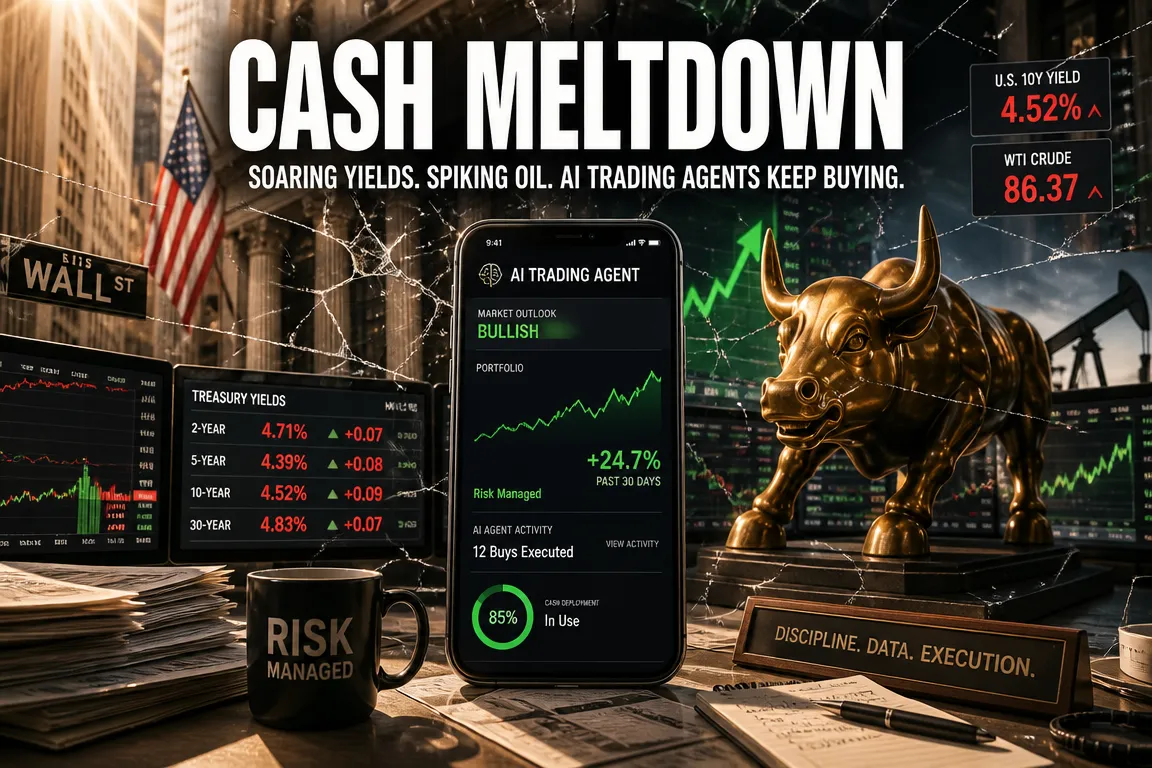
2. Primary Macro Variable: 10-Year Yield Near 4.6% and 30-Year Issuance at a 5% Coupon
The most consequential development remains the bond market rather than single-stock headlines.
The U.S. 10-year Treasury yield approached 4.6%, and new 30-year issuance referenced a 5% coupon.
This signals a potential shift in the valuation anchor for risk assets.
Higher long-term risk-free rates increase discount rates used across equities, real estate, and corporate valuation, potentially re-pricing asset “fair value” assumptions.
In practical terms, investors may require higher expected returns to hold risk assets.
- Higher U.S. 10-year yields → increased discount-rate pressure on growth equities
- 30-year 5% coupon context → suggests structurally higher long-duration cost of capital
- Rising long yields in Germany and Japan → broader repricing across global safe assets
- Potential unwinds of Japan-linked carry positioning → liquidity and cross-asset volatility risk
This is best viewed as a global long-rate regime transition, not a U.S.-only issue.
3. Why AI and Semiconductors Are Holding Up: Capex That Is Difficult to Cut
In a typical rate-driven selloff, growth equities are the first to de-rate.
The current cycle is different: big-tech AI capex increasingly resembles a strategic necessity rather than discretionary expansion.
Market commentary suggests that even a 10% reduction in planned AI investment by hyperscalers could materially pressure the S&P 500 and disproportionately impact tech hardware.
That same dynamic reduces the probability of near-term capex retrenchment, as slowing investment risks competitive disadvantage in model capability, productivity gains, and platform lock-in.
This is structurally distinct from cyclical industrial capex.
The key question is whether Nvidia’s earnings reveal any signal of customer capex moderation.
Absent such signals, a narrow AI-led rally may persist even under elevated rates.
4. This Week’s Key Events: Nvidia Earnings and the FOMC Minutes
Multiple events are scheduled, but Nvidia’s earnings are likely to be the highest-impact catalyst.
- May 19: Pending home sales, Home Depot earnings
- May 20: Nvidia earnings release, FOMC minutes
- Around May 22: S&P Global PMI, Walmart earnings
What to Monitor in Nvidia’s Results
- Revenue and EPS surprise magnitude
- Next-quarter guidance trajectory
- Strength of hyperscaler ordering patterns
- Progress on supply constraints in AI servers and GPUs
- Incremental catalysts such as share repurchases
The market focus is less on reported figures and more on whether the AI investment cycle remains intact.
The FOMC minutes may further clarify internal divergence on rate cuts and sensitivity to inflation persistence.
Recent pricing increasingly reflects “higher for longer,” with some probability assigned to renewed tightening if inflation re-accelerates.
5. Oil and the Strait of Hormuz: Why Iran’s “Lawful Transit Fee” Framing Matters
Middle East risk remains a potentially underappreciated variable.
Iran’s messaging on control and transit-fee legitimacy should be assessed as a signal with direct implications for energy supply chains and maritime logistics.
The Strait of Hormuz is a critical chokepoint for global crude flows; elevated tension can transmit rapidly into Brent and WTI pricing.
Brent briefly traded near $110, while WTI held near the $100 level.
The key risk is a shift toward supply-driven inflation.
- Higher oil prices → higher transportation costs
- Higher transportation costs → upward pressure on consumer goods prices
- Higher energy costs → margin compression risk
- Persistent inflation pressure → delayed easing by the Federal Reserve
- Slower growth with higher prices → elevated stagflation risk
This form of inflation is less responsive to monetary policy, increasing cross-asset sensitivity across rates, FX, consumption, and earnings expectations.
6. NextEra–Dominion M&A Discussions: Utilities as Strategic AI-Era Assets
The reported large-scale transaction involving NextEra Energy and Dominion Energy warrants attention beyond sector rotation.
It can be interpreted as early-stage competition for power capacity in the AI era.
Reportedly, NextEra has explored acquiring Dominion Energy in a deal valued at approximately $66 billion.
Dominion controls critical grid infrastructure in Virginia, a major data-center hub.
Northern Virginia is a globally significant concentration of data centers and internet traffic.
Securing electricity supply rights in data-center dense regions may materially improve negotiating leverage with hyperscalers.
Why This Matters
- AI data centers are structurally power-intensive
- Grid access increasingly functions as AI infrastructure access
- Transmission and distribution networks can be more strategic than generation assets
- Utilities may transition from “defensive dividend” profiles to strategic infrastructure exposure
- Power-infrastructure owners may see a structural re-rating
The market is beginning to price not only GPUs, but the full enabling stack—power, cooling, and distribution—into the AI value chain.
7. Vertiv Target Raised to $500: Reframing From Equipment Vendor to AI Infrastructure Platform
Loop Capital’s Buy rating and $500 price target for Vertiv aligns with the broader theme of AI infrastructure repricing.
Vertiv is often categorized as a data-center cooling and power-management hardware company; however, the key re-rating driver is the rising strategic importance of thermal management, power efficiency, distribution, and uptime in high-density AI deployments.
As air cooling faces constraints, demand for advanced thermal solutions (including liquid-based approaches) may increase, benefiting established suppliers.
Why Vertiv Remains in Focus
- Higher AI server density → accelerating cooling demand
- Power quality, distribution, and backup systems become more critical
- Data-center buildouts may translate into stronger backlog and orders
- Potential multiple expansion from industrial framing to AI-infrastructure framing
- Scope for broader sell-side coverage expansion
The market increasingly treats Vertiv as non-discretionary infrastructure exposure tied to AI capex growth.
8. Why Capital Concentration Is Increasing: Structural Flows Toward Mega-Cap AI
Institutional flows show increasing concentration.
As rates rise, the market tends to reward companies with pricing power and higher earnings visibility, accelerating flows into mega-cap technology and AI leaders rather than the broader growth complex.
Passive flows mechanically allocate more to the largest names, while active managers often prefer established market dominance under uncertainty.
As a result, indices can remain resilient even when breadth is weak.
- Small- and mid-cap performance may lag in investor “feel”
- Index levels are supported by mega-cap defensiveness
- Rotation occurs within the AI value chain
- Selective mean reversion into perceived under-owned segments
9. Global Market-Cap Rankings: Intensifying Technology Dominance
Global market-cap leadership includes gold alongside Nvidia, Alphabet, Apple, Microsoft, Amazon, TSMC, and Broadcom.
Nvidia’s rapid market-cap expansion reflects capital allocation priorities in the AI infrastructure cycle.
Leadership is shifting from platforms alone toward control of compute infrastructure.
For Korea-based investors, the positioning of Samsung Electronics and SK Hynix within the global top tier is relevant given U.S.–Taiwan–Korea interdependencies in the semiconductor supply chain.
Geopolitical risk can amplify valuation volatility across the supply chain.
10. Geopolitics Remains a Live Variable: U.S. Politics, Iran, China, and Taiwan
Beyond Middle East risk, U.S.–China dynamics and Taiwan remain key background variables.
Given TSMC’s centrality, rising cross-strait tension can impose geopolitical premia or discounts on semiconductor valuations independent of earnings fundamentals.
While near-term escalation cannot be assumed, markets recognize supply-chain concentration risk.
Expectations for Korean semiconductor firms often embed supply-chain diversification narratives; these should be assessed against observable policy and capacity shifts rather than headlines.
11. News-Style Summary: 8 Points to Retain
- Major U.S. indices were volatile intraday but closed positive.
- U.S. 10-year yields near 4.6% and a 30-year 5% coupon context could shift the market’s discount-rate regime.
- Higher oil prices are directly linked to rising Middle East and Hormuz-related risk.
- Iran’s framing of transit-fee legitimacy and control messaging increases supply-driven inflation concerns.
- Nvidia earnings are a checkpoint for AI capex durability, not merely an earnings event.
- The NextEra–Dominion situation signals early-stage competition to secure grid infrastructure for AI.
- Vertiv target increases reflect broader re-rating of cooling and power-management as AI infrastructure.
- Institutional flows continue to concentrate in mega-cap, semiconductors, and AI infrastructure.
12. Most Material Point: AI Has Become a System-Level Theme
The central issue is not whether Nvidia trades up or down, but that the AI cycle now links semiconductors with power grids, cooling, long-term rates, oil, and geopolitics.
- Hormuz risk can lift oil prices
- Higher oil can raise inflation expectations
- Higher inflation expectations can push long-term yields higher
- Higher yields pressure growth valuations
- Competitive AI dynamics reduce the likelihood of capex cuts
- GPU demand pulls through power, cooling, and utility infrastructure revaluation
AI is increasingly best characterized as an industrial-scale transformation that consumes energy and capital, not merely a software theme.
13. Practical Investor Checklist
Near-Term
- Nvidia earnings and guidance
- Inflation tone in the FOMC minutes
- Whether Brent reclaims $110
- Whether the U.S. 10-year yield stabilizes above 4.6%
- Whether semiconductor weakness reflects rotation or a structural break
Medium-Term
- Evidence of AI capex moderation
- Acceleration in power-infrastructure M&A
- Severity of data-center power constraints
- Further re-rating in cooling and power-management suppliers
- Observable supply-chain impacts from Middle East and Taiwan-related geopolitical risks
A simple “rates up, growth down” framework appears insufficient given the strength of the AI cycle.
Conversely, assuming uninterrupted AI upside understates the relevance of long-duration yields and oil-driven inflation risk.
Positioning may benefit from monitoring where capital is concentrating rather than relying on binary narratives.
< Summary >
U.S. equities remained resilient under higher rates, supported by AI and mega-cap leadership.
Rising U.S. 10-year yields and 30-year issuance at a 5% coupon context suggest a higher discount-rate anchor.
AI competitive dynamics reduce the likelihood of near-term capex cuts, supporting semiconductors and AI infrastructure despite rate pressure.
This week’s key catalysts are Nvidia earnings and the FOMC minutes.
Hormuz-related risk and higher oil increase supply-driven inflation and stagflation concerns.
The NextEra–Dominion situation highlights the strategic importance of grid infrastructure in the AI era, and the Vertiv re-rating reflects broader repricing of data-center cooling and power-management.
Overall, the market is transitioning from a semiconductor-only AI narrative to a broader AI infrastructure regime spanning rates, oil, power, cooling, and geopolitics.
[Related]
- Key U.S. Equity and AI Semiconductor Strategy Takeaways After Nvidia Earnings
- How Power-Grid Constraints Could Reshape AI: Utilities and Data-Center Beneficiaries
*Source: [ Maeil Business Newspaper ]
– 이란 호르무즈 통제 “통행료 징수 적법”ㅣ룹캐피탈, 버티브 ‘매수’&목표가 $500 제시ㅣ도미니언에너지, 넥스트에라와 완전 합병계약ㅣ홍키자의 매일뉴욕