● Tesla-409, Musk-Robotaxi, Model-Y-Hike, OpenAI-Loss
Tesla Shares at $409: Assessing Musk’s “Nationwide Rollout by Year-End” Claim — Robotaxi Fleet Reality (38 Vehicles), Model Y Price Increases, and an OpenAI Lawsuit Loss
This set of developments should be evaluated as a combined signal across U.S. risk sentiment, near-term Tesla price action drivers, the practical pace of autonomous-driving commercialization, EV margin dynamics, and the broader AI competitive landscape.
Key focus points:
- The gap between executive statements and observable operating data
- Whether Model Y price increases indicate demand normalization or margin defense
- Why the OpenAI lawsuit outcome may matter for Tesla/xAI positioning in the AI race
1. Tesla’s Share Decline: Why Macro Context Matters First
Tesla closed down 2.9% at $409.99, continuing to trade in the low-$400 range. The session lacked a strong company-specific catalyst, while broader market tone weakened.
1-1. Drivers Behind a Weaker U.S. Tape
- Renewed Iran-related geopolitical risk reduced risk appetite.
- Oil rose more than 1%.
- European government bond yields moved higher, contributing to tighter global financial conditions.
- In such environments, high-duration growth equities typically underperform.
1-2. Interpreting the Move Beyond Company Headlines
The decline is more consistent with simultaneous macro and sentiment pressure than with a single Tesla-specific item. When yields and oil rise together, equities with higher valuation sensitivity to discount rates often face disproportionate selling pressure. This can mute positive company news flow.
2. Musk’s “Nationwide U.S. Expansion by Year-End”: Interpreting the Statement
Musk appeared by video at a smart mobility event in Tel Aviv (Texas time: approximately 2:30 a.m.) and reiterated Tesla’s autonomy roadmap.
2-1. Core Points From Musk’s Remarks
- Tesla’s autonomy stack was framed as AI- and camera-centric.
- The company reaffirmed its strategy to avoid radar and lidar in favor of neural networks and vision, analogous to human driving.
- Musk stated the approach could ultimately become at least 10x safer than human drivers.
2-2. The Most Market-Relevant Claim
Musk said driverless vehicles with no safety operator are currently running in three Texas cities and expressed an expectation of U.S.-wide expansion by year-end.
2-3. Unsupervised Consumer FSD vs. Robotaxi Service Expansion
These are not equivalent:
- Unsupervised consumer FSD would imply broad permission for privately owned vehicles to operate without driver supervision.
- Robotaxi expansion more likely refers to a company-operated service scaling footprint and fleet size.
Prior commentary during earnings discussions has been closer to suggesting that unsupervised consumer capabilities may begin in a limited form in select regions around Q4, rather than a nationwide consumer rollout.
2-4. Observable Operating Data: Approximately 38 Vehicles
External tracking has cited an estimated fleet size of roughly 38 vehicles operating as unsupervised robotaxis. This aligns with the “three Texas cities” framing (e.g., Austin, Dallas, Houston). The figure supports proof of concept, but does not yet demonstrate large-scale commercialization.
2-5. Credibility Assessment
Directionally, the strategy may be consistent; however, timelines should be treated conservatively. Musk previously referenced a target of 1 million robotaxis by 2020 (stated in 2019), while current observable deployment remains at a small scale.
3. Robotaxi Commercialization: Practical Investor Checkpoints
The key question is not whether autonomy is achievable in principle, but the pace and scope of operational scaling.
3-1. Metrics That Matter at This Stage
1) Fleet scaling rate
- The time required to move from ~38 vehicles to ~380 vehicles (months vs. a year-plus) is a meaningful indicator.
2) Monetization and operational maturity
- Expansion in “cities” is less informative than evidence of repeatable paid rides and a durable revenue model.
3) Regulatory permissions
- “Nationwide” claims face state-by-state and city-level regulatory constraints, which can materially slow rollout.
3-2. “90% of Miles in 10 Years Will Be AI-Driven”: How to Frame It
The scenario may be plausible in a long horizon, but equity re-rating typically requires execution data: fleet count growth, safety statistics, regulatory progress, and unit economics.
4. Model Y Price Increases: Why the Directional Shift Matters
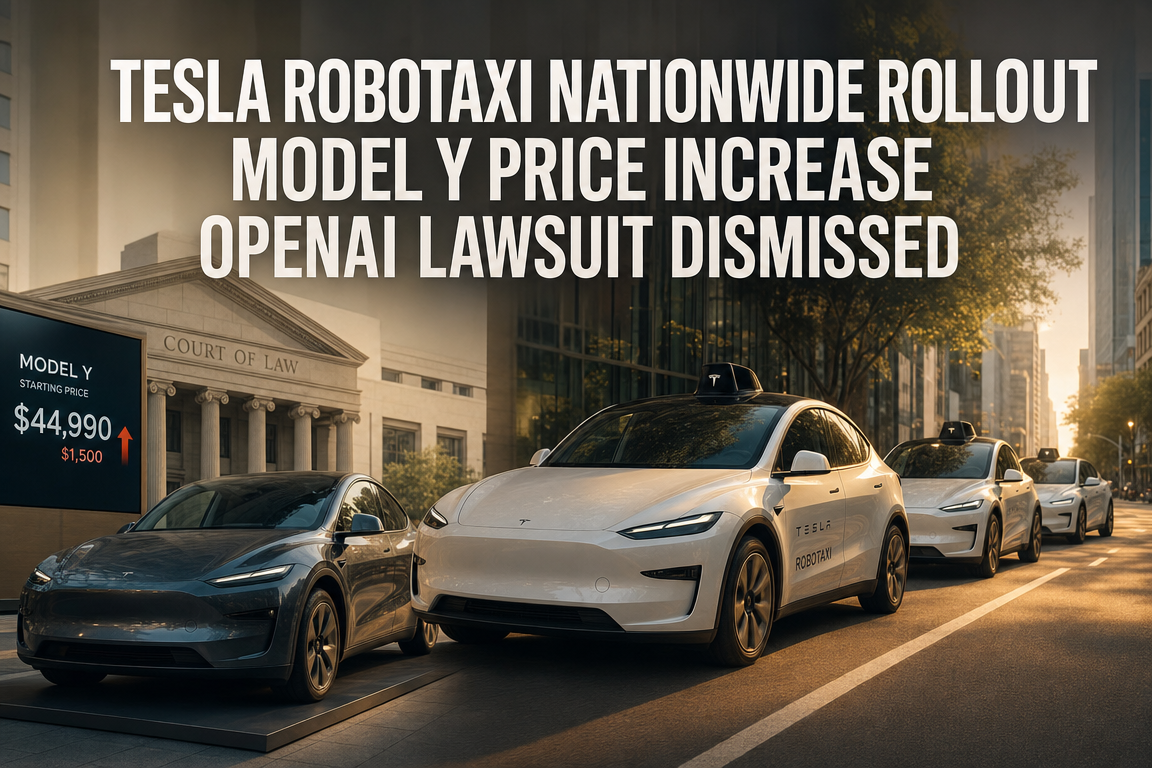
A more near-term earnings-relevant development is Tesla’s U.S. price increases on select Model Y trims, representing the first upward adjustment in approximately two years.
4-1. Details of the Price Changes
- Premium RWD: +$1,000 to $45,990
- Premium AWD: +$1,000 to $49,990
- Performance: +$500 to $57,990
- Base RWD and Base AWD: unchanged
4-2. Strategic Significance Beyond the Magnitude
The adjustments are modest (approximately 1–2%), but the shift away from persistent price cuts may signal a change in internal assessment of demand elasticity and margin priorities.
4-3. Potential Drivers
- Updated Model Y (“Juniper”) product improvements may have reduced price sensitivity in higher trims.
- Margin defense: aggressive price cuts over the past two years supported volume but compressed automotive profitability.
4-4. Upside Interpretation
Price increases can indicate that Tesla believes certain trims can sustain pricing without incremental discounting. Premium-trim-focused increases suggest an intent to protect or rebuild contribution margin. At scale, $500–$1,000 per unit can materially affect quarterly profitability.
4-5. Downside Interpretation
In a highly competitive EV market, premature increases may soften demand. Tesla continues to compete against alternatives such as Hyundai Ioniq 5 and Ford Mustang Mach-E. If brand strength, charging network advantages, and software differentiation do not offset price, elasticity risk increases.
4-6. Items to Confirm in the Next Quarter
- Order momentum following the price change
- Automotive gross margin trajectory
- Whether increases expand to additional trims or regions
- Net impact on ASP and profitability versus volume
5. Musk’s OpenAI Lawsuit Loss: Relevance for Tesla Shareholders
A federal jury in Oakland, California dismissed Musk’s case against OpenAI and Sam Altman after approximately 90 minutes of deliberation.
5-1. Central Issue: Timing Rather Than Merits
The dismissal was driven primarily by statute-of-limitations considerations rather than a detailed evaluation of OpenAI’s organizational changes. The jury concluded Musk was aware of the potential shift before 2021, making a 2024 filing time-barred.
5-2. Why This Matters for Tesla
While the case appears personal or xAI-related, it reduces Musk’s ability to use litigation to constrain a key AI competitor. Competitive pressure shifts further toward product execution, capital formation, and ecosystem scale.
5-3. Implications for xAI–Tesla Positioning
Musk continues to position Tesla as an AI-centric platform rather than solely an EV manufacturer. Autonomy, Optimus, compute infrastructure, and robotaxi services are AI-dependent. With legal leverage diminished, a stronger emphasis on integration narratives between xAI and Tesla is plausible, which could influence long-duration valuation frameworks.
5-4. Implications for OpenAI and Capital Flows
The ruling reduces a category of legal overhang. If OpenAI pursues an IPO or major financing, AI-sector capital allocation dynamics could shift, potentially affecting Tesla/xAI, Nvidia, and adjacent ecosystems.
6. Executive Summary (One-Line Items)
- Tesla fell to $409.99 amid weaker macro risk sentiment.
- Musk stated unsupervised robotaxis are operating in three Texas cities and expects U.S.-wide expansion by year-end.
- External estimates cite roughly 38 vehicles, consistent with early-stage deployment rather than broad commercialization.
- Tesla raised U.S. Model Y prices on select premium trims for the first time in about two years.
- The OpenAI lawsuit was dismissed on statute-of-limitations grounds, implying AI competition will center more on execution and capital than on litigation.
7. Key Points Commonly Missed in Surface-Level Coverage
7-1. “Nationwide” Is Less Important Than the Unit of Expansion
Relevant indicators:
- Operating area by city/zone
- Fleet growth rate
- Paid ride volume and utilization
- Transparency on incident and safety metrics
Without these, “nationwide” is closer to messaging than a validated business scale-up.
7-2. Model Y Pricing Likely Tests Margin Absorption, Not Only Demand
The critical variable is the market’s ability to absorb higher pricing without volume degradation. ASP and automotive margin may be more informative than headline deliveries.
7-3. The OpenAI Loss May Accelerate Internal AI Consolidation
Reduced external constraint efforts can increase incentives to pursue tighter internal integration and platform framing across Tesla and xAI.
7-4. For Holders at the $409 Level, the Priority Is a Verification Timeline
Monitor:
- Robotaxi fleet scaling
- Geographic expansion of unsupervised capabilities
- Order trends following Model Y price changes
- Automotive margin inflection
- Signals of strategic integration between xAI and Tesla
8. Forward Watchlist: Near-, Mid-, and Long-Term Variables
8-1. Near-Term Variables
- U.S. rate sensitivity and broader equity risk appetite
- Oil price trends and geopolitical risk
- EV demand conditions
- Post-price-increase Model Y order trajectory
8-2. Mid-Term Variables
- Expansion of unsupervised robotaxi operating areas
- Fleet scaling speed
- Safety statistics and regulatory approvals
- Automotive profitability recovery
8-3. Long-Term Variables
- Re-rating potential as an AI platform company
- xAI–Tesla technology and data synergies
- Real-world progress of Optimus and robotics commercialization
- Whether autonomy scales into a platform economics model
9. Conclusion: A Practical Framework for Tesla at This Level
Musk’s strategic vision remains central, but markets increasingly require measurable execution. Robotaxi deployment appears to be progressing, but ~38 vehicles represents initiation rather than mass adoption. Model Y price increases are a more immediate signal with direct implications for ASP and margins. The OpenAI lawsuit dismissal is a short-term headline but may have longer-term relevance in shaping the competitive posture of Tesla and xAI.
< Summary >
- Tesla declined to $409.99 amid macro-driven risk-off conditions.
- Musk reiterated a year-end expectation for U.S.-wide robotaxi expansion; observable deployment is estimated at ~38 vehicles.
- Key validation metrics include fleet growth, operating footprint, regulatory permissions, and monetization pace.
- Model Y price increases mark a directional shift and may reflect demand resilience and/or margin rebuilding efforts.
- The OpenAI lawsuit dismissal reduces litigation-based leverage and may reinforce a strategy centered on internal AI execution and ecosystem scale.
[Related Articles…]
- Tesla equity and autonomous-driving commercialization: key variables to monitor
- https://NextGenInsight.net?s=Tesla
- AI competition and U.S. equities: shifts in big-tech investment flows
- https://NextGenInsight.net?s=AI
*Source: [ 오늘의 테슬라 뉴스 ]
– 새벽 2시에 나타난 머스크, “올해 말 전국 확산” — 실제 38대인데 믿어야 하나? $409 주주는?
● Semis, Surge, AI, Boom
Should You Buy Samsung Electronics and SK Hynix Even Now?
Semiconductor Leadership Cycles and the Core Drivers of the Korean Equity Market
Recent investor demand has centered on one question: “Is it still reasonable to initiate positions in Samsung Electronics or SK Hynix?” This is not limited to two individual names. The Korean equity market is currently highly sensitive to semiconductors and AI-related chips, memory conditions, HBM demand, foreign investor flows, and global macro dynamics.
This report consolidates:
- Why Samsung Electronics and SK Hynix remain central to market interpretation
- Why KOSPI index-level signals can be misleading
- How leadership cycles typically evolve and when they tend to peak
- Practical checkpoints that materially influence risk/reward but are often underemphasized in headline coverage
1. Bottom Line: Why Samsung Electronics and SK Hynix Still Matter
The core message is constructive: the case to continue monitoring—and selectively accumulating—remains intact.
The Korean market’s effective leadership is currently semiconductors, with Samsung Electronics and SK Hynix at the center due to their outsized market capitalization influence. In this structure, market direction is frequently better explained by these leaders than by broad index narratives.
Key implication: the primary question is less “Is the index expensive?” and more “Is semiconductor leadership intact?”
2. Why the KOSPI Index Has Lower Informational Value
A key framework is that the index can be an unreliable proxy for market breadth. Samsung Electronics and SK Hynix represent a dominant share of index market cap; inclusion of closely related names can amplify the perceived concentration.
As a result:
- The index may rise while a large portion of the market remains weak.
- Index-based interpretations can overstate or understate underlying conditions.
A comparable pattern has appeared in the U.S. during mega-cap-driven periods, where headline indices advanced despite limited participation. The current environment is better characterized as a “mega-cap leadership market” than a broad-based index cycle.
3. Why Semiconductors Are Leading: AI Demand, Not Just a Cyclical Rebound
Interpreting the move as a standard cyclical bounce is incomplete. The current cycle combines:
- Memory upcycle dynamics
- Structural AI infrastructure demand
HBM (High Bandwidth Memory) has become a critical component in AI servers and GPU platforms. Continued AI capex by major ecosystem leaders has supported structurally stronger demand for HBM, DRAM, and server memory.
This suggests the rally is linked not only to inventory normalization but also to sustained AI infrastructure buildout, interacting with packaging constraints, supply limitations, and power infrastructure expansion.
4. “Most Leadership Trades End Within 2 Years”: Why This Matters
A frequently cited empirical observation is that most leadership cycles conclude within roughly two years. This should not be read as immediate downside, but as a risk-management framework:
- Leadership is not permanent.
- New leadership tends to emerge as liquidity and earnings momentum rotate.
The practical focus is determining whether the current semiconductor cycle is early, mid, or late stage, and whether earnings can continue to validate price performance through revisions, margins, and demand durability.
An additional view presented is that the most recent sustained leg may be approximately 8 months old, implying the cycle may not yet be mature, subject to earnings confirmation.
5. Why Investors Feel Elevated Uncertainty
Heightened market strength often increases perceived risk due to:
- FOMO-driven decision pressure
- Lower investor experience across full-cycle regimes
Less experienced participants may react more strongly to macro headlines (geopolitics, FX, rates, inflation, trade policy, recession risk). In practice, leadership sectors can outperform even in complex macro backdrops if earnings and flows remain supportive.
6. Key Takeaways (7 Points)
1) The primary driver in Korea is semiconductor leadership rather than the KOSPI index itself.
2) Market-cap concentration in Samsung Electronics and SK Hynix can distort index-based conclusions.
3) Semiconductor strength is supported by AI infrastructure investment and HBM expansion, not only rotation.
4) If leadership is in an early-to-mid phase, late entry risk can be managed through structure rather than avoidance.
5) Sector leadership typically changes over time; leaders often deliver relative returns even in weaker markets.
6) Investor fear can reflect behavioral and experience gaps more than fundamentals.
7) The key variable is whether earnings-backed leadership is maintained, not index-level forecasting.
7. Underemphasized but Decision-Critical Considerations
7-1. Samsung Electronics vs. SK Hynix: Different Exposure Profiles
Although both are semiconductor leaders, market focus differs:
- SK Hynix: more direct HBM and AI-memory sensitivity
- Samsung Electronics: requires a broader lens (memory, foundry, mobile/consumer devices, shareholder returns, corporate execution)
A uniform “semiconductors are strong” approach can misprice risk. SK Hynix may reflect more immediate AI-memory momentum, while Samsung Electronics may depend more on valuation, normalization, and execution in closing technology and competitiveness gaps.
7-2. The Core Variable Is the Durability of Earnings Revisions
Prices typically move ahead of fundamentals. “It has risen too much” is not a sufficient framework. The more relevant question is whether 6–12 month earnings expectations continue to trend upward.
Durability requires measurable confirmation across:
- HBM competitiveness and customer qualification
- Demand visibility
- DRAM pricing trajectory
- NAND recovery pace
- Capex discipline
- Inventory normalization
Consensus revisions and forward profitability are central to assessing whether leadership can persist.
7-3. A Strong KOSPI Does Not Necessarily Signal Broad Economic Recovery
Equity index strength may reflect liquidity concentration in select sectors rather than economy-wide improvement. Macro assessment should be separated into:
- Exports
- Manufacturing cycle
- Corporate capex
- Employment
- Domestic demand, property, and consumption
Index gains alone are insufficient evidence of broad real-economy acceleration.
7-4. The “Supercycle” Is Not Only About Memory Price Increases
Prior cycles were often framed primarily through DRAM price rebounds. The current setup is more system-level:
- AI data center expansion
- GPU ecosystem demand
- HBM supply tightness
- Advanced packaging bottlenecks
- Power infrastructure scaling
The key question becomes whether AI ecosystem capex remains sustained, positioning semiconductors as core AI infrastructure rather than a purely cyclical manufacturing trade.
8. Practical Investment Checkpoints
8-1. Staged Entry Over Chasing
Even if leadership remains intact, short-term volatility can rise after sharp moves. A staggered accumulation approach can improve execution and risk control.
8-2. Evaluate Cycle and Valuation Together
Leaders can remain expensive and continue to outperform if earnings momentum persists. Valuation becomes a constraint when revisions stall. The central question is whether forward earnings can continue to validate the price level.
8-3. Assess Supply-Side Execution, Not Only AI Narratives
HBM outcomes depend on more than demand:
- Yield and quality
- Customer qualification and delivery schedules
- Capacity expansion
- Back-end and packaging coordination
Headline-driven positioning without supply-side verification increases error risk.
8-4. Leadership Will Rotate
Current dominance does not imply permanence. Monitoring is required for inflection points in earnings momentum and flows as leadership rotates across sectors.
9. Why a Global Framework Is Required
Samsung Electronics and SK Hynix are globally leveraged businesses. Key dependencies include:
- U.S. mega-cap AI capex continuity
- Global liquidity conditions
- USD strength and KRW dynamics
- U.S.–China technology friction
- Semiconductor equipment/materials supply chain constraints
Domestic-only monitoring is insufficient to evaluate the persistence of semiconductor leadership.
10. A Practical Framework (Not a Single-Line Call)
It may be premature to conclude the trade is purely valuation-driven and overextended; it is equally inappropriate to assume risk-free late-cycle upside.
A structured framework:1) Semiconductors remain the leadership sector.
2) AI and HBM provide more structural demand than in prior cycles.
3) Sustained upside typically requires earnings delivery and supportive flows, not sentiment alone.
The relevant question is whether the cycle remains mid-phase rather than already completed, subject to earnings confirmation.
11. Most Actionable Interpretation for Investors
Attempting to forecast the index is less effective than tracking the dominant earnings-and-liquidity channel. Macro complexity persists, but realized returns often concentrate in the strongest sectors.
Current market structure places semiconductors at the center, with Samsung Electronics and SK Hynix as the principal leaders. A disciplined approach focuses on earnings, cycle data, AI demand indicators, flow trends, valuation context, and leadership duration.
< Summary >
- The Korean market is currently best characterized as a semiconductor-led regime centered on Samsung Electronics and SK Hynix.
- The principal driver is AI infrastructure investment and rising HBM demand, not only a cyclical recovery.
- Leadership is not permanent, but evidence does not require concluding the cycle has ended; confirmation depends on earnings and revisions.
- Index-level signals can be distorted by concentration; investors should track earnings revisions, flows, and competitive positioning in AI memory.
- The central question is not whether prices are high, but whether forward earnings can continue to improve.
[Related Links…]
- https://NextGenInsight.net?s=semiconductors
- https://NextGenInsight.net?s=AI
*Source: [ 경제 읽어주는 남자(김광석TV) ]
– 삼성전자·SK하이닉스, 지금이라도 사야 할까 주도주는 아직 끝나지 않았다 | 경읽남과 토론합시다 | 한규범 대표 [1편]