● Eli Lilly, SpaceX, Quantum Surge, Walmart Shock, Nvidia Fade
Eli Lilly Obesity Drug (28.3% Weight Loss), SpaceX IPO, and USD 2B U.S. Quantum Support: Key Market Points
This set of developments is not routine headline flow. It contains signals relevant to U.S. equity direction, the next investment axis in AI, dispersion between semiconductors and software, early signs of consumer softening, and longer-term supply-chain and industrial policy implications.
This report summarizes:
- Why the market response to NVIDIA’s earnings was muted
- Why Walmart’s results matter as a real-time indicator of U.S. consumer resilience
- Why Eli Lilly’s obesity data may reshape broader healthcare dynamics
- Why a SpaceX IPO could influence summer liquidity conditions
- Why U.S. quantum funding is positioned as a strategic asset alongside AI, not after it
1. U.S. Market Snapshot: Stock-level dispersion dominated index moves
U.S. equities opened weaker and recovered part of the intraday decline. The primary signal was dispersion across sectors and single names rather than index-level direction.
- Nasdaq: higher volatility in technology
- S&P 500: broad weakness in large caps
- Dow: mixed performance in cyclicals and consumer
- Russell: attempted intraday rebound in small caps
With rates, inflation, oil, and geopolitical risk still present, “good earnings = automatic upside” has been less reliable. The regime remains selective rather than liquidity-driven.
2. Eli Lilly obesity therapy: implications of 28.3% average weight reduction
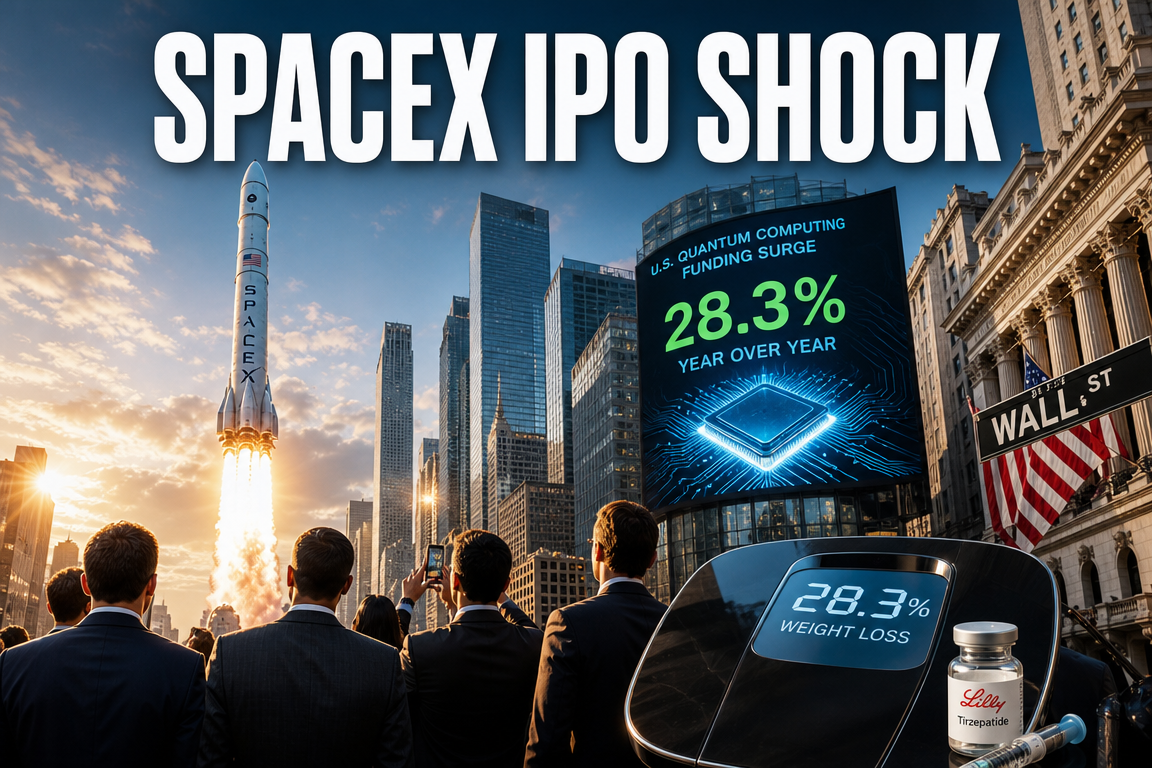
One of the most market-relevant announcements was Eli Lilly’s obesity drug data showing 28.3% average weight reduction. This is material beyond a single-product headline.
2-1. Why the number matters
The global obesity market is led by Novo Nordisk and Eli Lilly. A result in the high-20% range resets expectations and reinforces obesity as a central pillar of chronic disease management, linked to cardiometabolic outcomes.
2-2. Why equity markets treat it as structural
Eli Lilly is priced not only as a pharmaceutical company but as a long-duration healthcare innovation platform. Secular drivers include aging demographics, rising chronic disease prevalence, and increased emphasis on preventive medicine.
2-3. Potential sector-wide spillovers
- Intensified competition in obesity therapeutics
- Greater linkage to diabetes, cardiovascular, and fatty liver indications
- Potential acceleration of payer and coverage discussions
- Indirect effects on food, healthcare services, and fitness ecosystems
Obesity treatment is increasingly tied to insurance coverage, employer benefits, and public healthcare spending, implying a higher addressable revenue ceiling.
2-4. Investor takeaways
Recent market behavior continues to favor category leaders over second-tier peers across both semiconductors and healthcare. If growth equities are re-rated, AI and obesity therapeutics are candidates to remain core structural narratives.
3. SpaceX IPO filing: why it is not viewed as a standard listing
Reports that SpaceX submitted IPO-related documentation drew substantial attention, with discussions referencing a potential valuation up to approximately USD 80B.
3-1. Strategic relevance
SpaceX is increasingly viewed as infrastructure exposure rather than a single-industry aerospace name, spanning launch, satellite communications, defense, Starlink-enabled connectivity, and space logistics.
3-2. Link to summer correction risk
Large IPOs can absorb institutional liquidity. Participation often requires cash generation, which can create near-term supply pressure on existing holdings, including large-cap growth and technology.
3-3. Tesla sentiment linkage
Markets often connect SpaceX and Tesla via Elon Musk’s influence, advanced manufacturing signaling, and potential convergence narratives (autonomy, connectivity, U.S. technology leadership). IPO expectations may therefore affect Tesla sentiment at the margin.
4. U.S. quantum computing: reported USD 2B support for nine companies
Reports that the U.S. will allocate USD 2B to nine quantum computing companies constitute a policy signal on national technology priorities.
4-1. Why quantum matters now
Quantum is increasingly framed as adjacent to AI and national competitiveness rather than a distant standalone theme:
- Expanded compute pathways for advanced AI workloads
- Acceleration in drug discovery and materials science
- Defense, cryptography, and security architecture implications
- Optimization for finance, logistics, and complex simulation
Quantum is positioned as interconnected with AI, semiconductors, biotech, defense, and energy.
4-2. Implications of public funding
Government funding can re-anchor perceived feasibility for early-stage technologies that are difficult to scale on private capital alone. The allocation also indicates the U.S. views quantum as a critical domain in strategic competition with China.
4-3. Investor interpretation
Near-term volatility in related equities is plausible. More important is the policy-level signal that next-generation computing should be evaluated across the stack: quantum, power, cooling, high-performance networking, and security infrastructure.
5. Walmart earnings: why the stock fell despite solid results
Walmart reported solid performance but the stock declined materially, consistent with a market focus on forward guidance over backward-looking results.
5-1. Headline performance
- Revenue: USD 177.8B
- U.S. comparable sales growth: 4.1%
- Global e-commerce growth: 26%
- Advertising revenue growth: 37%
Operationally, Walmart continues to expand higher-margin digital and advertising capabilities.
5-2. Driver of the selloff
Second-quarter guidance was conservative. Management emphasized ongoing uncertainty in the consumer environment and indicated low-income consumer capacity is reaching constraints.
5-3. Observable changes in consumption
- Higher visit frequency, smaller basket size
- Greater emphasis on staples
- Relative weakness in discretionary categories such as electronics and apparel
- Increased reliance on higher-income cohorts to sustain aggregate consumption
This pattern is consistent with late-cycle behavior: consumption persists, but shifts toward necessity-driven purchasing.
5-4. Business model improvement remains evident
- Stores increasingly used as distributed fulfillment nodes
- Strengthening in fresh delivery
- Expansion of high-margin advertising
- Continued progress in digital transformation consistent with Nasdaq-100 inclusion
Walmart is evolving from a low-price retailer into an omnichannel platform with physical infrastructure advantages.
6. NVIDIA post-earnings: why record results did not drive a stronger reaction
NVIDIA delivered another strong quarter, but market response was comparatively restrained, a relevant signal for AI-related positioning.
6-1. Expectations are structurally elevated
“Strong results” have become the baseline. Markets are increasingly focused on durability of growth rates and incremental market expansion rather than one-quarter beats.
6-2. Strategic expansion toward CPUs
Management messaging suggests continued expansion beyond GPUs into CPUs and broader data center stack control. The objective appears to be platform-level influence across compute and interconnect, reinforcing NVIDIA-centric architectures.
6-3. Reducing concentration risk
A key historical concern has been reliance on a small set of hyperscale customers. Current positioning emphasizes broader data center and edge opportunities, implying a more balanced demand base.
6-4. Core overhang: AI ROI
A central market question persists: whether hyperscalers are monetizing AI at a rate sufficient to justify ongoing capital expenditure. For the AI rally to broaden, software-layer monetization and repeatable revenue models must become more visible.
7. Palantir and software: what distinguishes durable AI-era software
A report projecting potential USD 1T market capitalization within five years drew attention, though the market remains cautious.
7-1. Sources of hesitation
- Elevated valuation
- Delayed rate cuts sustaining discount-rate pressure on growth equities
- Competitive concerns from AI-native tooling
Large language model platforms can replicate parts of legacy software functionality, increasing competitive intensity.
7-2. Differentiation thesis
Palantir is positioned around security, access control, and enterprise/government deployment constraints rather than generic data tooling. Sensitive internal data cannot be freely exposed to external AI systems; governance, permissioning, and controlled inference remain critical. This supports a distinct role for vendors enabling compliant AI deployment.
8. Oil, long rates, and geopolitics: residual macro constraints
Brent and WTI strengthened again amid unresolved geopolitical risk. Higher oil prices can reintroduce inflation pressure and delay easing expectations.
- Brent: ~USD 107
- WTI: ~USD 100
- VIX: above 20
- Long-term yields: elevated
AI optimism and selective earnings strength have supported equities, but sustained high energy prices may cap valuation expansion.
9. Most material cross-signal: technology optimism vs. real-economy softening
The combined headlines indicate a market supported by long-duration technology narratives while underlying consumer conditions and cost pressures remain active.
9-1. Technology reflects future expectations; retail reflects current conditions
NVIDIA, SpaceX, quantum initiatives, and Palantir trade primarily on forward expectations. Walmart is a direct read-through on real-time consumer capacity. The current configuration requires that AI-driven monetization and productivity gains materialize faster than consumer weakening.
9-2. Focus on polarization, not averages
Low-income consumers appear pressured while higher-income cohorts sustain aggregate spending. This can produce stable headline data alongside weakening breadth, with implications for policy, election dynamics, and consumer-facing earnings.
9-3. The next AI question: monetization beyond chips
The leadership phase has been hardware-led. The next phase requires clearer evidence of revenue generation from AI agents, enterprise software, security, automation, and industrial AI. Outcomes will influence dispersion across high-multiple growth assets.
10. Key Points (News-style)
- Eli Lilly obesity therapy data: 28.3% average weight reduction, reinforcing a structural healthcare growth narrative
- SpaceX IPO filing: potential large offering with implications for summer liquidity and growth equity flows
- U.S. quantum support: reported USD 2B across nine companies, signaling strategic technology prioritization
- Walmart: strong results but conservative guidance; consumer softening signal
- NVIDIA: strong performance but expectations remain high; market increasingly focused on durability and ROI
- Palantir: potential re-rating tied to secure enterprise AI deployment, governance, and permissioning
- Oil and yields: remain constraints on equity valuation upside
11. Investor Checklist: near-term items to monitor
- Progress in AI monetization at the software and application layer
- Breadth and pace of U.S. consumer slowdown across income cohorts
- Oil-driven inflation expectations and implications for rate policy
- Whether a SpaceX IPO creates measurable flow pressure in large-cap growth
- Post-funding expansion in the quantum ecosystem and enabling infrastructure
Eli Lilly’s obesity drug data (28.3% average weight reduction) strengthens a long-duration healthcare growth thesis.
A SpaceX IPO would represent infrastructure exposure and could affect market liquidity and positioning in large technology holdings.
Reported U.S. USD 2B quantum support signals policy prioritization of next-generation computing alongside AI.
Walmart’s conservative guidance, despite solid results, highlights fragility in lower-income consumer demand.
NVIDIA remains operationally strong, but market focus is shifting toward sustainability of growth and AI investment ROI.
Overall, the market reflects simultaneous technology optimism and real-economy softening, increasing the need for selective, evidence-based positioning.
[Related Links…]
- NVIDIA post-earnings AI semiconductor rally: key points to reassess (https://NextGenInsight.net?s=NVIDIA)
- U.S. rates and inflation: outlook for global equities in 2H (https://NextGenInsight.net?s=interest%20rates)
*Source: [ Maeil Business Newspaper ]
– 일라이릴리 새 비만치료제, 28.3% 체중감소 효과ㅣ스페이스X, 기업공개 신청서 제출ㅣ美, 양자컴퓨팅 기업 9곳에 20억달러 지원 보도ㅣ홍키자의 매일뉴욕