● AI Sentiment Gap
Core takeaway for surpassing AI video ‘Uncanny Valley’: Director Heo Jun-ho’s working method of designing the mind through story
Nowadays, since AI videos are getting better too fast, there are moments where, oddly enough, “The technology is cool, but no emotions come through.”
But today’s post is a story that flips that around.
There’s only one conclusion Director Heo Jun-ho talks about.
Don’t stop at designing for something to look “convincing”; you must design a narrative that creates “resonance.”
And in this article, I’ll also summarize—like a news roundup—how to implement that narrative as an actual production workflow (storyboard + prompts + voice/acting/assembling + tool selection).
Here, the especially important keywords are going to be emotion/narrative/workflow/tools (cinematic production).
1) Director Heo Jun-ho: Proof that AI videos can be accepted in film festivals with ‘School Mangle’
- Awards scale: Mentions “about 25 film-festival wins, including official selections”
- Submission start time: “starting from last November”
- Award path:
- Domestic competitions →
- Chroma Awards, regarded as a leading AI-category award (mentions being in the top ranks) →
- International festivals such as New York/Hollywood (a mixed structure of general film festivals + AI categories)
The core point isn’t that “AI works get watched less,” but that there’s now a flow where they win awards confidently even while everyone knows they’re AI.
2) The reality of the ‘Uncanny Valley’: More fatal than the fake-feeling (Too AI) is the absence of narrative
- AI’s uncomfortable valley (Uncanny Valley) definitely exists
- Many people/companies note in comparisons that they often “choose animation instead”
- Why:
- Live action (phones/faces/movements) still triggers rejection because it looks “fake”
- Results that are too AI-like create a larger sense of alienation
- Solution: You need to resolve that discomfort through narrative so people follow the emotions
Director Heo summarizes it as: “Technology can create discomfort, but if you move people’s hearts, you’ll get resonance.”
In other words, it’s not only about the impression of the outcome—you must design the emotional journey of the audience.
3) Why ‘School Mangle’ stays with people especially long: It wins even 6 months after the presentation, not right after
- Director Heo places storyline (narrative) at the center, not technical competition
- So it doesn’t end with a short-lived trend; it keeps working in film festivals even as time passes
- Differentiation compared to the atmosphere at the time:
- Other AI videos had lots of themes like space/robots/human-robots
- Director Heo put “human stories” in first
- Built empathy by using an “immigrant story” axis (low birthrate/family/emotion-linked themes)
What matters here is that “emotion” isn’t an abstraction; when narrative is included, emotional responses actually change, based on lived experience.
4) From self-teaching to an expert-level workflow: “Voice/lyrics/dubbing failures” became the real textbook
- Started self-learning (mentioned around last July–August)
- Early constraints:
- A time when there was no voice in the video
- Even with dubbing, it was awkward and didn’t look like a video
- Switching strategy:
- To add songs, write lyrics and structure them like dialogue
- Experiment step by step, and that’s when “learning” starts to accumulate
This process eventually leads to the flow of realizing: “Even AI videos can’t survive without cinematic elements.”
5) Director Heo’s production method (summary): planning → training data → storyboard → tool-based generation → assembling
- Planning/research: An approach for training director/film/novel/sentences
- Structuring prompts:
- Set things up so the learning content appears all at once with a meta-prompt
- Template it so the desired outcome comes out
- Previsualization (tighter in the past):
- In the beginning, the key was a method of building storyboards in fine detail
- But with the advancement of the latest tools, “what’s needed changes”
- Editing/sound:
- Mentions using Kapers for editing
- Sound uses AI music/sound tools
- Background music matching and subtitle composition
In conclusion, it’s not just generation—it’s a content production pipeline.
6) It looks like a music video, but actually it’s a genre where narrative is embedded as narration/dialogue
- The work feels like a music video
- Differentiation:
- Not simply matching song and scenes
- The song itself plays the role of narration/dialogue
- So the story moves forward even just by looking at the screen
Director Heo emphasizes that the song strongly creates a hook, and makes the result feel “absorbing” from a single “shot.”
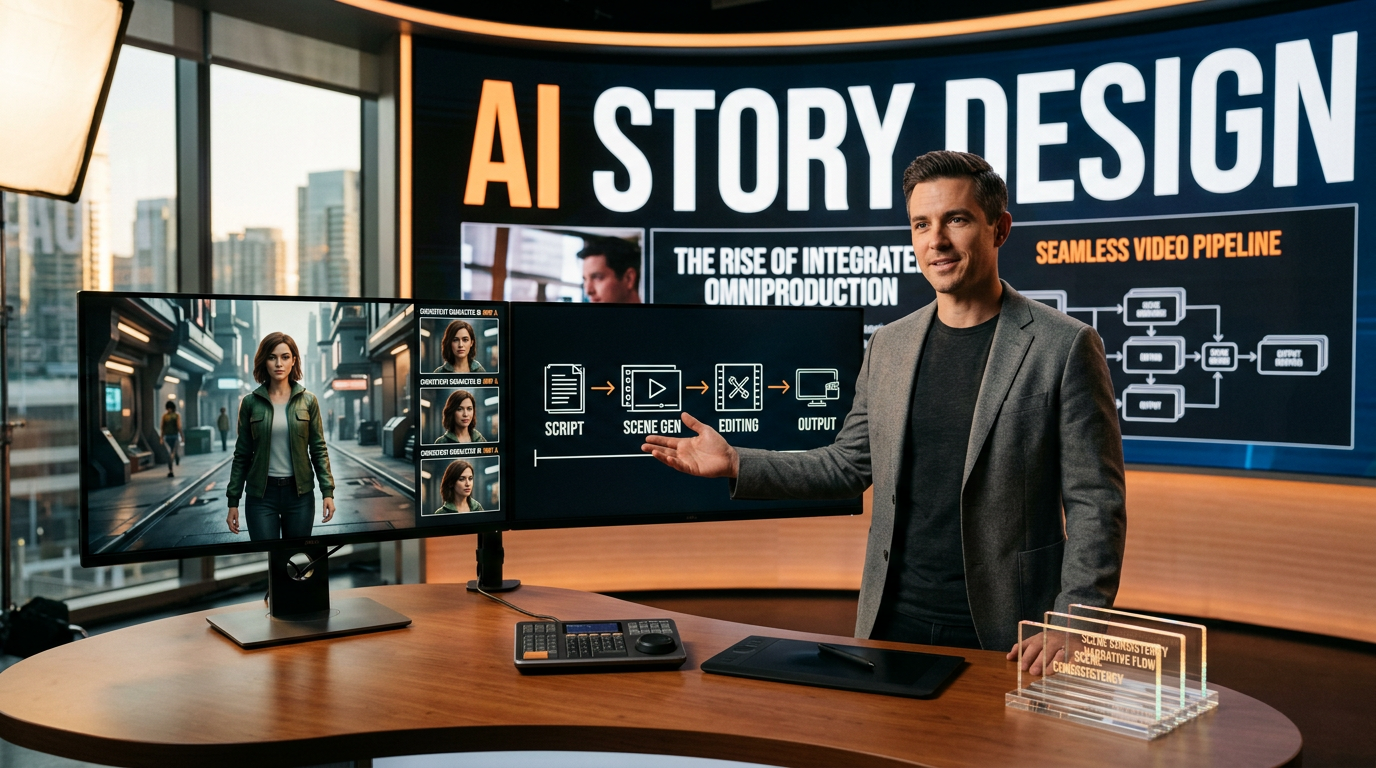
7) The latest tools landscape: Competition around the ‘Omni production paradigm’ and consistency of character acting/voice
- Generation shift:
- Past: generate images (frame generation) → assemble into a video
- Now: add characters/backgrounds, and the tools handle directing/cinematography/assembling automatically
- Key comparison:
- It’s not that storyboard became “less necessary”; its role changed
- The storyboard sets the overall flow, but prompts/tools handle the connection between mid-scenes more naturally
- Camera movement/walking:
- Now much more natural, which reduces the sense that “cuts are breaking”
- Voice/voice consistency:
- Explains how the voice created in one video is maintained across other scenes
The key point readers should feel is not “because the technology got better,” but that there is production productivity to push the narrative through to the end.
8) Tool selection guide: Sidens/Cling/Systems/Actors/Grokk/Bio—costs and quality vary by use
- Sidens 2.0:
- Mentions resolution of 1080p
- Its signature feel is an advantage
- There’s a pricing/cost burden (based on video length)
- Cling:
- Strong at inserting the character “subject” accurately
- Emphasizes that clothing/details are expressed well
- Part of the flow where it’s widely used for ads/commercial videos
- Sys:
- Primarily used for drama/film-like work
- Actors:
- Mentioned as a tool for voice/acting (initially, Actor 3.1 handles the voice element)
- Mentions that while pricing used to be expensive, there’s now been relative change
- Grokk / Bio:
- For beginners, recommend Grokk (mentions a monthly plan, voice/music generation, and an Omni format)
- Bio is an alternative, but relatively recommends Grokk more
- Pricing strategy:
- Unit costs vary greatly depending on resolution (1080p vs 4K) and plans (standard/ultra)
- For beginners, cheaper options for practice are advantageous
This part is ultimately a signal that as AI video becomes marketized, optimizing production costs becomes competitiveness.
9) ‘Togglable consistency’ creates narrative completeness: assembling + keeping character/voice
- Explains assembling as a key function:
- Shots from the previous video connect naturally to the next video
- Camera movement doesn’t break, so it looks “like a directed film”
- Maintains character actions (continuity of behavior)
- Voice continuity too:
- Even if the voice from one video is brought back into another scene, it stays consistent
So, while AI can make “a single scene” well, from the producer’s perspective, what ultimately matters is a complete narrative (continuity across multiple scenes).
10) A unique case: Not persuading with a ‘robot fight,’ but with a parent’s emotions
- The example Director Heo actually showed (son’s Cybertruck/glasses theme)
- Key device:
- Turns the child’s discomfort/guilt (nearsightedness + broken glasses) into ‘superhero’ emotions
- As a result, the focus becomes a mood narrative of “happiness/relief,” not a “fight video”
This case shows most intuitively that “if AI videos include narrative, the audience’s emotions move.”
Only the ‘most important content’ that’s not covered elsewhere—整理 separately
- Don’t try to eliminate AI discomfort; make it interpretable through narrative
- Tool development shifted the axis of competition from ‘scene generation’ to ‘production that connects like film (continuity)’
- Even if it looks like a music video, the tears point appears when the song acts as narration/dialogue
- Storyboards haven’t disappeared; their role changed in “tightly detailed previsualization,” focusing on “overall flow + connecting prompts”
- Tool choice isn’t about preference; it’s determined by requirements for cost/resolution/consistency (character/voice/camera movement)
Main takeaway you want to convey (one sentence)
If you want to create emotion with AI video, you need to design it to be “more story-like,” not “more pretty.”
< Summary >
- Director Heo Jun-ho emphasizes that instead of trying to solve the ‘Uncanny Valley (uncomfortable valley)’ with technology alone, he creates resonance through narrative.
- ‘School Mangle’ built empathy by focusing on human stories and is presented as a case where film festival awards continued even 6 months after release.
- During the self-learning process, to overcome voice constraints, he accumulated his workflow by first creating lyrics/dialogue/songs.
- With the latest tools becoming more ‘Omni production’-oriented, camera movement/assembling/voice consistency becomes more natural.
- Sidens/Cling/Sys/Actors/Grokk/Bio divide roles based on purpose and cost, and for beginners, cost optimization is crucial.
[Related posts…]
- Narrative-based AI video production trends
- Uncanny Valley and emotional narrative design in AI video
*Source: [ 티타임즈TV ]
– AI 영상의 ‘불쾌한 골짜기’를 넘어설 수 있는 방법은? (허준호 감독)