● China CXMT IPO, Huawei Sanctions Backfire, Korea Chip Risk
China’s CXMT IPO, Huawei’s Sanctions Paradox, and the Core Risks to Korea’s Semiconductor Industry
The current semiconductor cycle cannot be evaluated solely through “strong earnings at Samsung Electronics and SK hynix.”
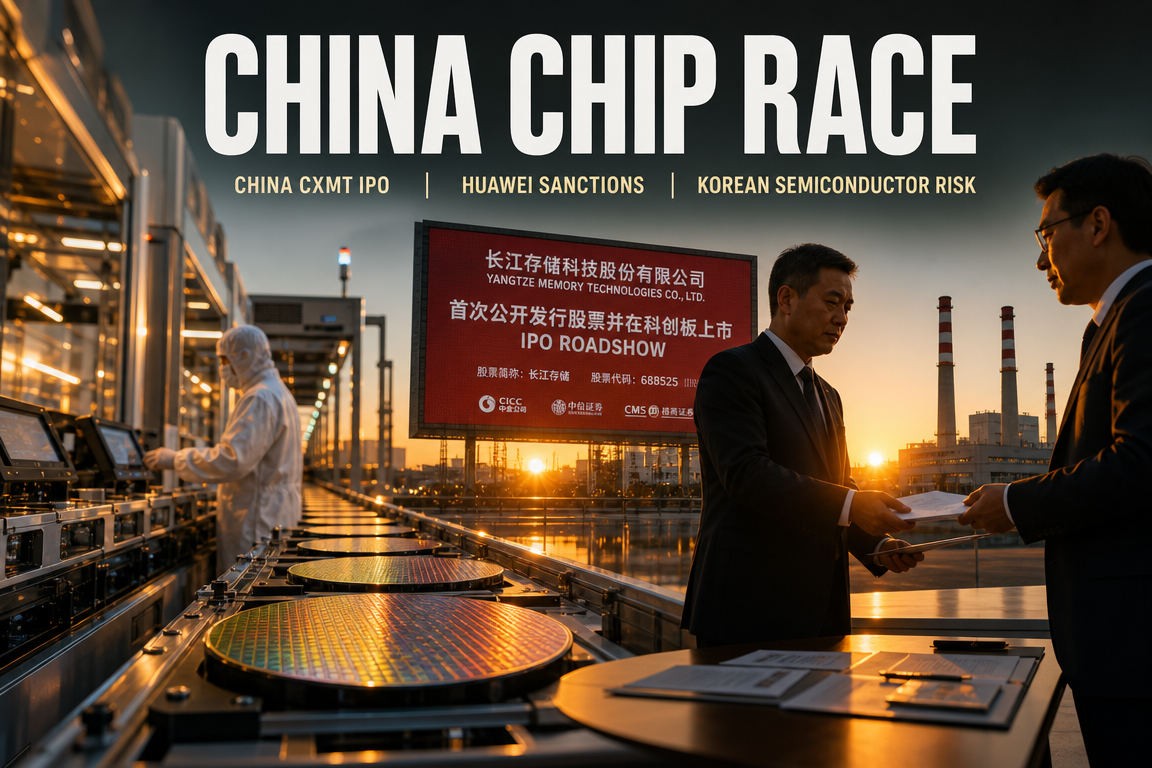
This report consolidates: (i) ChangXin Memory Technologies (CXMT)’s IPO initiative as a key pillar of China’s semiconductor self-reliance strategy, (ii) the structural mechanism by which Huawei has converted US sanctions into a catalyst for technology localization, (iii) Korea’s competitiveness across memory and non-memory semiconductors, and (iv) potential medium- to long-term implications for capital markets and exports from 2026 onward.
It focuses on risks embedded behind headline earnings strength, the extent of China’s progress in memory, why Korea appears more exposed in AI semiconductors and foundry competition, and what investors, corporates, and policymakers should monitor.
1. Key Takeaway: China Semiconductors Moving from “Catch-Up” to “Ecosystem Build-Out”
China’s semiconductor agenda is progressing beyond localization slogans into an integrated ecosystem linking capital, technology, policy, listings, and domestic demand.
Huawei and CXMT are central to this transition.
Despite US restrictions, Huawei has advanced domestic process and system design capabilities; CXMT is pursuing a large-scale IPO to expand memory production capacity.
This is not a single-firm growth story. It reflects coordinated, structural investment involving the Chinese state, big technology platforms, national semiconductor funds, and upstream/downstream suppliers—raising competitive pressure on Korea’s semiconductor sector.
2. Huawei: The Sanctions Paradox—Why Constraints Have Not Halted Progress
2-1. Nature of US Restrictions
US measures have extended beyond chip sales constraints to include limits on access to advanced semiconductors, GPU availability, and critical manufacturing equipment.
In particular, restricted access to ASML EUV tools is intended to impede leading-edge node progression.
2-2. Why Huawei Continued
A key point is that China has not relied solely on replicating established technology pathways.
Huawei has pursued approaches aimed at achieving high integration without EUV. Rather than only shrinking geometries, it has emphasized alternative methods such as layout/architecture changes, 3D design approaches, and signal-movement optimization to improve performance and density.
This is not merely circumvention. The principal implication is that sanctions can redirect the innovation pathway.
2-3. Core Implication for Korea
Coverage often concentrates on “which node China has reached.” A more material issue is China’s development of alternative technical frameworks that function under equipment constraints.
Over time, this could alter competitive rules and reduce the durability of incumbents’ advantages if they rely on conventional roadmaps.
3. CXMT IPO: China’s Memory Expansion Entering a New Phase
3-1. Company Profile
CXMT is China’s leading memory semiconductor company, with a primary focus on DRAM. It is increasingly viewed as a symbolic and strategic asset within China’s memory self-reliance effort.
3-2. Why the IPO Matters
The IPO is not simply a financing event. Market discussion has referenced potential proceeds of approximately KRW 6–7 trillion.
Likely uses include DRAM capacity expansion, strengthening mass-production readiness for high-bandwidth memory (HBM)-related products, and technology upgrades.
Accordingly, the IPO should be viewed as a potential inflection point for capacity and execution.
3-3. Shareholder Structure
Reported shareholders include Alibaba, Tencent, and the national semiconductor “Big Fund.”
This structure indicates an industrial-policy configuration combining state capital, platform-company funding, and captive domestic demand—enabling persistence through periods that may not be justified by near-term profitability and providing time for technology catch-up.
4. Korea’s Memory Segment: Strong Near-Term Earnings, Limited Basis for Complacency
4-1. Earnings Backdrop
Samsung Electronics and SK hynix earnings are likely to remain supported in the near term by AI data center build-outs, HBM demand, and recovering server memory demand.
4-2. Market Share Trend Divergence
Current earnings momentum does not equate to long-term competitive stability.
Based on the referenced figures, Korea’s DRAM market share declined from a prior peak around 77% to the high-60% range, while China increased from negligible levels to the high-single-digit range (around 7%). NAND trends similarly show Korea’s share declining and China’s share rising.
The implication: strong current profitability does not ensure sustained dominance.
4-3. Earnings Drivers Require Disaggregation
Recent export and earnings improvements are not explained by volume alone; pricing effects have been significant.
If incremental supply increases and memory pricing (DDR4, DDR5, NAND) plateaus or begins to correct, earnings growth rates could decelerate more quickly than headline momentum implies.
5. Non-Memory and Foundry: The Area of Greater Structural Exposure for Korea
5-1. Expanding Market, Weakening Relative Position
Non-memory markets are structurally growing faster than memory, driven by AI accelerators, automotive semiconductors, power devices, communications chips, and server-class system semiconductors.
Korea’s position in these segments remains comparatively weaker.
5-2. Foundry Dynamics
TSMC continues to reinforce foundry leadership, while China’s SMIC and peers expand on the basis of domestic demand.
Samsung Electronics’ foundry performance, particularly in market share terms, has remained below prior expectations. This reflects a broader issue: Korea’s industrial structure remains concentrated in memory.
5-3. AI Era Increases the Importance of Non-Memory Ecosystems
AI data center growth increases memory demand, but value capture is increasingly concentrated across system semiconductors and AI ecosystems that integrate compute, accelerators, networking, power efficiency, advanced packaging, and software optimization.
A memory-only leadership position is insufficient to secure top-tier value-chain control in the AI era.
6. Why the Issue Is Highly Sensitive for Korea’s Economy and Capital Markets
6-1. Export Concentration
Semiconductors already represent a high share of Korea’s exports, exceeding 30% at certain points. This amplifies both upside during upcycles and downside during downturns.
6-2. KOSPI Linkage
Samsung Electronics and SK hynix are central to KOSPI valuation support. Therefore, the key variable is not whether earnings are strong today, but whether expectations for continued earnings acceleration remain intact.
6-3. Real Economy vs. Equity Market Timing
The real economy may benefit from near-term export strength, while equity markets typically discount 6–24 months ahead.
Even if earnings remain solid through 2026, the market may reprice earlier if it anticipates 2027+ pressures such as share erosion, pricing peak-out, China capacity additions, and expanded US supply.
7. 2026 APEC in Shenzhen: Signaling and Industrial Narrative
A notable point is that the 2026 APEC leaders’ meeting is scheduled to be held in Shenzhen.
Beyond diplomacy, this could serve as a platform for China to showcase technology capabilities. Shenzhen has high symbolic relevance to Huawei and functions as a demonstration hub for advanced manufacturing, telecommunications, robotics, drones, and smart industry.
This narrative may influence global supply-chain restructuring and cross-border investment sentiment.
8. Under-Discussed Core Issues
8-1. The Primary Risk Is Sustained Investment Capacity, Not Only Current Technology Level
A large share of commentary focuses on node progress or HBM catch-up. A more critical factor is China’s ability to prioritize strategy over near-term profitability through state funding, platform capital, policy protection, domestic market scale, and local customers—potentially making time an advantage.
8-2. Korea’s Risk: “Earnings Optical Illusion”
Current profitability is factual, but it may reflect the pricing cycle, AI capex surge, and temporary supply tightness rather than durable competitive expansion.
The required response is accelerated reinvestment and widening the technology gap.
8-3. Memory Leadership Alone Is Insufficient
Semiconductor leadership will be determined by an integrated ecosystem spanning design, foundry, advanced packaging, AI accelerators, and data center infrastructure.
8-4. Semiconductors as a National Portfolio Risk
This is not limited to company earnings. It links to exports, trade balance, employment, capex, equity markets, pension assets, and FX sensitivity. Competitiveness erosion should be treated as a national risk-management issue.
9. Response Framework for Korea
9-1. Corporate Actions
1) Maintain memory leadership while accelerating investment in post-HBM next-generation memory.
2) Pursue more aggressive expansion into AI and system semiconductors.
3) Restore foundry competitiveness as a necessity, not an option.
4) Build capabilities in advanced packaging and power-efficiency optimization within back-end processes.
9-2. Policy Actions
Policy priorities include tax incentives, power/water/site infrastructure, talent development, and strengthening materials/equipment ecosystems.
A strategic rebalance is required from memory-centric support toward non-memory and AI semiconductor priorities.
In parallel, Korea should define pragmatic technology-cooperation priorities with the US, Taiwan, Japan, and Europe amid supply-chain reconfiguration.
9-3. Investor Checklist
Investors should separate “strong earnings” from “further equity upside.”
Key indicators include the memory pricing cycle, China capacity expansion pace, US semiconductor policy, AI capex trends, and foundry order momentum.
Given the semiconductor weighting in Korea’s equity market, sector cyclicality can transmit into broad index volatility.
10. Conclusion: Prioritize Preparation for the Next Competitive Phase
China’s semiconductor self-reliance has moved beyond declarations. Huawei is using sanctions constraints to redirect innovation pathways, and CXMT’s IPO could provide capital for a capacity-scale transition in DRAM and HBM-related production.
Korea remains a top-tier memory player; however, market share trends, weaker positioning in non-memory, and the AI-era shift toward full-stack ecosystems argue against complacency.
Near-term earnings strength can persist, but the strategic contest is increasingly defined by supply-chain policy, China’s sustained investment, US reshoring efforts, and AI-centered industry restructuring.
The central decision is whether to anchor strategy on current-cycle profitability or to invest for leadership through the next five years of semiconductor competition.
China, led by Huawei and CXMT, is transitioning from semiconductor localization to an integrated domestic ecosystem build-out.
Huawei has treated US sanctions as a catalyst for alternative process and design approaches; CXMT’s IPO could secure large-scale funding to expand DRAM and HBM-related capacity.
Korea’s semiconductor earnings are strong, but memory market share is trending lower, while competitiveness in non-memory and foundry segments appears more exposed.
Given semiconductors’ outsized role in Korea’s exports and the KOSPI, this is a macro-critical variable affecting growth, trade balance, and investment strategy. The priority is to sustain memory leadership while expanding into AI and non-memory, strengthening foundry and advanced packaging, and aligning policy support toward these objectives.
[Related Articles…]
- China Semiconductor Self-Reliance: Capital, Policy, and Capacity Expansion
- AI Data Center Capex and the Semiconductor Supply Chain Reset
*Source: [ 경제 읽어주는 남자(김광석TV) ]
– 중국 창신메모리(CXMT) 상장과 반도체 독립 추진. 한국 반도체에 올 위협 [경읽남 249화]
● K-Space Surge, SpaceX Buzz, Starlink Boom, ETF Breakout
Why Revisit the K-Space Value Chain Now: Key Takeaways on the SOL Space Aerospace Value Chain ETF
SpaceX IPO expectations, rapid Starlink subscriber growth, easing U.S. space-related regulation, and improving earnings visibility among Korean space aerospace components and materials suppliers all point to a shift from narrative-driven interest to measurable commercialization.
This report summarizes:
- Structural changes in the space-aerospace industry
- Competitive positioning of the Korean space value chain
- The portfolio construction logic of the SOL Space Aerospace Value Chain ETF
- Differences versus existing space-themed ETFs
- Under-discussed investment considerations in the current market environment
In volatile markets, sector selection should prioritize industries with observable revenue conversion within global macro trends, rather than theme momentum alone.
1. What This Theme Represents (One-Line Summary)
The space industry is transitioning from a long-duration “future theme” to an integrated industrial ecosystem linking launch, manufacturing, and data services. As this ecosystem scales, segments aligned with Korea’s strengths in manufacturing, materials, parts, and equipment are gaining relevance.
The SOL Space Aerospace Value Chain ETF is positioned to capture this shift.
2. Market Developments (News-Style Summary)
2-1. U.S. Commercial Space: Moving from Attention to Verifiable Metrics
The largest near-term catalyst is the expectation of a SpaceX IPO, with discussions around valuation, potential inflows, and post-listing volatility. More material than the listing event is the broader trend: space companies are increasingly entering public markets, and operational performance and capital deployment are becoming visible through reported figures.
This represents a different phase than early-cycle speculation.
2-2. Starlink: From “Possibility” to an Established Business Model
A rapid increase in Starlink subscribers, reaching more than 10 million within a short period, indicates satellite communications are no longer experimental and have achieved commercial adoption.
Implications for the broader space industry:1) Recurring demand for satellite manufacturing and launch capacity
2) Expansion of downstream value in communications infrastructure and data services
2-3. U.S. Policy: A More Supportive Stance Toward Space Industry Expansion
The U.S. has historically maintained relatively strict environmental regulation around launch activity; recent trends indicate easing constraints. This creates a more favorable alignment between government policy support and private-sector monetization incentives.
Industries with this policy-commercial alignment often translate into medium- to long-term capex, supply-chain expansion, and employment growth, reinforcing the sector’s macro relevance.
3. Korea’s Space Aerospace Industry: Late Start, Potentially Increasing Opportunity
3-1. Korea as a Follower, With a Clear Manufacturing Advantage
Korea entered the space sector later than the U.S., with gaps in technology investment and the pace of commercial market formation. However, as the industry shifts toward factory-style mass production, competitive advantage increasingly depends on precision, cost, and supply stability—areas where Korea has demonstrated structural strength.
3-2. National Policy Tailwinds and Institutional Support
The establishment of a dedicated national space agency in 2024 signals a more systematized industrial policy framework and supports longer-horizon contract visibility for private companies. Sector revenue surpassing KRW 1 trillion indicates the market is forming beyond expectations-driven narratives.
3-3. High Switching Costs: Supply-Chain Entrenchment Once Qualified
Space aerospace requires high technical standards and lengthy qualification cycles. Once suppliers are integrated into qualified programs, relationships tend to be more durable. Space-focused components/materials suppliers should therefore be evaluated as long-duration industrials with potential contract visibility, rather than purely as theme-driven equities.
4. How the SOL Space Aerospace Value Chain ETF Differs from Existing Space ETFs
4-1. Higher Purity Exposure to Space Aerospace
Many existing space ETFs include meaningful allocations to adjacent themes (e.g., drones or future mobility), diluting direct space exposure. This ETF is structured to focus more directly on the space aerospace value chain, providing a clearer investment thesis.
4-2. Concentrated Portfolio Emphasizing Earnings Visibility
The ETF is described as holding approximately 10 companies. In the current market, capital often concentrates in category leaders and core suppliers. A concentrated approach may be more effective than broad diversification when the objective is to capture companies with observable commercial revenue and identifiable momentum.
4-3. Position Limits to Reduce Single-Name Concentration Risk
A per-name cap around 15% has been referenced. This structure aims to balance meaningful exposure with controls against excessive single-name concentration.
5. Portfolio Logic by Segment: Upstream, Midstream, Downstream
5-1. Upstream: Satellite Manufacturing and Critical Materials
Upstream includes pre-launch manufacturing such as satellite platforms, payloads, and specialized materials.
- Satrec Initiative: core capability in satellite manufacturing, with potential extension into satellite image data analytics (downstream optionality).
- Hanwha Systems: radar satellite payload capability with relevance across defense and commercial applications, consistent with increasing overlap between defense and space.
- Specialized alloys/materials: rocket engines and fuel systems require ultra-high temperature/pressure and cryogenic performance, driving demand for advanced materials; HVM is cited in this context.
5-2. Midstream: Connectivity and Ground-to-Space Link Infrastructure
Midstream focuses on maintaining reliable data transmission between space assets and ground systems under interference-heavy environments.
- Intellian Technologies: frequently cited in satellite antenna systems. As the space economy scales as a data economy, antennas and communications equipment become critical infrastructure. As AI adoption increases, the value of data collection and transmission infrastructure may rise in parallel.
5-3. Downstream: Monetizing Data via Services and Distribution
Downstream converts space-derived data into revenue through services, processing, and distribution.
- Spear: referenced for distribution channels and global supply-chain functions. In practice, value creation extends beyond manufacturing into processing, delivery, and service-layer monetization.
6. Why Korean Space Components and Materials Suppliers May Be Advantageously Positioned
6-1. Low-Earth-Orbit Satellites Have Short Replacement Cycles
A key feature of the “new space” model is that low-earth-orbit satellites typically have a 3–5 year lifespan due to atmospheric drag and orbital decay dynamics. This creates structural replacement demand and supports a recurring order framework.
6-2. U.S. Cost Structure Can Create Openings for Korean Suppliers
High labor costs and ongoing component bottlenecks in the U.S. increase the attractiveness of suppliers that can deliver precision manufacturing with cost competitiveness. Korean firms may be positioned as efficiency-driven alternatives within global supply chains.
6-3. The “Non-China Premium” as a Material Variable
In a prolonged U.S.-China technology competition environment, U.S. and European prime contractors may increase scrutiny around China-linked technologies and components. Supply-chain reallocation can benefit Korean suppliers, particularly in sectors with high reliability and security sensitivity such as space aerospace.
7. Rationale for Combining U.S. Space ETFs with Korea Space Value Chain Exposure
Large U.S. space companies tend to lead industry standards, policy influence, and platform positioning. Korean components/materials suppliers can capture growth through manufacturing efficiency and delivery into expanding programs. Viewed together, this can function as exposure to both ecosystem leadership (U.S.) and supply-chain revenue capture (Korea), with diversification benefits.
8. Under-Discussed Investment Considerations
8-1. The Core Thesis May Be a Re-Rating of Advanced Manufacturing
Much coverage frames space as a long-horizon thematic trade. A more relevant interpretation is that Korea’s advanced manufacturing capabilities—proven in semiconductors, batteries, and autos—may extend into space aerospace. This ETF can be viewed as both a space allocation and a manufacturing re-rating mechanism.
8-2. AI and Space Infrastructure Are Structurally Linked
As AI scales, demand for data increases. Satellite imagery, real-time observation, and communications infrastructure data may become more valuable. Space aerospace should be evaluated as part of data collection and transmission infrastructure, not solely as a launch/manufacturing theme.
8-3. Prioritize Recurring Revenue Mechanics Over Listing Catalysts
IPO-related events can drive sentiment, but investment durability depends on repeatable revenue drivers: satellite replacement, launch cadence, advanced materials supply, communications equipment refresh cycles, and expanding data services. The ETF’s stated construction direction aligns with this framework.
9. Key Risks to Monitor
9-1. Elevated Expectations Can Increase Short-Term Volatility
Space-related equities can experience sharp swings as sentiment shifts, particularly around high-profile events such as a SpaceX IPO.
9-2. Industry Expansion and Company-Level Earnings Can Diverge
The sector may grow while individual company earnings scale more slowly due to long cycles for certification, testing, contracting, and ramp to volume production.
9-3. Concentrated ETF Structure Increases Selection Sensitivity
A ~10-holding structure can strengthen thesis clarity but increases dependence on constituent selection quality. Ongoing monitoring of index methodology, inclusion criteria, and rebalancing is required.
10. How to Interpret This ETF
The SOL Space Aerospace Value Chain ETF is more accurately described through three lenses:1) Korea’s advanced manufacturing expansion into space aerospace
2) Supply-chain participation benefits driven by U.S.-led ecosystem scaling
3) Structural transition toward satellite communications, data, and services
While branded as “space aerospace,” it also represents an allocation to Korea’s high-technology manufacturing base and to data-infrastructure scaling in an AI-driven environment.
11. Final Summary Points
The central investment thesis is the K-space value chain. As global primes expand programs, suppliers of parts, equipment, and materials may benefit through increased procurement. Korea’s positioning combines manufacturing efficiency, cost competitiveness, technical reliability, recurring order potential, and potential “non-China premium” effects.
This ETF is better evaluated as an earnings-linked supply-chain allocation rather than a purely thematic space trade. Space aerospace should be assessed increasingly on revenue mechanics rather than narrative optionality.
< Summary >
The space industry is moving from expectation-driven interest toward measurable commercialization, supported by SpaceX IPO anticipation and Starlink’s scaling adoption.
The SOL Space Aerospace Value Chain ETF concentrates on approximately 10 Korean space aerospace value-chain companies, emphasizing segments with observable revenue and growth visibility.
Key competitive factors include Korea’s manufacturing efficiency, technical capability, potential for recurring orders, and the “non-China premium.”
The ETF represents not only space exposure but also a targeted allocation to advanced manufacturing and to data-infrastructure expansion associated with AI-era demand.
[Related Articles…]
- Space Investment Focus: Key Drivers in the Expanding Commercial Space Economy
- AI Infrastructure and Satellite Connectivity: The Next Data Transmission Bottleneck
*Source: [ Jun’s economy lab ]
– ‘K-우주 밸류체인’의 글로벌 활약! SOL 우주항공밸류체인 ETF가 나왔습니다(SOL 우주항공밸류체인 ETF)