● SpaceX Surge, Nasdaq Inclusion, Supply Shock
The Primary Driver Behind SpaceX’s Surge Is Not Sentiment, but Market Supply Dynamics
SpaceX has recently become one of the most discussed names in the market. While the move is often attributed to themes such as “growth in the space industry,” an “Elon Musk premium,” or broad “future-industry optimism,” the more material driver is the trading supply structure.
This report consolidates:1) why the stock has risen sharply post-listing,
2) how constrained float amplifies price action,
3) how potential Nasdaq inclusion can create mechanical buying,
4) why ETFs and passive flows matter, and
5) why short-term volatility could increase after early July.
1. SpaceX’s Surge: The Key Factor Is Limited Tradable Supply, Not Intrinsic Value
The principal driver is not solely company quality. The more fundamental issue is that the number of shares available for trading is very limited.
Newly listed equities typically release only a portion of shares into the market, while a large share base remains restricted under lock-up provisions. This creates an imbalance: substantial demand meets limited supply.
Under these conditions, even modest incremental buying can push prices disproportionately higher, particularly in markets that are sensitive to liquidity and thematic momentum.
In practical terms, the price is being driven less by gradual changes in intrinsic value and more by scarcity in the freely tradable float.
2. Why Low Float Can Be a Material Price Amplifier
Equity prices are ultimately set by supply and demand. When supply is constrained, market behavior changes.
In low-float stocks, bids can quickly consume available offers, leaving order books thin. As a result, prices may advance in discrete jumps rather than through incremental appreciation.
This mechanism can be more pronounced when institutional or large-scale capital enters, because such investors often cannot source desired size without paying up. That buying pressure itself can further accelerate the move, reinforcing a feedback loop.
This is characteristic of a flow-driven market rather than an earnings-driven market. In such phases, price can move faster than fundamentals.
3. Why Potential Nasdaq Inclusion Matters
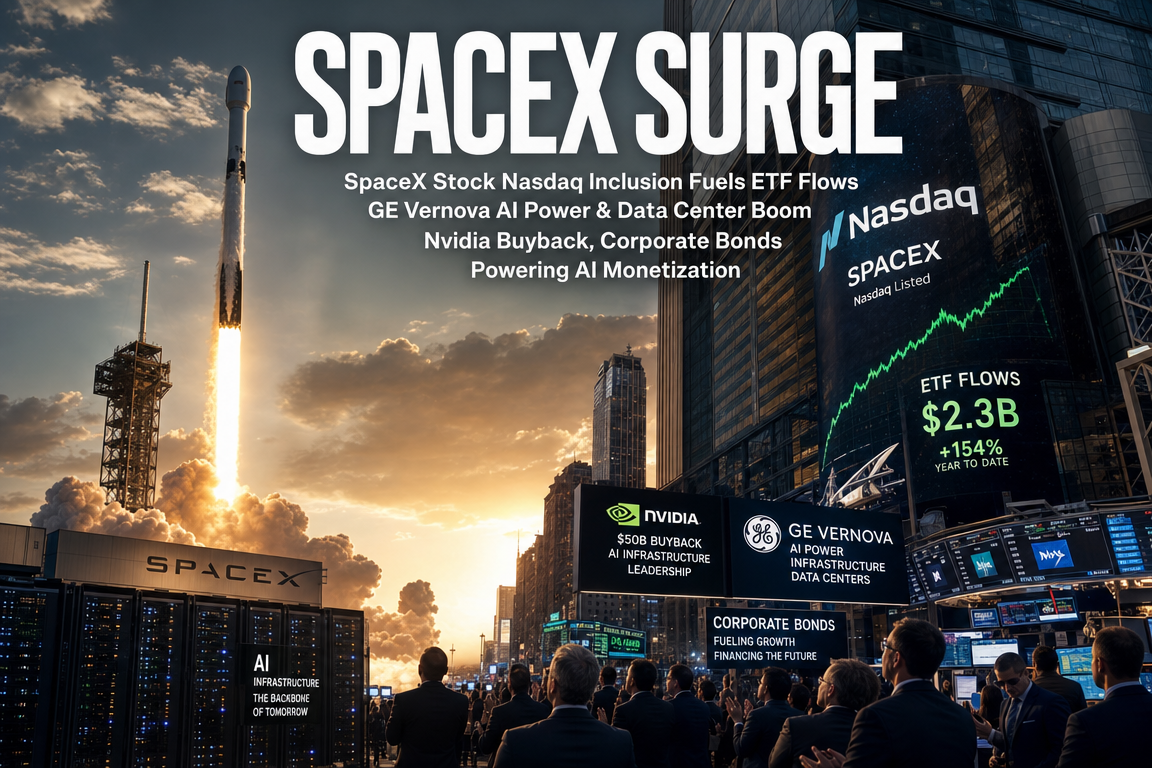
A key near-term catalyst is the market’s expectation of Nasdaq index inclusion.
Index inclusion is not symbolic. Once confirmed, index-tracking ETFs, index funds, and other passive vehicles are required to buy the stock in proportion to its index weight.
The critical point is that passive mandates are not discretionary. These vehicles generally cannot avoid buying solely due to valuation concerns; tracking the benchmark takes priority. This can create a predictable, mechanical demand window around inclusion.
Markets often price this in ahead of time. Anticipation that “ETFs will have to buy” can attract front-running flows, lifting the stock before the inclusion date—an event-driven pattern frequently observed in U.S. equities.
4. ETFs and Passive Flows: The Non-Visible Engine of the Move
Many retail investors underweight the influence of ETFs and passive capital.
In the U.S. market, index-linked flows often rival or exceed the impact of active managers, particularly in large benchmark ecosystems such as Nasdaq-related products. A newly included name can face concentrated buying pressure over a short period.
If this demand arrives while the float remains constrained, the price response can be materially steeper than implied by fundamentals alone.
The exact magnitude matters less than market consensus about the structure. In practice, equities often react more to how participants interpret the flow mechanics than to the precise figures.
5. Current Market Sequence (News-Style Summary)
5-1. Stage 1: Post-Listing Float Constraint
- Tradable supply is limited after listing.
- A meaningful portion of shares remains under lock-up.
- Even modest buying can move price materially.
5-2. Stage 2: Nasdaq Inclusion Expectation
- Inclusion probability drives expectations of passive inflows.
- ETFs and index funds would be required to purchase at index weights.
- This expectation attracts both retail and institutional pre-positioning.
5-3. Stage 3: Pre-Inclusion Front-Running
- Investors seek gains ahead of the effective inclusion date.
- The thesis is that passive buyers will later purchase at higher levels.
- Prices can rise faster than fundamentals during this phase.
5-4. Stage 4: Post-Event Volatility Risk
- After inclusion, event-driven capital may realize profits quickly.
- The market may treat the inclusion as “catalyst exhaustion,” increasing downside volatility.
6. The Most Important Point Often Omitted in General Coverage
Many summaries frame the move as a long-term story (industry tailwinds, founder premium). However, the near-term surge is more consistent with:
- a forced-buying framework, and
- constrained supply.
This implies the current rally may be driven more by short-term flow mechanics than by long-duration fundamental repricing.
Importantly, index-inclusion buying is typically non-recurring. Earnings are reassessed quarterly; index inclusion is a one-time mechanical event. After the flows are absorbed, the question becomes: “Who is the next marginal buyer?” If incremental demand weakens, price can re-rate quickly.
7. Key Risks for Investors
7-1. Lock-Up Expiration Risk
If scarcity of tradable shares is supporting the price, lock-up expirations can increase supply. Investors should monitor schedules for restricted shares becoming eligible for sale.
At elevated prices, early investors and major holders may have stronger incentives to monetize positions, potentially altering supply-demand dynamics.
7-2. Catalyst Exhaustion After Inclusion
Index inclusion is typically strongest as an expectation. Once the event is completed, the market may rotate to profit-taking (“buy the rumor, sell the news”).
7-3. Short-Term Capital Exit Risk
Sharp rallies often attract fast-turn capital. These flows can exit first when momentum weakens.
If volume spikes while upside follow-through diminishes (e.g., long upper wicks, fading intraday strength), profit-taking can cluster.
7-4. Valuation–Fundamentals Gap
Over longer horizons, revenue growth, profitability trajectory, technical differentiation, and competitive positioning are determinative.
In event-driven phases, price can move ahead of those metrics. As the gap widens, volatility risk typically rises.
8. Why SpaceX Should Also Be Evaluated Through Macro and AI Trend Linkages
SpaceX is not solely a space manufacturing business. In the current global cycle, the space sector is increasingly linked with semiconductors, artificial intelligence, defense technology, satellite communications, and data infrastructure.
From an AI-driven perspective, potential growth areas include satellite networks, real-time data processing, autonomous systems, defense AI, and utilization of Earth-observation data.
However, investors should separate:
- long-term industrial integration (AI + space infrastructure), from
- short-term price action driven by flows and event catalysts.
9. Practical Investor Positioning Considerations
9-1. Prioritize Event Timelines Over Chasing Price
In this environment, the end-date of the catalyst can matter more than the quality narrative. Key items to monitor include inclusion timelines, timing of flow realization, volume behavior, and lock-up schedules.
9-2. Do Not Mix Short-Term Event Trades with Long-Term Holdings
If the position is initiated for an event, it should be managed as an event trade. Reframing losses as “long-term conviction” can impair risk control.
Conversely, long-term investors should avoid being whipsawed by event-driven volatility and focus on fundamentals and execution milestones.
9-3. Volume and Flow Signals Are Primary Indicators
In flow-driven names, volume often leads headlines. Monitor:
- whether volume confirms the uptrend,
- whether inclusion-period trading shows distribution characteristics, and
- whether incremental buyers remain after passive demand is satisfied.
10. One-Sentence Summary
The core driver of SpaceX’s surge is a structure in which limited float meets potential mechanical buying from Nasdaq-linked passive funds, with pre-positioning flows amplifying the move.
11. Key Takeaways
- The rally appears more flow-driven than fundamentals-driven in the near term.
- Limited float increases price sensitivity to incremental demand.
- Potential Nasdaq inclusion can force ETF/index fund purchases.
- Pre-positioning by retail and tactical capital can accelerate upside.
- Volatility may rise around early July as the event window matures.
- Avoid conflating long-term thesis with short-term event mechanics.
< Summary >
SpaceX’s rally is being driven less by broad space-industry optimism and more by constrained tradable supply and expectations of Nasdaq-related passive inflows. Mechanical buying from ETFs and index funds, together with front-running demand, can intensify price moves. After the inclusion event, catalyst exhaustion and profit-taking can increase volatility. Investors should monitor supply dynamics, inclusion schedules, lock-up expirations, and volume/flow changes rather than relying solely on narrative.
[Related Articles…]
- Nasdaq Index Inclusion: Extension Risk vs. Post-Event Reversal
- How ETF Passive Flows Mechanically Move U.S. Equities
*Source: [ 내일은 투자왕 – 김단테 ]
– 스페이스엑스 떡상의 비밀
● AI-Driven Market Shock
SpaceX USD 60bn AI Acquisition, GE Vernova as a Top Pick, Nvidia’s Potential Buyback Lever… Key Points Investors Should Track Now
Today’s market moves are not adequately explained by “semiconductors up” or “oil down.” The current tape reflects the simultaneous interaction of: a large-scale AI acquisition by SpaceX, a re-rating of power infrastructure (with GE Vernova in focus), a potential shift in Nvidia’s capital policy, and a nuanced tension between the Federal Reserve and persistent inflation.
The critical issue is why U.S. equities are moving beyond mega-cap tech to financials, industrials, and power-related names; how AI capex links memory, data centers, power grids, and credit markets; and why this is a period to evaluate U.S. economic structure and the broader industrial transformation together.
In practical terms, this is less an “AI rally, round two” and more a phase in which AI investment is increasingly reshaping the real economy.
1. U.S. Equity Market Snapshot: Headline Mixed, Underlying Rotation and Broadening
In early trading, the Nasdaq traded around flat, while the S&P 500 and Dow showed relative strength.
This appears less like a simple pause in tech and more like evidence that leadership is broadening from a single AI semiconductor theme into financials, industrials, and power infrastructure.
- Nasdaq: early weakness, attempted rebound
- S&P 500: modest gains
- Dow: relative strength
- Russell: small- and mid-cap participation improved
The key point is that AI-related capital spending is increasingly diffusing across the U.S. economy rather than concentrating in a narrow group of names.
2. SpaceX Confirms Acquisition of Cursor Developer: Why This Is More Than M&A
2-1. Implications of a USD 60bn Transaction
SpaceX’s USD 60bn acquisition of a company associated with the AI coding tool “Cursor” is notable not only for size but for strategic direction.
This is not simply an aerospace company buying a software asset. It is better interpreted as a move to integrate space, satellites, networks, data infrastructure, and AI software into a unified platform strategy.
2-2. Why an AI Coding Company
AI coding tools are evolving from productivity utilities into core infrastructure for large-scale software automation.
For SpaceX, this can accelerate development and iteration across:
- launch systems and mission operations
- satellite fleet operations
- Starlink network optimization
- real-time data processing
- space-based communications software
The strategic objective is to control software development velocity alongside hardware execution.
2-3. Significance of an All-Stock Structure
The stock-for-stock emphasis suggests:
- SpaceX is actively using its elevated valuation as acquisition currency
- the market is treating the valuation as a strategic asset rather than purely short-term froth
Rather than operating defensively after a surge in value, SpaceX is deploying that value into large-scale strategic expansion, reinforcing the message that it is not positioning as a single-category aerospace company.
2-4. What the Market Capitalization Move Signals
SpaceX’s rapid rise into the top tier by market capitalization invites bubble concerns. However, the current premium appears tied to perceived scarcity value and strategic positioning across defense, space, communications, and AI.
The market is implicitly valuing SpaceX as a multi-domain strategic platform rather than a conventional consumer or internet business.
3. SpaceX Key Near-Term Risk: Index-Inclusion-Driven Volatility
The long-term strategic narrative does not eliminate near-term event risk. Index inclusion can become a volatility catalyst, particularly if appreciation has already been heavily front-run.
- Russell inclusion
- MSCI inclusion
- potential Nasdaq-100 inclusion expectations
Passive inflow expectations can coincide with institutional profit-taking. “High-quality business” and “attractive entry point” may diverge in the near term.
4. GE Vernova: Why Power Infrastructure Is Re-Entering the Center of the AI Trade
4-1. Why Jefferies Named It a Top Pick
Jefferies’ top-pick designation is best interpreted through AI-driven load growth. As data centers and AI infrastructure expand, electricity demand increases, and companies involved in generation and grid management can see renewed valuation support.
AI is not a semiconductor-only story; it is ultimately power-constrained.
4-2. Structural Positioning
- competitive position in gas turbines and generation equipment
- beneficiaries of grid modernization
- bridge exposure across renewables and legacy grid infrastructure
- long-duration exposure to data-center-driven power demand
Markets are increasingly recognizing that AI capex propagates into generation and transmission investment.
4-3. Why Power Infrastructure Matters Most
The primary bottleneck may be power availability rather than chips. Data centers are fundamentally power-consuming assets; insufficient grid expansion can slow downstream AI deployment. This remains under-discussed relative to semiconductors but may become a major medium- to long-term theme in U.S. equities.
5. Nvidia: Potential Bond Issuance and the Signaling Effect of Buybacks
5-1. Core of the Wedbush Interpretation
The scenario that Nvidia could issue corporate bonds to fund share repurchases is notable as a signal of capital policy evolution.
It suggests a company at the center of the AI semiconductor cycle may increasingly operate with a maturity profile resembling large-cap “value” capital-return frameworks while maintaining growth characteristics.
5-2. Why It Matters
- confidence in durable cash-generation capacity
- explicit support for shareholder returns and potential downside defense
- implicit internal conviction that leadership in AI compute demand can persist
Debt-funded buybacks can appear counterintuitive in higher-rate regimes, but the market may interpret this as management conviction in future cash flows.
5-3. Key Monitoring Items
Such policies can face scrutiny if growth expectations soften. Ongoing confirmation of data-center demand and AI capex durability remains central to the thesis.
6. Memory Semiconductors: Why the Segment Remains Supported
Intraday trading may resemble consolidation in names such as Micron and memory-linked peers, but the direction of Wall Street target revisions indicates continued emphasis on sustained AI infrastructure buildout.
6-1. Why Memory Matters
- HBM is central to AI training and inference performance
- NAND and high-performance SSDs support accelerating data storage requirements
- data-center upgrades structurally increase memory content per system
AI infrastructure requires synchronized growth across compute, storage, networking, power, cooling, and full server stacks.
7. Microsoft Weakness: Early Evidence of a Shift Toward Monetization Scrutiny
Microsoft traded lower on news of litigation tied to allegations regarding AI profitability messaging. This may prove transitory, but it underscores the market’s evolving questions:
- AI investment is large; is revenue conversion fast enough?
- do cloud and generative AI revenues justify current valuations?
- is enterprise AI spending sustainable?
The market is likely to become more demanding on “AI monetization” rather than “AI narrative,” with valuation discipline increasing across mega-cap platforms.
8. Oil Decline and Inflation: Relief, Not Resolution
8-1. WTI Pullback and Market Relief
WTI declined into the mid-to-high USD 70s, easing near-term inflation concerns and, by extension, rate sensitivity—particularly supportive for long-duration growth valuations.
8-2. Why Complacency Is Premature
Geopolitical risk is not fully resolved. Announcements regarding corridors or agreements do not guarantee stable, normalized logistics. If de-escalation proves incomplete, oil can reprice higher. The move is better viewed as partial risk premium compression rather than full risk removal.
8-3. Commodity Index Decline: Constructive Signal
Moves in broad commodity benchmarks indicate moderation in commodity-driven inflation pressure:
- easing cost-push dynamics
- partial relief to corporate margin pressure
- marginal reduction in Fed policy constraints
However, a short-term decline in energy prices alone does not ensure a stable disinflation path.
9. Import Prices: Evidence of Sticky Inflation Dynamics
A key detail in the import price data was strength in non-petroleum import prices, indicating broader price pressure across consumer goods, intermediates, and critical components.
9-1. Why This Matters
- potential leading signal for CPI/PCE trajectories
- could delay rate-cut expectations
- consistent with resilient domestic demand
The current dilemma is not recession risk but the persistence of inflation under stronger-than-expected activity, increasing the likelihood of continued Fed caution.
10. Financials and Industrials at Highs: AI as a Broad U.S. Investment Cycle
A critical feature of the session was concurrent strength in major financials (e.g., Morgan Stanley, Goldman Sachs), industrials (e.g., Caterpillar), and semiconductor equipment.
This indicates AI is increasingly a capex cycle impacting the full economy rather than a contained technology theme.
10-1. Why Financials Are Rising
AI expansion increases financing and advisory demand:
- data-center construction funding
- semiconductor fab expansion
- large-scale M&A
- corporate bond issuance
Large financial institutions can be viewed as beneficiaries of AI-driven capital formation, not solely rate plays.
10-2. Why Industrials Are Rising
AI requires physical buildout: constructing facilities, expanding grids, deploying equipment, and scaling logistics. Industrial strength aligns with AI translating into real-economy investment.
10-3. Why Semiconductor Equipment Is Rising
Companies such as Lam Research and Applied Materials function as “picks-and-shovels” suppliers. As long as wafer capacity and advanced packaging expand, equipment demand tends to follow, often with a more diversified risk profile than single-product winners.
11. Why “U.S. Exceptionalism” Is Re-Strengthening
Capital flows are increasingly concentrating in the U.S. for structural reasons:
- reserve-currency advantage
- relative energy independence
- technology leadership in AI and semiconductors
- integrated investment ecosystem spanning power, finance, and industrial capacity
In contrast, Europe faces growth constraints, and China remains burdened by domestic demand and property-sector challenges. The current move is therefore not only Nasdaq strength, but a broader repricing of U.S. economic and market primacy.
12. The Underappreciated Core Point
The market is moving beyond “finding AI beneficiaries” and toward mapping the sequence by which AI reshapes the real economy:
- Phase 1: compute leaders (e.g., Nvidia, Broadcom)
- Phase 2: memory, SSDs, networking, servers
- Phase 3: data-center construction, power generation, grid buildout, cooling
- Phase 4: financing, corporate credit, large-scale M&A, capital market expansion
- Phase 5: defense, space, industrial automation, national strategic integration
The same-day prominence of SpaceX’s AI acquisition, GE Vernova’s re-rating, and Nvidia’s capital policy scenario is consistent with AI becoming a multi-sector investment and industrial cycle linking power, finance, defense, space, and industrial production.
13. Portfolio Framing
13-1. Near Term
- SpaceX: monitor overheating risk and index-inclusion volatility
- oil rebound risk and Fed communication remain key variables
- mega-cap tech: monetization validation phase for AI narratives
13-2. Medium Term
- memory and semiconductor equipment: still supported by infrastructure buildout
- power infrastructure and data-center enablers: potential for further re-rating
- financials: indirect beneficiaries of AI-driven capital formation
13-3. Long Term
A U.S.-centered AI capex cycle may persist. The core evaluation should focus on whether AI continues converting into cash flows, physical investment, and strategic policy priorities.
14. News-Style Key Takeaways
- SpaceX confirms a USD 60bn acquisition of an AI coding company, accelerating a space-plus-AI platform strategy
- GE Vernova draws attention as data-center power demand rises; Jefferies highlights it as a top pick
- Nvidia: potential bond-funded buybacks raise attention to evolving capital policy
- Micron and memory complex: target-price momentum reflects continued AI infrastructure expectations
- Microsoft: short-term pressure amid heightened scrutiny of AI profitability claims
- oil decline is supportive, but Middle East risk is not fully resolved
- stronger import prices reinforce inflation stickiness
- concurrent strength in financials, industrials, and power names signals AI diffusion into the broader U.S. economy
< Summary >
SpaceX’s USD 60bn AI acquisition reads less as adjacency expansion and more as early-stage integration of space, AI, and data infrastructure.
GE Vernova’s renewed strength reinforces that power infrastructure may become a binding constraint and a key beneficiary in the AI buildout.
Nvidia’s potential buyback pathway indicates leading AI beneficiaries may increasingly pair high growth with more assertive capital return frameworks.
Broad participation across memory, financials, industrials, and power suggests AI is evolving into a U.S.-wide investment cycle rather than a narrow technology trade, supporting a premium on U.S. structural advantages.
[Related Articles…]
- SpaceX: platform integration and strategic infrastructure
- Nvidia: capital policy and AI infrastructure cycle
*Source: [ Maeil Business Newspaper ]
– 스페이스X, ‘커서’ 개발사 $600억 인수 확정ㅣ제프리스, 최선호주로 ‘GE버노바’ 선정ㅣ웨드부시 “엔비디아 자사주 매입위해 회사채 발행“ㅣ홍키자의 매일뉴욕