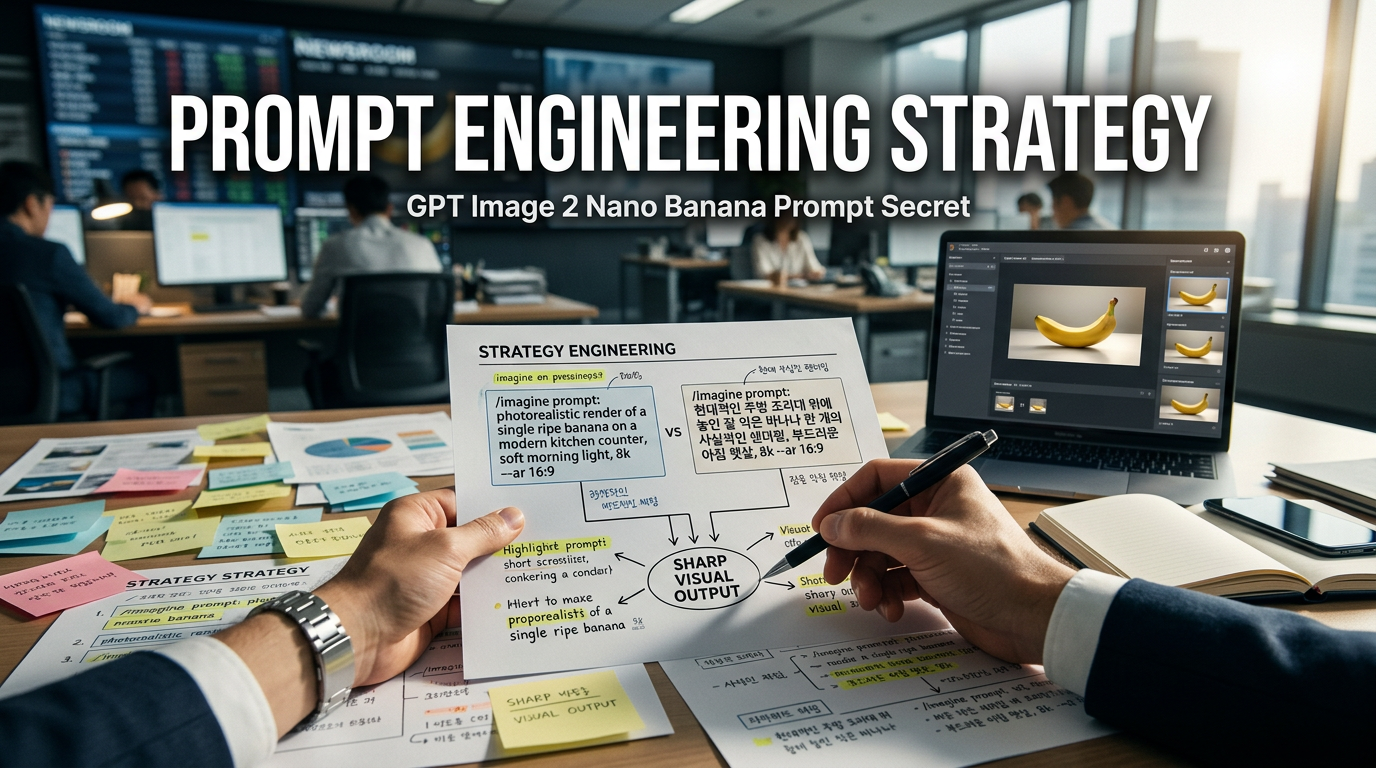
● AI prompt battles spark higher output efficiency
“When You Write Prompts Like This, the Results Change” — An AI Leverage Strategy Seen Through a Comparison of GPT Image 2 and Nanovana
The core point I’ll highlight in today’s post is exactly four things.
① Keywords vs. Sentences — How some models work better with “keywords,” while others work better with “sentence-style” prompts.
② Nouns vs. Adjectives — How the trigger that captures “what to draw” (nouns) and the precision that shapes “what feeling to convey” (adjectives) operate differently.
③ Reduce negatives for more stability, and if you must use them, “describing a semantically different alternative” works better than “directly prohibiting.”
④ Korean vs. English isn’t just an issue of translation accuracy; differences in culture, nuance, and training data also affect the outcome.
I’ll organize these four items through experimental flows with GPT Image 2 and Nanovana Pro.
1) Why is this connected to the economic and AI trend? “AI Leverage” is the core point
These days, companies adopt generative AI not merely to automate “research,” but to connect it to AI leverage that boosts work impact.
And prompts are no longer just writing tips; they’re turning into a productivity tool that determines quality relative to cost.
Especially for image/video generation, it’s not “shoot it once and done”—repeated costs arise because you have to quickly revise and regenerate.
So knowing “which prompt forms cause less instability across which models” directly helps you reduce both work time and costs.
2) Latest model flow: GPT Image 2 multilingual rendering + strengthening “reasoning/output” before generation
The two latest points addressed in the original text are as follows.
① Strengthened support for multilingual rendering
There’s an explanation that development is moving in a direction where Korean doesn’t break and text typos are reduced significantly.
② Strengthened the pre-generation “reasoning/output” (native tanking) stage
It describes a flow where, before generating images, more refined internal interpretation happens, and as a result, the quality of details work like posters/infographics improves.
In other words, even with the same prompt, results differ because the “way the model interprets the prompt” is different.
3) Experiment conclusion 1: Keywords vs. Sentences — Different models require different input formats
This is the first branching point of the original experiment.
Observation
- Some models generate well even with only keywords
- Some models produce better results with sentence-style prompts
Why does this happen?
Because there are differences in how prompts are processed with “priority” by the image generation model internally.
So it’s not about a single “perfect prompt”—the closer you match the input format that fits your model’s strengths, the closer you get to the right answer.
Practical tips
- Start by trying quickly with keywords
- If the results wobble, make the “intent/relationships” clearer with sentence-style prompts
- Try to find an optimal input approach that reduces the cost of regenerating two or three times
4) Experiment conclusion 2: Nouns vs. Adjectives — “Nouns are strong triggers,” adjectives are precision
This is the real core point.
Core summary from the original text
- Nouns play a big role as a trigger that determines “what to draw”
- Adjectives precisely enhance “how it should feel/what attributes to convey”
Example flow from the experiment
- If you insert an abstract noun like “beauty,” the model interprets it more freely and the results diverge into things like goddess/ideal-type images
- Conversely, if you provide a concrete noun like “ballerina,” it’s easier for the overall framework to stay intact
- When you add adjectives (e.g., “young ballerina, white tutu, spinning”), consistency begins to appear even across multiple generations
One-line conclusion
“Nouns grab first, and adjectives bind the details.”
And abstract emotion-words like “love/freedom/happiness” are likely to create gaps in image generation, so it says you must concretize them into elements (situation/object/style).
5) Experiment conclusion 3: Negatives are more stable when you do “semantic reconstruction” rather than “direct prohibition”
When you insert negatives, it often doesn’t work well. The original text also demonstrates that flow through experiments.
Direct negation vs. semantic negation
- Direct negation: “Don’t use red” / “Don’t ~”
- Semantic negation: “Use a cool color palette,” “Avoid red,” and similar detour/alternative descriptions
Observed results
- Direct negation can leave errors behind (unwanted elements may remain partially)
- Semantic negation tends to remove the “thing you’re trying to exclude” more effectively
- Using many negatives can reduce overall accuracy of the model
Practical translation
Instead of memorizing “prohibitions,” a method of rewriting the desired state “positively” is more stable.
6) Experiment conclusion 4: Korean vs. English — Even with the same meaning, the results change
This part is really amazing.
The point isn’t merely “the translation introduced errors when we changed languages.” It’s that the cultural distinctiveness and expression style contained in the prompt get reflected in the results.
A representative case from the original text
- In expressions like “A person eating breakfast on a traditional table”
- Korean prompts connect better to images of Korean breakfast and table settings
- If translated directly into English, it can shift toward a “breakfast table” pattern that people in Western contexts tend to imagine
Additional points
- Korean viral phrases/emotional lines (e.g., “please draw it again in a pitiful way”) retain their texture better in Korean
- Even if the intent seems similar, English translation can change the “emotional state/tone,” leading to result differences
So the conclusion
- If your goal is a “Korean output,” Korean often has an advantage
- English may still be strong at conveying delicate touches (detailed instructions) accurately
- You should choose the language strategically, not by simple translation, but considering the target culture/style
7) Perspective on model selection: “Design matched to your tools,” not a “perfect prompt”
The educational philosophy emphasized in the original text shows through clearly.
Don’t copy prompts that others say are great. What matters is the ability to choose the model/tool that’s optimized for the results I want.
And you can also summarize the intuition based on experiments.
- Some image models find keyword-based input effective
- Some models do better when sentence-style context is provided as a complement
- However, even within the same “sentence-style,” the model’s preferred way may differ (whether it focuses on concrete elements vs. relationships)
One more thing: how the model handles negatives and abstract emotional words depends heavily not only on the model, but also on the prompt structure itself.
8) Final message: Prompt-sharing culture can become a “company asset”
The content from the latter part of the original text is also quite meaningful.
Prompts can become knowledge/assets inside an organization beyond personal productivity.
Advantages of sharing
- A culture forms where people collect and compare prompts that work well
- As real application cases accumulate, the value of the original prompts compounds
- Discussing “why it worked well,” not just the outcome, speeds up learning
So in the era of generative AI, “prompt engineering” expands from an individual skill into an organizational capability.
Main points to convey (the “core point” that isn’t usually organized well elsewhere)
1) A prompt isn’t “writing sentences well”; it’s aligning with the input structure the model prefers
Keywords/sentences, nouns/adjectives, and language choice all connect to the model’s “interpretation method.”
2) Don’t use too many negatives—create a removal effect by rewriting the “desired alternative (positive)” anew
With direct prohibition prompts, partial errors are observed as likely to remain.
3) Korean vs. English isn’t a translation-accuracy problem; “cultural distinctiveness + tone” changes the results
So don’t cling to the expectation that “the same meaning will produce the same outcome.” Instead, choose the language strategically to fit the target cultural region.
4) If you just throw “abstract emotion words” as-is, the gap (model interpretation) grows
Words like happiness/love need to be structured into elements like situation/object/style to create consistency.
Natural SEO keywords to include (core themes covered in the article)
Today’s post is organized from the perspective of especially important AI models, generative AI prompts, image generation, prompt engineering, and AI automation when using generative AI.
< Summary >
1) GPT Image 2 and Nanovana Pro interpret prompts differently, so the results change depending on the keyword/sentence input format.
2) Nouns are strong triggers (what), and adjectives are precision (what feeling). When you structure both elements together, consistency increases.
3) Direct prohibition prompts may leave more errors, and semantic negation (alternative descriptions) removes them more reliably. Using many negatives can reduce accuracy.
4) Korean vs. English reflects culture, tone, and phrasing nuances in the results beyond translation errors. If you want Korean outputs, Korean often has an advantage.
5) Prompts can become organizational assets beyond personal skills, so sharing, discussion, and accumulating case studies are important.
[Related Articles…]
*Source: [ 티타임즈TV ]
– 이미지 프롬프트는 명사와 형용사, 키워드와 문장 중에서 어느 게 좋을까? (강수진 박사)