● AI-Semiconductor-Crash
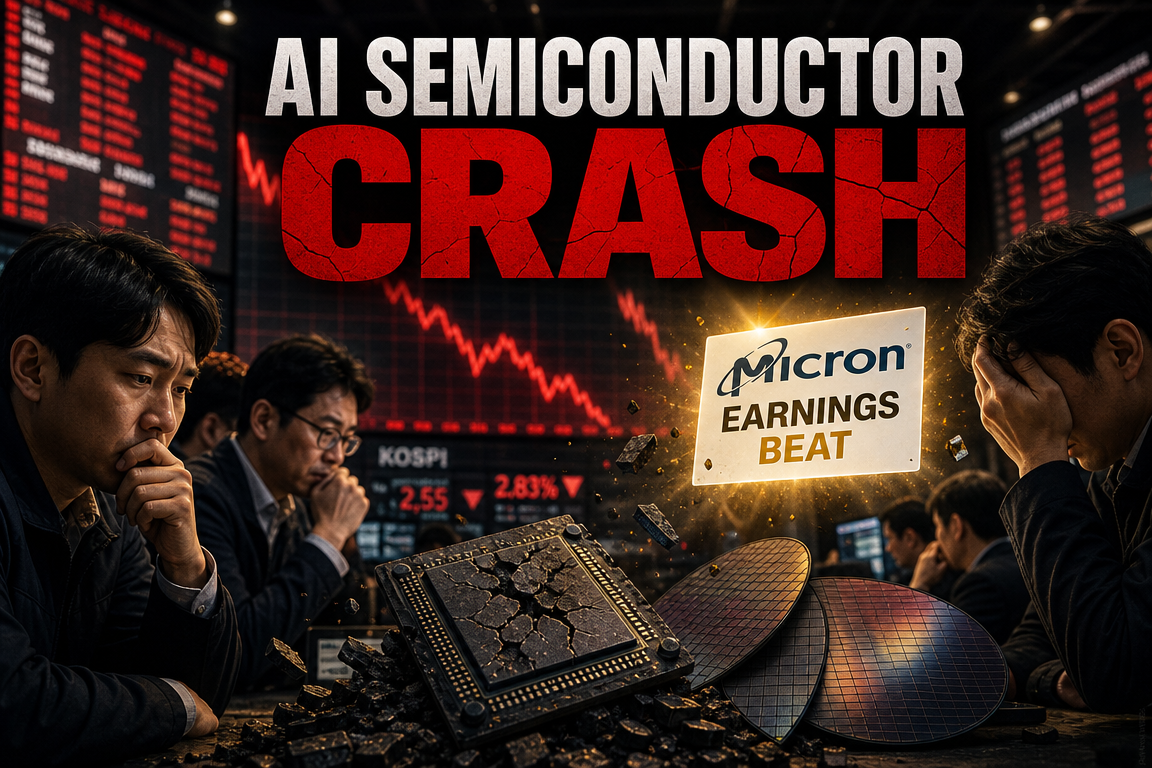
Unprecedented KOSPI Collapse: Is a Severe Downturn Beginning? The Key Variables Are AI Semiconductor Cycles and Interest Rates
The most important point in this decline is not simply that stock prices fell sharply.
The critical issue is that the KOSPI selloff also pulled down the U.S. Nasdaq.
Another notable feature is that the decline was concentrated in AI semiconductor stocks such as SK Hynix, Samsung Electronics, Micron, Nvidia, and AMD rather than the broader market.
In other words, this episode appears less like a global equity crash and more like a sudden reassessment of the AI investment cycle.
That said, the story does not end there.
Rate-hike concerns, renewed inflation risks, leveraged position unwinds, political debate over stock taxation, and uncertainty ahead of Micron’s earnings release all appear to have amplified market volatility.
The bottom line is that it is still premature to conclude that this is a market to abandon entirely.
However, over the next few days, AI memory industry conditions, U.S. rate expectations, and Micron’s earnings report are likely to determine market direction.
1. The Most Unusual Feature of This Selloff: Korea Led the U.S. Lower
Normally, global equity markets move with the U.S. first, and Korea follows.
When the Nasdaq declines, the KOSPI and KOSDAQ typically weaken the following day.
This time, however, the sequence was different.
After the KOSPI plunged, AI infrastructure and semiconductor-related stocks in the U.S. also came under pressure.
This is the main reason this decline can be described as unprecedented.
Historically, Korean equities were relatively low on the priority list for global investors.
This year, however, the situation has changed.
The KOSPI has been among the stronger major equity indices globally, led by Samsung Electronics and SK Hynix.
In particular, the combination of HBM, memory semiconductors, and AI server demand has elevated Korean chipmakers into a key part of the global AI investment cycle.
As a result, a sharp decline in Korean semiconductor stocks is no longer just a domestic issue.
For global investors, it can be interpreted as a signal that the AI semiconductor cycle may be losing momentum.
This also helps explain why the U.S. selloff was concentrated in AI infrastructure and hardware names such as Nvidia, Micron, AMD, and Intel.
2. The Nature of the Nasdaq Decline: A Correction Concentrated in AI Infrastructure, Not a Broad Market Collapse
Overnight, the Nasdaq fell by roughly 1%.
What matters more than the index level, however, is the distribution of losses.
Market heat maps showed that large-cap technology names such as Alphabet, Amazon, Microsoft, and Apple were relatively resilient.
By contrast, AI semiconductor and hardware infrastructure names including Nvidia, Micron, AMD, and Intel declined sharply.
Consumer staples, energy, financials, insurers, and defensive names such as Berkshire Hathaway were comparatively stable.
This indicates that the market did not undergo a broad, indiscriminate selloff.
The most dangerous market environment is one in which all stocks fall simultaneously regardless of sector.
This episode appears closer to a sharp de-rating of the most crowded AI infrastructure names, combined with profit-taking and fear, rather than a system-wide liquidity crisis.
That does not mean the situation is benign.
Because AI investment has been the main driver of global equity gains, weakness in AI semiconductor stocks can weaken broader market sentiment.
Still, the current move is better characterized as an AI infrastructure valuation reset than as a full market collapse.
3. Why the 9.99% KOSPI Drop Was So Concerning
A near-10% one-day decline in the KOSPI is highly unusual.
By historical standards, it ranks among the largest daily losses in the index’s history.
The concern is heightened by the fact that this drop was not driven by a single clearly identifiable catalyst.
Major historical selloffs typically had an obvious trigger.
War risks, the 9/11 attacks, the global financial crisis, or the collapse of a major hedge fund were identifiable shocks.
This time, the KOSPI decline reflected multiple overlapping factors.
Paradoxically, the presence of many causes also suggests that no single decisive trigger existed.
- Deteriorating sentiment following the previous day’s Nasdaq decline
- Renewed concerns about U.S. rate hikes
- Potential forced selling from margin debt and leveraged ETFs
- Political debate over taxation on stock and real estate gains
- Reintroduction of stock tax discussions
- Uncertainty around memory semiconductor conditions ahead of Micron’s earnings release
These factors collectively pressured investor sentiment.
In highly leveraged markets, once selling begins, it can quickly turn into self-reinforcing liquidation.
As margin financing, leveraged ETFs, and 2x or 3x products have expanded, market volatility has increased.
Even modest downside momentum can accelerate through stop-loss selling and margin calls.
4. Two Indicators That Matter Most in This Selloff
To determine whether this decline marks the start of a true bear market, two indicators matter most.
The first is the AI memory and semiconductor cycle.
The second is the macro backdrop, especially U.S. interest rates and inflation.
| Key Checkpoint | Why It Matters | Current Interpretation |
|---|---|---|
| AI memory cycle | Determines the earnings and share-price direction of Samsung Electronics, SK Hynix, and Micron | Demand still appears resilient |
| Big Tech AI spending | Fundamental driver of demand for data centers, GPUs, and HBM | Microsoft and others still appear to be expanding investment |
| U.S. rate-hike risk | Directly affects valuation multiples for growth and semiconductor names | Concerns have increased, but no policy shift is confirmed |
| Self-reinforcing market decline | Nasdaq weakness can trigger KOSPI selling, which then feeds back into the Nasdaq | Not yet a full-blown negative loop |
5. Has the AI Semiconductor Cycle Actually Turned?
Based on current signals, AI memory demand does not appear to have collapsed suddenly.
Instead, the broader trend of AI investment and data center expansion continues.
One important development is the cooperation between Micron and Anthropic.
This is not merely a supply agreement; the key point is that the collaboration extends into semiconductor design and architecture.
That suggests AI model developers are placing greater importance on memory design at an early stage.
In the past, AI performance discussions centered primarily on GPUs.
Nvidia GPUs were the core engine for training and inference.
Now, however, HBM and high-performance memory are becoming increasingly important.
As AI models scale larger, memory bandwidth and data transfer speed become bottlenecks.
In practical terms, AI performance is no longer determined by GPU capability alone.
How efficiently memory supplies data is increasingly central to system performance.
This is structurally positive for memory manufacturers such as SK Hynix, Samsung Electronics, and Micron.
6. Microsoft’s Data Center Expansion Is Another Important Signal
Microsoft’s disclosure of a large-scale data center expansion plan is another point the market should not overlook.
The original reference cited a 2 GW-scale data center investment, which is substantial by any standard.
Greater data center power capacity implies rising demand for AI servers, GPUs, HBM, SSDs, and networking equipment.
Microsoft is generally viewed as a relatively disciplined spender among major tech platforms.
If even a company with that level of capital discipline continues to expand AI infrastructure, it suggests the AI investment cycle is not over.
The core issue is not whether AI demand has disappeared, but whether the market has simply re-rated the valuations of AI-related stocks too quickly.
7. How to Read the SpaceX Bond Issue From a Semiconductor Perspective
The original text also mentioned SpaceX’s corporate bond issuance.
News that a company is borrowing can naturally raise concerns about funding pressure or liquidity needs.
That can weigh on related stocks and broader sentiment.
From a semiconductor perspective, however, the issue can be viewed differently.
If the capital raised through bond issuance is ultimately used for data centers, AI infrastructure, satellite networks, or computing equipment, the impact on semiconductor demand may be constructive.
In other words, fundraising itself may pressure sentiment in the short term, but actual capital deployment could support AI-related chip demand.
One important condition still applies.
Financial markets must remain stable enough for companies to access funding through bonds, equity issuance, or IPOs.
If both equity and credit markets weaken at the same time, AI infrastructure spending could slow.
8. The Real Macro Risk: Rates and Inflation
AI memory fundamentals alone do not yet show a severe deterioration.
The macro environment, however, is clearly less stable.
In particular, renewed discussion of possible U.S. rate hikes has made markets more sensitive.
Bank of America was said to have shifted from a rate-hold view toward a greater probability of future rate increases.
That change is a meaningful headwind for markets.
Rate hikes tend to reduce valuations for growth stocks and technology names, especially those with earnings expectations weighted far into the future, such as AI semiconductor companies.
When rates rise, investors tend to prefer current cash flow and defensive earnings over distant growth.
That creates a less favorable backdrop for high-growth technology names and a relatively better environment for financials and defensive sectors.
The fact that semiconductors sold off sharply while financials and consumer staples held up comparatively well is consistent with that dynamic.
9. Will the Fed Actually Raise Rates?
The key market question is whether the Federal Reserve will actually move toward rate hikes.
The original text noted that recent Fed-related remarks were interpreted as more hawkish than expected.
In particular, repeated emphasis on price stability and the suggestion that policy is not especially restrictive created unease in markets.
Additional inflation pressures from tariffs, supply-chain disruptions, geopolitical risk around the Strait of Hormuz, and oil-price volatility could keep inflation elevated.
In that case, the Fed may lean toward holding rates steady rather than cutting them, and rate hikes cannot be ruled out entirely.
That said, the original author takes a more cautious view.
The remarks by the Fed official may have been interpreted too aggressively by the market.
They may have reflected an effort to avoid giving explicit forward guidance rather than a firm policy shift.
In other words, the market may have overread a largely standard policy statement.
This remains difficult to conclude with certainty.
Rate hikes cannot be ruled out, but there is not yet enough evidence to treat consecutive hikes as the base case.
Still, markets can be destabilized by the mere possibility of rate hikes.
10. The Most Dangerous Scenario: A Self-Reinforcing Selloff
The main risk to watch is a self-reinforcing decline.
That is a pattern in which one decline triggers another.
- Nasdaq falls
- KOSPI drops sharply the next day
- U.S. investors see the KOSPI decline and sell AI semiconductor names
- The Nasdaq falls again
- The KOSPI weakens further in response
If that loop develops, sentiment and positioning can dominate fundamentals.
This is especially dangerous in a market with heavy leverage.
Margin calls, leveraged ETF rebalancing, and institutional risk management can all intensify downside moves.
Encouragingly, the original text noted that KOSPI night futures were slightly positive.
That suggests it is still too early to conclude that a worst-case feedback loop has already begun.
In addition, the U.S. market decline remains concentrated in AI semiconductors rather than broad-based across all sectors, so this still does not look like a systemic financial crisis.
11. The Key Point Many Commentary Pieces Miss: AI Risk Emerges When Funding Breaks Down, Not When Share Prices Move for a Day or Two
The most important but frequently overlooked issue is different.
The real risk to the AI investment cycle is not a one- or two-day decline in chip prices.
The real danger is that financial market stress reduces the ability of large tech companies and AI startups to raise capital.
Current AI infrastructure investment requires enormous amounts of cash.
Building data centers, purchasing GPUs, securing HBM supply, and expanding power infrastructure all require major capital commitments.
Large tech firms have strong internal cash flow, but further aggressive AI spending may still require bond issuance or external funding.
The same applies to companies such as OpenAI and Anthropic.
If these firms rely on high valuations to attract investment or pursue future IPOs, equity markets need to remain stable.
If markets become volatile and risk appetite weakens, AI companies may find fundraising more difficult.
That could slow data center investment and eventually weaken semiconductor demand expectations.
In other words, the key question is not how much Micron’s stock falls today.
What matters more is whether capital continues to flow through the broader AI ecosystem.
12. Why Micron’s Earnings Are the Decisive Near-Term Catalyst
The most important near-term event for the market is Micron’s earnings release.
The original text referenced a scheduled release at 5:00 a.m. on June 25.
Micron is one of the best indicators of the global memory cycle.
As a result, its earnings and conference call can directly affect sentiment toward Samsung Electronics and SK Hynix.
The challenge is that even strong results may not guarantee a positive stock reaction.
The market already expects a solid report from Micron.
When expectations are elevated, good numbers alone are often not enough.
If revenue, earnings, guidance, HBM supply commentary, gross margin, or inventory trends fall short of expectations, the stock can still react sharply lower.
The original text also noted that Micron’s earnings reaction has not always been positive immediately after release.
In some cases, the stock has fallen the next day even when medium-term performance improved over the following one to two months.
That underscores the difference between short-term market reaction and medium-term industry direction.
13. What Investors Should Monitor Now
This is not a moment for emotionally driven all-in selling or indiscriminate buying.
Given the elevated volatility, investors should rely on a disciplined checklist.
- Confirm whether Micron’s earnings call supports continued HBM demand expectations.
- Assess whether the pace of gross margin improvement meets market forecasts.
- Watch for any slowdown in AI data center spending by Microsoft, Amazon, Alphabet, and Meta.
- Monitor whether the U.S. 10-year Treasury yield and the U.S. dollar index rise sharply.
- Check whether rising oil prices are reintroducing inflation concerns.
- Determine whether KOSPI night futures and the Nasdaq semiconductor index are feeding a negative feedback loop.
- Track whether margin debt and forced liquidation volumes are rising materially.
The most dangerous combination is simultaneous deterioration in rates and semiconductor fundamentals.
If AI demand remains intact but rates are the only concern, a post-correction recovery remains plausible.
If rates are stable but AI demand weakens, semiconductor valuations may need a structural reset.
If both rate-hike concerns and AI demand deterioration emerge together, a defensive stance becomes appropriate.
14. Is This a Time to Sell Everything and Exit?
Based on current information, it is still difficult to justify a full liquidation.
There is no clear evidence yet of a collapse in AI memory fundamentals.
Big Tech AI spending is still ongoing.
Micron’s collaboration with Anthropic and Microsoft’s data center expansion both support the view that the AI investment cycle remains intact.
However, short-term market volatility could still increase.
If leverage becomes disorderly, stock prices can fall further regardless of fundamentals.
Accordingly, the more prudent approach is to manage exposure carefully, maintain some cash, use staged buying, define exit levels, and consider hedging where appropriate.
The key is not to panic and sell everything.
At the same time, it is also risky to ignore the decline under the assumption that AI will continue rising indefinitely.
This episode should be viewed as an initial stress test for the AI semiconductor cycle.
Ultimately, the answer is likely to come from Micron’s earnings, the Fed’s rate stance, and whether the Nasdaq-KOSPI feedback loop intensifies.
< Summary >
This selloff appears to be a sharp correction centered on AI semiconductors and memory stocks rather than a broad market collapse.
The most unusual feature is that the KOSPI decline helped trigger weakness in U.S. Nasdaq semiconductor names.
The AI memory cycle has not yet shown clear signs of a structural break.
Micron-Anthropic cooperation and Microsoft’s data center expansion indicate that the AI investment cycle is still active.
However, rate-hike concerns and inflation pressure remain the biggest risks.
The most dangerous scenario is a self-reinforcing selloff in which the Nasdaq and KOSPI weaken each other.
Micron’s earnings release is the key event for Samsung Electronics, SK Hynix, and global semiconductor sentiment.
At this stage, exposure management, cash preservation, monitoring Micron’s earnings, and tracking rate trends appear more appropriate than full liquidation.
[Related Articles…]
- AI Semiconductor Cycle and Global Memory Market Outlook
- How U.S. Interest-Rate Outlook Affects the Nasdaq and KOSPI
*Source: [ 내일은 투자왕 – 김단테 ]
– 전무후무한 폭락장..다 팔고 튀어야 하나?
● Samsung, SK Hynix Crash, ETF Panic
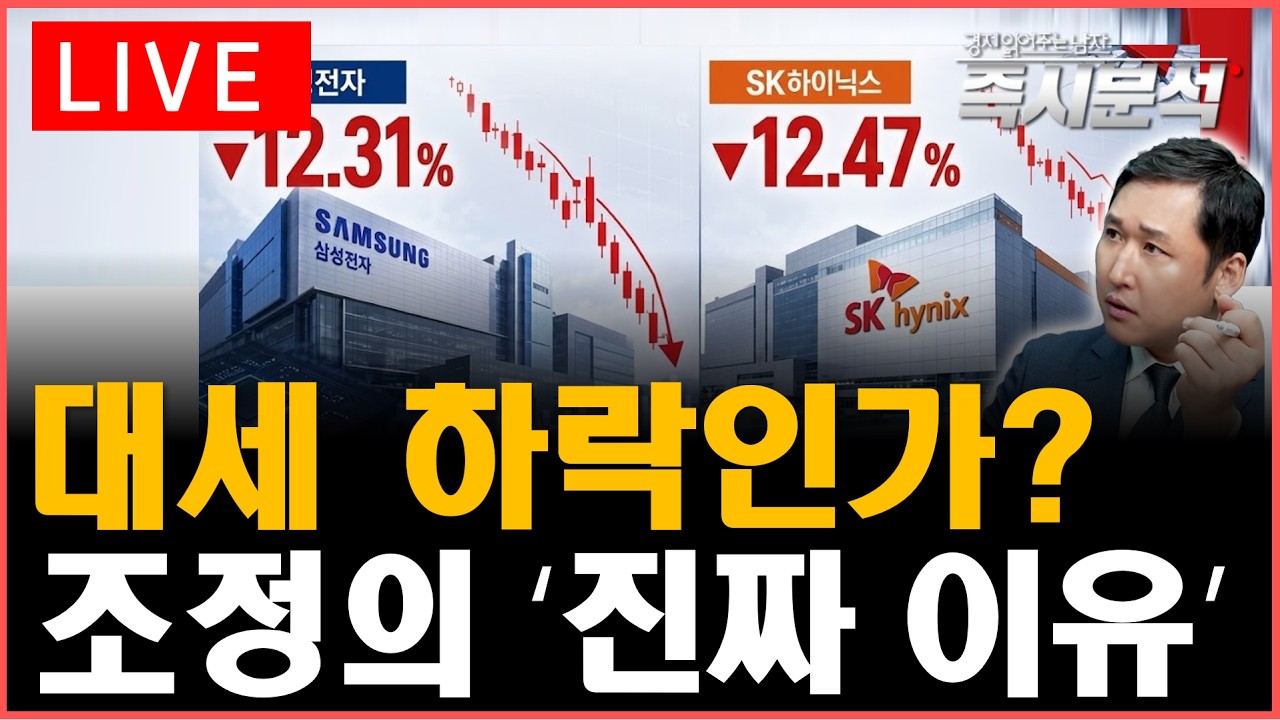
Samsung Electronics and SK Hynix Fall More Than 12%; This Appears More Like a Leverage ETF-Driven Correction Than a Secular Downtrend
The key issue in this sharp selloff is not simply that Samsung Electronics and SK Hynix declined materially.
The central question is whether this is a correction driven by deteriorating semiconductor fundamentals, or by mechanical selling triggered by leveraged ETFs and margin-based trading.
This report reviews the causes of the KOSPI slump, the market debate over the market-cap ranking between Samsung Electronics and SK Hynix, the risk embedded in single-stock leveraged ETFs, and the potential impact of Micron’s earnings release on Korean equities.
It also addresses the ETF rebalancing mechanism and explains why leveraged products can amplify market declines.
1. KOSPI’s sharp decline: why did the market fall so much?
On June 23, 2026, Korean equities saw a sharp correction led by semiconductors.
Samsung Electronics and SK Hynix fell sharply in tandem, intensifying risk aversion across the market.
Both names declined by more than 12%, a drawdown described by some as the largest since the financial crisis.
However, one point is important.
This selloff does not currently appear to have been caused by a deterioration in earnings expectations for Samsung Electronics and SK Hynix.
There is no clear evidence yet that the semiconductor cycle has suddenly weakened, that AI chip demand has rolled over, or that the HBM outlook has materially worsened.
By contrast, U.S. markets had recently seen selected semiconductor names such as Micron and Intel rise on earnings expectations.
That makes it difficult to argue that external conditions had deteriorated enough to justify such a steep decline in Korea.
So what was the main driver?
The most important factor was leveraged ETF flows and short-term overheated capital.
2. The first major driver: overheating in single-stock leveraged ETFs
One of the main sources of volatility in the Korean market has been single-stock leveraged ETFs.
As of June 23, the net assets of 14 single-stock leveraged ETFs launched on May 27 had expanded to approximately 16 trillion won.
Since listing, their cumulative trading value over 17 sessions exceeded 142 trillion won.
On a daily average basis, more than 8 trillion won was traded in these products.
In particular, leveraged ETFs linked to SK Hynix recorded more than 3 trillion won in average daily trading value during the first week after listing.
Retail net buying exceeded 7 trillion won, reflecting a strong wave of 2x leveraged speculation.
The issue is that leveraged ETFs magnify gains in rising markets, but they also amplify losses and selling pressure in declining markets.
As a result, the impact is not limited to individual investors; it increases overall market volatility.
3. The key point often missed in coverage: mechanical ETF rebalancing
The most important structural issue in this correction is mechanical ETF rebalancing.
This is often mentioned only briefly, or omitted entirely, in general news coverage.
ETFs are managed to maintain specific portfolio weights.
For example, if an ETF holds Samsung Electronics at 30%, SK Hynix at 30%, and other names at 40%, a sharp rally in the two semiconductor stocks will cause their weights to rise above target.
In that case, the manager must sell part of the holdings to restore the target allocation.
This is rebalancing.
The logic is similar to institutions such as the National Pension Service trimming exposure after gains to maintain a target allocation.
In leveraged ETFs, the effect can be stronger.
These products can create amplified buying in up markets and amplified selling in down markets.
Once a correction begins, selling can become self-reinforcing.
In this case, the decline in Samsung Electronics and SK Hynix appears to reflect not a sudden collapse in intrinsic value, but rather a heavy concentration of ETF capital unwinding through mechanical selling.
4. Have fundamentals for Samsung Electronics and SK Hynix really deteriorated?
Based on currently available information, there is no clear evidence that fundamentals for Samsung Electronics and SK Hynix have deteriorated sharply.
Markets continue to expect earnings improvement at Samsung Electronics and growth at SK Hynix driven by HBM exposure.
AI infrastructure investment, high-bandwidth memory demand, and the recovery in memory prices remain key support factors.
The issue is that share prices had run ahead of earnings expectations.
Large-cap semiconductor stocks led the KOSPI higher, causing excessive concentration in one sector.
As short-term capital and leveraged flows built up, signs of overheating increased.
In conclusion, this correction appears to be more about excessive positioning being unwound than a collapse in fundamentals.
However, the presence of leveraged ETF flows has clearly intensified the downside move.
5. From “Samsung-Hynix” to “Hynix-Samsung”: what does the market-cap reversal mean?
Two phrases have recently been used frequently in the market: “Samsung-Hynix” and “Hynix-Samsung.”
This reflects the fact that SK Hynix has challenged Samsung Electronics’ long-standing position as Korea’s largest listed company by market capitalization.
Hana Securities analyst Lee Jaeman previously argued that the end of a bull market would be signaled when SK Hynix’s market capitalization surpasses Samsung Electronics’.
That view should not be interpreted as meaning that a shift in market cap ranking automatically signals a broad market downturn.
The real implication is this:
If the ranking changes without a corresponding change in earnings or corporate value, it can be viewed as a sign of overheating.
Samsung Electronics has a diversified business portfolio spanning semiconductors, smartphones, home appliances, foundry, and system semiconductors.
SK Hynix, by contrast, is highly leveraged to memory semiconductors, particularly HBM and the AI memory value chain.
Given the premium currently assigned to AI-linked assets, the rerating of SK Hynix is understandable.
However, if market expectations move much faster than earnings, short-term overheating becomes difficult to avoid.
Therefore, the issue is not the ranking change itself, but the reason the change occurred.
6. SK Hynix overtaking Samsung Electronics is not necessarily a negative signal
A change in the market-cap leader is not inherently negative.
In a healthy capital market, leadership changes over time as industries evolve.
In the U.S. market, companies such as Apple, Microsoft, Nvidia, Amazon, and Alphabet have repeatedly competed for the top position.
In Korea as well, a market in which Samsung Electronics is always first would not necessarily be preferable to one in which firms such as SK Hynix rise on the back of structural change in the AI semiconductor industry.
SK Hynix’s strong position in HBM is a meaningful competitive advantage in the AI semiconductor cycle.
That said, market recognition of future growth should be distinguished from speculative buying that pushes valuations ahead of fundamentals.
This correction is best understood as a warning that the latter has become excessive.
7. Why Micron’s earnings release matters
The most important global event this week is Micron’s earnings release.
It is scheduled for around 5:00 a.m. KST on June 25.
Micron, together with Samsung Electronics and SK Hynix, is a key reference point for the global memory semiconductor cycle.
The market is watching whether Micron’s revenue and EPS will exceed expectations.
If Micron posts an earnings beat, Korean semiconductor stocks could benefit.
If it disappoints, near-term volatility in Samsung Electronics and SK Hynix may increase further.
At present, the base case still assumes that earnings expectations for Micron remain intact.
On that basis, it is difficult to conclude that the Korean selloff is simply the market pricing in a global semiconductor earnings downturn.
8. Next trading session scenario: lower open, then possible rebound
Following this sharp decline, the KOSPI is likely to open lower, depending on the direction of the U.S. market.
If U.S.-listed semiconductor stocks such as Micron and Nvidia extend losses, Korean equities may face early-session pressure.
However, if the correction has been driven primarily by leveraged ETF unwinding and short-term profit taking rather than by fundamentals, an intraday rebound remains possible.
In other words, a lower open followed by a reversal higher is a plausible scenario.
If further sharp declines continue in the next session, long-term investors may view them as an opportunity to accumulate.
That view is valid only if the earnings outlook for Samsung Electronics and SK Hynix remains intact.
The key turning point is Micron’s earnings release.
If Micron beats expectations, buying interest in semiconductor stocks is likely to return.
If results are weak, the correction could extend.
9. Global variables: U.S. rate concerns and foreign investor profit taking
This correction was not driven by domestic factors alone.
Some global investment banks have raised the possibility that U.S. rate cuts may be delayed, and that rate hikes could remain on the table.
If the market shifts from expecting rate cuts to considering rate hikes, growth stocks and semiconductors would face pressure.
Rate concerns also provide foreign investors with a rationale for taking profits.
After a strong run in Korean semiconductor stocks, foreign investors may see the recent move as an opportunity to lock in gains.
Weaker expectations for inclusion on the MSCI developed markets watchlist may also have weighed on sentiment.
High expectations naturally amplified the disappointment.
10. U.S. megacap and AI stock trends should also be monitored
This correction is not limited to Korean semiconductors; it is linked to broader volatility in global technology stocks.
In the U.S. market, Nvidia and Micron came under pressure, and Alphabet also weakened.
In Alphabet’s case, reports that key AI talent from Google were moving to competitors such as OpenAI weighed on the stock.
In AI, the movement of core researchers can be interpreted as a shift in competitive capability, not merely as staff turnover.
Issues surrounding SpaceX have also affected risk sentiment.
Concerns about debt at xAI, bridge loans, and potential future bond issuance have added to investor caution.
Overall, global markets are now dealing with simultaneous pressure from AI growth expectations, interest-rate concerns, debt risk, and valuation constraints.
11. Why leveraged investing is risky
Leverage appears attractive in rising markets.
A 2x leveraged product can theoretically generate a 10% gain when the underlying stock rises 5%.
But losses also double when the market falls.
The larger issue is behavioral.
Long-term investing requires time and capital that can absorb volatility.
Leveraged ETFs and margin-based investing make investors highly sensitive to short-term moves.
That can lead to selling in panic and re-entering only after the rally is largely over.
Equity investment should be investment, not speculation.
Using rental deposits, student loans, living expenses, or unsecured credit to invest in equities is highly risky.
In particular, leveraged products can threaten not only capital but also personal financial stability if used without sufficient margin for error.
12. What regulators should do now
This issue is not limited to individual investors.
It also raises questions about financial regulation and capital market design.
First, approval of additional single-stock leveraged ETFs should be approached cautiously.
If a product increases overall market volatility, investor protection should take priority over short-term trading activity.
Second, eligibility requirements for leveraged products should be strengthened.
Investors should demonstrate that they understand the product structure, potential losses, rebalancing effects, and volatility decay.
Third, broader financial education is needed.
Institutions such as the Bank of Korea, KDI, and the Ministry of Economy and Finance have financial education functions.
These functions should be used more effectively to shape investor behavior.
A healthy equity market is built on long-term investment culture, not short-term speculation.
13. Investment response: sell now, or hold?
The worst response in this environment is panic-driven liquidation.
If fundamentals remain intact and the price decline is driven primarily by flow and leverage, investors should remain disciplined.
That said, volatility may continue in the near term.
Micron’s earnings, U.S. rate expectations, foreign flows, and leveraged ETF liquidation pressure all remain relevant variables.
Long-term investors should monitor the following factors:
- Whether earnings expectations for Samsung Electronics and SK Hynix remain intact
- Whether demand for HBM and AI semiconductors continues to expand
- Whether the memory price recovery cycle remains in place
- Whether leveraged ETF selling is temporary or structural
- How much pressure U.S. monetary policy may place on growth valuations
If these factors remain broadly unchanged, this correction is more consistent with an overheating reset than with the start of a secular downtrend.
14. Conclusion: is this a signal of a broader downtrend?
Based on current information, this selloff should not yet be regarded as confirmation of a secular bear market.
The decline appears to have been driven by leveraged ETF overheating, mechanical rebalancing, foreign profit taking, and rate concerns, rather than by a collapse in fundamentals for Samsung Electronics and SK Hynix.
There is, however, a clear warning signal.
Korean equities have become overly concentrated in semiconductors and AI expectations, with excessive leverage layered on top.
In this structure, even modest negative news can trigger outsized moves.
Going forward, the market will need to focus less on whether prices are rising or falling and more on how volatility is being managed.
Even if the KOSPI maintains its medium-term uptrend, sharp interim corrections are likely to recur.
In a market led by semiconductor heavyweights, Micron earnings, Nvidia performance, U.S. rates, and the AI investment cycle must all be monitored closely.
15. The most important point missing from most coverage
The essence of this correction is not that semiconductors are finished, but that markets that rise on leverage can also fall on leverage.
Most coverage focuses on the decline percentages of Samsung Electronics and SK Hynix, the market-cap reversal, and foreign selling.
But the key issue is that single-stock leveraged ETFs have changed the market structure.
In the past, declines in Samsung Electronics and SK Hynix were driven mainly by discretionary investor selling.
Today, ETF structure can trigger mechanical selling once certain conditions are met.
When leverage is added on top of that structure, downside moves become more severe.
Accordingly, investors in Korea should now monitor not only company earnings but also ETF flows, leveraged positioning, retail buying, foreign profit taking, and interest-rate direction.
That is the central market dynamic in 2026.
< Summary >
The more than 12% decline in Samsung Electronics and SK Hynix represents one of the sharpest corrections since the financial crisis.
Current evidence suggests that the main drivers were overheating in single-stock leveraged ETFs and mechanical rebalancing, rather than a collapse in fundamentals.
The market-cap reversal involving SK Hynix may reflect positive AI semiconductor rerating, but if valuation expectations move too far ahead of earnings, it becomes a warning sign.
Micron’s earnings release is a key near-term catalyst for Samsung Electronics, SK Hynix, and the KOSPI.
Investors should assess fundamentals, rate risk, semiconductor cycle trends, and leveraged ETF flows rather than reacting solely to panic selling.
This correction is better understood as a period of overheating adjustment and heightened volatility, not as a confirmed secular downtrend.
[Related Articles…]
- AI Semiconductor Supercycle and the Outlook for Korean Equities
- Key Risks Investors Should Understand Before Using Leveraged ETFs
*Source: [ 경제 읽어주는 남자(김광석TV) ]
– [LIVE] 레버리지 투자가 가져온 대조정, 금융위기 이후 최대치 조정. 대세하락의 시그널인가? [즉시분석]