● Tesla FSD Shock, Korea First, 8 10 Subscription Shift
Tesla FSD 14 Lite Rolls Out in South Korea as Subscription Transition Looms on August 10: Is the 9.043 Million Won Purchase Worth It?
The key issue in this development is not simply that Tesla FSD has arrived in Korea.
The more important point is that Korea has become the second market after the United States to receive the supervised FSD Version 14 Lite, while the purchase model may shift from an upfront payment to a monthly subscription starting August 10.
This is a practical decision problem for owners of U.S.-made Hardware 3 Model 3 and Model Y vehicles sold between 2019 and 2022.
They now have to decide whether to pay 9,043,000 won upfront for FSD or move to a monthly subscription at 150,000 won.
There is another important variable.
Elon Musk has stated that Hardware 3 vehicles face structural limitations in achieving unsupervised autonomous driving, including robotaxi-level capability.
As a result, FSD 14 Lite should be viewed not only as a software update, but also as a potential final major FSD upgrade for Hardware 3 vehicles.
Below is a news-style summary that combines Tesla stock, FSD subscription, autonomous driving regulation, AI semiconductors, and overseas equity investment considerations.
1. Market Snapshot: FSD News Drew More Attention Than Tesla Shares
In the original report, Tesla closed at $407.76, up 0.3% from the previous day.
Broader market sentiment was driven by semiconductor and AI-related stocks.
Analysts attributed part of the positive tone in the Nasdaq and technology stocks to easing geopolitical risk after President Trump mentioned the possibility of talks with Iran.
For Tesla investors, however, the domestic rollout of FSD was a far larger event than short-term share-price movement.
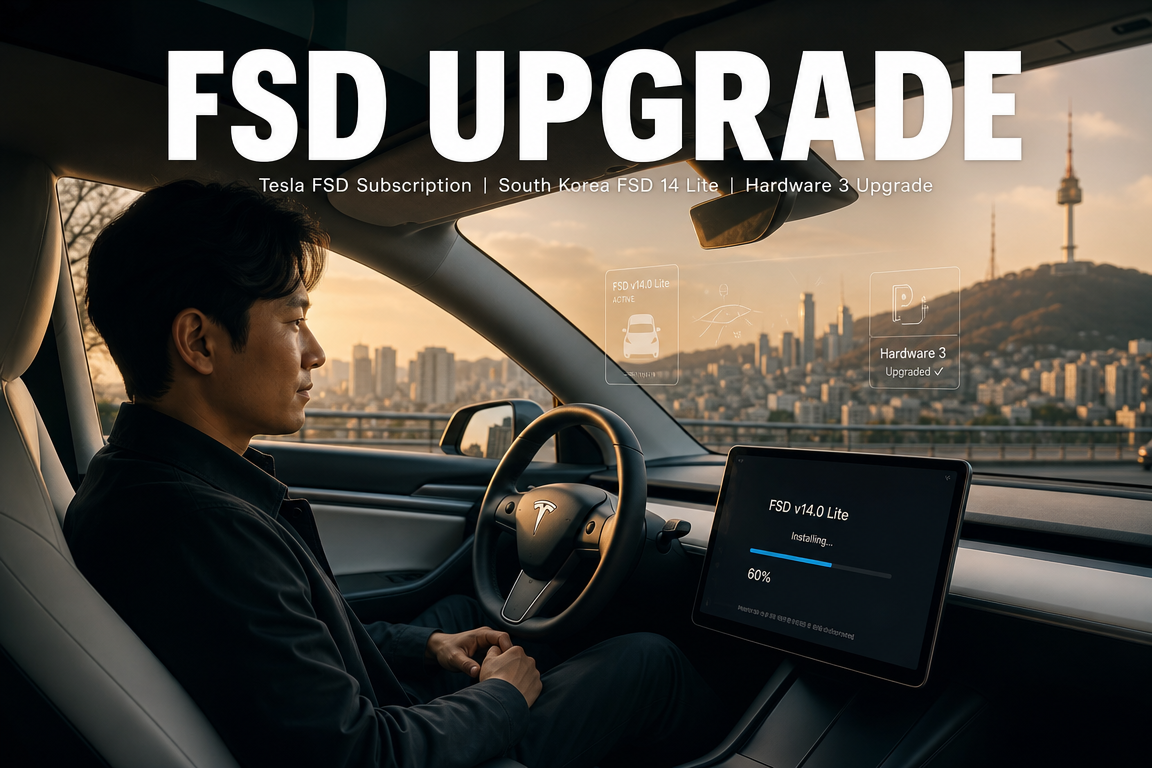
Tesla Korea announced a phased rollout of supervised FSD Version 14 Lite in South Korea.
This has been described as one of the fastest international deployments outside the United States.
The fact that Korea is the second country to receive FSD 14 Lite has again highlighted the strategic importance of the Korean Tesla market.
2. What Is Supervised FSD Version 14 Lite?
FSD 14 Lite is an optimized version of the latest FSD decision architecture adapted for Hardware 3 vehicles.
It can be understood as a compressed form of the Version 14 logic used on Hardware 4, adjusted for the camera and compute limits of Hardware 3.
In other words, it is not simply a downgraded feature set, but software that adapts a newer decision framework to older vehicle hardware.
The expected functions include city driving, highway driving, lane changes, intersection handling, and merge/diverge decisions within a single driving flow.
It is also reported to reduce unnecessary hard braking and unnatural driving behavior.
Improvements at the destination stage, such as parking-lot entry and final approach routing, have also been noted.
The ability to back out of dead ends has also been highlighted as a practical difference from earlier FSD versions.
In that sense, the system is increasingly closer to an AI-based autonomous driving platform rather than a simple driver-assistance feature.
3. Why Did Korea Receive FSD 14 Lite After the United States?
The main reason appears to be the Free Trade Agreement between the United States and Korea and the related certification framework.
Vehicles produced in the United States and certified under U.S. safety standards can receive software updates in Korea without separate certification in some cases.
As a result, the main beneficiaries of this rollout are older U.S.-made Model 3 and Model Y vehicles.
By contrast, the Chinese-made Model Y and Model 3, which are more common in Korea, are subject to European safety standards.
That is why they were excluded from this update.
This distinction is important.
Most Tesla vehicles sold in Korea recently have been Chinese-made Model Y and Model 3 units.
However, the current FSD 14 Lite rollout primarily benefits a small number of older U.S.-made vehicles.
According to the original report, only about 145 of the 47,941 Tesla vehicles sold in Korea last year were U.S.-made.
On that basis, most Korean Tesla owners are not included in the current rollout.
Chinese-made Tesla owners will likely need to wait for regulatory and certification progress in Europe before broader availability in Korea.
4. This Is Not Full Self-Driving, but a Supervised Level 2 Function
One issue requires caution.
Although the name includes Full Self-Driving, FSD 14 Lite is not legally full autonomous driving.
Under Korea’s Ministry of Land, Infrastructure and Transport and police standards, it is classified as a Level 2 driver-assistance system under SAE definitions.
That means the vehicle may assist with many driving decisions, but the driver remains fully responsible.
The driver must remain attentive and ready to intervene at all times.
Without that distinction, FSD could be mistaken for robotaxi-level or Level 3+ autonomy.
Tesla’s AI autonomous driving technology is advancing quickly, but the currently available function in Korea remains a supervised FSD system.
5. What Changes on August 10: From Upfront Purchase to Monthly Subscription
According to Tesla Korea, FSD can be purchased upfront until August 9.
The reported price is 9,043,000 won.
Starting August 10, the purchase model may shift to a monthly subscription at around 150,000 won.
However, the actual timing, eligible vehicles, and pricing may vary depending on final policy confirmation and system readiness.
In other words, this should be viewed as a preliminary notice rather than a final confirmed policy.
Tesla in the United States has already moved away from upfront FSD sales and toward a monthly subscription model priced at $99.
Korea’s 150,000 won monthly fee is broadly comparable once exchange rates are taken into account.
This change appears to be less about simply raising the price and more about lowering entry barriers to expand the user base.
Paying more than 9 million won upfront is a major commitment, whereas a monthly fee allows users to test the service before deciding.
6. Cost Comparison: 9.043 Million Won Upfront vs. 150,000 Won Monthly
The most practical calculation is the break-even point.
Dividing 9,043,000 won by 150,000 won yields roughly 60 months.
In other words, an upfront purchase may be economically rational only if the system will be used consistently for more than five years.
If the usage period is shorter, the subscription model is more efficient.
The main advantage of the subscription model is flexibility.
Users can activate it for long-distance travel months and cancel it during normal commuting periods.
If there is no separate activation fee, the subscription model is more efficient from a cost-management perspective.
It may be especially practical for owners who are uncertain about long-term vehicle retention, are considering replacement within two to three years, or may move to a different Tesla model later.
7. For Owners of Multiple Teslas: FSD Subscription Is Vehicle-Specific
Owners with multiple Tesla vehicles are likely to focus on one question.
Does the FSD subscription attach to the account or to the vehicle?
Based on the original report, the subscription is tied to a specific vehicle rather than to the account.
That means if an owner has two Tesla vehicles, FSD must be subscribed to separately for each one.
It is not a shared subscription that can be moved freely between vehicles under one account.
This policy could change in the future, but the current structure should be understood as vehicle-based billing.
8. The Most Important Variable: The Future of Hardware 3
The core issue that many reports overlook is the limitation of Hardware 3.
Elon Musk has said in earnings calls that Hardware 3 has physical limitations that make unsupervised autonomous driving difficult.
The key constraints are memory bandwidth and compute performance.
Hardware 3 has less compute headroom than Hardware 4 and may not support robotaxi-level operation without human intervention.
Given that roughly 4 million Hardware 3 vehicles are installed worldwide, this is not a minor legacy-hardware issue.
It is directly tied to Tesla’s broader FSD business model.
Another important point is that Version 15 may not include a Lite version for Hardware 3.
If that proves true, FSD 14 Lite could become the final major FSD upgrade for Hardware 3 vehicles.
For that reason, paying 9.043 million won upfront is not simply a decision about whether to buy FSD, but whether to prepay for what may be the last major update available to this hardware generation.
9. Existing FSD Buyers and the Litigation Risk
For existing FSD buyers, this development may not be entirely positive.
Some prior owners paid between $8,000 and $15,000 for FSD.
In Korea, some owners also paid more than 9 million won for the option.
Yet full autonomous driving has not materialized, and concerns have grown as Hardware 3 is seen as incapable of supporting robotaxi-level unsupervised operation.
The original report noted a class action involving approximately 7,000 plaintiffs in the Netherlands and similar litigation in Australia.
It also stated that Tesla owners in Korea are pursuing a lawsuit against Tesla Korea for purchase-price recovery.
A case involving 98 Tesla owners is reportedly underway at the Seoul Central District Court, with plaintiffs seeking contract rescission based on expectations of full self-driving capability.
Tesla argues that many FSD features, including Autopilot, automatic lane changes, and automatic parking, have already been delivered.
This case is significant because it may become a key domestic ruling on the legal nature of Tesla’s FSD option.
For that reason, some interpret the rapid rollout of FSD 14 Lite in Korea as a way to reduce litigation risk.
10. Tesla’s Response: Hardware Upgrades and FSD Transfer Incentives
Tesla is reportedly considering several measures to address the Hardware 3 issue.
The original report mentioned a micro-factory plan that would allow Hardware 3 computers and cameras to be upgraded in major cities.
It also described a promotion allowing FSD to be transferred to a new vehicle without charge if a Hardware 3 vehicle is traded in and replaced with a new car.
The condition was said to require ordering by September 30 and delivery by December 31.
Such policies can be seen as an effort to reduce dissatisfaction among existing customers while encouraging new vehicle purchases.
For Tesla, the challenge is that Hardware 3 vehicles cannot simply be abandoned, but neither can they be guaranteed robotaxi-level autonomy.
In that context, the FSD transfer promotion is a practical way to retain customers while shifting them toward Hardware 4-based vehicles.
11. Wall Street’s View: Could FSD Become Tesla’s iPhone Moment?
On Wall Street, FSD is increasingly being compared with the early iPhone.
When the iPhone first launched, many viewed it as an expensive phone.
Over time, however, it became a platform that changed consumer behavior and digital services.
Initial market estimates were around 10 million units per year, but the iPhone eventually became a product sold in hundreds of millions of units annually.
From this perspective, FSD may be viewed not as a vehicle option but as an AI platform that changes the driving experience.
If consumers find it sufficiently useful and reliable, especially for commuting, market perceptions of Tesla’s valuation could change.
Automobiles are not smartphones, of course.
Replacement cycles are longer and safety regulation is far stricter.
Still, if FSD becomes widely adopted and trusted, Tesla’s valuation framework could shift materially.
This is a long-term variable that overseas equity investors should monitor closely.
12. AI Semiconductors and Autonomous Driving: Why This Is More Than an Auto Story
FSD may look like a vehicle feature, but in practice it links AI semiconductors, data centers, edge computing, and robotics AI.
To improve FSD, Tesla needs driving data from vehicles, in-car inference chips, and cloud training infrastructure.
As a result, FSD expansion is also tied to demand for AI semiconductors.
The more sophisticated the autonomous driving software becomes, the more compute resources and higher-efficiency chips it requires.
That is why Tesla remains heavily focused on its own AI chips and Dojo supercomputer.
Ultimately, the FSD subscription model is not just a software revenue stream. It is a core monetization path in Tesla’s transition from an automaker to an AI platform company.
13. SpaceX and Technology Sentiment: Why Shorter Launch Intervals Matter
The original report also included SpaceX-related developments.
It referenced preparations for Starship Version 3’s second flight, Flight 13, including booster movement and FAA aviation notices.
It also noted that preparations for Flight 14 were already underway.
The key point is that the interval between launches is becoming shorter.
This suggests that SpaceX is turning launch activity from an experimental event into a repeatable industrial process.
Tesla and SpaceX are separate companies, but investors tend to assess the execution pace across Elon Musk’s broader ecosystem.
FSD and Starship share a common pattern.
Both rely on rapid iteration across software and hardware.
14. The Core Points Often Missed in Other Coverage
First, FSD 14 Lite is not a broad Korea-wide rollout, but a limited expansion centered on older U.S.-made vehicles.
Many Korean owners drive Chinese-made Model Y and Model 3 vehicles, and those are unlikely to be included.
Accordingly, this should be viewed not as a full nationwide rollout but as a deployment made possible by the certification structure.
Second, the 9.043 million won upfront price only makes economic sense if the system is used consistently for more than five years.
When vehicle replacement risk, Hardware 3 limitations, and the possibility of no Hardware 3 version of FSD 15 are considered, the appeal of upfront payment is weaker than before.
Third, for Hardware 3 owners, this update is both a benefit and a warning.
FSD 14 Lite may improve the user experience, but it also signals that long-term unsupervised autonomy remains uncertain.
Fourth, Tesla’s subscription transition may be more about data acquisition than price increases.
More users on a monthly plan means more real-world driving data, which in turn improves the AI model.
Fifth, the outcome of FSD-related litigation could materially affect Tesla’s domestic sales and option marketing.
How courts interpret the gap between FSD marketing language and consumer expectations may shape future autonomous-driving advertising and sales practices.
15. So Should Investors or Owners Buy FSD Now?
For U.S.-made Hardware 3 owners who already purchased FSD, the standard approach is to wait for the phased update without additional cost.
The priority is to assess how much the real-world driving experience improves.
For U.S.-made Hardware 3 owners who have not yet purchased FSD, the 9.043 million won upfront payment should be considered carefully.
If the vehicle will be kept for more than five years and FSD will be used regularly, the upfront option may be reasonable.
However, if vehicle replacement is likely or if usage will be limited to weekends and long trips, the monthly subscription is more rational.
For owners who already purchased Enhanced Autopilot, it is important to confirm whether only the price difference is required.
In that case, the cost structure may be different from that of a full FSD buyer.
For owners of Chinese-made Model Y and Model 3 vehicles, waiting for European certification and local implementation remains the practical approach.
At present, the key question is whether supervised FSD approval expands in Europe and then reaches Korea.
For prospective Tesla buyers, FSD transfer incentives, Hardware 4 availability, and future subscription policy should all be evaluated together.
If autonomous driving is strategically important over the long term, a Hardware 4-based vehicle is likely to be the stronger choice.
16. Investment View: What the FSD Subscription Transition Means for Tesla
From an investor’s perspective, the FSD subscription transition is highly significant.
Vehicle sales are influenced by the economic cycle, interest rates, subsidies, and production volumes.
By contrast, software subscription revenue has a recurring and more predictable profile.
As Tesla expands FSD adoption, the quality of its revenue mix could improve.
That would support a shift in market perception from an automaker to a software and AI platform company.
However, regulatory constraints, safety concerns, consumer trust, and hardware-generation differences remain material risks.
Accordingly, Tesla investors should monitor not only vehicle delivery volumes, but also FSD activation rates, subscription conversion rates, approval timelines by region, and Hardware 3 support policies.
If these metrics improve, Tesla may be re-rated as an AI autonomous driving platform rather than simply an EV manufacturer.
If litigation and regulatory risk increase, however, the premium attached to FSD could be discounted by the market.
< Summary >
Tesla Korea has announced a phased rollout of supervised FSD Version 14 Lite in South Korea.
Korea has been described as the second market after the United States to receive the feature.
The rollout primarily targets U.S.-made Hardware 3 Model 3 and Model Y vehicles sold between 2019 and 2022.
Chinese-made Model Y and Model 3 vehicles are likely excluded because of European safety standard requirements.
Starting August 10, the FSD purchase model may shift from a 9,043,000 won upfront payment to a monthly subscription of 150,000 won.
The break-even point is approximately five years.
If the system will be used consistently for more than five years, the upfront purchase may be preferable; if not, the subscription model is more efficient.
Because Hardware 3 has limitations in achieving unsupervised autonomy, FSD 14 Lite may also represent the last major upgrade for that hardware generation.
Ongoing litigation involving existing FSD buyers could also affect Tesla’s domestic sales and option strategy.
From an investment perspective, the subscription transition is a key factor in Tesla’s evolution from an EV manufacturer to an AI autonomous driving platform company.
[Related Articles…]
- Tesla FSD Subscription Model and Autonomous Driving Market Outlook
- Tesla Stock and Key Investment Themes in AI Autonomy
*Source: [ 오늘의 테슬라 뉴스 ]
– FSD 라이트, 8월 10일 전에 사야 할까요? FSD 오너들 계산기 두드려보세요
● AI-Capex Boom, Wage Squeeze
Capital Shifts from Wage Growth to AI Data Centers: Big Tech Capex Trends and Beneficiary Sectors
The key issue is not simply that “AI is positive.”
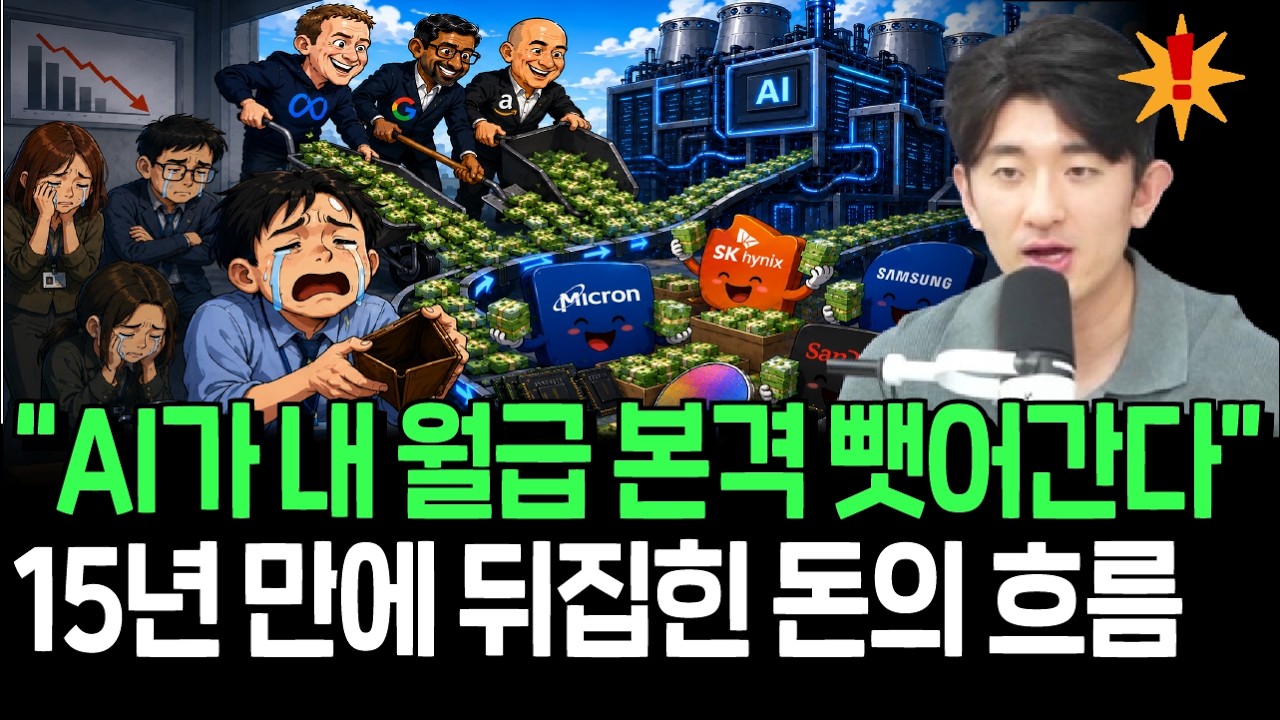
The more important development is that corporate surplus cash is increasingly being redirected away from employee compensation and toward data centers, semiconductors, power infrastructure, and fiber-optic networks.
In earlier periods, capital flowed to lower-cost overseas labor markets through globalization. After the global financial crisis, it flowed to shareholders through share repurchases. The current phase appears to be shifting capital toward AI infrastructure investment.
This structural change has implications for the global economic outlook, U.S. equities, Big Tech earnings, the semiconductor cycle, and power infrastructure spending.
1. Wall Street’s Core Question: Where Did the Wage Increases Go?
A recent Wall Street report raises a direct question.
Corporate productivity and profits have increased substantially over the past several decades, but real wages for workers have not kept pace.
In principle, higher corporate profits should translate into higher employee compensation.
In practice, however, a significant portion of profit growth has not been distributed to labor.
- 1990s–2009: Wage growth was absorbed by investment in lower-cost overseas markets
- 2009–2022: Wage growth was redirected toward share buybacks and stock support
- Post-2026: Wage growth appears to be flowing into AI data centers and related infrastructure
In other words, corporate earnings improved, but the gains did not fully reach workers through higher pay.
The report suggests that the largest destination for capital going forward is likely to be AI investment and data center infrastructure.
2. 1990s–2009: Globalization Absorbed Wage Growth
From the 1990s onward, multinational companies accelerated the relocation of production facilities overseas.
Instead of paying higher wages in developed markets such as the United States, Europe, and Japan, firms shifted manufacturing to emerging and lower-cost economies.
This improved corporate productivity and profit margins.
For workers in developed markets, however, upward pressure on wages weakened.
The report interprets this as wage increases being redirected toward lower-cost foreign production bases.
Although the wording is provocative, the broader global economic pattern is consistent with this interpretation.
- Companies reduced costs by using lower labor expenses.
- Supply chains became globally distributed.
- Consumers benefited from lower-priced goods, while labor bargaining power weakened.
- Corporate profits increased, while labor’s share of income declined.
During this period, globalization supported higher corporate margins but constrained wage growth.
3. 2009–2022: After the Crisis, Capital Shifted to Share Buybacks
Following the 2008 financial crisis, capital allocation shifted again.
Central banks lowered rates during major shocks such as the financial crisis and the pandemic, allowing companies to raise funds at low cost.
In theory, firms could have used this capital to expand hiring, build facilities, and raise wages.
In practice, many firms chose share repurchases to support equity prices.
Share buybacks reduce the number of shares outstanding, improve earnings per share, and can support stock prices.
This benefits shareholders, but it can also mean less capital is directed toward wage growth.
- Zero-rate and low-rate conditions reduced financing costs for companies.
- Many firms prioritized buybacks and dividend expansion over new investment.
- Equity markets recovered faster than the real economy.
- Wealth inequality widened between equity holders and non-holders.
This is relevant for investors because wage income alone has often been insufficient to keep pace with inflation and rising asset prices.
In particular, the long-term strength of the U.S. equity market has been supported by strong cash generation and share repurchases among large technology firms.
4. 2026: Capital Is Moving Toward AI Data Centers
The most important change now is the direction of capital spending.
According to the report, Big Tech share repurchase growth in Q1 2026 was only about 1% year over year.
By contrast, AI-related investment increased by about 38% year over year.
This is not merely a numerical shift; it indicates a major change in capital allocation strategy among large technology companies.
Historically, Big Tech generated large amounts of cash and returned it to shareholders through buybacks and dividends.
Today, that cash is being directed into AI data centers, GPUs, servers, power systems, cooling infrastructure, and fiber-optic networks.
Capital that might have been used for immediate shareholder returns is increasingly being deployed into long-term AI infrastructure.
- Share buybacks: Focused on stock support and shareholder returns
- AI investment: Focused on data centers, semiconductors, and power equipment
- Corporate strategy: Long-term infrastructure buildout over short-term capital return
- Market implication: Sector leadership within U.S. equities may continue to rotate
This suggests that the AI investment cycle is moving beyond a short-term thematic trade and into a broader capital expenditure cycle.
The key question is shifting from which AI application will lead to who will supply the power, manufacture the chips, and build the infrastructure required to operate AI systems.
5. Why AI Infrastructure May Conflict with Wage Growth
AI data centers require substantial capital but relatively limited labor.
This is a critical point.
A factory may require large numbers of production, logistics, and management staff.
By contrast, AI data centers typically need far fewer workers relative to the size of the investment.
For companies, investing in AI infrastructure may appear more attractive than increasing headcount and wages.
This helps explain why major technology firms and global corporations are reducing labor intensity while increasing capital spending on AI-related infrastructure.
- AI can function as a cost-reduction tool for companies.
- Data centers require large capital expenditures.
- Server and semiconductor investment may take priority over hiring.
- Wage growth may slow while capital spending rises.
For investors, the implication is clear: labor income alone may not be sufficient to track inflation and asset appreciation.
As AI investment reshapes corporate earnings and industry structure, personal asset allocation may need to adjust accordingly.
6. Primary Beneficiary Sector: Semiconductors and AI Servers
The first major destination for AI data center spending is semiconductors.
GPUs, HBM, AI accelerators, and high-performance server components are core elements of AI infrastructure.
Generative AI models require substantial compute capacity for both training and inference.
That demand requires advanced chips and memory products.
- GPU: Core processing hardware for AI workloads
- HBM: High-bandwidth memory essential for advanced AI chips
- AI servers: Central hardware within data centers
- Semiconductor equipment: Supporting industrial base for expanded chip production
As a result, the semiconductor cycle is increasingly tied not only to economic recovery but also to AI capital expenditure.
This may affect both U.S. equities and semiconductor companies in Korea.
7. Secondary Beneficiary Sector: Power Grids and Energy Infrastructure
Many market participants focus on semiconductors when discussing AI investment.
However, a more persistent bottleneck may be electricity.
AI data centers consume significant amounts of power.
Cooling systems also require substantial energy.
As data center capacity expands, electricity demand rises and grid upgrades become necessary.
This supports demand for generation, transmission, distribution, transformers, and power management systems.
- Rising electricity demand from data centers
- Need to replace and upgrade aging power grids
- Higher demand for transformers and electrical equipment
- Renewed debate over renewables and nuclear power
- Greater importance of power-efficiency solutions
The key constraint in AI infrastructure is not only chip supply.
Securing reliable electricity to run those chips continuously may become an even larger issue.
8. Third Beneficiary Sector: Data Center Construction and Cooling Systems
AI data centers are not conventional office buildings.
They require specialized design, cooling, power delivery, security, and network connectivity.
Because AI servers generate substantial heat, cooling technology is becoming increasingly important.
- Data center REITs: Exposure to data center real estate and leasing demand
- Construction and engineering: Beneficiaries of large-scale data center projects
- Cooling systems: Higher demand for liquid cooling and other efficient technologies
- Power management equipment: Required for stable and efficient electricity delivery
AI competition is becoming both a model-performance race and an infrastructure-capacity race.
Companies are seeking to secure locations with access to power, land, and network connectivity.
9. Fourth Beneficiary Sector: Fiber-Optic Networks and Communications Infrastructure
As AI data centers expand, data traffic will increase materially.
Cloud services, AI inference, and enterprise AI adoption all raise demand for high-speed network infrastructure.
This supports fiber-optic networks, data transmission equipment, and network switching technologies.
- Higher demand for inter-data-center connectivity
- Expansion of cloud and AI services
- Need to reduce network latency
- Increased demand for high-performance communications equipment and optical modules
As AI becomes more advanced, more data must move faster behind the scenes.
For that reason, AI infrastructure investment extends beyond semiconductors into communications infrastructure.
10. The Most Important Point Often Missed in Other Coverage
The most important development is the slowdown in Big Tech share buybacks.
Many reports emphasize only the increase in AI spending.
However, the more important market signal is that capital previously used for buybacks is being redirected to AI capital expenditures.
For years, the U.S. equity market benefited from strong support from large technology companies’ repurchase activity.
Now, that capital is being used to build data centers rather than support share prices.
In the near term, this may pressure free cash flow and reduce stock-price support for some large technology companies.
Over the long term, however, firms that secure AI infrastructure may widen their competitive advantage relative to those that do not.
- Higher AI spending may support long-term growth but pressure near-term margins.
- Lower buyback activity may weaken stock-price support.
- Companies that successfully build AI infrastructure may gain durable advantages.
- Investors should evaluate cash flow, power access, and customer demand rather than themes alone.
In short, investors should distinguish between companies that market themselves as AI beneficiaries and those that are actually deploying capital into AI infrastructure and can monetize that spending.
11. Implications for Individual Investors
The report is uncomfortable but realistic for one reason.
Wage growth has continued to lag inflation and asset-price appreciation.
If productivity gains are not fully passed through to labor, investors need to understand where capital is being allocated.
This does not mean taking excessive risk.
It means managing assets more systematically.
- Wages should be managed as the foundation of household stability.
- Investments should be diversified over the long term.
- Structural growth sectors such as AI, data centers, semiconductors, and power infrastructure require close study.
- Interest-rate and inflation trends remain important for growth-stock valuations.
- Long-term cash flow and industry positioning matter more than short-term price moves.
AI infrastructure investment represents a significant trend.
However, not all related stocks will benefit equally.
Investors should focus on companies with real earnings exposure, infrastructure control, and sustainable demand.
12. Financial Event Summary in the Source Material
The source material also includes promotional content related to Shinhan Investment Corp. and Shinhan Financial Group.
The main events are the Super SOL new sign-up campaign and the SOL LINK account opening campaign.
- Event period: July 1, 2026 to September 30, 2026
- Super SOL new sign-up benefit: KRW 5,000 equivalent benefit for new registrations
- Referral benefit: KRW 1,000 equivalent for the referrer and KRW 2,000 equivalent Naver Pay points for the referred user
- SOL LINK account opening benefit: Investment coupons for new or inactive Shinhan Investment customers
- Investment coupon: KRW 20,000 for new customers, KRW 15,000 for inactive customers
- Trading event: Automatic Tesla Model Y drawing entry for weekly trading of KRW 1 million or more with balance maintenance
The Super SOL app is presented as an integrated financial application covering securities, banking, cards, and insurance.
It provides a consolidated view of assets, stock positions, and spending, and includes AI agent functions for questions related to loan interest and deposit rates.
However, financial products involve principal loss risk, and domestic and overseas stock trading also carries transaction fee and foreign exchange risks.
Investment decisions should be based on personal objectives, investment horizon, and risk tolerance rather than promotional incentives alone.
13. Investment Checklist
Investors seeking exposure to the AI cycle should avoid relying only on popular themes.
The following criteria are more useful for evaluating sectors and companies.
- Revenue conversion: Whether AI spending translates into actual sales growth
- Margin sustainability: Whether higher revenue is offset by capex pressure
- Power access: Whether the company has secured electricity supply and favorable locations
- Customer concentration: High dependence on a small number of large technology customers increases risk
- Valuation: Attractive businesses can still produce poor returns if purchased at excessive prices
- Interest-rate environment: Higher rates increase discount-rate pressure on long-duration growth assets
AI data center investment is a major structural trend.
However, not every related name will perform equally well.
Over time, market attention is likely to narrow toward companies that generate real cash flow, resolve bottlenecks, and control critical infrastructure.
< Summary >
Over the past four decades, corporate profits have risen significantly, but real wage growth has not fully kept pace.
From the 1990s onward, capital flowed to lower-cost overseas markets through globalization, and after 2009 it shifted toward shareholders through share repurchases.
In 2026, Big Tech buyback growth is slowing while AI investment and data center capex are rising rapidly.
Key beneficiaries include semiconductors, AI servers, power grids, data center construction, cooling systems, and fiber-optic networks.
Individual investors should recognize that labor income alone may struggle to keep pace with inflation and asset-price growth, and they should study sectors where capital is moving over the long term.
[Related Articles…]
*Source: [ 소수몽키 ]
– 월급 인상 대신 AI에 본격 돈 퍼붓는다, 거대한 돈 흐름 변화의 수혜주들