● SK hynix ADR Shock, AI Chip Supercycle Signal or Hidden Trap
SK Hynix ADR Gains Traction in the U.S.: A Signal of a Semiconductor Supercycle, or a Hidden Risk? Key Takeaways and Watchpoints
The core issue here is not simply that “SK Hynix sold well in the U.S.”
The more important question is whether U.S. equity investors are beginning to view memory semiconductors as growth stocks again, whether the AI investment cycle remains intact, and whether rising long-term yields could once again compress semiconductor valuations.
In particular, the strong reception of the SK Hynix ADR does not change fundamentals by itself, but it does matter for market sentiment because it broadens global capital access to Korea’s leading semiconductor name.
Below, we summarize the event in a news-style format and highlight the key variables that markets may overlook.
1. Event Summary: Strong Demand for the SK Hynix ADR in the U.S. Market
According to the source material, SK Hynix gained broader access to U.S. investors through its American Depositary Receipt, or ADR.
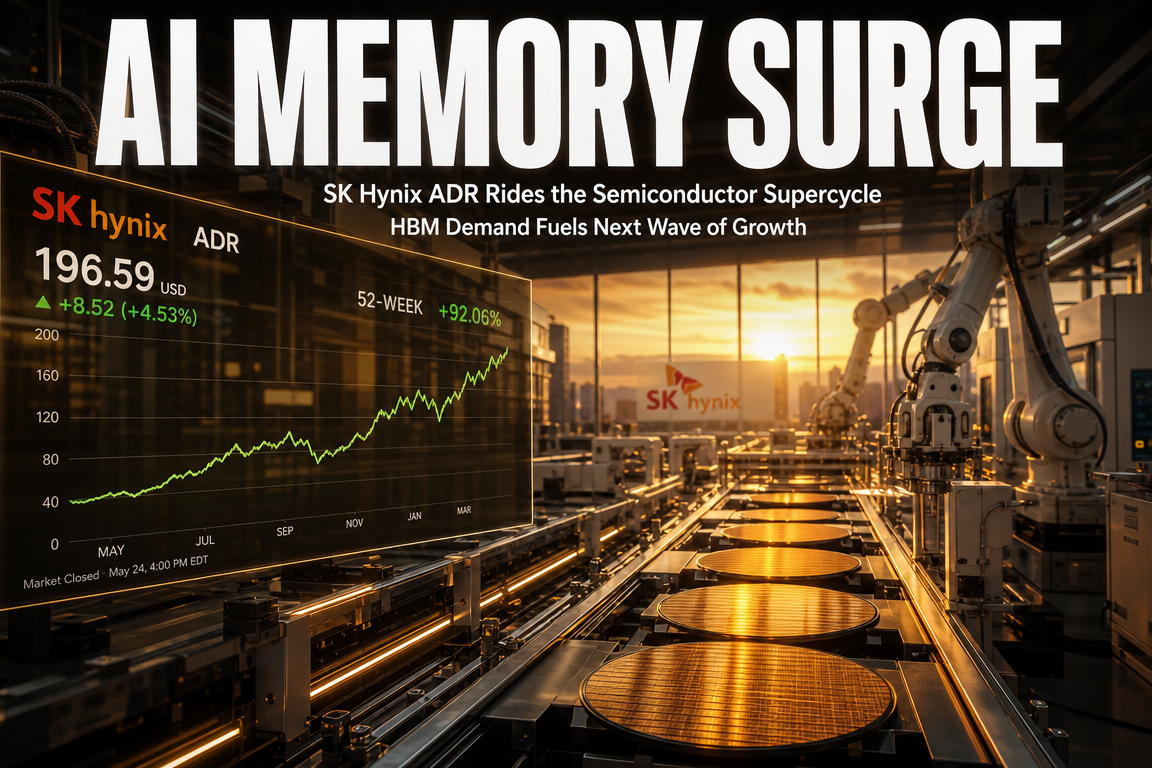
On the first day of trading, the ADR reportedly closed around $168 per share, about 13% above the offering price.
This move carries meaning beyond a short-term share price gain.
The U.S. is the world’s largest capital market, with highly active institutional and retail investor participation.
Until now, investors in the U.S. faced multiple barriers to direct exposure to SK Hynix, including access to the Korean market, currency conversion, account setup, and time-zone differences.
With ADR access, SK Hynix is more likely to be discussed alongside Samsung Electronics and Micron in global semiconductor comparison sets.
In other words, this is both a company-specific positive and a development that affects sentiment across the broader memory semiconductor sector.
2. The Key Message from Chairman Chey: The Memory Cycle Has Changed
The most notable part of the source is Chairman Chey Tae-won’s remarks on memory semiconductors.
The key point is that memory chips should no longer be viewed only as a conventional cyclical industry.
In the past, DRAM and NAND followed a typical cycle: when supply increased, prices fell; when prices fell, investment declined; and when supply tightened, prices recovered.
That structure may be changing as AI servers, data centers, and HBM demand expand rapidly.
If customers continue asking when more chips can be delivered and how much more supply can be provided, that suggests a different market structure from the past.
In the AI semiconductor market, GPUs are not the only critical component.
If GPUs handle computation, HBM and high-performance DRAM ensure that data continues flowing without interruption.
As AI models grow larger and data processing intensity increases, memory semiconductors become even more essential.
3. Fundamentals Have Not Changed Overnight
There is, however, an important point of caution.
The SK Hynix ADR rally did not change the company’s production capacity, customer contracts, HBM share, or earnings outlook overnight.
The source also makes this clear.
Before this event, the market already understood that AI-related memory demand was strong.
Chairman Chey’s comments were less a new revelation than a reaffirmation of an already established bullish narrative.
The reason the stock reacted strongly is different.
Equity markets do not move on fundamentals alone.
Even with the same earnings outlook, valuation can change depending on who is buying, where the stock is traded, and what narrative surrounds it.
This ADR event changed both market access and the investment narrative.
4. Three Reasons the Market Repriced SK Hynix
First, access for U.S. investors improved materially.
When a stock becomes tradable in the U.S. market, global investors can more easily compare SK Hynix with AI semiconductor names such as Micron, Nvidia, AMD, and Broadcom.
Historically, Korean semiconductor equities have often traded at a discount despite strong earnings.
The ADR listing may help narrow part of that discount.
Second, memory semiconductor valuations remain relatively low.
The source notes that forward P/E ratios for SK Hynix and Micron remain below 10x.
If AI demand is recognized as structural growth, the market may assign a higher valuation multiple to memory semiconductor companies.
In that case, the market shift would be from “this is a cyclical peak” to “this is a core AI infrastructure name that deserves re-rating.”
Third, the likelihood of continued hyperscaler AI investment has been reaffirmed.
Recently, markets have worried that large tech firms could slow AI spending.
However, the source mentions that Meta may expand computing capacity to 7GW this year and 14GW next year.
The implication is straightforward.
Competition in AI data centers is not over, and major technology firms may continue investing aggressively.
5. Why This Matters for Samsung Electronics and Micron
The SK Hynix ADR surge is not only a company-specific development.
The global memory market is led by Samsung Electronics, SK Hynix, and Micron.
If U.S. investors begin reassessing the structural growth profile of memory through SK Hynix, sentiment could also improve for Samsung Electronics and Micron.
For Samsung Electronics, the key issue remains whether it can close the gap in HBM competitiveness.
While SK Hynix has commanded a premium in HBM, Samsung has been viewed more cautiously by the market.
However, if AI memory demand continues to expand, Samsung may still be re-rated as it moves through a recovery phase.
Micron, as a U.S.-listed memory semiconductor name, is the most direct comparable for the SK Hynix ADR.
For U.S. investors, the choice may increasingly become whether to own Micron alone or to include SK Hynix as well.
6. The Bullish Case: Memory Is No Longer Just a Cyclical Sector
The strongest argument behind the recent rally is the changing nature of the memory industry.
Historically, memory was treated as a cyclical sector tied to PC, smartphone, and server demand.
Today, a new demand driver has emerged in the form of AI data centers.
AI servers require not only high-performance GPUs, but also large volumes of HBM, DRAM, and SSD storage.
As large language models and generative AI services expand, data throughput requirements rise sharply.
In that context, memory semiconductors become not just components, but critical assets that remove bottlenecks in AI infrastructure.
As a result, markets are beginning to view SK Hynix less as a traditional cyclical stock and more as a direct beneficiary of AI infrastructure spending.
7. The Bearish Case Is Also Clear
That said, the outlook should not be viewed through a purely optimistic lens.
As the source notes, markets can change rapidly.
After Micron’s earnings release, stronger long-term contract mix and improved earnings expectations drove a sharp share price gain.
But as the narrative shifted, semiconductor stocks came under renewed pressure.
This suggests that today’s positive sentiment can reverse quickly.
AI investment cycles are already priced for strong expectations, so even modest disappointments can trigger sharp volatility.
For example, if hyperscaler capex growth slows, if concerns rise over the efficiency of AI data center investment, or if higher GPU and memory prices begin to burden customers, markets could turn defensive again.
8. Key Risk 1: Slowing Growth in Hyperscaler CAPEX
For AI semiconductor pricing power to remain justified, big tech capital expenditure must continue to rise.
What matters most is not the absolute level, but the rate of change.
Even if spending remains high, a slowdown in growth can be interpreted by markets as a sign of deceleration.
If budgets remain flat while memory prices continue rising, purchasing volumes could weaken.
Accordingly, the next stage for SK Hynix depends not only on strong AI demand, but on whether customers continue buying more at higher prices.
Investors should track hyperscaler AI plans, data center buildout speed, power availability, and cloud monetization trends.
9. Key Risk 2: Rising Long-Term Yields and Valuation Pressure
The most important macro risk highlighted in the source is long-term interest rates.
In particular, a sharp rise in the U.S. 30-year yield can weigh on growth and technology stocks.
When long-term yields rise, the present value of future earnings declines.
Stocks with stronger future growth expectations, such as AI semiconductors, are especially sensitive to rate moves.
Even if memory semiconductor companies trade at low forward P/E multiples, the sector can still weaken if higher yields compress the broader market multiple.
In that sense, the ADR listing is a company-specific positive, while long-term yields remain a market-wide macro variable.
10. Key Risk 3: Leverage ETFs and Tokenized Products Could Increase Volatility
One of the more important but less discussed points in the source is the emergence of leveraged and tokenized products linked to SK Hynix.
The text notes that 2x ETFs already trade in Korea and Hong Kong, and that a 2x product tied to SK Hynix is also being prepared in the U.S.
It also suggests that tokenized trading products may emerge following the ADR listing.
These products can improve liquidity, but they can also amplify volatility.
Leveraged products intensify buying in an uptrend, but they can also accelerate selling in a downturn.
In other words, the ADR listing is a long-term positive for accessibility, but in the short term it may attract speculative flows and increase volatility.
11. The Most Important Point Often Missed: Better Access to the Underlying Stock and More Derivatives at the Same Time
The key issue is not only that SK Hynix is becoming easier to access in the U.S.
The more important point is that direct access is improving at the same time as leveraged ETFs and tokenized instruments are expanding.
This combination has two opposing effects on the market.
First, if long-term global capital enters, the valuation discount on SK Hynix could narrow.
Second, if short-term leveraged capital grows, the share price may move more sharply than fundamentals alone would justify.
In simple terms, the ADR event gives SK Hynix access to more investors.
But whether those investors are long-term institutions or short-term leveraged traders will determine the stock’s trading behavior.
Going forward, investors should monitor not just earnings, but also trading volume, ADR premium, leveraged product flows, and short interest.
12. Five Key Watchpoints Going Forward
First, ADR trading volume and premium stability.
A strong first-day debut can be event-driven.
The key question is whether trading volume remains durable and whether U.S. investors continue to buy.
Second, HBM supply contracts and pricing power.
SK Hynix’s core advantage lies in HBM.
Long-term contract mix, pricing improvements, and volume expansion will determine earnings visibility.
Third, the growth rate of AI spending by major tech firms.
Investors should continue tracking infrastructure plans from Meta, Microsoft, Google, Amazon, and OpenAI-related ecosystem spending.
Even if AI spending increases in absolute terms, a slowdown in growth rates may pressure the stock.
Fourth, U.S. long-term yield trends.
Rising 30-year yields can compress valuations across the technology sector.
Even strong semiconductor names can lose momentum if rate pressure intensifies.
Fifth, the expansion of leveraged and tokenized trading products.
This is a key variable for short-term volatility.
Sharp advances followed by abrupt corrections are possible.
13. Scenario-Based Interpretation for Investors
Bullish scenario.
The SK Hynix ADR establishes stable trading in the U.S., attracting long-term capital.
At the same time, HBM demand remains stronger than expected and big tech AI spending continues to expand.
In this case, memory semiconductors may be re-rated from cyclical discount stocks to core AI infrastructure names.
Neutral scenario.
The ADR debut is positive, but much of the benefit is already reflected in the stock price.
Earnings remain solid, but higher yields and valuation pressure keep the stock range-bound.
In this case, investors should wait for earnings releases, customer capex guidance, and HBM pricing trends.
Bearish scenario.
Concerns emerge that AI investment growth is slowing, while long-term yields continue to rise.
Leveraged products trigger additional selling pressure and short-term volatility increases.
In that case, SK Hynix may remain fundamentally strong while still experiencing sharp share price swings.
14. One-Sentence Conclusion
The SK Hynix ADR rally does not change the company’s fundamentals overnight, but it may signal that global capital is beginning to reprice memory semiconductors as growth assets within AI infrastructure.
For the rally to continue, the stock must pass four tests: HBM demand, hyperscaler CAPEX, long-term yields, and derivative-market volatility.
For now, the more realistic view is not “unconditional upside,” but rather “strong fundamentals with elevated volatility.”
[Related Articles…]
AI Semiconductor Supercycle and Memory Market Outlook
How Rising U.S. Long-Term Yields Affect Technology Stocks and Equities
*Source: [ Maeil Business Newspaper ]
– [홍장원의 불앤베어] SK하이닉스 미국 상장 대박에 가려진 우려. 향후 관전 포인트는