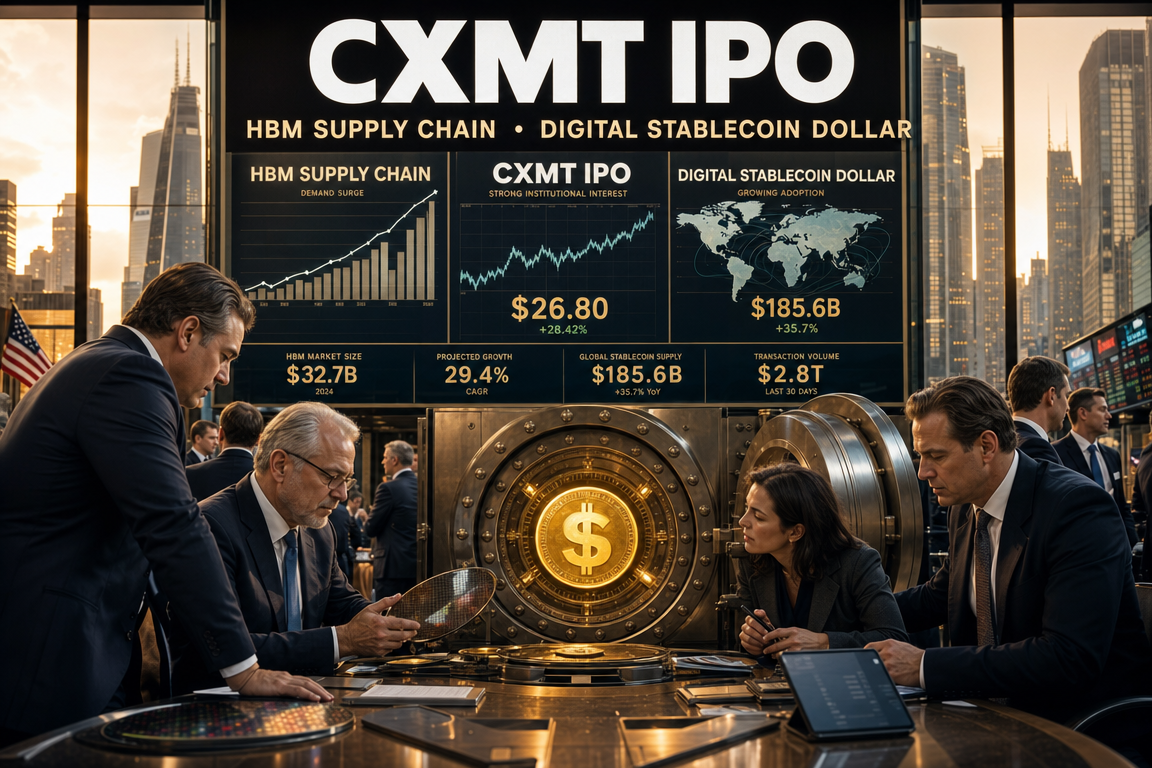
● China Memory Power Surge, Korea Semiconductors on Edge
Why CXMT’s Re-IPO Push and China’s Semiconductor Self-Reliance Strategy Matter for Korean Semiconductors
The key issue is not simply that “one Chinese semiconductor company is going public.”
China’s CXMT is reportedly seeking to raise roughly KRW 6 trillion to 7 trillion through an IPO, with the proceeds likely to be directed toward DRAM capacity expansion and HBM production preparation.
Huawei, despite U.S. restrictions on ASML’s EUV equipment, is also pursuing alternative methods to work around advanced-node process constraints.
This development connects Korean semiconductors, Samsung Electronics, SK hynix, HBM, AI data centers, the U.S.-China strategic rivalry, and the broader direction of the KOSPI.
Importantly, strong current earnings for Korean semiconductor companies do not necessarily imply continued medium- to long-term competitive strength.
1. CXMT’s Re-IPO Push: Why It Matters
CXMT, China’s leading memory semiconductor company, is once again pursuing a listing on China’s NASDAQ-like market.
According to the source text, the IPO could secure approximately KRW 6 trillion to 7 trillion in capital.
This funding is likely to be used not only for operations, but for DRAM line expansion, DDR5 mass production, and preparation for entry into HBM.
The shareholder structure is notable.
- Alibaba
- Tencent
- China’s National Integrated Circuit Industry Investment Fund
This indicates that CXMT is not simply a private company, but a strategic industry asset supported by both the Chinese government and major technology firms.
China views semiconductors not just as a commercial sector, but as critical infrastructure in its technology competition with the United States.
For that reason, CXMT’s IPO should be seen as both a financing event for China’s semiconductor development and a potential source of direct pressure on Korean memory market share.
2. The Paradox of U.S. Sanctions: Why Huawei May Be More of a Risk
Since 2018, the United States has tightened semiconductor-related restrictions centered on Huawei.
The main measures include blocking advanced GPU supplies, restricting semiconductor manufacturing equipment, and denying access to ASML’s EUV lithography systems.
EUV equipment is widely regarded as essential for sub-5nm process nodes.
Even so, Huawei has responded by pursuing alternative development paths.
Traditional semiconductor miniaturization increases circuit density within the same area.
The source describes this as spatial compression and geometric scaling.
Huawei’s approach, by contrast, is described as folding and stacking circuits in a more three-dimensional structure to reduce signal travel time.
In simple terms, it is closer to building upward like a high-rise rather than shrinking the footprint.
This matters because U.S. sanctions have not only constrained Chinese development; they have also accelerated China’s effort to build an independent ecosystem.
This is often described as the paradox of sanctions.
China is trying to create its own process technology, design capability, and supply chain that can operate without U.S. equipment or U.S. semiconductors.
The process may be inefficient in the short term, but over time it could become a significant competitive challenge for Korean semiconductor companies.
3. Korean Memory Semiconductors Remain Strong, but Market Share Is Already Under Pressure
Samsung Electronics and SK hynix continue to hold dominant positions in the DRAM market.
SK hynix has also become a key HBM supplier in Nvidia’s ecosystem, while Samsung is expanding its own supply efforts.
The issue is that current leadership does not guarantee that the gap will remain intact.
Market share trends in DRAM suggest warning signs.
- Korean companies’ combined market share once reached around 77.4%.
- It later declined to around 68.2%, according to the source text.
- By contrast, China’s DRAM share rose from around 0.5% to about 7.1%.
The implication is straightforward.
China is capturing part of the market that Korea has lost.
China has not yet caught up technologically with Samsung Electronics and SK hynix, but once it secures sufficient quality and price competitiveness in mainstream memory, it can become a force that pressures pricing across the industry.
The NAND market shows a similar pattern.
- Korean companies’ combined share reportedly fell from around 59% to around 50.1%.
- China’s NAND share increased from around 4.4% to around 10.2%.
Memory semiconductors are a scale-driven industry.
When prices rise, all producers benefit, but when supply increases and prices weaken, profitability is usually the first area to come under pressure.
This explains why Chinese companies are pushing into DDR4, DDR5, NAND, and even HBM.
4. Korea’s Structural Weakness Is More Visible in Non-Memory and Foundry Semiconductors
Korea remains strong in memory semiconductors, but the situation is different in non-memory chips and foundry services.
As AI data centers expand, demand is rising not only for memory, but also for GPUs, NPUs, ASICs, power semiconductors, networking chips, and advanced packaging.
In the foundry market, TSMC’s dominance continues to strengthen.
By contrast, Samsung Electronics’ foundry share reportedly declined from around 13% to around 7%, according to the source text.
SMIC, UMC, and other competitors are maintaining or expanding their positions in their respective segments.
This is highly relevant to Korea’s economic outlook.
Korean firms are generating substantial profits from memory, but they have not yet established comparable strength in the larger growth areas of the semiconductor industry, especially non-memory.
The source notes that Samsung’s memory division has remained highly profitable, while its non-memory and foundry businesses have continued to post losses.
In other words, the current cycle does not necessarily imply a structurally stronger semiconductor industry for Korea as a whole.
5. Strong Earnings Do Not Always Translate into Share Price Performance
One of the most practical observations in the source is that corporate earnings and stock market valuation can diverge.
Samsung Electronics and SK hynix may continue to post strong results in 2026.
However, equity markets price not just good earnings, but expectations for further improvement.
For example, if first-quarter 2026 earnings rise sharply, markets will focus on whether that growth can continue.
Even if earnings remain at a high level, share prices may weaken if growth rates slow.
This is especially important because semiconductor-related names account for a very large share of the KOSPI.
The source notes that semiconductor-related large-cap stocks, including Samsung Electronics preferred shares and SK Square, account for more than 50% of the KOSPI by weight.
That means a slowdown in semiconductor earnings or a correction in semiconductor stocks could affect the entire Korean equity market.
Korean semiconductors are therefore not just a corporate issue, but a capital market issue as well.
6. Korea’s Export Structure Has Become Too Dependent on Semiconductors
Semiconductors already account for a very large share of Korea’s exports.
According to the source, semiconductors make up about 24.4% of total exports, and that share may have risen to around 36.1% in the first quarter of 2026.
If a single product category accounts for more than one-third of exports, the Korean economy is heavily exposed to the semiconductor cycle.
The quality of export growth is also important.
The source argues that recent semiconductor export growth has been driven more by price increases than by volume growth.
In other words, export value may have risen because prices increased, not necessarily because more units were sold.
The risk is that price increases are unlikely to continue indefinitely.
DDR4, DDR5, and NAND prices have reportedly peaked and shown signs of weakening.
If supply expands further, price pressure is likely to increase.
As CXMT, Micron, and China’s broader semiconductor ecosystem expand capacity, the upper bound on memory pricing may remain constrained.
7. HBM Is Not a Permanent Monopoly Market
HBM is currently the area where Korean semiconductor firms are receiving the most attention.
AI data center expansion, rising Nvidia GPU demand, and higher spending on server infrastructure are driving strong HBM demand.
However, the source emphasizes that HBM is also becoming more competitive.
In the past, SK hynix held an almost dominant position in Nvidia’s HBM supply chain.
Samsung Electronics later pursued entry into Nvidia’s supply chain, and Micron has also reportedly passed qualification tests and begun scaling production.
Chinese firms are also attempting to enter HBM over the longer term.
HBM is technically difficult and difficult to replicate quickly, so China is unlikely to catch up in the near term.
Still, the semiconductor industry is known for late entrants eventually using price competition to pressure the lower end of the market.
Korean firms must continue to advance in HBM3E, HBM4, advanced packaging, CXL memory, and customized memory for AI servers.
8. The 2026 APEC Meeting in Shenzhen Could Become a Chinese Technology Showcase
The source also highlights the 2026 APEC summit, which will be held in Shenzhen, China, as a symbolic event.
Shenzhen is Huawei’s base and a symbol of China’s advanced industrial capacity.
Where Korea has showcased K-pop, cultural content, and soft power at major international events, China is likely to showcase robotics, drones, telecommunications, AI, and semiconductors.
Such events are not merely ceremonial.
They signal which industries a country is choosing to elevate as its future global brands.
China is likely to present Huawei, CXMT, electric vehicles, batteries, robotics, drones, and AI infrastructure as a unified technology package.
Its semiconductor self-reliance strategy will likely be embedded in that message.
9. The U.S.-China Rivalry Is Being Fought Across Resources, Currency, and Technology
The semiconductor issue is one part of the broader U.S.-China strategic competition.
The source frames this rivalry in terms of resource power, currency power, and technology power.
First is resource power.
China has a dominant position in rare earth mining, refining, and permanent magnet production.
In rare earth refining in particular, China’s share is said to be around 90%.
Rare earths are essential for semiconductors, batteries, electric vehicles, defense systems, and robotics.
Second is currency power.
The United States has long dominated global finance through the dollar and the SWIFT network.
China, learning from sanctions imposed on Russia, is expanding CIPS, its cross-border yuan payment system.
The yuan’s share remains small relative to the dollar, but China is gradually increasing its role in trade settlement.
Third is technology power.
China is rapidly closing the gap through large numbers of science and engineering graduates, strong R&D spending, and state-led industrial policy.
On an R&D-to-GDP basis, Korea is also high, but in absolute spending the United States and China are far ahead.
Ultimately, future technology competition will depend on capital, talent, market access, and government strategy working together.
10. China’s Debt Risk Should Not Be Read as a Simple Collapse Story
The latter part of the source presents a different perspective on China’s debt situation.
Local government debt, LGFV exposure, shadow banking, and the property downturn are all clear risks.
However, Chinese policy and research institutions argue that domestic-currency debt and foreign-currency debt should be assessed separately.
High foreign-currency debt and a large share of short-term external liabilities can raise the risk of a balance-of-payments crisis.
Korea experienced this vulnerability during its own financial crisis.
By contrast, debt issued in the domestic currency offers policymakers and the financial system more flexibility.
The key point is that China’s debt should not be viewed only as a collapse signal; the direction of capital deployment matters.
China is directing debt and fiscal resources into infrastructure, semiconductors, AI, EVs, batteries, and robotics.
For Korea, that is the more significant concern.
If China is using leverage not for consumption but to build future industrial capacity, long-term competitive conditions may change materially.
11. The Most Important Point Missing from Much of the Coverage
First, China does not need to beat top-tier technology immediately in order to disrupt markets.
Even if Samsung Electronics and SK hynix remain ahead in cutting-edge HBM, China can weaken pricing power once it achieves sufficient quality in mainstream DRAM and NAND.
In semiconductors, profitability depends not only on technology, but also on supply growth and the pricing cycle.
Second, Korea’s main risk is not a single company, but the concentration of the broader economy.
Semiconductors now account for an outsized share of exports, KOSPI earnings, corporate profits, and tax revenue.
If semiconductors weaken, the entire Korean economy becomes more vulnerable.
Third, U.S. sanctions are both constraining China and pushing it toward substitute technologies.
When ASML EUV tools are unavailable, China is forced to build its own process, equipment, and design ecosystem.
Even if the process is initially inefficient, sustained state support can eventually create an industrial base.
Fourth, CXMT’s IPO is not just a financing event; it is a financial signal of China’s semiconductor independence strategy.
The participation of Alibaba, Tencent, and the national semiconductor fund suggests alignment between Chinese capital and the government’s strategic direction.
That structure is a meaningful concern for Korean companies.
Fifth, Korea should focus on chokepoint technologies rather than trying to win every segment.
Korea needs technologies that are indispensable to both the United States and China, and in which Korean firms retain leadership.
Only then can Korea preserve bargaining power in the U.S.-China rivalry.
12. Strategic Priorities for Korean Semiconductors
At the corporate level, the definition of “super-gap” leadership should be expanded.
This means moving beyond better DRAM production to HBM4, CXL, advanced packaging, customized memory for AI servers, and low-power high-performance semiconductors.
Profits from memory should be reinvested into non-memory chips, foundry yield improvement, design ecosystems, and localization of materials, parts, and equipment.
At the policy level, fiscal allocation priorities should be reassessed.
If tax revenue has increased due to strong semiconductor earnings, the focus should shift from short-term consumption or one-off spending toward R&D, talent development, power infrastructure, AI data center infrastructure, and semiconductor cluster upgrading.
Semiconductors are an ecosystem industry that depends on power, water, talent, equipment, materials, design capability, and customers.
For investors, the key variables are cycle and market share, not just earnings.
Investors should monitor DRAM and NAND pricing, HBM supply competition, Micron’s progress, CXMT’s production capabilities, and the scale of Chinese government support, rather than focusing only on Samsung Electronics and SK hynix quarterly results.
Stock prices are generally driven more by the rate of earnings growth and future expectations than by absolute earnings levels.
At the national strategy level, Korea needs strategic clarity rather than strategic ambiguity.
Korea cannot simply choose between the United States and China in a binary way.
It needs to manage security clearly, cooperate pragmatically on economic issues, and maintain leadership in core technologies.
Ultimately, Korea must build technological leverage that makes both the United States and China want to work with it.
< Summary >
CXMT’s renewed IPO push is not merely a corporate listing event, but a central financing step in China’s semiconductor independence strategy.
CXMT may raise KRW 6 trillion to 7 trillion and use the capital to expand DRAM, DDR5, and HBM-related capacity.
Huawei, under U.S. restrictions on ASML EUV tools, is seeking alternative process and design methods.
Korea remains strong in DRAM and HBM, but DRAM market share has declined from previous peaks while China’s share has risen quickly.
Korea’s structural weakness is more visible in non-memory semiconductors and foundry services.
With semiconductor exports and semiconductor-related KOSPI weight both high, Korea’s economy is increasingly exposed to the semiconductor cycle.
China is using debt and state capital to build future industries, including semiconductors, AI, robotics, EVs, and batteries.
Korea needs to preserve memory leadership while securing chokepoint technologies such as HBM4, CXL, advanced packaging, AI chips, and foundry yield improvement.
[Related Articles…]
- China’s Semiconductor Drive and Korea’s Strategic Response
- AI Data Center Investment and the Outlook for HBM
*Source: [ 경제 읽어주는 남자(김광석TV) ]
– [모아보기] 중국 창신메모리(CXMT) 상장과 반도체 독립 추진. 한국 반도체에 올 위협 | 중국 반도체 |
● Gold- Stablecoin- AI Chip Power Grab
Gold Outlook, Stablecoins, and the U.S. Strategy Behind AI Semiconductor Dominance
The core issue is not simply whether gold prices will rise or fall.
The United States is using stablecoins to extend dollar dominance into the digital financial system, while also seeking to control the Nvidia GPU and semiconductor supply chain to reshape the payment architecture of the AI market.
Gold outlook, U.S. interest rates, stablecoins, semiconductor supply chains, and the AI market are not moving independently. They are increasingly linked within a broader global economic outlook.
The references in the original text to rumors circulating inside the White House regarding gold prices or to “stablecoins as a trap” should be viewed as market narratives rather than confirmed policy announcements.
This report focuses on structural changes that matter to investors and economic observers, rather than on exaggerated risk scenarios.
1. Why Gold Is Back in Focus: An Undervalued Window Created by U.S. Rate Anxiety
The first key point in the original text is that gold may be undervalued due to fears of interest rate hikes.
Gold is generally a non-yielding asset.
When U.S. interest rates rise, bonds and dollar deposits become more attractive, which often puts pressure on gold prices.
However, gold does not move solely based on the policy rate.
Gold also reflects real interest rates, the dollar, geopolitical risk, central bank buying, U.S. fiscal deficits, and confidence in the financial system.
In other words, even if nominal rates remain high, gold can strengthen if markets believe rates will not remain elevated or if U.S. fiscal burdens are becoming unsustainable.
-
As the debate over peak U.S. rates intensifies, the gold outlook may improve.
-
Weakening confidence in the dollar can lead to a revaluation of gold as an alternative safe-haven asset.
-
Central bank gold accumulation to reduce dollar dependence can support long-term demand.
-
Rising geopolitical uncertainty tends to reinforce gold’s role as a defensive asset.
The phrase “this may be a good opportunity” should be understood in this context.
When gold is depressed by rate concerns, it may represent a phased entry point for long-term investors.
2. Gold After the Nixon Shock: What Is Similar Today
The original text refers to the volatility in gold prices after the Nixon Shock.
The Nixon Shock refers to the 1971 decision by the United States to suspend dollar-to-gold convertibility.
In practical terms, this ended the era in which the dollar was backed by gold and established the modern credit-based dollar system.
Gold prices fell sharply in the short term and later surged significantly.
This episode is relevant because asset prices do not move in a straight line during periods of financial system change.
Initially, policy shocks, liquidity tightening, and rate volatility can weaken gold.
Over time, however, markets may begin to view the shift as evidence that the monetary system itself is changing, which can restore gold’s appeal.
-
The Nixon Shock marked the end of the gold standard.
-
Today, a new dollar system is emerging around digital dollars and stablecoins.
-
Then, the link between the dollar and gold was severed; now, the link between the dollar and digital payment networks is strengthening.
-
In this transition, gold may again serve as a hedge against distrust in the monetary system.
From this perspective, the gold outlook should be assessed not only through short-term charts but also through the direction of the dollar system.
3. Why Are Stablecoins Described as a “Trap”?
One of the most provocative claims in the original text is that “stablecoins are a trap.”
Stablecoins are digital assets designed to maintain a 1:1 peg with the U.S. dollar.
Examples include USDT and USDC, which now function as dollar equivalents in much of the global crypto market.
The key point is that stablecoins are not merely crypto tokens. They can extend global digital demand for the dollar.
Stablecoin issuers typically hold cash or U.S. Treasury securities against customer deposits.
As stablecoin usage grows, demand for short-term U.S. government debt can rise as well.
For the United States, this creates a mechanism through which the dollar can be used more broadly across digital finance worldwide.
This is the essence of digital dollar dominance.
-
As stablecoins expand, dollar dependence in global payments may increase.
-
They can become a new channel supporting demand for U.S. Treasury securities.
-
Their use may extend beyond crypto into trade settlement, AI infrastructure payments, and cloud services payments.
-
With regulatory control, the United States can strengthen oversight through stablecoin issuers and payment networks.
Why, then, call it a trap?
Users adopt stablecoins for convenience, but the system as a whole pulls them deeper into a dollar-based digital framework.
This is especially relevant for emerging markets, crypto investors, and global corporations that increasingly rely on stablecoin settlement instead of local currencies.
This is the basis for the interpretation that the United States is pursuing a larger strategic design.
4. What the United States Wants Is Not Just a Coin, but a Computer Dollar System
Another important phrase in the original text is “computer dollar system.”
This is a significant concept.
The traditional dollar system has been built around banks, cross-border payment networks, U.S. Treasury markets, and energy-related settlement flows.
Going forward, a new dollar system may emerge that combines AI servers, GPUs, cloud computing, data centers, and stablecoin-based payments.
In practical terms, access to the core infrastructure of the AI era may require passage through a dollar-based digital payment system.
If that structure is established, the United States becomes not only the issuer of a currency, but also the standard-setter for payments in the AI economy.
-
AI training requires Nvidia GPUs.
-
Mass deployment of GPUs requires cloud infrastructure and data centers.
-
Data center operations require substantial power and capital.
-
If this payment system shifts to stablecoins, digital dollar dominance is reinforced.
This is not simply a matter of token prices.
It is about the expansion of dollar power from finance into AI infrastructure within the global economic outlook.
5. Why Samsung Electronics, SK hynix, TSMC, and Nvidia Matter
The original text argues that if the United States secures control over Samsung Electronics, SK hynix, TSMC, and Nvidia, it can effectively dominate the global semiconductor market and the AI market.
This is a plausible interpretation.
The core of the AI market is not software alone.
High-performance semiconductors are required to train and operate AI systems.
Among them, Nvidia GPUs, HBM memory from SK hynix and Samsung Electronics, and TSMC’s advanced foundry capacity are central.
The United States has AI demand leaders and design leaders such as Nvidia, AMD, Google, Microsoft, Amazon, and Meta.
But it remains heavily dependent on manufacturing capacity and memory supply from Taiwan and South Korea.
As a result, the United States is using semiconductor legislation, export controls, restrictions on China, and supply chain realignment with allies to anchor this ecosystem around U.S. interests.
-
Nvidia is the key company in the AI GPU market.
-
TSMC is the critical foundry for leading-edge GPU and AI chip production.
-
SK hynix has strong competitiveness in the HBM market.
-
Samsung Electronics connects memory, foundry, and packaging capabilities.
-
The United States is using both policy and market mechanisms to prevent these companies from shifting toward China.
Ultimately, AI leadership is not just about building a better chatbot.
It is about who supplies GPUs, who controls HBM, who operates the foundries, and who standardizes the payment system.
6. The Meaning of a Scenario Where GPUs Are Paid for Only in Stablecoins
One of the most notable points in the original text is the possibility that high-end GPU chips could be sold only through stablecoin settlement.
This should be treated as a forward-looking scenario rather than a confirmed policy.
Even so, it is not purely speculative.
Global trade and advanced technology transactions are already strongly influenced by the dollar payment system.
If stablecoins are added to that structure, settlement speed, traceability, sanctions enforcement, and liquidity management could all change.
For example, if a company or country wants to buy high-performance GPUs, it could be required to settle through a U.S.-approved stablecoin network.
That would allow the United States to track and, if necessary, restrict transaction flows more effectively.
-
If AI semiconductor payments move to stablecoins, dollar dominance becomes more precise.
-
The United States can track GPU transactions more effectively.
-
Sanctioned countries or entities can be blocked earlier in the payment process.
-
Stablecoin issuers and exchanges would function as financial gatekeepers.
If this scenario develops, the AI market becomes both a technology competition and a financial settlement competition.
That is the part often missed in conventional news coverage.
7. The Most Important Point Rarely Emphasized by Other Media
Most financial coverage of gold focuses only on rates and the dollar index.
Coverage of stablecoins often focuses on crypto regulation or Bitcoin prices.
Semiconductor reporting tends to focus on Nvidia earnings or Samsung Electronics share prices.
What matters more, however, is that these three themes are converging into a single system.
The United States previously relied on oil settlement and Treasury markets to preserve dollar dominance.
In the future, it may rely on AI semiconductors, data centers, cloud infrastructure, and stablecoin payment rails.
In other words, if petroleum was the core of 20th-century dollar dominance, AI infrastructure may become the core of 21st-century dollar dominance.
-
Gold can strengthen when confidence in the existing dollar system weakens.
-
Stablecoins may become a core tool in the new digital dollar system.
-
The semiconductor supply chain can connect U.S. technology dominance with financial dominance.
-
If GPU payments become dollar-based, the AI industry itself may be reorganized around the United States.
From this perspective, gold, stablecoins, and semiconductors are not separate investment themes.
They should be viewed as components of a broader global power transition.
8. Key Checkpoints for Investors
From an investment perspective, the message is not simply to buy gold or trust stablecoins.
The more important task is to identify which indicators signal a change in direction.
Gold Investment Checkpoints
-
Monitor whether U.S. real interest rates begin to decline.
-
Track whether the U.S. dollar index turns weaker.
-
Watch whether U.S. fiscal deficits and Treasury issuance pressures increase.
-
Assess whether central bank gold purchases from China, India, and the Middle East continue.
-
Monitor renewed inflows into gold ETFs.
Stablecoin Checkpoints
-
Track the direction of U.S. congressional and regulatory policy on stablecoins.
-
Review the reserve asset composition of major stablecoins such as USDT and USDC.
-
Assess the impact of stablecoin issuance on the short-term U.S. Treasury market.
-
Monitor whether global companies begin using stablecoins for actual settlement.
AI Semiconductor Checkpoints
-
Track how long Nvidia GPU shortages persist.
-
Watch the competitive dynamics between SK hynix and Samsung Electronics in HBM.
-
Monitor TSMC’s leading-edge capacity and related geopolitical risks.
-
Assess whether U.S. export controls on China continue to tighten.
-
Track whether the AI data center investment cycle remains intact.
9. How Should Investors Respond if They Already Hold Gold?
The original text includes a title implying advice on what to do with gold holdings.
Because individual financial situations differ, a strategic rather than absolute approach is more appropriate.
Gold should be treated primarily as portfolio insurance rather than as a short-term return asset.
Accordingly, phased accumulation and position management are more practical than all-at-once decisions.
-
If gold exposure is already significant, consider separating partial profit-taking from long-term holdings.
-
If there is no gold allocation, phased entry through a modest portfolio share may be more prudent.
-
Physical gold, gold ETFs, and gold-related equities carry different risk profiles and should be treated separately.
-
Leveraged gold products may be unsuitable for long-term holding due to higher volatility.
-
Short-term pullbacks remain possible if expectations for U.S. rate cuts are already fully priced in.
Chasing gold after a large run-up can be risky.
However, if the dollar system continues to evolve, fiscal stress rises, geopolitical uncertainty persists, and central bank buying continues, gold’s long-term case remains intact.
10. Core Conclusion
The central message of the original text is not simply that gold prices will rise.
The broader conclusion is that the United States is linking finance, technology, semiconductors, and AI infrastructure to preserve dollar dominance.
Stablecoins are a leading candidate for that payment system.
Nvidia GPUs and HBM semiconductors are the industrial core of that system.
Gold reflects the market’s response to uncertainty about the existing monetary order.
Therefore, the global economic outlook ahead cannot be understood through interest rates alone.
The dollar, gold, stablecoins, semiconductor supply chains, and the AI market must be analyzed together.
Once these five elements converge, the structure of the investment landscape could change materially.
< Summary >
Gold may currently be constrained by U.S. rate concerns, but it retains medium- to long-term revaluation potential if dollar confidence weakens and central bank purchases continue.
Stablecoins are not just digital tokens; they can serve as a mechanism for extending digital dollar dominance.
The United States may combine AI semiconductor supply chains with stablecoin payment networks to build a new computer-based dollar system.
Nvidia, TSMC, Samsung Electronics, and SK hynix remain critical to the AI and semiconductor ecosystem.
Investors should monitor gold prices, U.S. rates, stablecoin regulation, semiconductor supply chains, and AI data center investment together.
[Related Articles…]
-
Stablecoin Policy and the Future of Digital Dollar Dominance
-
AI Semiconductor Supply Chain Restructuring and the Global Outlook
*Source: [ 달란트투자 ]
– 미 백악관 내부에 싹다 퍼졌다 금값에 대한 충격적 소문 | 김창익 대표 3부