● Kospi-Soars, Samsung, SK Hynix, Foreign-Buying
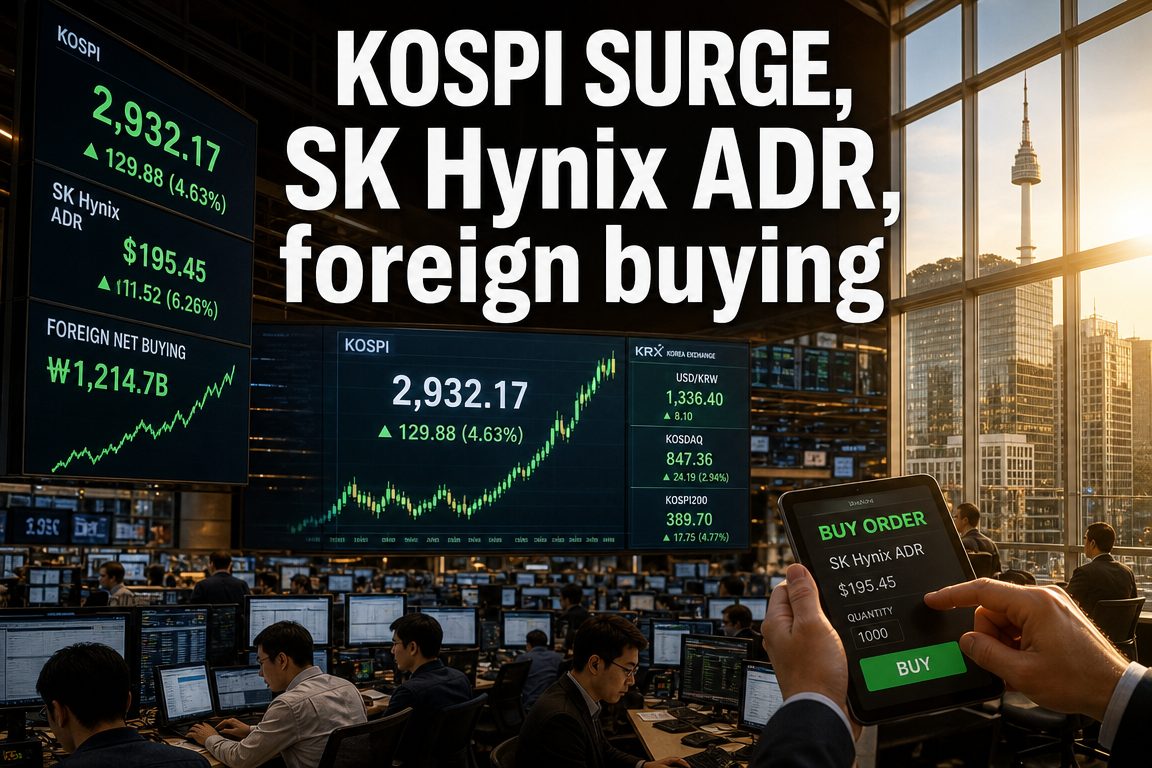
Key Drivers Behind the KOSPI Surge: SK Hynix ADR, Samsung Electronics Rebound, and Renewed Foreign Buying
This sharp KOSPI rally should not be reduced to a simple “semiconductors rose” explanation.
The key point is that IBM’s remarks reaffirmed memory-chip demand, Wall Street reports and U.S. investor flows began to build around the SK Hynix ADR, and leveraged ETF activity amplified the move, sending a strong rebound signal across Korean equities.
Most importantly, foreign investors have started to lead the KOSPI advance again.
In previous rallies, retail investors tended to buy while foreign investors sold. This time, the pattern is different.
The main question is whether this is a one-off move or the start of a broader re-rating of Korean semiconductor stocks.
1. Why the KOSPI shifted from a downside sidecar to an upside sidecar
The KOSPI has recently moved in an exceptionally volatile range.
Just days ago, a sharp decline triggered a sidecar. This time, a rapid rally triggered an upside sidecar.
A sidecar is a mechanism that temporarily restricts program trading when futures prices move too quickly.
In practical terms, it is a circuit-breaker designed to slow excessive one-sided market movement.
- Days earlier: Sharp KOSPI decline, weaker sentiment, higher volatility
- Today: Strong gains in Samsung Electronics and SK Hynix, foreign inflows
- Main backdrop: Reconfirmation of U.S. memory-chip demand, ADR-related flows, Wall Street reports, leveraged product effects
The move is best understood as more than a technical rebound.
This rally reflects the simultaneous influence of AI semiconductors, memory chips, foreign flows, and global equity sentiment.
2. First catalyst: IBM comments reaffirmed memory-chip demand
The most important trigger was a remark related to IBM.
The core message was:
“Customers are buying memory chips and reducing purchases of IBM products.”
For IBM, this is clearly a negative signal.
For Korean semiconductor investors, however, the interpretation is different.
It suggests that corporate IT budgets are not being reduced, but rather redirected toward memory semiconductors and AI infrastructure.
- Investment in AI data centers remains active.
- Demand for high-bandwidth memory, or HBM, remains firm.
- Expectations for server DRAM and enterprise memory pricing remain intact.
- Market expectations for improved earnings at memory-chip companies have strengthened.
The market conclusion was straightforward:
Concerns over a peak in memory-chip demand may be premature.
This was the main factor lifting both Samsung Electronics and SK Hynix.
3. Second factor: Wall Street began responding to the SK Hynix ADR
Another important point is that SK Hynix gained attention not only within the Korean market.
U.S. investors began showing greater interest through the SK Hynix ADR.
An ADR is an American depositary receipt.
It allows U.S. investors to trade foreign equities more easily in the U.S. market.
For U.S. investors who do not directly trade Korean shares, it materially improves access.
The report indicated that major Wall Street banks issued favorable research after the ADR listing.
This matters for several reasons:
- U.S. institutional investors began covering SK Hynix more actively.
- SK Hynix gained visibility as a beneficiary of AI semiconductors.
- Its role in the Nvidia supply chain, HBM market share, and memory-cycle recovery became a focus.
- Korean semiconductor exposure became easier to incorporate into U.S. portfolios.
Until recently, Korean semiconductors were familiar to U.S. investors but less convenient to access directly.
The ADR structure changes that dynamic.
Direct tradability in the U.S. market can have a meaningful effect on flows.
4. Third factor: ADR leveraged ETFs amplified the move
Leveraged ETFs were another contributor to the rally.
The report noted that leveraged ETFs linked to the SK Hynix ADR had also been listed.
Leveraged ETFs are structured to track the underlying asset at 2x or more of its movement.
When such products are introduced, short-term flows can become more sensitive.
When prices rise, additional buying through leveraged products can reinforce the move and extend the rally.
- Greater access through the ADR
- Rising investor attention following Wall Street coverage
- More aggressive flows through leveraged ETFs
- Sharp gains in SK Hynix-related products in the U.S. market
- Subsequent spillover into Korean semiconductor stocks
The report stated that the SK Hynix ADR rose 27% in a single day in the U.S. market.
A one-day gain of that size is not simply a rebound; it indicates a strong reassessment of Korean memory-chip exposure by U.S. investors.
5. Why Samsung Electronics and SK Hynix moved together
The rally was not limited to SK Hynix.
Samsung Electronics also rose sharply.
The reason is clear.
When the memory-chip cycle improves, Samsung Electronics and SK Hynix are typically treated as joint beneficiaries in the Korean market.
- SK Hynix: HBM competitiveness, AI data-center demand, Nvidia supply-chain expectations
- Samsung Electronics: Memory price recovery, HBM expansion potential, foundry improvement expectations
- KOSPI: Large semiconductor weighting amplifies index-level gains
In Korea, Samsung Electronics and SK Hynix are not merely individual stocks.
They are the primary names that drive the KOSPI.
When both move higher at the same time, the index tends to rise quickly.
6. The most important shift today: foreign buying has returned
The most important development is foreign investor behavior.
The report also noted that, unlike prior rallies where retail investors bought and foreign investors sold, foreign investors are now leading the advance.
This is highly significant.
In the Korean market, broad trends are often shaped by foreign flows.
Retail demand matters, but the main force behind major moves in large-cap stocks usually comes from foreign and institutional investors.
- When foreigners buy Samsung Electronics and SK Hynix, the KOSPI strengthens.
- Any easing in won weakness makes foreign inflows easier.
- If U.S. semiconductor sentiment improves, Korean semiconductors tend to re-rate with it.
- If foreign buying continues, the move may extend beyond a short-term rebound.
One day of inflows is not enough to conclude that foreign investors have fully returned.
Still, today’s session showed an early sign of renewed foreign capital entering Korean semiconductor names.
7. The core point missed by many headlines: this is a U.S.-style revaluation of Korean semiconductors
The more important interpretation is this.
Many headlines will likely focus on “Samsung Electronics surged,” “SK Hynix strengthened,” or “the KOSPI triggered a sidecar.”
However, the deeper change is that Korean semiconductors are being priced more directly within the U.S. investor framework.
Historically, SK Hynix and Samsung Electronics were evaluated on global earnings, but priced largely within the Korean market structure.
That reflected, in part, a Korea discount.
But when ADRs, Wall Street research, leveraged ETFs, and AI-memory demand align, the framework changes.
- U.S. investors begin viewing Korean semiconductors as part of the Nvidia supply chain.
- HBM is re-rated not as a standard memory product, but as an essential AI infrastructure component.
- Samsung Electronics and SK Hynix are increasingly analyzed through U.S. equity-market logic rather than only Korean-market logic.
- Once flows arrive, the valuation gap can narrow quickly.
This is the key issue.
The question is not only how much the stocks rose today, but who is buying them.
If U.S. investors begin treating SK Hynix as an AI-memory supply-chain leader rather than a Korean company with limited access, the valuation framework can shift materially.
8. Key indicators to watch next
To determine whether this move is a short-lived event or the start of a broader trend, several indicators matter.
- Sustained foreign net buying: Not just one session, but continued purchases of large-cap semiconductor names
- SK Hynix ADR trading volume: Whether U.S. interest is translating into real activity
- Samsung Electronics HBM-related news: Supply expansion, customer wins, and certification progress
- Memory-chip pricing: Continued gains in DRAM and NAND would support earnings expectations
- KRW/USD exchange rate: A stable won environment supports foreign inflows
- U.S. tech and semiconductor equities: Strength in the Nasdaq and Philadelphia Semiconductor Index tends to support Korean names
Foreign flows and memory pricing should be watched together.
Flows without earnings support are difficult to sustain.
Conversely, when strong earnings expectations align with foreign buying, the KOSPI can re-rate quickly.
9. Risks investors should monitor
The current tone is constructive, but risks remain.
A sharp rally may invite profit-taking.
Moves supported by leveraged products can reverse quickly as well.
- Profit-taking after a sharp advance
- Pressure on growth and semiconductor stocks if U.S. rates rise
- Concerns about excessive enthusiasm in AI semiconductors
- A slowdown in memory-price gains
- Higher FX volatility
- Foreign flows shifting back to net selling
Accordingly, the more prudent approach is to monitor whether flows remain intact rather than chase the move immediately.
For Samsung Electronics and SK Hynix, which are core KOSPI names, earnings direction and foreign trading patterns matter more than short-term headlines.
10. One-sentence summary of the rally
IBM comments reaffirmed memory demand, the SK Hynix ADR and Wall Street research attracted U.S. flows, and foreign buying lifted Samsung Electronics and the KOSPI as a whole.
This was not simply a rebound in semiconductor stocks.
It reflected the simultaneous impact of AI semiconductor demand, memory-cycle recovery, foreign flows, and a broader re-rating of Korean large-cap equities.
The key question now is whether this becomes a one-day event or the beginning of a new upcycle for Korean equities.
< Summary >
The KOSPI has shown extreme volatility, moving from a downside sidecar to an upside sidecar in a short period.
The main driver of the latest rally was the signal that memory-chip demand remains firm following IBM-related comments.
The SK Hynix ADR and favorable Wall Street coverage drew stronger attention from U.S. investors.
Leveraged ETF activity tied to the ADR further amplified flows in the U.S. market.
Samsung Electronics and SK Hynix rose together, lifting the broader KOSPI.
The most important shift is that foreign investors have begun buying Korean semiconductor large caps again.
Key variables to monitor include foreign flows, memory pricing, SK Hynix ADR trading volume, Samsung Electronics HBM developments, and the KRW/USD exchange rate.
[Related Articles…]
- KOSPI Foreign Flows and the Semiconductor Rally Outlook
- AI Semiconductor Supercycle and Memory Market Re-rating
*Source: [ 내일은 투자왕 – 김단테 ]
– 코스피 대폭등의 비밀 #하이닉스 #ADR #삼성전자
● War-Economy Shock, Drone Blitz, Sea Power Shift
Reassessing the Russia-Ukraine War from an Economic Perspective: How Western Media Frames, Drone Warfare, Mapping, and Maritime Power Will Shape the 2026 Global Economic Outlook
The core points to note in this article are threefold.
First, the Russia-Ukraine war cannot be fully understood as a simple military conflict between Russia and Ukraine.
Second, the more important issue than victory or defeat is the underlying industrial war: drone production capacity, artillery consumption, air defense systems, and industrial output.
Third, seas, borders, energy facilities, and maritime transport routes are emerging as the key variables determining geopolitical risk and the global economic outlook.
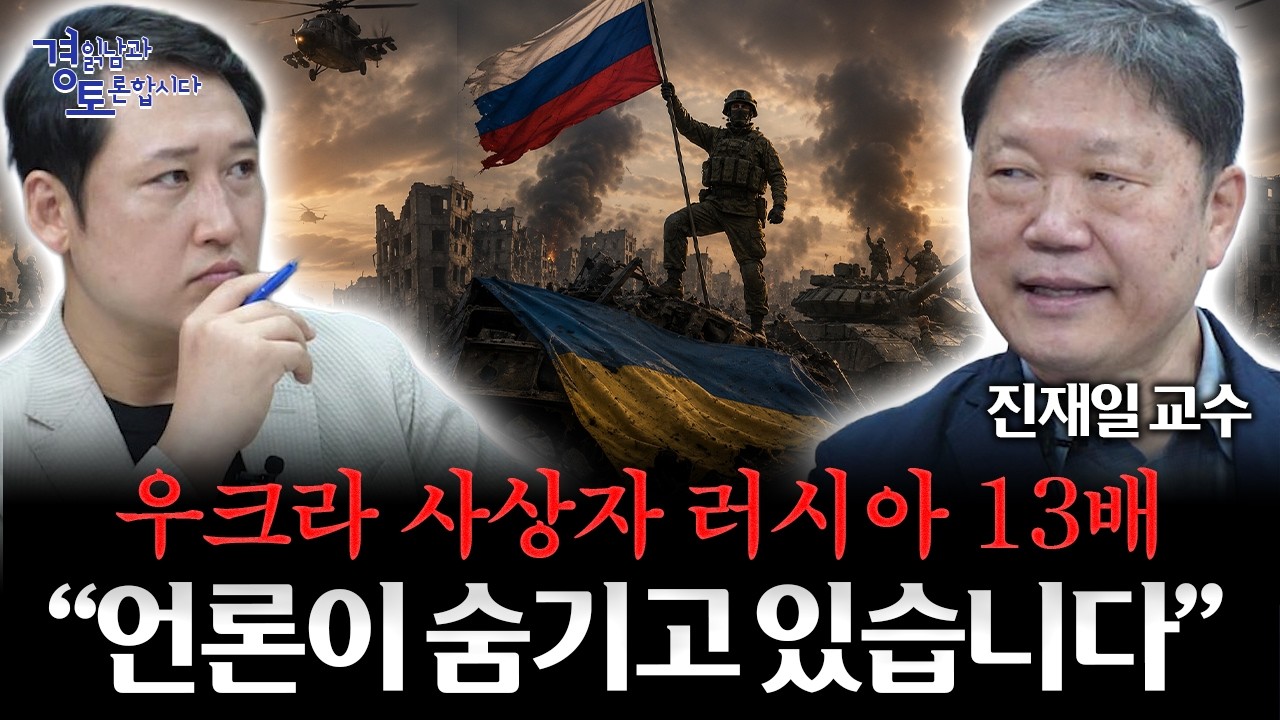
The original discussion placed strong emphasis on battlefront interpretation that is often underreported in Western media, Russia’s long-term attrition strategy, the potential for confrontation between NATO and Russia, the importance of maritime borders, and the idea that maps can help predict war.
1. The first framework for interpreting the war: “Media coverage alone is insufficient to read the battlefield”
The discussion first focused on how Western media covers the war.
Professor Jin Jae-il argued that modern media is no longer a fully neutral channel of information, but one shaped by capital and political interests.
He noted that major global outlets such as BBC, CNN, CBS, ABC, the New York Times, and the Guardian largely operate from a Western-centered perspective.
The point is not that all Western media are false, but that the selection of what is highlighted and what is minimized can shape public perception.
For example, Ukrainian drone strikes on Russian refineries or energy infrastructure are often reported prominently.
By contrast, reporting on which areas are losing ground, how casualties are accumulating, or the condition of artillery power and air defenses tends to be more limited.
In that structure, audiences are more likely to react to event-driven news than to the broader trajectory of the war.
From an economic perspective, this matters.
War coverage directly affects energy prices, commodity markets, defense industries, global supply chains, and inflation expectations.
If the battlefield is misread, investors, companies, and policymakers may under- or overestimate risk.
2. The article’s reading of the battlefield: “Russia is gradually but decisively in a stronger position”
Professor Jin characterized the current trajectory of the war as one in which Russia holds a strong advantage.
However, this should be understood as one analytical view presented in the original discussion, as wartime casualty and loss figures are difficult to verify externally because they are treated as military-security information by the parties involved.
Accordingly, readers should treat this as an interpretation rather than a confirmed fact.
The main arguments presented were fourfold.
First, there is an artillery and firepower gap.
It was argued that Russia’s artillery consumption rate is roughly five to ten times higher than Ukraine’s.
In modern warfare, the decisive factor in attrition is not drones alone, but artillery, air power, missiles, and ballistic missiles.
If one side holds a sustained advantage in firepower, the argument is that it will be better positioned in a long war.
Second, Ukraine’s air defense systems are under strain.
Ukraine’s continued requests for Patriot and other air defense systems were interpreted as evidence of a growing shortage of effective interception capability against Russian missiles and ballistic missiles.
As air defenses weaken, military facilities, drone production sites, energy infrastructure, and command-and-control systems become more vulnerable.
Third, casualty estimates were inferred from body exchange data.
The discussion referenced the exchange of bodies of the fallen between Russia and Ukraine as one basis for estimating cumulative losses, suggesting an unfavorable ratio for Ukraine.
At the same time, wartime data can be part of information warfare, and collection standards may differ, so independent verification is necessary.
Fourth, Russia’s industrial production capacity was emphasized.
The argument was that Russia has expanded production of drones, shells, and missiles and is maintaining a structure suited to prolonged war.
In this view, the war is not decided by a few advanced weapons, but by whether production lines, raw materials, logistics, manpower, and defense factories can endure.
3. Why Russia is not ending the war quickly: “It is preparing for a long confrontation with NATO”
A key question is why Russia does not end the war more quickly if it is in a stronger position.
The answer given in the discussion is that Russia is not only dealing with Ukraine, but is also accounting for the possibility of a long-term confrontation with NATO.
Russia officially refers to the war as a “special military operation.”
In the discussion, this was interpreted as indicating a phased pressure strategy rather than the full mobilization of all resources into a total war posture.
Donbas, in particular, contains mines, industrial zones, and complex defensive terrain.
From Russia’s perspective, an overly rapid push could cause heavy casualties.
Accordingly, the strategy is described as a slow advance based on artillery and drones designed to wear down defensive lines.
This structure resembles high-ground battles in the Korean War.
What appears on a map as a small territorial shift can, in practice, require substantial manpower and firepower to capture a single position.
4. Drone warfare and AI warfare: The reality of a fourth-industrial-revolution battlefield
The most visible change in the Russia-Ukraine war is the rise of drones.
The discussion emphasized Russia’s large-scale drone production capacity.
While the exact figures require independent verification, the key point is that the war has become a testing ground for drone- and AI-based warfare systems.
Drones are not merely weapons.
They are now used across reconnaissance, target identification, suicide attacks, artillery adjustment, psychological operations, and infrastructure strikes.
When combined with AI-based image recognition, automatic target tracking, electronic warfare evasion, and swarm drone technologies, the cost structure of war changes fundamentally.
In the past, the battlefield centered on aircraft and missile defense systems worth billions of won.
Now, low-cost drones priced at relatively modest levels can destroy expensive equipment or paralyze energy facilities and military infrastructure.
This shift has major implications for the defense industry.
Future global defense demand is likely to expand not only for tanks and fighter jets, but also for drones, counter-drone systems, electronic warfare equipment, AI command-and-control systems, satellite data analytics, and cybersecurity.
For Korean companies, this creates potential opportunities across defense exports, semiconductors, batteries, telecommunications equipment, and AI software.
5. The economic meaning of attacks on energy facilities: “A greater shock to market sentiment than to the frontline”
Ukrainian attacks on Russian refineries may matter more for global energy prices than for the battlefield itself.
Refineries generally have fire barriers and automatic shutdown systems, so damage to one facility does not necessarily disable the entire network permanently.
However, in the short term, disruptions in output, export delays, higher insurance costs, and increased transport expenses can occur.
Such developments can be reflected immediately in international oil and gas prices, refining margins, and freight rates.
If uncertainty over Russian crude oil and petroleum product supplies rises, energy security concerns in Europe and Asia will also intensify.
The key issue is that the scale of actual damage and the scale of market fear are not always the same.
War-related news affects supply chain restructuring and inflation expectations.
It can also indirectly influence central bank rate-cut timing, corporate cost burdens, and consumer price trends.
6. The Western dilemma: Support must continue, but public consent is weakening
The discussion argued that Western governments want to continue supporting Ukraine, but domestic political pressure is increasing.
Most aid packages must pass through parliaments and budget procedures.
Political leaders must justify military and fiscal support with taxpayer funds, which requires public persuasion.
Media coverage plays an important role in this process.
Reports of Ukrainian strikes on Russian territory, claims of heavy Russian losses, and appeals for support from President Zelensky can help justify additional aid in Western politics.
At the same time, Europe faces welfare pressures, higher medical spending, rising energy costs, refugee issues, and economic slowdown.
Political instability after Brexit in the United Kingdom, the rise of right-wing parties in Europe, and conflicts tied to the U.S. election cycle and congressional gridlock are all factors that can weaken continued support for Ukraine.
In the end, the war has become a test not only of battlefield endurance, but also of fiscal capacity and public fatigue within democratic states.
7. Maps predict war: Why geography remains central to understanding Russia, Europe, and NATO
One of the most notable statements in the discussion was that geography determines destiny, and maps can help predict war.
The conflict between Russia and Europe cannot be explained solely by the personal preferences of leaders.
Western Russia extends across vast plains.
It lacks major natural defensive barriers such as large mountain ranges or seas.
Historically, Napoleon and Hitler both invaded Russia and failed, in part because of this geography.
Russia has strategic depth, allowing it to retreat and buy time.
By contrast, Europe is a relatively compressed space with borders that meet directly, making repeated tension difficult to avoid.
From this perspective, Russia sees Ukraine not simply as a neighboring state, but as a buffer between Russia and NATO.
The West emphasizes Ukraine’s sovereignty and borders, while Russia approaches the issue through the lens of security space and historical buffers.
The clash between these two perspectives has prolonged the war.
8. The sea is the new border: Maritime power and the future of global supply chains
The discussion also emphasized the importance of maritime borders, drawing on the book Atlas of Invisible Borders.
Since the 1982 UN Convention on the Law of the Sea, the ocean has become not just open water, but a strategic space shaped by territorial waters, exclusive economic zones, seabed resources, and sea lanes.
The sea matters for three reasons.
First, it contains energy resources.
Offshore oil, natural gas, marine minerals, and rare earth resources are becoming sources of inter-state competition.
Second, it contains critical shipping routes.
The Strait of Hormuz, Bab el-Mandeb, the Strait of Malacca, and the South China Sea are essential routes for the global supply chain.
If any one of these routes is disrupted, oil, LNG, semiconductor components, grain, and container freight rates can be affected.
Third, it involves military control.
Naval power, missiles, submarines, aircraft carriers, and maritime surveillance systems effectively determine control over sea borders.
China’s nine-dash line claims in the South China Sea and its disputes with neighboring states reflect this logic.
Even if international court rulings exist, great powers may not accept them, and force remains decisive in practice.
The implication is that the international system still functions less as a fully legal order and more as a structure in which power and interests collide.
9. Are borders disappearing or strengthening? The EU and Brexit show the paradox
Another question raised in the discussion is whether borders will disappear in the future or become stronger.
The answer offered is that both trends can occur simultaneously.
Within some regions, borders may weaken, while external frontiers become more tightly controlled.
The European Union is a leading example.
Under the Schengen system, movement within the EU became freer.
However, border controls were strengthened for refugees, migrants, and security threats entering from outside.
The COVID-19 pandemic showed a similar pattern.
Countries that had long allowed free movement suddenly closed their borders.
This showed that borders had not disappeared, but remained mechanisms that could be reactivated at any time.
Brexit also illustrates the complexity of border politics.
The United Kingdom left the European Union, but subsequently faced costs in trade, labor, finance, and political stability.
The slogan of regaining borders turned into friction costs in the real economy.
10. The same logic applies to the Korean Peninsula: DMZ, Northern Limit Line, Dokdo, and Ieodo
This discussion is not limited to distant regions.
The Korean Peninsula also has complex border and maritime boundary issues.
The Demilitarized Zone, the Northern Limit Line, Dokdo, and Ieodo are all areas with latent geopolitical risk.
Korea also relies heavily on imported energy and raw materials and has an export-oriented economic structure.
The Middle East shipping lanes, the South China Sea, the Taiwan Strait, the Russia-Ukraine war, and U.S.-China tensions all directly affect the Korean economy.
Accordingly, geopolitics is not only a matter of diplomacy and security, but also a variable that affects exchange rates, trade balances, inflation, corporate earnings, and the stock market.
11. The most important point often missing from other news and YouTube commentary
The most important point is that the essence of the Russia-Ukraine war is not “battle news” but “industrial production competition.”
Much of the coverage focuses on drone strikes, explosion footage, summits, and support packages.
But the factors that determine the direction of the war are artillery production, drone production lines, missile inventories, air defense sustainability, mobilization capacity, and the ability to repair energy infrastructure.
This is especially important for readers focused on the economy.
As the war continues, defense industries, commodity markets, energy prices, global supply chains, fiscal deficits, and defense budgets move together.
In other words, the Russia-Ukraine war is not just a military issue; it is a core variable in the 2026 economic outlook.
The second key point is that the sea is the new border.
Future wars and economic shocks are more likely to emerge first in maritime transport routes than in land borders.
The Strait of Hormuz, the Strait of Malacca, Bab el-Mandeb, the South China Sea, and the Taiwan Strait are the arteries of the global economy.
If these routes are disrupted, oil and shipping costs could rise, bringing inflation back into focus.
The third key point is that AI and drones are changing the cost structure of warfare.
The shift is moving from high-cost weapons toward low-cost drones, software, data, and electronic warfare.
This could create new markets not only for defense firms, but also for semiconductors, batteries, telecommunications, cloud services, and AI companies.
12. Economic variables investors and companies should monitor
First, international oil and natural gas prices.
Attacks on Russian energy facilities, risks in Middle Eastern shipping lanes, and maritime transport disruptions could push energy prices higher.
Second, the defense industry and the drone value chain.
Drones, counter-drone systems, radar, electronic warfare, satellite communications, and AI analytics solutions are likely to remain long-term growth themes.
Third, commodities and supply chain restructuring.
As the war continues, volatility in metals, rare earths, grain, fertilizer, and energy logistics may increase.
Fourth, European fiscal and political risk.
As the burden of support for Ukraine rises, fiscal policy, welfare policy, and election outcomes across Europe may become more volatile.
Fifth, the U.S.-China power competition and maritime dominance.
Risks in the South China Sea and the Taiwan Strait are directly linked to semiconductor supply chains and the global trade order.
< Summary >
The Russia-Ukraine war is not a regional conflict alone, but a long-term geopolitical risk shaped by industrial production capacity, drone warfare, air defenses, energy infrastructure, and maritime power.
The original discussion argued that Western media coverage does not fully capture the battlefield trajectory and presented the view that Russia is gaining an advantage through a prolonged war of attrition.
The key issue is not victory in a single battle, but the ability to produce and sustain artillery, drones, missiles, and air defenses over time.
At the same time, the sea is becoming the new border, and shipping lanes and energy facilities are emerging as critical variables for the global economic outlook and inflation.
Investors and companies should therefore track the Russia-Ukraine war, the defense sector, energy prices, supply chain restructuring, and AI drone technologies together.
[Related Articles…]
*Source: [ 경제 읽어주는 남자(김광석TV) ]
– 러우전쟁, 서방 언론이 말하지 않는 진짜 전황… 지도는 전쟁을 예측한다 | 경읽남과 토론합시다 | 진재일 교수 [3편]