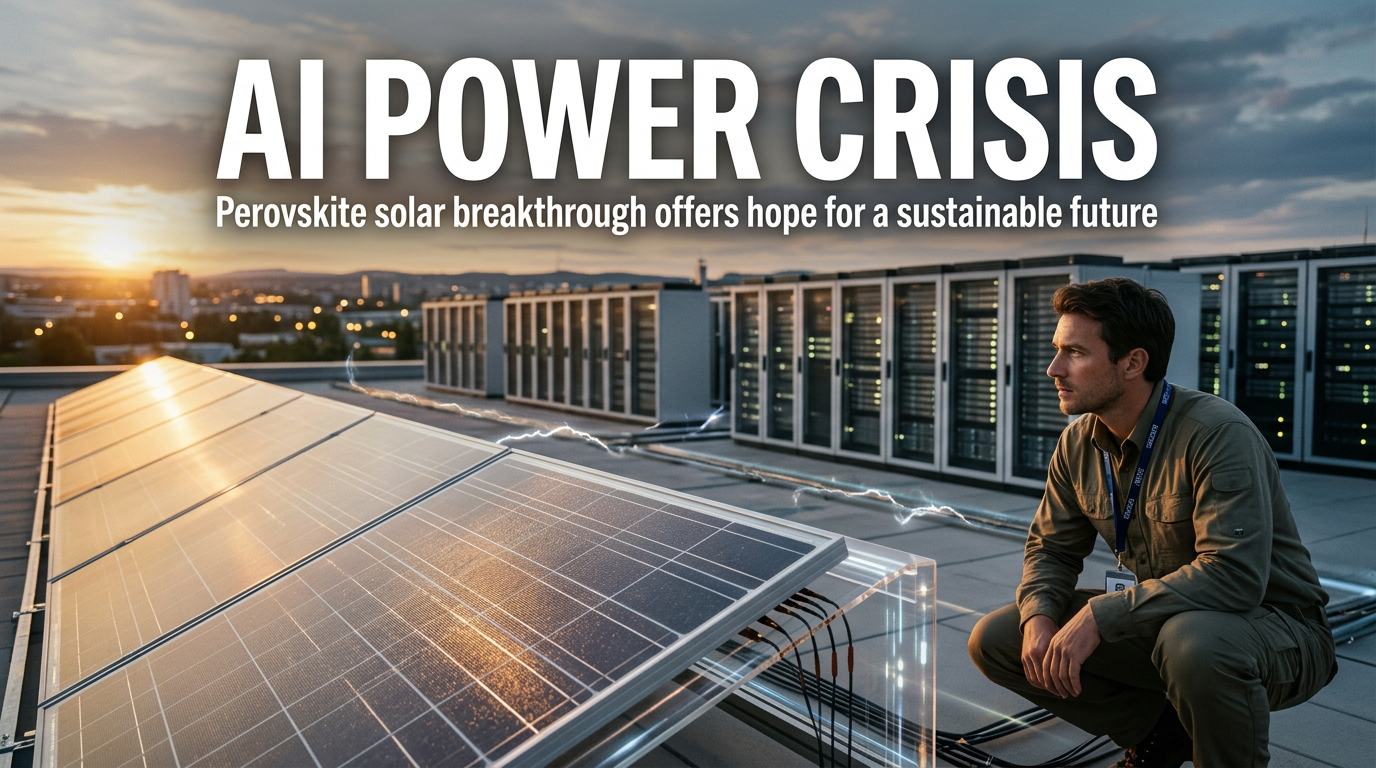
● Perovskite Solar Shock for AI Data Centers and Space Energy Dominance
Why Solid-State Perovskite Solar Cells Are Changing the Game for AI Data Centers, the Space Industry, and Energy Sovereignty
The core point of this article is not simply that “a new solar cell has arrived.”
It is a story that connects the power crunch at AI data centers, space AI data centers, satellite power supply, China’s domination of the solar industry, and Korea’s K-energy strategy all at once.
This is especially why Elon Musk cannot help but pay attention.
In space, neither coal, gas, nor wind can be used, and in the end solar cells are effectively the only energy source.
But conventional silicon solar cells are heavy and thick, which limits expansion in the space industry.
By contrast, solid-state perovskite solar cells are thin, light, and deliver overwhelmingly high power output per unit weight, emerging as a core technology that could transform the power infrastructure of the AI era.
1. Core News Summary: Why Solar Cells Again Now
As the AI era accelerates, one of the most important variables in global economic outlooks is electricity.
Generative AI such as ChatGPT, cloud infrastructure, autonomous driving, robotics, and semiconductor fabs all require enormous amounts of power.
The problem is that AI data centers must keep running 24 hours a day without stopping.
As electricity consumption surges, pressure on the power grid increases, directly affecting electricity prices and industrial competitiveness.
So AI competition is now moving beyond model performance and into a race to secure energy.
The point emphasized by Professor Emeritus Nam-Gyu Park of Sungkyunkwan University’s Department of Chemical Engineering is exactly here.
To respond to climate change, fossil fuel use must be reduced, while at the same time the power demand of AI data centers and the electric vehicle era continues to rise.
The representative renewable energy that can solve both at once is the solar cell.
Solar power has the limitation of generating electricity only during the day, but when combined with ESS energy storage systems, it can expand into a 24-hour power supply system.
2. The 70-Year History and Limits of Silicon Solar Cells
The mainstream of the current solar market is silicon solar cells.
Silicon solar cells were first announced in 1954 by Bell Labs in the United States at about 6% efficiency.
In 1958, they were installed on American satellites and used as a power source for space applications.
In the 2000s, commercialization began in earnest as prices fell and efficiency improved.
Commercial silicon solar cells currently have an efficiency of roughly 22~23%.
In laboratory settings, they have reached about 28%.
The problem is that silicon solar cells have already undergone technological development for a long time, so the room for further efficiency gains is shrinking.
Moreover, because silicon has relatively low light absorption capability, it must be made thick.
This increases weight and makes it disadvantageous in the space industry and other ultra-lightweight applications.
| Category | Silicon Solar Cell | Solid-State Perovskite Solar Cell |
|---|---|---|
| Commercialization history | Started in the 1950s, popularized in the 2000s | Rapid growth since solid-state research in 2012 |
| Commercial efficiency | About 22~23% | Reached about 28% in laboratory settings |
| Thickness | About 200~300 micrometers | About 0.8~1 micrometer |
| Weight | Relatively heavy | Very light |
| Strengths | Durability, mass-production experience | Ultra-lightweight, high efficiency, space applicability |
| Weaknesses | Efficiency limits, weight | Moisture stability, long-term durability |
3. Why Perovskite Is Fundamentally Different from Silicon
The biggest advantage of perovskite is its excellent ability to convert light into electricity.
In technical terms, this is described as having a high absorption coefficient.
According to Professor Park, the absorption coefficient of perovskite materials is about 100 times better than silicon.
Put simply, it is a material that absorbs light far more effectively.
If light is absorbed well, there is no need to make the solar cell thick.
If a silicon solar cell is about 2~3 times the thickness of a strand of hair, perovskite can function sufficiently at about one-hundredth of that.
This difference is enormously significant in the space industry.
For satellites carried on rockets, weight is directly tied to cost.
Reducing solar panel weight allows more satellites to be loaded onto the same rocket and lowers satellite operating costs as well.
Another important feature is defect tolerance.
Inside semiconductor materials, defects can occur when atoms are missing or the structure is incomplete.
In silicon, such defects hinder electron movement and reduce efficiency.
By contrast, perovskite allows electrons to move relatively well even when defects are present.
Professor Park explained it as “in silicon, electrons fall into a pothole, but in perovskite, they can pass even if there is a pothole.”
4. The Turning Point Created by Professor Nam-Gyu Park: From Liquid to Solid
Perovskite as a material itself is not newly discovered.
The name originates from the calcium titanium oxide structure discovered in the Ural Mountains in the 1800s.
The organic-inorganic halide perovskite materials used in solar cells later developed through synthesis research.
Early perovskite solar cells used liquid electrolytes.
But there was a problem.
The perovskite material dissolved easily in the liquid electrolyte.
It was similar to salt dissolving in water.
In this state, commercialization was effectively difficult.
Here, Professor Park’s research became a decisive turning point.
Instead of a liquid electrolyte, he used a solid hole conductor to realize a solid-state perovskite solar cell.
In 2012, his research team announced a solid-state perovskite solar cell with about 9.7% efficiency and 500 hours of stability.
After that, researchers around the world entered the field, and efficiency rose rapidly.
It is currently mentioned as having reached about 28% in laboratory settings.
5. The Biggest Technical Challenge Right Now: Not Efficiency, but Durability
In terms of efficiency, perovskite solar cells have already grown very rapidly.
The problem is durability.
Perovskite is weak against moisture and polar solvents.
Performance can degrade when exposed to rain or humidity.
That is why encapsulation technology, which blocks external moisture, is extremely important.
Encapsulation technologies used in the OLED display industry can also be referenced for perovskite solar cells.
Recent studies are even discussing the possibility of 10-year-level stability.
However, to become a product used for more than 20~25 years like existing silicon solar cells, much more durability verification is still needed.
The important point here is that the standard for commercialization is not simply “high efficiency.”
In the power infrastructure market, efficiency, durability, production yield, installation cost, and maintenance cost all matter.
Especially in facilities that require large-scale power, such as AI data centers or semiconductor clusters, long-term reliability becomes a key factor in investment decisions.
6. The Area Where China Is Ahead: Silicon-Perovskite Tandem Solar Cells
The country moving fastest in the commercialization race right now is China.
China has already effectively dominated the silicon solar industry.
On top of this existing foundation, it is actively developing tandem solar cells that add perovskite layers.
Tandem solar cells stack two solar cells vertically to absorb different wavelength ranges of light separately.
The top perovskite layer absorbs short wavelengths, while the lower silicon layer absorbs long wavelengths.
This makes it possible to achieve higher efficiency than a single-junction solar cell.
For example, if a silicon solar cell has about 27% efficiency, a tandem structure with perovskite on top can improve efficiency to about 35%.
In theory, efficiency in the 40% range is also within reach.
Professor Park mentioned the practical possible efficiency of silicon-perovskite tandem cells as reaching about 43%.
It is also economically attractive.
Even if adding a perovskite layer increases costs by about 15%, a roughly 30% increase in power generation can lower the overall cost of electricity.
In other words, the profitability of the solar industry itself could change.
7. Korea’s Reality: Following China’s Path Will Be Difficult
Korea has achieved world-class results in the fundamental research of solid-state perovskite solar cells.
However, its industrial ecosystem and mass-production foundation are weak.
While China is said to have more than 100 related companies in motion, Korea has very limited commercialization companies.
It is not easy for Korea to go head-to-head with China in the silicon-perovskite tandem market.
China already has strong economies of scale across silicon materials, wafers, cells, modules, equipment, and supply chains.
In the end, following the same path is likely to lose out on price competitiveness.
So the winning move proposed by Professor Park is different.
It is a strategy of making multijunction solar cells using only perovskite, without silicon.
The approach goes toward perovskite-perovskite double-junction cells and further toward 3-junction, 4-junction, 5-junction, and 6-junction multijunction structures.
In this case, simulations also mention the possibility of ultra-high efficiency in the 49~50% range.
8. Korea’s True High-Ground: Multijunction and Interface Technology
In multijunction solar cells, the key is not simply stacking more layers.
What matters is how well the interfaces between layers are controlled.
Just as in semiconductor devices people say, “A device is an interface,” in solar cells as well, the interface determines efficiency and durability.
In perovskite multijunctions, heterojunction structures are formed where different material layers meet.
At this point, an intermediate layer is needed so that the two layers adhere stably, electrons move well, and defects do not form.
This intermediate material may be organic or inorganic.
The material and process themselves can become patents.
This is exactly where Korea should make its real play.
If China pushes silicon-perovskite tandem cells through scale, Korea should move toward ultra-high-efficiency perovskite multijunctions and interface control technology.
This is why it becomes not just competition in solar modules, but a competition for core technology in the next-generation power infrastructure.
9. Why Elon Musk and Space AI Data Centers Need Perovskite
In space, there are almost no energy-source options.
Because there is no wind, wind power is impossible.
Burning fossil fuels is also unrealistic.
Batteries cannot be used independently for long periods without a charging source.
In the end, solar cells are essential for satellites, space stations, and space data centers.
The power problem becomes even more important when imagining a space AI data center.
AI computation uses enormous amounts of electricity.
To process data in Earth orbit and transmit it back to Earth, a stable power supply is necessary.
Here, the key is power output per unit weight.
According to Professor Park, if a silicon solar cell is assumed to generate 2 kW per 1 kg, perovskite could reach as much as 30 kW per 1 kg.
That means a difference of about 15 times in power output per unit weight.
Considering rocket launch costs and satellite payload capacity, this difference can completely change economic viability.
It is introduced that NASA is also conducting research to test perovskite solar cells in space environments.
The fact that performance is being evaluated favorably even in space conditions such as radiation and extreme temperature changes is extremely important.
This is why perovskite can emerge in the space industry not merely as a substitute, but as an essential technology.
10. Application Potential That Expands to Smartphones, Cars, and Buildings
Because perovskite solar cells are thin and light, they have a wide range of applications.
It is possible to coat the back of a smartphone with a thin solar film for auxiliary charging using indoor lighting or natural light.
There is also potential use in vehicle mounts, car roofs, building exteriors, window-type solar cells, drones, and wearable devices.
In particular, the fact that they can perform relatively well even under indoor lighting is an advantage that distinguishes them from existing silicon solar cells.
This feature is highly meaningful in the markets for IoT devices, sensors, smart factory equipment, and low-power devices.
The number of ultra-small, energy-independent devices that can operate without being connected to power lines may increase.
11. From the Perspective of Energy Sovereignty: In the AI Era, the Countries That Have Electricity Win
Energy sovereignty in the AI era is not simply about producing a lot of electricity.
The core of national competitiveness is whether clean power can be supplied stably, cheaply, and over the long term.
Semiconductor fabs, AI data centers, EV battery plants, and robot production facilities are all power-intensive industries.
If electricity prices are high and supply is unstable, advanced industrial competitiveness inevitably weakens.
Korea has a high dependence on energy imports.
If oil and gas supply chains are shaken by risks such as the Strait of Hormuz, the entire economy is affected.
Therefore, in the long term, renewable energy, nuclear power, ESS, grid modernization, and industrial electrification must all move together.
The direction proposed by Professor Park is the K-energy system.
It produces electricity with ultra-high-efficiency solar cells, stores it in intelligent ESS, and supplies power according to load fluctuations at AI data centers.
Excess electricity is used for industrial electrification.
If this whole system is operated through an AI digital twin, it can become an exportable energy package.
12. K-Energy Strategy: Solar Cells + ESS + Industrial Electrification + AI Digital Twin
The core point of the K-energy strategy is not to view each technology separately.
It is not enough to make only the solar cell well.
ESS alone is not enough.
Just increasing AI data centers can worsen the power shortage.
All of this must be tied together into one energy operating system.
- Ultra-high-efficiency solar cells
More electricity must be produced from a limited area through perovskite multijunction technology. - Intelligent ESS
Electricity must be supplied instantly in line with peak power demand at AI data centers, reducing pressure on the power grid. - Industrial electrification
Industrial heat that used to be produced by burning fossil fuels must be replaced with electricity to reduce carbon emissions. - AI digital twin
Generation, storage, power demand, prices, and weather conditions must be predicted and optimized in a virtual environment. - Export-type energy package
Rather than looking only at the domestic market, Korea must create solutions that can be exported to data center markets in the Middle East, Southeast Asia, Europe, and the United States.
13. The Most Important Point That Other News Stories Do Not Explain Well
Most news outlets describe perovskite simply as a “next-generation solar cell.”
But the truly important point is elsewhere.
Perovskite is not just a technology that improves solar panel efficiency; it is a strategic technology that can remove the power bottleneck of the AI era.
First, for AI data centers, electricity cost is directly tied to profitability.
Companies and countries that secure electricity cheaply and stably have an advantage in the competition for AI infrastructure.
Second, in the space industry, weight is money.
Perovskite’s ultra-lightweight characteristics improve satellite economics and the practicality of space AI data centers.
Third, China is already extremely strong in the silicon-based solar industry.
If Korea competes on price in the same way, it will be at a disadvantage.
Therefore, Korea must move toward multijunction, interface, and ultra-high-efficiency technologies.
Fourth, energy sovereignty is now a security issue.
In a structure dependent on oil and gas imports, it is hard to endure the long-term competition for AI and semiconductor supremacy.
Fifth, K-energy must be a system, not just a product.
Only by combining solar cells, ESS, industrial electrification, and AI digital twins into an exportable package can it become Korea’s new growth engine in the global economic outlook.
14. Checkpoints to Consider from an Investment and Industry Perspective
Perovskite solar cells cannot yet be considered fully mass-commercialized.
Therefore, from an investment perspective, it is better to look at technology verification and supply chain changes together rather than approach it based only on expectations.
- Durability verification
Companies that prove long-term use of more than 20 years are likely to lead the market. - Mass-production yield
What matters is not lab efficiency, but whether the product can be produced uniformly at scale in actual factories. - Dependence on China’s supply chain
Because silicon-based tandem products are likely to be linked to China’s supply chain, geopolitical risks must be considered. - Space qualification
Technologies that pass radiation, temperature change, and vacuum environment tests can move into premium markets. - AI data center linkage
Companies that provide solar power, ESS, and power management software together may receive higher valuations.
15. Conclusion: Perovskite Is Not Just a Solar Technology, but the Infrastructure Technology of the AI Economy
Solid-state perovskite solar cells are not merely a laboratory technology.
They are a core technology that cuts across the power shortage at AI data centers, growth in the space industry, energy sovereignty, expansion of renewable energy, and the restructuring of the solar industry.
China is rapidly pushing commercialization with silicon-perovskite tandem cells.
Korea must create an ultra-gap advantage through perovskite multijunction and interface technology rather than competing on price in the same way.
If this is combined with ESS, industrial electrification, and AI digital twins, Korea can create a new export industry called K-energy.
In the end, the winner in the AI era is not only the country that builds the best AI models.
The real winner is likely the country that can stably secure the electricity needed to run that AI.
Perovskite solar cells are moving to the center of that power supremacy competition.
< Summary >
Solid-state perovskite solar cells are next-generation solar cells that are thin, light, and excellent at absorbing light.
The importance of solar cells is growing due to the power shortage at AI data centers and the expansion of the space industry.
Silicon solar cells are stable, but they are heavy and have efficiency limits.
Perovskite has reached about 28% efficiency in laboratory settings, but securing long-term durability remains a challenge.
China is rapidly pulling ahead in the commercialization of silicon-perovskite tandem solar cells.
Korea should aim for an ultra-high-efficiency strategy through perovskite multijunction and interface technology.
Going forward, K-energy should become an export-oriented energy system that combines solar cells, ESS, industrial electrification, and AI digital twins.
[Related Articles…]
- Perovskite Solar Cell Commercialization and Next-Generation Energy Strategy
- AI Data Center Power Shortage and Global Power Infrastructure Investment Outlook
*Source: [ 티타임즈TV ]
– ‘고체 페로브스카이트 태양전지’ 세계적 권위자 (박남규 성균관대 교수)