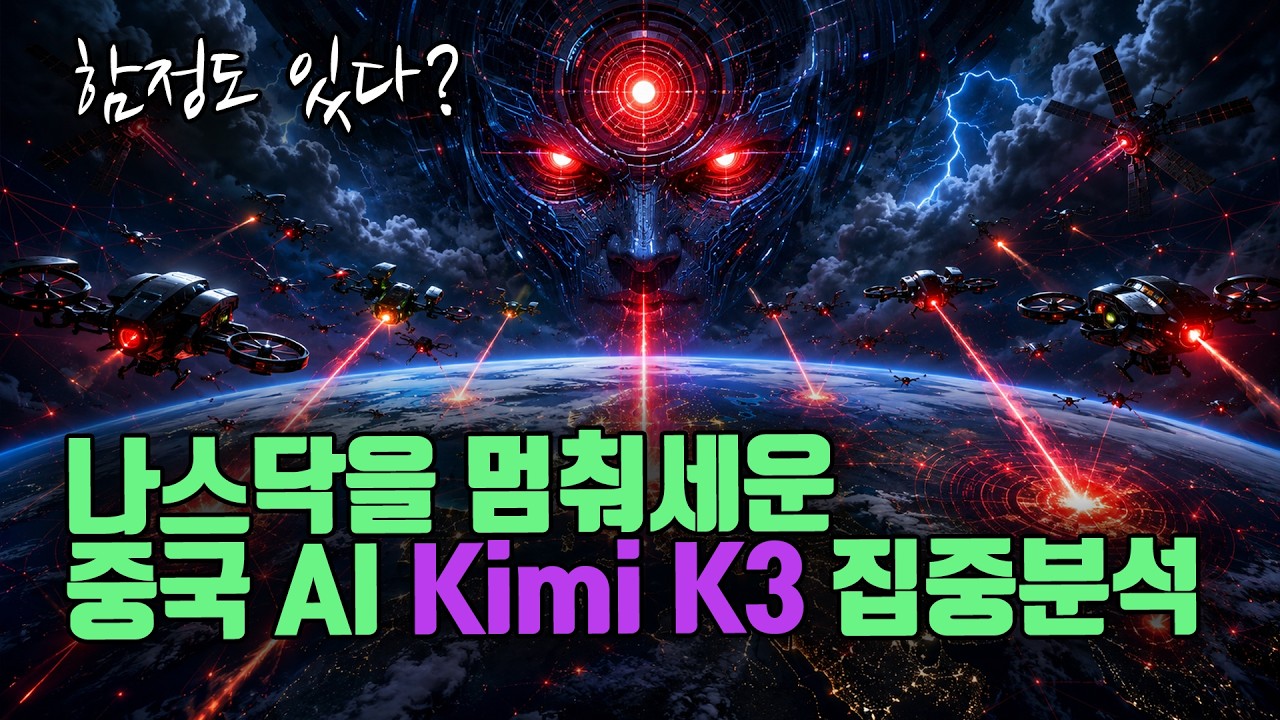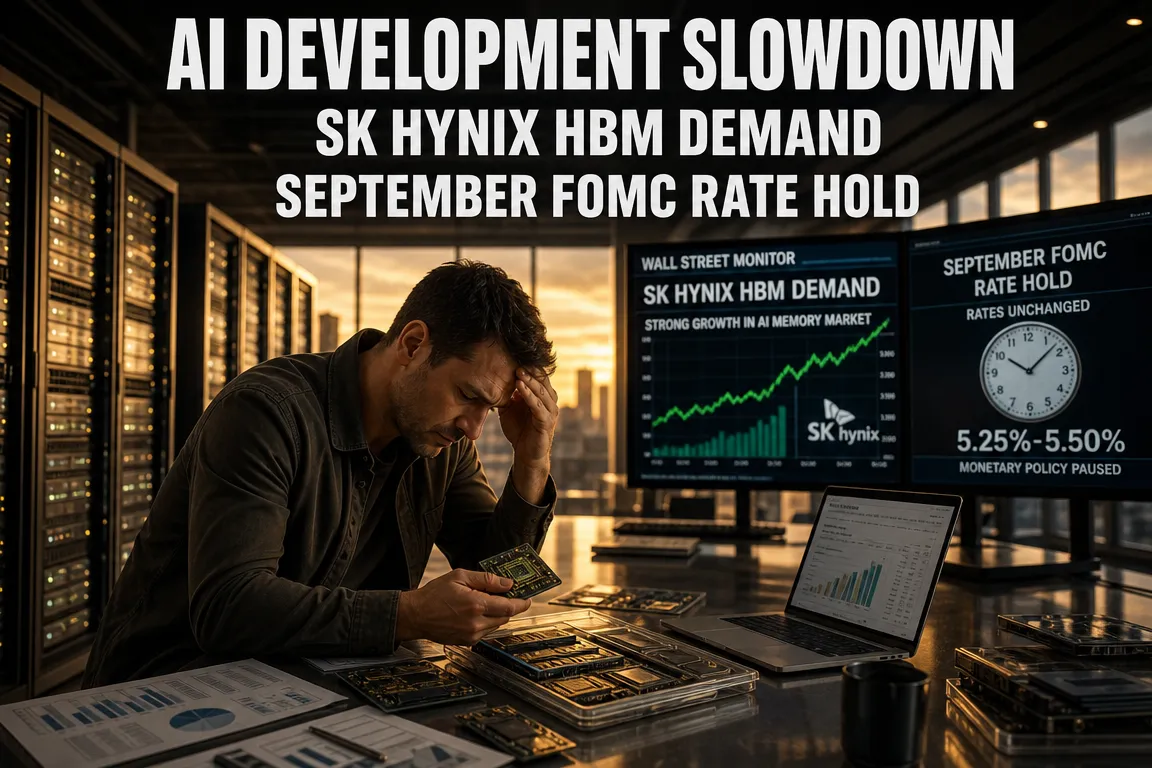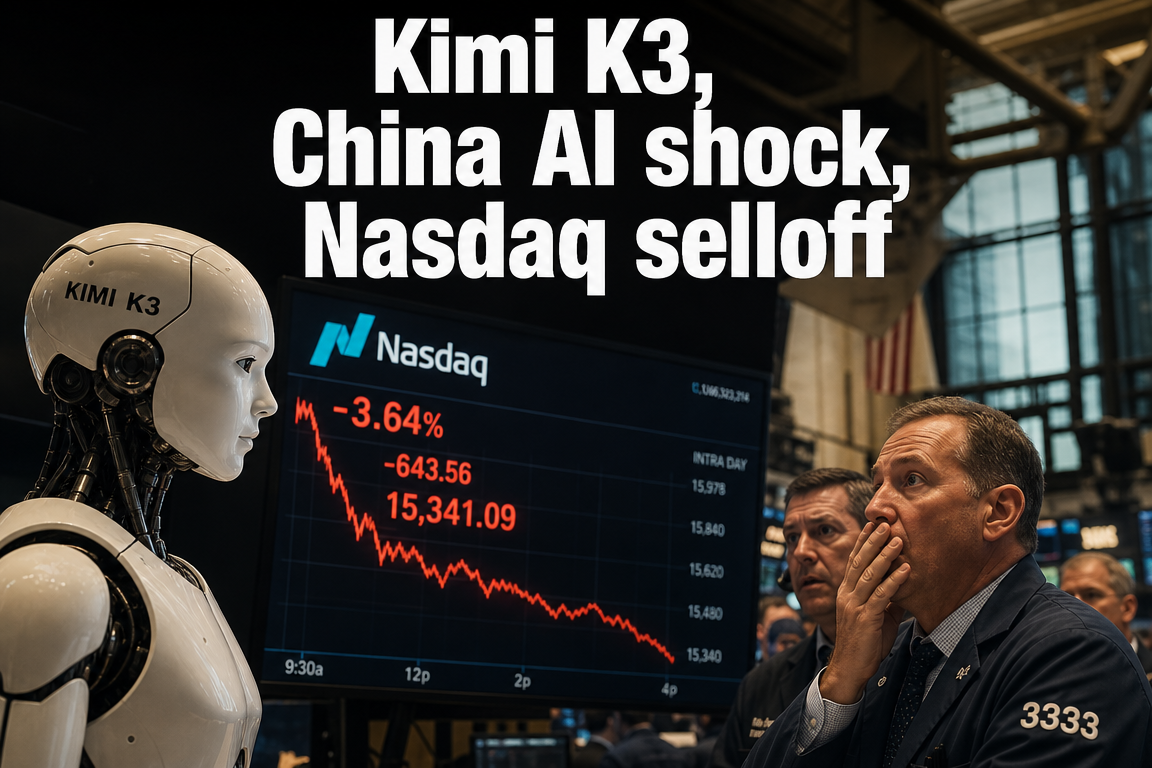
● China AI Shock, Nasdaq Jitters
Focused Analysis of China’s AI “Kimi K3” That Shook Nasdaq: DeepSeek 2.0 Shock or Overstated Reaction?
The core issue is not simply that “Chinese AI performed well.”
The reason Nasdaq moved sharply intraday, why major technology and semiconductor stocks came under simultaneous pressure, and why the market partially recovered are all linked to Kimi K3’s performance and cost structure.
One important point is that Kimi K3 is indeed a strong model, but it is difficult to conclude immediately that “low-cost Chinese AI will undermine U.S. AI infrastructure investment.”
On closer inspection, inference cost, memory usage, and AI infrastructure demand still suggest that the investment case for semiconductors and data centers has not disappeared.
1. The Starting Point for the Global Market Move: Nasdaq Decline and the China AI Shock
In the U.S. market, the Nasdaq at one point fell by more than 2% and briefly approached a 4% to 5% decline intraday.
It later trimmed losses and closed around a 1.5% decline, but the market impact was significant.
Most technology stocks were at the center of the selloff.
With the exception of Apple, major tech stocks were weak, and semiconductor names also underperformed.
By contrast, defensive sectors such as energy and healthcare held up relatively well.
As a result, the Dow was more stable than the Nasdaq.
The market interpreted this move as a “China AI shock.”
The trigger was Kimi K3 from Moonshot AI, which delivered stronger-than-expected results on major AI evaluation platforms.
This was not merely a technology headline; it affected global equities, AI investment, big tech earnings, and semiconductor valuations at the same time.
2. What Kimi K3 Is: A Frontier-Grade Model Built by Moonshot AI
Kimi K3 is a large language model developed by Moonshot AI, a Chinese startup.
Moonshot AI is not one of China’s major tech companies such as Alibaba, Tencent, ByteDance, or Baidu.
It is a startup with approximately 300 employees.
The founder is described as being born in 1992 and educated at Tsinghua University before pursuing doctoral studies at Carnegie Mellon University.
This is precisely why the market reacted strongly.
A Chinese startup with around 300 employees produced a model comparable to those developed by OpenAI, Anthropic, Google Gemini, and xAI, all of which operate with capital expenditures on the scale of tens of billions of dollars.
The fact that Chinese companies may be building competitive models with much lower AI infrastructure spending than U.S. peers increased market concern.
3. The LLM Arena Result: What “No. 1” Actually Means
One major reason Kimi K3 drew attention was its strong performance in LLM Arena.
LLM Arena is a platform where multiple AI models answer the same question and users select the better response.
It functions as a head-to-head evaluation system for AI models.
Scores are assigned based on human preference, and rankings are then formed.
Initially, Kimi K3 was highlighted as ranking first in frontend coding.
Frontend coding refers to the code used to build the user-facing part of websites and applications.
In other words, it is more accurate to say it ranked highly in a specific category rather than being the overall No. 1 coding model.
Over time, however, its overall coding ranking reportedly moved down to around the top 10.
What matters here is not only the score but also the number of votes.
Just as a restaurant can have a 5.0 rating but only 10 reviews, rankings on LLM Arena can be volatile when participation is limited.
Kimi K3’s coding-related vote count was cited at around 798.
Accordingly, it would be premature to conclude from the initial ranking alone that it has decisively outperformed U.S. frontier models.
4. Why the Market Initially Turned Risk-Averse: “If Chinese AI Is Cheaper, What Happens to U.S. AI?”
The market’s primary fear was straightforward.
If Chinese AI models can match U.S. models at much lower prices, companies may have less reason to continue using expensive U.S. AI APIs.
That could pressure the revenue expectations of the U.S. AI ecosystem, including OpenAI, Anthropic, Google, Meta, and xAI.
It could also raise concerns that spending on Nvidia GPUs, HBM memory, AI servers, and data centers has been excessive.
This led to a reaction often described as “DeepSeek 2.0.”
During the DeepSeek shock, markets were also unsettled by the possibility that China could build powerful AI models at lower cost.
Kimi K3 was received in a similar way, weighing on the Nasdaq, the Nikkei, and semiconductor-related stocks.
5. Why the Nikkei and Semiconductor Stocks Weakened: AI Capex Concern
The Nikkei also came under notable pressure.
Japanese equities have significant exposure to semiconductor equipment, materials, components, and storage-related companies.
Companies such as Kioxia were also weak, but the broader issue was concern over AI infrastructure investment.
The key question was:
If building AI models requires less capital expenditure than previously assumed, has the market overestimated the need for AI data center investment?
That question alone was enough to pressure valuations across semiconductor stocks.
After significant gains in AI storage, memory, HBM, and power infrastructure names, investors were quick to take profits on even modest doubts.
6. Why the Market Partially Recovered: Kimi K3 Was Not Cheap
Initially, the market feared that “cheap Chinese AI” could threaten U.S. AI.
However, investors later reassessed Kimi K3’s cost structure.
The conclusion was that Kimi K3 should not be viewed as a low-cost model.
Its API pricing may appear comparable to Claude Sonnet at first glance, but actual task-level costs are likely higher.
The reason is that it does not appear to dynamically control the depth of reasoning.
In simple terms, an efficient model should think briefly on simple tasks and spend more compute on complex ones. Kimi K3 appears closer to a model that reasons deeply across tasks.
That makes it expensive even for routine high-volume workloads.
As a result, the effective cost can approach that of top-tier models despite a seemingly reasonable sticker price.
This appears to have been a key factor in calming the market.
Chinese AI may be strong, but if it requires substantial compute and memory to achieve that performance, AI infrastructure demand does not disappear.
7. The Main Caveat: Strong Training Efficiency, Weaker Inference Efficiency
The most important issue surrounding Kimi K3 is the difference between training efficiency and inference efficiency.
Training efficiency means the model was built at relatively low cost during development.
Inference efficiency means the cost of generating answers for real users is low.
Kimi K3 appears impressive in training efficiency, but not equally strong in inference efficiency.
Some analysts have raised the possibility of distillation.
Distillation is a method in which a new model is trained efficiently using outputs from a stronger existing model.
In simple terms, it means using answers generated by an already capable model to train a follower model more quickly.
This cannot be confirmed as a fact.
However, if training is highly efficient but inference costs remain heavy, it may suggest not a fully independent efficiency breakthrough but rather the use of knowledge from existing frontier models.
Even so, the fact that a startup with around 300 employees built a model of this scale remains a meaningful market event.
8. Memory and AI Infrastructure: Why Semiconductor Demand Has Not Disappeared
Kimi K3 is described as a very large model.
Its parameter count has been reported at around 2.8 trillion.
A model of this scale cannot run on a consumer PC.
It likely requires high-end AI servers or supernode-level infrastructure.
GB200 NVL72-class systems were even cited as an example.
That implies equipment that may cost billions of won at minimum.
Another important point is that inference requires substantial memory usage.
Large language models depend not only on GPU compute but also on high-bandwidth memory, KV cache, network bandwidth, storage, and power efficiency.
If Kimi K3 requires high inference cost and significant memory, AI infrastructure and memory demand may remain firm.
For that reason, while semiconductor stocks initially sold off sharply, some memory-related names later held up better than expected.
The market began to shift from “better AI models mean semiconductors are no longer needed” to “serving better AI models still requires expensive infrastructure.”
9. Xi Jinping’s Attendance at the AI Conference: China Views AI as a National Security Issue
Another notable development was Chinese President Xi Jinping’s first attendance at the Shanghai World AI Conference.
The conference itself has been held before, but Xi’s direct presence was symbolically important.
It signaled that China’s leadership views AI not merely as an industrial technology but as a core element of national strategy and security.
Xi said that AI technology has entered an unprecedented phase of innovation.
Open source, AI governance, technological sovereignty, and security issues were also highlighted.
This suggests that the Chinese government may provide more support to AI startups, semiconductor self-sufficiency, data infrastructure, and the open-source ecosystem.
From an investment perspective, China’s AI development should be viewed as a structural competitive dynamic rather than a one-off event.
The U.S.-China AI rivalry is likely to remain an important source of market volatility over the long term.
10. Why Apple Overtook Nvidia to Become No. 1 in Market Cap: The “Toll Booth” Strategy in the AI Era
Another notable market shift was Apple overtaking Nvidia to once again become the world’s most valuable company.
Nvidia has been a key beneficiary of AI infrastructure spending, but it has also become highly sensitive to valuation risk and concerns over AI capex.
Apple, by contrast, has relatively low direct AI capital expenditure requirements.
Apple’s strategy has been compared to that of Standard Oil.
Rather than taking the risk of direct oil exploration, Standard Oil controlled the refining process that turned crude oil into usable products.
In other words, it captured value at the stage where all oil eventually had to pass through.
Apple’s position is similar.
Rather than spending heavily on building its own foundation model, it can secure the necessary technology through acquisitions or partnerships.
It also controls the user interface for consumers through the iPhone, iPad, Mac, App Store, and operating system ecosystem.
Ultimately, AI services need a consumer-facing channel, and Apple sits at that point of access.
In this structure, other companies bear the model-development risk while Apple can collect value as a platform toll collector.
That helps explain why the market has reassessed Apple favorably: its platform strategy requires much less capital spending.
11. The Most Important Point Missing from Many Other Reports and Videos
The real point of the Kimi K3 story is not that “Chinese AI beat U.S. AI.”
The real issue is that the winner in AI may not be the model developer.
First, building a strong model is different from monetizing it.
Even if Kimi K3 performs well, high inference costs could compress margins in large-scale commercial deployment.
The true competitiveness of an AI company is determined not only by model quality but also by token cost, inference speed, memory efficiency, server utilization, and API pricing.
Second, low training cost does not necessarily mean low service cost.
The market initially reacted as if “China can build it cheaply, so AI capex in the U.S. will collapse.”
In reality, serving large models still requires high-end GPUs, HBM, power, cooling, and network infrastructure.
This means the semiconductor cycle should not be considered finished.
Third, platform companies such as Apple may be the ultimate beneficiaries of the AI era.
AI model companies are spending heavily to compete, while platforms with consumer access can monetize the distribution of those capabilities.
From this perspective, it is important to evaluate not only Nvidia, OpenAI, and Anthropic, but also Apple, Microsoft, Google, and Amazon.
Fourth, the rise of Chinese AI is a long-duration investment variable, more important than short-term rates or cyclical growth.
The AI race can reshape data center investment, semiconductor supply chains, cloud costs, big tech earnings, and national security policy.
Accordingly, the more important issue is not short-term price action but who bears the cost and who captures the cash flow in the AI value chain.
12. What Investors Should Watch Now
First, monitor Kimi K3’s actual usage cost.
More important than benchmark rankings is how the model performs on a cost-versus-performance basis in real enterprise use.
Second, watch inference infrastructure demand.
As models like Kimi K3 spread, demand for inference GPUs, HBM, servers, and networking equipment may increase.
Third, focus on AI monetization.
The market still wants evidence that AI investment can generate real earnings.
In big tech earnings reports, investors should track AI revenue, cloud growth, and the burden of data center depreciation.
Fourth, monitor the open-source strategy of Chinese AI models.
If Kimi K3 eventually releases its full weights, the impact on the open-source ecosystem will matter.
However, the model is so large that it will not be easy for ordinary developers to run.
Fifth, evaluate platform bargaining power.
As more AI models emerge, model quality may become increasingly commoditized.
By contrast, platforms with user access and payment channels may gain more power.
13. Conclusion: Kimi K3 Is a Threat, but Not a Signal of AI Infrastructure Collapse
Kimi K3 clearly confirms the progress of China’s AI capabilities.
In particular, the fact that a startup with around 300 employees produced a model comparable to frontier systems is a warning sign for the U.S. AI ecosystem.
However, it is too early to interpret this as evidence that “China can now build everything cheaply, so AI semiconductors and data centers are finished.”
The key issue with Kimi K3 is its cost structure.
It is a powerful model, but inference costs are high, memory usage is substantial, and significant AI infrastructure may still be required for commercial deployment.
This episode is therefore better viewed as a sign that the AI industry is entering a more rigorous phase of profitability validation rather than as a burst-bubble signal.
Going forward, the market is likely to focus less on which model is smartest and more on which company can acquire users at lower cost and generate real cash flow.
Nasdaq volatility may continue, but within that volatility the market is beginning to identify the true winners across the AI value chain.
< Summary >
Moonshot AI’s Kimi K3 has shaken Nasdaq and semiconductor stocks with a strong performance.
However, it does not appear to be a cheap model in the way the market initially assumed; inference costs and memory requirements are significant.
The LLM Arena result should also be read cautiously, as initial strength in frontend coding should not be overinterpreted without considering vote counts and overall rankings.
The rise of Chinese AI is a clear competitive threat, but it does not imply an immediate collapse in AI infrastructure and semiconductor demand.
The real focus is cost structure, inference efficiency, platform control, and AI monetization.
Apple overtaking Nvidia in market capitalization also suggests that, in the AI era, platform companies with consumer access may be valued more highly than firms that directly absorb infrastructure spending.
[Related Articles…]
China’s AI Competition and Its Impact on Global Equities
AI Infrastructure and Semiconductor Cycle Investment Strategy
*Source: [ 내일은 투자왕 – 김단테 ]
– 나스닥을 멈춰세운 중국 AI 키미 K3 집중분석 (함정도 있다?)