● China-AI Shock, KOSPI Crash, Samsung, SK Hynix Slump
The Core of the China AI Shock: KOSPI Selloff, Samsung Electronics and SK Hynix Selling Pressure, and the Market’s Misread Memory Demand Paradox
The key issue is not simply that “Chinese AI performed well.”
Against the backdrop of a 4% decline in the KOSPI and a 5% drop in the KOSDAQ, Samsung Electronics and SK Hynix fell in tandem for three main reasons.
First, market commentary on China’s AI model, Kimi K3, which was viewed as approaching the performance of Claude and ChatGPT, triggered concern that GPUs and memory may become less necessary.
Second, as in the earlier DeepSeek shock, the market moved toward selling semiconductors before technical validation.
Third, geopolitical risk tied to Iran and uncertainty around the Strait of Hormuz raised oil prices, inflation concerns, and rate expectations, reinforcing risk-off sentiment.
However, the most important point is elsewhere.
If an AI such as Kimi gains adoption and user growth accelerates, AI semiconductor and memory demand may increase rather than decline.
1. Why the Market Panicked: Fear That “Chinese AI Works Well Without GPUs”
The initial driver of the selloff was the market reaction to Kimi K3.
In the source material, Kimi K3 was described as delivering performance comparable to Claude or ChatGPT.
The issue was less the model itself than the message investors inferred from it.
Investors interpreted it as evidence that future demand for high-end GPUs and advanced memory could weaken.
That interpretation was the main factor pressuring Samsung Electronics and SK Hynix.
- Improving Chinese AI performance: concern that the U.S.-centered AI dominance structure may weaken
- GPU demand slowdown fears: expectation that the AI infrastructure investment cycle led by Nvidia could cool
- Memory demand concerns: concern that HBM, DRAM, and server memory demand may be weaker than expected
- Broad semiconductor selling: concentrated selling in large-cap semiconductor stocks such as Samsung Electronics and SK Hynix
Korea’s equity market has a high semiconductor weight.
As a result, doubts about the AI investment cycle quickly undermine the broader KOSPI outlook.
When semiconductors weaken, foreign flows, the won, and sentiment toward large-cap stocks can deteriorate simultaneously.
2. Similar to the DeepSeek Shock: The Market Sells Before It Verifies
The Kimi K3 reaction followed a pattern similar to the DeepSeek shock.
When DeepSeek emerged, the market reacted in the same way.
The logic was that if high-performance AI could be built at lower cost, demand for expensive GPUs might not be as strong.
That led to a sharp short-term correction in AI semiconductor-related stocks.
The same pattern appeared again.
Before examining what infrastructure Kimi K3 actually uses, or how its training and inference costs compare, the market sold first.
The current market environment tends to react to a single uncomfortable headline with “sell first, verify later.”
This is especially true for AI-related stocks that have already risen significantly, where short-term profit-taking can intensify quickly.
- Step 1: Chinese AI model performance headline
- Step 2: Fears of weaker GPU and memory demand
- Step 3: Selling in major semiconductor names
- Step 4: Broad KOSPI and KOSDAQ decline
- Step 5: Further downside from margin and leveraged positions
The key point is that the market does not always move in the right direction first.
In the short term, prices respond more to the speed of fear than to the underlying truth.
3. Why Samsung Electronics and SK Hynix Were Hit Harder
Samsung Electronics and SK Hynix are the Korean stocks that most directly reflect sentiment on AI semiconductors.
In particular, SK Hynix has been viewed as a leading beneficiary of global AI infrastructure expansion due to its HBM competitiveness.
Samsung Electronics had also been supported by expectations for HBM recovery, memory cycle improvement, and foundry stabilization.
When the Kimi K3 issue emerged, the market asked both names the same question.
“If AI becomes more efficient, will demand for high-performance memory still be as strong as expected?”
That question immediately weighed on both Samsung Electronics and SK Hynix.
| Category | Market Concern | Impact on Stock Price |
|---|---|---|
| Samsung Electronics | HBM recovery pace and weaker memory cycle expectations | Large-cap fund outflows and added pressure on the KOSPI |
| SK Hynix | Possible slowdown in AI server HBM demand | Concentrated profit-taking in the AI semiconductor leader |
| KOSPI | High semiconductor weight creates index-level shock | Foreign selling and weaker sentiment |
| KOSDAQ | Risk-off behavior in growth and theme stocks | Deeper losses and higher volatility |
In Korea, semiconductors are not just another sector.
They are a core driver of foreign flows, the won, export expectations, and corporate earnings outlook.
Accordingly, semiconductor weakness quickly becomes a broader KOSPI concern.
4. Iran Risk and the Strait of Hormuz: Oil Fears Added to the AI Shock
This correction cannot be explained by the AI issue alone.
The source also referenced geopolitical risk involving Iran.
As tensions between the U.S. and Iran continue, concern over the Strait of Hormuz quickly raises oil market sensitivity.
The Strait of Hormuz is a critical route for global crude transportation.
Any disruption there can push up international oil prices.
Higher oil prices can reignite inflation concerns.
Inflation pressure can weaken expectations for rate cuts.
Weaker rate-cut expectations tend to compress growth and technology valuations.
- Escalation in Hormuz risk → crude supply concerns
- Higher international oil prices → rising inflation pressure
- Inflation reacceleration → weaker rate-cut expectations
- Higher rate burden → correction in growth and technology stocks
- Risk-off sentiment → broad weakness in KOSPI and KOSDAQ
In effect, the market faced both an AI shock and a geopolitical shock at the same time.
One side raised concerns about semiconductor demand, while the other raised concerns about oil and inflation.
That combination is one of the most difficult environments for investors.
5. The Market Missed the Key Point: Stronger Kimi Adoption Could Increase Memory Demand
This is the most important point.
Most reports stop at “Chinese AI emerges, GPU demand may fall, semiconductor stocks decline.”
But the real issue comes next.
If Kimi K3 or a similar AI service gains popularity and user growth accelerates, inference infrastructure demand could rise sharply.
AI models do not consume GPU and memory only during training.
Every time a user asks a question, generates a response, or processes an image or code, inference computation occurs.
That inference layer also requires GPUs, servers, memory, and network equipment.
The source includes a key hint.
Reports that Kimi is experiencing heavy user traffic and has stopped accepting new sign-ups suggest that demand may be outpacing infrastructure capacity.
If that is the case, the real takeaway is not that memory is becoming unnecessary, but that service demand is scaling faster than supply.
- AI model training: requires large amounts of GPUs and HBM upfront
- AI service operation: rising users increase the need for inference servers and memory
- Traffic surge: sign-up restrictions may signal infrastructure constraints
- Chinese AI expansion: potential increase in cloud, server, and memory procurement
- Long-term demand: broader AI adoption can expand semiconductor demand
In other words, greater AI efficiency does not automatically reduce semiconductor demand.
Lower AI costs may instead accelerate adoption and usage.
As usage expands, total infrastructure demand can rise again.
This is the memory-demand paradox the market is missing during the current panic.
6. The Less Discussed But More Important Point: Inference Demand Is Becoming More Important Than Training Demand
When analyzing the AI semiconductor market, the focus can no longer be limited to how much GPU capacity is needed to train large models.
The more important question going forward is how much server capacity is required when hundreds of millions of users interact with AI every day.
The initial AI investment cycle was training-driven.
Building large language models required massive GPU clusters and HBM supply.
That is why the market viewed companies such as Nvidia, TSMC, SK Hynix, and Samsung Electronics as beneficiaries of AI infrastructure investment.
As AI expands into real services, the center of gravity shifts toward inference.
Chatbots, search, coding, advertising, e-commerce, gaming, finance, healthcare, and manufacturing automation all generate recurring inference demand.
In that phase, model efficiency can actually increase total demand.
- Lower model cost → more companies adopt AI
- Lower response cost → users interact more frequently
- Broader service adoption → higher inference traffic
- Higher traffic → more servers, GPUs, and memory required
- Ultimately → continued expansion in semiconductor demand
From this perspective, Kimi K3 is both a short-term negative and a potential long-term positive for the semiconductor market.
It creates short-term fears about AI efficiency, while also demonstrating that AI demand is broadening.
7. Key Checkpoints for Korean Semiconductor Investors
To determine whether this decline is an overreaction or the start of a broader trend, investors should monitor several indicators.
Rather than assuming a rebound simply because prices have fallen sharply, demand, pricing, and flows should be checked together.
Checkpoint 1. HBM Prices and Order Flow
HBM demand is the most important variable for SK Hynix and Samsung Electronics.
Even if AI efficiency concerns remain, the short-term fear should ease if HBM orders from major cloud and technology companies are sustained.
By contrast, if HBM capacity expansion becomes excessive and pricing power weakens, a recovery in share prices may take longer.
Checkpoint 2. Server Expansion by Chinese AI Companies
If usage of Chinese AI services such as Kimi continues to rise, server and memory demand in China may increase.
Investors should track how aggressively Chinese companies seek GPUs, ASICs, server DRAM, HBM, and high-capacity SSDs.
Stronger Chinese AI adoption may increase memory demand rather than reduce it.
Checkpoint 3. Nvidia and Global AI Infrastructure Investment
The direction of the global AI cycle remains anchored in Nvidia earnings and cloud capex plans.
If Microsoft, Google, Amazon, and Meta continue investing in AI data centers, the broader semiconductor investment thesis remains intact.
Checkpoint 4. International Oil Prices and Inflation
If geopolitical risk pushes up oil prices, recovery in technology stocks may remain limited.
Higher inflation pressure can reduce rate-cut expectations and weigh on growth valuations.
Accordingly, oil prices should be monitored alongside the AI narrative.
Checkpoint 5. Foreign Flows and Exchange Rates
Foreign flows are critical for the KOSPI outlook.
If foreign investors continue selling large-cap semiconductor stocks, index recovery may remain limited.
Conversely, if foreign selling slows and the won stabilizes after the decline, a technical rebound becomes more likely.
8. Is a Rebound Possible After the Sharp Decline?
The source suggests that the scale of the decline may justify at least a short-term rebound.
A 4% fall in the KOSPI and a 5% drop in the KOSDAQ can be interpreted as an oversold condition.
In particular, highly liquid names such as Samsung Electronics and SK Hynix often rebound technically after sharp declines.
However, a rebound does not necessarily mean the trend has reversed.
The quality of the rebound matters.
A recovery on lower trading volume may be only a tactical bounce.
By contrast, a rebound supported by foreign buying, improving semiconductor fundamentals, and confirmation of continued AI infrastructure spending would be more durable.
- Short-term rebound potential: possible after an oversold move
- Condition for trend recovery: easing of AI memory demand concerns
- Key variables: HBM orders, foreign flows, and oil stability
- Risk factor: continued volatility if margin and leveraged selling persist
9. Investment View: Is This a Time to Buy Fear or Avoid Risk?
The market is highly sensitive at present.
Given the strong AI investment narrative, disappointment triggers exaggerated reactions.
Accordingly, investors should avoid both indiscriminate buying and indiscriminate selling, and instead approach the market through scenarios.
| Scenario | Key Condition | Market Impact |
|---|---|---|
| Positive | Kimi user growth translates into inference infrastructure demand | Potential recovery in semiconductor shares |
| Neutral | AI efficiency concerns and memory demand expectations remain mixed | Range-bound volatility |
| Negative | HBM orders slow, oil rises sharply, foreign selling continues | Further KOSPI correction possible |
For individual investors, Samsung Electronics and SK Hynix should not be treated as a single homogeneous semiconductor trade.
SK Hynix is primarily driven by HBM demand and customer concentration.
Samsung Electronics must be assessed based on HBM competitiveness, the conventional memory cycle, and foundry recovery.
The broader KOSPI is also highly sensitive to foreign flows and the currency outlook.
10. Conclusion: The China AI Shock May Be a Signal of Changing AI Demand Structure, Not the End of Semiconductors
This China AI shock should not be interpreted simply as a negative event for semiconductors.
If Kimi K3 is genuinely a high-performance AI model and user growth is accelerating, it may indicate that AI adoption is expanding faster.
As AI becomes more widely used, inference demand is likely to become more important than training demand.
That shift would eventually support additional spending on servers, GPUs, memory, and data centers.
In the short term, the market does not evaluate such structural changes calmly.
Current price action reflects a tendency to sell first and interpret later.
That is why the KOSPI, KOSDAQ, Samsung Electronics, and SK Hynix all fell sharply at the same time.
However, the key long-term question is straightforward.
Does AI efficiency lead to a world that needs less semiconductors, or does AI usage growth create a world that needs more infrastructure?
At present, the latter remains a credible outcome.
For that reason, this correction is better understood not as a definitive demand collapse, but as a signal that AI semiconductor demand is shifting from training-led to inference-led growth.
< Summary >
Kimi K3, a Chinese AI model, triggered a sharp decline in the KOSPI and KOSDAQ, with heavy pressure on Samsung Electronics and SK Hynix.
The market reacted to fears that more capable AI may require less GPU and memory capacity.
Geopolitical risk involving Iran and the Strait of Hormuz added oil, inflation, and rate concerns.
However, if Kimi usage is rising rapidly and new sign-ups are restricted, inference infrastructure and memory demand may increase instead.
The key issue is the structural shift in AI semiconductor demand from training toward inference.
Short-term volatility remains high, but AI adoption could ultimately create new demand for semiconductors.
[Related Articles…]
- AI Semiconductor Outlook and Memory Demand Shifts
- KOSPI Outlook and Samsung Electronics and SK Hynix Strategy
*Source: [ 내일은 투자왕 – 김단테 ]
– 중국 AI 쇼크의 진실 #코스피 #삼성전자 #하이닉스
● Won-Dollar Reversal, August Shock, Rate Gap Tightens
2026 KRW/USD Outlook: Why a Reversal in the Exchange Rate Could Materialize After August
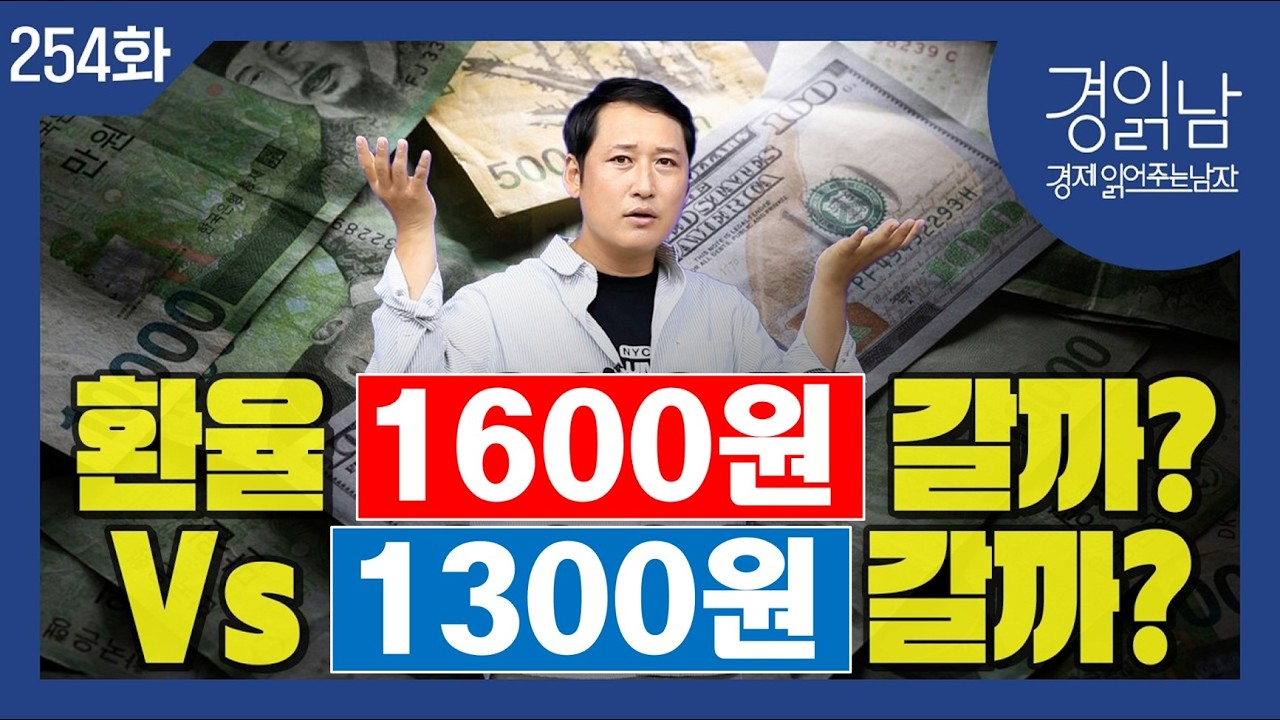
The key issue in this exchange-rate outlook is not simply whether the rate reaches 1,600 or returns to 1,300.
The core question is why the won has weakened even as the dollar index has declined.
The main focus is whether, after August, a simultaneous shift in the U.S.-Korea policy rate gap, M2 liquidity, foreign capital flows, semiconductor exports, and South Korea’s growth outlook could stabilize the KRW/USD rate in the low-1,400 range.
An especially important factor, often overlooked in other reports, is when exporters begin converting U.S. dollar revenues back into won.
This may become the trigger for a genuine exchange-rate reversal.
1. Why the Current Exchange Rate Is Unusual
The current KRW/USD trend is different from the patterns seen during the Asian financial crisis or the 2008 global financial crisis.
In those episodes, the exchange rate spiked sharply and then retreated in a pronounced spike-and-reversal pattern.
By contrast, the current market is not showing a clear crisis shock, but rather a structurally elevated exchange rate.
- Past crises: The exchange rate surged because an external crisis had occurred.
- Current environment: The exchange rate remains elevated despite the absence of a clear foreign-exchange crisis.
- Core issue: The dollar is weakening, yet the won is also weakening.
Normally, a decline in the dollar index implies a weaker dollar.
In that case, the won should strengthen relatively, and the KRW/USD rate should decline.
However, recent market behavior has shown the dollar index falling while the KRW/USD rate has remained high or moved higher.
This suggests a break in the usual correlation between the dollar and the won, rather than a routine currency fluctuation.
2. Exchange Rates Are Not Driven by Interest Rates Alone
An exchange rate is the price of one currency relative to another.
The KRW/USD rate is the price of the won against the dollar.
That means the won is influenced by Korea’s interest rates, inflation, exports, current account balance, capital flows, and policy credibility.
The dollar is influenced by U.S. policy rates, inflation, fiscal policy, liquidity, the dollar index, and global demand for safe assets.
In addition, movements in the yen, euro, pound, and Swiss franc also affect the dollar index.
Accordingly, the KRW/USD rate cannot be understood by looking only at Korea or only at the United States.
It must be analyzed in the context of Japanese rates, European inflation, U.S. fiscal deficits, and global liquidity conditions.
That is why no exchange-rate forecast can be perfectly accurate.
The difference lies in which variables are given the greatest weight.
3. Why Official Intervention Did Not Fully Stabilize the Won
Authorities have intervened actively in the foreign-exchange market to defend the won.
According to the source text, there was roughly $20 billion in net dollar sales intervention in Q4 2025, followed by about $13.6 billion in Q1 2026.
Even so, the exchange rate did not stabilize easily.
- The exchange rate did not rise because authorities were inactive.
- Large-scale dollar sales intervention had only limited impact.
- This indicates that downward pressure on the won was structurally strong.
This suggests that the market is reflecting deeper forces than short-term supply and demand.
These likely include interest-rate differentials, liquidity differentials, foreign capital outflows, delayed exporter conversion, and increased overseas investment.
4. Reversal Factor 1 After August: Narrowing U.S.-Korea Policy Rate Differentials
The first reversal factor is the interest-rate gap between Korea and the United States.
The base case in the source text assumes that the U.S. will keep rates unchanged through the second half of 2026, while Korea still retains room for additional rate hikes.
If U.S. rates remain unchanged while Korea tightens further, the rate differential will narrow.
A narrower differential improves the relative attractiveness of won-denominated assets.
This would support KRW stability.
- United States: High probability of policy-rate hold.
- Korea: Additional tightening remains possible for inflation and FX stabilization.
- FX impact: Narrower rate differentials are positive for the won.
However, policy rates alone cannot explain exchange-rate movements.
Even when the U.S.-Korea rate gap has remained unchanged in the past, the KRW/USD rate has varied materially.
In other words, rates matter, but they are not the sole driver.
5. Reversal Factor 2 After August: Relative M2 Liquidity Momentum
The second key variable is liquidity.
In simple terms, this is how rapidly money is being created.
The growth rate of broad money supply, M2, can be used to compare liquidity conditions in Korea and the United States.
Until recently, Korea’s M2 growth rate was higher than that of the United States.
When Korean liquidity expands faster than U.S. liquidity, the won can weaken more sharply.
In that case, more won is required to buy dollars, pushing the KRW/USD rate higher.
The most important point in the source text is what happens after August.
Korea’s M2 growth may slow or remain stable, while the United States may expand liquidity more aggressively ahead of the midterm election cycle.
- First half: Korea’s M2 growth outpaced the U.S., adding pressure to the won.
- After August: U.S. liquidity growth may accelerate relative to Korea.
- FX impact: Faster U.S. dollar liquidity growth could weaken the dollar and support KRW stabilization.
This is not simply a matter of Korea printing more money.
In foreign exchange, the relative pace of money supply growth matters more than absolute liquidity levels.
6. Reversal Factor 3 After August: U.S. Political Cycle and Dollar Liquidity
The source text also treats the U.S. political calendar in the second half of 2026 as an important variable.
If the Trump administration enters a midterm-election phase, it may pursue policies favorable to growth and asset markets.
In particular, the text interprets the debt-ceiling expansion as creating room for larger liquidity provision.
If the U.S. increases fiscal support and liquidity, the dollar could weaken.
A weaker dollar would place downward pressure on the KRW/USD rate.
This is an often-overlooked point in exchange-rate analysis.
The U.S. election cycle can influence not only equities, but also dollar liquidity and FX direction.
7. Reversal Factor 4 After August: Slowing Foreign Selling
Another factor that has supported the rise in the KRW/USD rate is foreign selling of Korean equities.
When foreign investors sell KOSPI holdings and convert proceeds into dollars, pressure on the won increases.
The source text notes that foreign ownership of Korean equities is near historical lows.
While further declines are possible, the magnitude of additional selling may be limited because much of the reduction has already occurred.
- Foreign net selling has been a negative factor for the won.
- If selling is already extensive, the incremental pressure may diminish.
- A return to foreign net buying would support KRW stability.
By contrast, retail investment in U.S. equities may rise again in the second half of the year.
When individuals increase U.S. equity purchases, dollar demand rises, which can offset downward pressure on the KRW/USD rate.
Accordingly, foreign inflows and retail overseas investment may exert opposite effects on the exchange rate.
8. Reversal Factor 5 After August: Improvement in Korea’s Economic Fundamentals
The most structural exchange-rate driver is ultimately Korea’s macroeconomic fundamentals.
If exports improve, the current account remains in surplus, and growth expectations rise, the won can strengthen.
The source text emphasizes semiconductor exports as the key driver of improvement.
In particular, D-RAM revenue forecasts continue to be revised upward, and AI hardware demand is viewed as supportive for Korea’s economy.
- Semiconductor strength: A major driver of aggregate growth.
- Current account surplus: Supports foreign-exchange inflows.
- IMF growth revision: Signals improving fundamentals.
- AI hardware exports: Direct beneficiary of the global AI investment cycle.
There are still limitations.
The recovery is concentrated in semiconductors.
Not all sectors have recovered equally.
Domestic demand remains weak, industrial dispersion persists, and SME conditions are still soft.
Even so, Korea’s aggregate outlook for 2026 appears better than in 2025.
That can still support a stronger won over time.
9. The Key Factor Often Missed by the Market: Corporate Dollar Conversion Timing
The most overlooked factor in media coverage is the timing of exporters’ currency conversion.
Korean exporters earn U.S. dollars overseas.
When they expect the exchange rate to keep rising, they delay converting those dollars into won.
They prefer to hold dollars for longer.
Once there are clear signs that the exchange rate is peaking, the behavior changes.
Companies may try to convert dollars into won before the window closes.
That creates simultaneous dollar selling and won buying, which can strengthen the won quickly.
- Strong exports alone may not immediately lower the exchange rate.
- Corporate conversion is needed for a meaningful won-strengthening effect.
- If expectations turn toward lower FX levels, exporter conversion can trigger a reversal.
In other words, the current account surplus is already a favorable fundamental.
But for it to be reflected in FX, corporate sentiment toward dollar holdings must change.
10. Reversal Factor 6 After August: Domestic Mega Projects and AI Investment
The source text also identifies large-scale capital spending and construction investment in Korea as supportive for the won.
Investment in semiconductor production sites, AI data centers, R&D centers, materials, components and equipment, and physical AI ecosystems could raise productivity.
Large investment projects do more than support construction activity.
They can attract domestic and foreign capital and position Korea as a core hub in the AI hardware and semiconductor value chain.
- Semiconductor production sites: Improve export competitiveness.
- AI data centers: Increase demand for power, cooling, servers, and semiconductors.
- R&D investment: Strengthens the high-value-added industrial base.
- Physical AI: Expands robotics, autonomous driving, and manufacturing automation ecosystems.
If these investments materialize, Korea’s growth outlook can improve and confidence in won-denominated assets can strengthen.
Over the medium term, this would support a more stable exchange rate.
11. Reversal Factor 7 After August: FDI Inflows and Slower Capital Outflows
To stabilize the exchange rate structurally, more capital must flow into Korea.
Here, FDI is important.
FDI refers to foreign direct investment.
When foreign direct investment flows into Korea, demand for the won increases.
By contrast, when Korean companies invest heavily overseas, won depreciation pressure rises.
- FDI inflow: Capital invested by foreign companies in Korea.
- FDI outflow: Capital invested by Korean companies overseas.
- FX stabilization condition: Inflows should rise while outflows moderate.
If AI data centers, semiconductor clusters, and physical AI ecosystems are built in Korea, foreign companies will have stronger incentives to establish production and R&D bases there.
That would increase FDI inflows and support the won.
12. Base Case for the Second Half of 2026
The base case in the source text is a gradual stabilization of the KRW/USD rate in the second half of 2026.
Absent a major external shock, the exchange rate may trend toward the low-1,400 range.
- Base case: Stabilization in the low-1,400 range.
- Bullish case: A combination of foreign net buying, corporate conversion, and U.S. liquidity expansion could support a move into the 1,300 range.
- Bearish case: Escalation in the Middle East, a global shock, a surge in commodity prices, or stronger retail overseas investment could push the rate back above 1,500.
- Extreme case: A financial-market shock or geopolitical escalation could not fully rule out a move toward 1,600.
The important point is that the exchange rate will not move in only one direction.
Volatility may remain high in the near term.
However, if rate differentials narrow, U.S. liquidity expands, and Korea’s fundamentals improve at the same time, the second half of the year could shift toward stabilization.
13. What Investors and Companies Should Monitor
To assess the exchange-rate outlook directly, the following indicators should be tracked:
- Dollar index: Whether the dollar is strengthening or weakening.
- U.S.-Korea policy rate gap: Whether policy divergence is widening or narrowing.
- M2 growth rate: Which country is seeing faster liquidity expansion.
- Foreign net buying in KOSPI: Whether foreign capital is returning to Korea.
- Retail overseas investment: Whether it is increasing dollar demand.
- Current account and exports: How many dollars Korea is earning.
- Corporate FX conversion: Whether exporters begin converting dollars into won.
- Semiconductor exports and AI investment: The durability of Korea’s improving fundamentals.
For companies, holding dollars simply because the exchange rate is high is not always optimal.
When signs of FX weakness emerge, hedging and conversion timing should be reviewed.
For individual investors, U.S. equity returns should be evaluated together with the exchange rate.
Even if U.S. stocks rise, a sharp decline in the KRW/USD rate can reduce returns in won terms.
14. Conclusion: The Key to a Reversal After August Is Relative Speed
The central issue in the 2026 FX outlook is not the absolute level, but the relative speed of change.
What matters is which country is expanding liquidity faster, which central bank is moving faster, and where capital is moving more quickly.
In the first half of the year, Korea’s faster liquidity expansion, foreign selling, and exporter dollar retention supported won weakness.
In the second half, however, U.S. liquidity expansion, narrowing policy-rate gaps, slower foreign selling, strong semiconductor exports, and AI-related investment could stabilize the KRW/USD rate.
The most important reversal signal is corporate dollar conversion.
Once exporters conclude that further upside in the exchange rate is limited, dollar sales and won purchases may accelerate.
At that point, the exchange-rate trend could change faster than expected.
< Summary >
The KRW/USD rate may stabilize in the second half of 2026, particularly after August.
Key supporting factors include narrower U.S.-Korea policy-rate differentials, faster U.S. M2 growth, slower foreign selling, stronger semiconductor exports, and expanded investment in AI data centers and major domestic projects.
The most important hidden variable is the timing of exporters’ dollar conversion.
If companies begin converting dollars into won, the won could strengthen quickly.
Absent major geopolitical shocks, the exchange rate may move toward the low-1,400 range.
[Related Articles…]
*Source: [ 경제 읽어주는 남자(김광석TV) ]
– 2026년 환율 전망 : 8월 이후 반전 올까? [경읽남 254화]