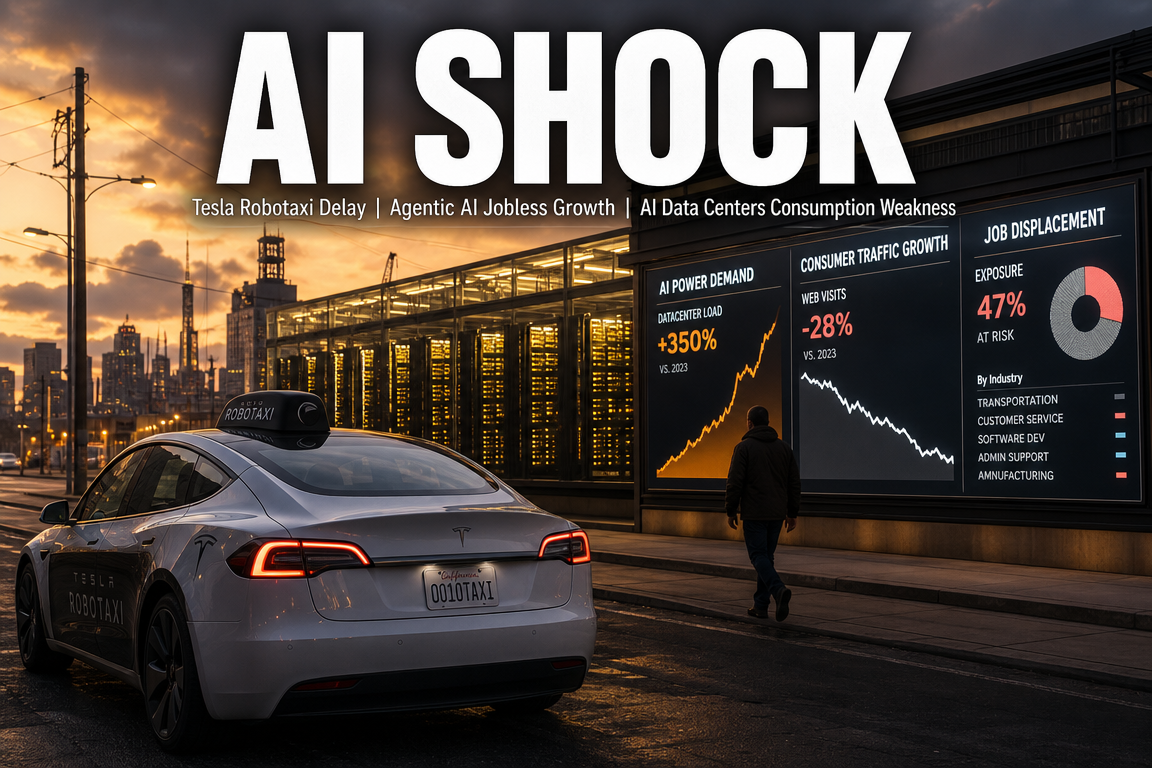
● Tesla, Stock, Slides, RoboTaxi, Miss, Sparks, Fury
Tesla Shares Fall to the $369 Range as Investors Focus on Missed Robotaxi Execution Rather Than Earnings
The key issue in this Tesla earnings release is not a single revenue figure.
The main concern is that Tesla has missed its near-term robotaxi targets for three consecutive quarters.
Investor questions also centered on why promised robotaxi expansion continues to be delayed.
At the same time, rising crude oil prices, fading expectations for U.S. rate cuts, broader technology sector volatility, bearish options positioning, and Alphabet’s earnings release have made sentiment around Tesla more fragile.
This is not simply a Tesla story. It is an issue that connects global macroeconomic outlook, AI investment sentiment, autonomous driving regulatory risk, and robotics valuation.
1. Market backdrop: the pressure is broader than Tesla alone
Tesla closed at 369.57 dollars in the original reference, down about 2.96% on the day.
SpaceX-related shares were also cited at around 119.85 dollars, down about 3.34%.
Although this appears to be a Tesla-specific setback, the broader market context is also weighing on sentiment.
-
Brent crude rose above 90 dollars per barrel as tensions between the U.S. and Iran intensified.
Higher oil prices are reviving inflation concerns.
-
The Nasdaq fell about 2.9% over the week, the largest decline among the three major U.S. indexes.
This signals weakening appetite for growth and technology stocks.
-
The S&P 500, Nasdaq, and Dow Jones all traded lower.
This reflects a broader shift toward risk aversion.
The most important point is that higher oil prices weaken expectations for U.S. rate cuts.
If inflation reaccelerates, the Federal Reserve may find it harder to lower rates quickly.
Some parts of the market may even start discussing renewed tightening risk.
In this environment, Tesla is under greater pressure because much of its valuation depends on future growth expectations.
2. This week’s earnings setup: Tesla and Alphabet face the market at the same time
According to the original reference, Tesla and Alphabet were both scheduled to report second-quarter results on July 22 U.S. time.
The fact that both companies report on the same day is meaningful for the market.
Alphabet must demonstrate strength across AI, cloud, and search advertising.
Tesla must validate not only vehicle sales, but also the credibility of its robotaxi and Optimus businesses.
-
Alphabet has established cash-generating businesses in search advertising and cloud.
Even if AI spending ramps more slowly, those businesses provide support.
-
Tesla cannot easily justify its valuation through automotive earnings alone.
Its stock is heavily supported by expectations for autonomous driving, robotaxi, and humanoid robotics.
That distinction matters.
For Alphabet, the question is whether it is executing on AI effectively.
For Tesla, the question is whether it is delivering on the future it has described.
As a result, this earnings release is effectively a credibility test for Tesla.
3. SpaceX-related risk: Starship, earnings, and lockup dynamics increase Musk-related pressure
The original reference also highlighted SpaceX-related developments.
Starship Flight 13 was scheduled for July 23 U.S. time.
SpaceX’s first quarterly earnings webcast was expected on August 4.
A key market focus is the large lockup expiration after the earnings event.
According to the original reference, as much as 20% of outstanding shares, or up to 911.5 million shares, could become eligible for sale.
At the current price, that was described as roughly 19.2 billion dollars.
Such a large potential supply increase could raise short-term volatility.
The original reference also noted that an additional 10% of shares would remain locked if price conditions were not met.
Another item was a false report.
A Taiwan-based rumor claimed SpaceX would purchase 52 billion dollars of Nvidia GPUs, but Musk reportedly denied it directly.
The rumor reflects how sensitive the market has become to AI infrastructure, space, and semiconductor supply-chain themes.
In practice, SpaceX developments matter beyond SpaceX itself because they influence sentiment across Musk-related assets.
For Tesla investors, Musk risk extends across Tesla, SpaceX, xAI, and X.
4. The visible reason for Tesla’s decline: options positioning suggests more downside hedging
One reason for Tesla’s nearly 3% drop is options-market positioning.
For the July 24 expiration, the market was pricing in a post-earnings move of about 7% in either direction.
The original reference noted that this was actually lower than Tesla’s historical average post-earnings move.
That could imply a relatively contained reaction.
However, the directional bias is more important.
According to the original reference, about 550 million dollars in options were positioned for downside in Tesla over the day.
The market appears to expect moderate volatility but is leaning more clearly toward downside risk.
That is an uncomfortable signal for shareholders.
It does not necessarily mean earnings will be weak, but it suggests investors doubt that Tesla will provide a decisive update on its future businesses.
5. Analyst view: price targets remain elevated, but conviction is limited
The original reference stated that Bank of America raised its Tesla target ahead of earnings.
TipRanks data was cited as showing 12 Buy ratings, 28 Hold ratings, and 4 Sell ratings.
The average price target was listed at 405.42 dollars.
That is above the current share price in the 369 dollar range.
However, the more important point is that most analysts remain at Hold rather than strong Buy.
This suggests that Wall Street still sees long-term upside potential, but near-term conviction remains limited.
Until Tesla provides more clarity on robotaxi timing, Cybercab commercialization, and Optimus production, many analysts are likely to remain cautious.
6. The core valuation problem: Tesla cannot be evaluated as a traditional automaker
The original reference cited Tesla’s price-to-earnings ratio at about 339 times.
If accurate, that means Tesla is being valued under a framework very different from that of a conventional auto manufacturer.
Traditional automakers are judged on vehicle sales, operating margin, cash flow, and inventory levels.
Tesla, by contrast, cannot be fully explained by electric vehicle earnings alone.
The market is pricing Tesla as an AI company, an autonomous-driving platform, and a robotics company.
In that context, Tesla’s valuation depends on three questions:
-
Can robotaxi become commercially scalable?
-
Can Cybercab move from prototype to mass production and service expansion?
-
Can Optimus expand into factory automation and external sales?
That is why this earnings release matters less for revenue alone and more for execution visibility.
7. The main shareholder question: why has the robotaxi timeline missed its targets for three straight quarters?
The central issue is the question investors themselves are asking.
On the Say Technologies platform, Tesla shareholders can vote on questions they want addressed during earnings.
Each question is weighted by the number of shares supporting it, making it a better gauge of shareholder sentiment than ordinary comments.
According to the original reference, around 300 questions were submitted, and the top question received 620 votes representing about 1.4 million shares.
The question was direct:
Why has Tesla missed its near-term robotaxi targets for three consecutive quarters, and what is causing the delay?
This is significant.
What shareholders want to know is not simply vehicle delivery volume.
They want to know whether Tesla’s robotaxi roadmap is credible.
8. Repeated execution misses: the pattern matters more than the individual delay
The original reference pointed to earlier robotaxi targets that were not met.
-
A goal was mentioned to cover 50% of the U.S. population with robotaxis by the end of 2025.
The actual result was described as effectively 0%.
-
Another target was to operate robotaxis in 8 to 10 major metro areas by year-end.
In practice, only about one major metro area was said to be active.
-
There was also a claim that paid passenger vehicles in the Bay Area and Austin would exceed 500 units and then double monthly.
The original reference said the actual fleet remained largely unchanged.
That is where investor frustration comes from.
The problem is not merely delay.
The problem is the repeated pattern of specific promises being replaced by new targets without clear explanation for the prior misses.
For investors, failure is less damaging than unexplained failure.
For a company whose valuation is heavily driven by future expectations, credibility is part of the multiple.
9. The second major question: how do robotaxi expansion and Cybercab production connect?
The second most-supported question focused on robotaxi scaling and Cybercab production.
It asked what is preventing faster robotaxi expansion and how that connects with Cybercab manufacturing plans.
The original reference said Austin service had been running for more than a year, but the fleet remained around 20 vehicles.
It also noted that unsupervised driving service had begun in parts of Dallas and Texas.
Cybercab testing was observed on public roads in Austin, but the commercial launch date remained unclear.
The important point is that Cybercab is not just a vehicle model.
It is central to the economics of Tesla’s robotaxi business.
A low-cost, steering-wheel-free autonomous vehicle must be produced at scale for the unit economics of robotaxi to work.
In other words, if robotaxi expansion slows, Cybercab production is questioned; if Cybercab production slows, the robotaxi valuation weakens.
10. The third major question: can Optimus timing be trusted?
The third most-voted question concerned Optimus.
Shareholders asked whether Optimus Gen 3 production and mass production in 2027 are realistic.
The question also covered the timing of external sales.
This shows that robotaxi delays are now affecting confidence in Optimus as well.
Once Tesla misses robotaxi timelines repeatedly, investors naturally begin to doubt Optimus schedules too.
Optimus remains a potentially large opportunity for Tesla.
But at this stage, investors are looking for an executable roadmap rather than broad long-term vision.
Production timing, deployment use cases, cost structure, and external sales timing matter more than aspirational milestones.
11. The less-discussed core issue: the bottleneck may be regulatory timing, not technology alone
The most important point is that Tesla’s robotaxi delay may not be driven only by technical constraints.
Most reporting simplifies the issue as Tesla failing to build autonomous driving properly.
However, as the original reference noted, the real bottleneck may be regulatory approval.
For example, Nevada reportedly passed autonomous vehicle certification but had not yet applied for actual commercial operating permission.
Arizona had obtained state approval, but actual operations were expected to start much later.
That distinction matters.
Technical capability and the ability to run a paid passenger service are not the same.
Commercial deployment requires technical validation, insurance, liability frameworks, state approval, city-level traffic rules, remote monitoring standards, and safety data submission.
Musk tends to speak in terms of technology progress.
But commercialization is constrained by regulatory timelines.
When those timelines do not match, investors conclude that the company may be repeating overly optimistic guidance.
For this earnings release, the critical answer is not simply “we are making progress.”
It is which states are at which approval stages, what conditions remain, and why the schedule slipped.
12. Tesla is not necessarily wrong on direction: the long-term case remains intact
Tesla should not be viewed as fundamentally broken.
The original reference acknowledged that although Tesla has missed target dates, robotaxi itself is real.
Tesla’s autonomous driving service is already carrying passengers in some areas.
Expansion efforts in Dallas, Houston, and Miami were also described as positive developments.
Cybercab testing is also taking place.
In other words, Tesla is not moving in the wrong direction.
The issue is speed.
The gap between investor expectations and actual rollout speed remains too wide.
Long term, successful robotaxi deployment could open a market far larger than traditional vehicle sales.
That is because the model shifts from a one-time vehicle sale to recurring revenue per hour of operation.
That is the reason Tesla still commands a premium valuation.
13. Key items to watch in this earnings release
For investors, the Q&A may matter more than the headline numbers.
The following items deserve close attention:
-
Robotaxi expansion schedule
Investors will need specific city names, approval stages, and launch timing rather than general statements.
-
Commercial operating approvals
Technical testing and paid passenger authorization are different, so regulatory progress must be explained clearly.
-
Current fleet size and monthly growth rate
Prior statements about 500 vehicles and monthly doubling need to be reconciled with actual numbers.
-
Cybercab production roadmap
Prototype testing is not enough; investors need visibility on mass production timing and unit economics.
-
Optimus Gen 3 and the feasibility of 2027 mass production
Investors will want to know whether Tesla is repeating the same optimistic timing pattern in robotics.
-
Automotive margin recovery
Even if robotaxi expectations are the main story, current cash flow still depends on vehicle profitability.
-
AI investment and compute infrastructure costs
Autonomy development requires substantial AI training spend and data-center investment.
14. Investor takeaway: Tesla needs to rebuild trust, not just defend the stock
Investors are frustrated not only because Tesla stock declined on the day.
The deeper issue is that management has repeatedly set specific targets that were not met, without enough explanation for the delays.
For a growth company like Tesla, the future is the core of the valuation.
What sustains that valuation is not technology alone, but communication and credibility.
Investors do not need another optimistic forecast; they need an accounting of prior commitments.
If Tesla clearly explains regulatory approvals, commercial operating permissions, fleet size, city expansion, and milestone timing, some of the market’s skepticism may ease.
If it instead offers new targets while avoiding the prior delays, volatility could increase further.
The central message of this earnings release is straightforward:
Tesla can continue describing its future, but it now needs to show when, where, under what regulations, and at what scale that future becomes real.
< Summary >
Tesla shares fell to the 369 dollar range amid uncertainty ahead of earnings.
Higher oil prices and renewed inflation concerns have weakened expectations for U.S. rate cuts and pressured technology stocks broadly.
The main issue for shareholders is that Tesla has missed robotaxi targets for three consecutive quarters.
Options-market positioning showed increased hedging against downside after earnings.
Tesla’s valuation is driven more by robotaxi, Cybercab, and Optimus expectations than by electric vehicle sales alone.
For this earnings release, regulatory approvals, commercial operating timelines, fleet size, and Cybercab production plans are more important than revenue alone.
The key underappreciated issue is that the delay may reflect regulatory timing misses more than technology failure.
To restore confidence, Tesla needs to explain why prior commitments slipped rather than simply presenting new upside scenarios.
[Related Articles…]
*Source: [ 오늘의 테슬라 뉴스 ]
– “3분기 연속 약속 어김” — $369 테슬라 주주가 화난 진짜 이유는?
● AI Growth, Job Loss, Consumer Collapse
The Moment AI Reshapes Jobs, Growth Can Rise While Consumption Weakens
The core issue in this discussion is not simply that AI takes jobs.
The more important point is that agentic AI can absorb inefficiencies in white-collar work, creating a simultaneous rise in jobless growth and consumption weakness.
On the surface, the economy may appear stronger through data center investment, AI semiconductor demand, rising Nasdaq technology shares, and higher GDP growth.
However, beneath that, new hiring cuts, the expansion of the gig economy, lower real income, slower U.S. consumer spending, and mortgage stress may deepen.
The most important scenario in this dialogue is that if AI-driven productivity gains accumulate only as corporate profits and do not flow through to household consumption, the shock could differ from the 2008 financial crisis.
1. Core Structural Shift from Agentic AI: Productivity Gains Can Translate into Lower Employment
Agentic AI is not merely a chatbot that answers questions.
It is closer to an AI agent that can plan, execute, and review tasks independently.
It can handle repetitive office work such as report writing, research, email processing, scheduling, code writing, customer response, and data analysis.
- Traditional generative AI: Produces responses when prompted by a user.
- Agentic AI: Breaks down objectives into steps and performs tasks directly.
- For companies: It enables the same workforce to produce more output, or the same output with fewer employees.
- For labor markets: Productivity gains can translate into slower hiring or layoffs.
The discussion argues that many office jobs are filled with repetitive clicking, document handling, meeting preparation, and communication coordination.
The rapid expansion of remote work during the pandemic already showed that many corporate functions contain substantial inefficiency.
Once agentic AI absorbs this inefficiency, firms will naturally ask whether all existing staff are still necessary.
2. White-Collar Layoffs May Appear Faster in the United States
The U.S. labor market is far more flexible than Korea’s when it comes to layoffs.
Once firms confirm productivity gains, workforce adjustments can proceed quickly.
The discussion suggests that many repetitive white-collar roles in the U.S. could face direct exposure to agentic AI.
- Highly exposed roles: office administration, research support, junior consulting, accounting support, legal support, customer service, marketing operations, and back-office functions.
- Corporate response: Firms may either augment existing workers with AI or reduce headcount.
- Difference in Korea: Because layoffs are more difficult, a slowdown in new hiring is more likely than large-scale dismissals.
The key issue is not that AI eliminates all occupations at once.
The problem is that the first rung of the career ladder may disappear.
If internships, research assistant roles, contract research positions, junior analysts, junior developers, and junior consultants are replaced by AI, younger workers may lose the first entry point into their careers.
3. Jobless Growth: GDP Can Rise While Household Conditions Deteriorate
The central paradox of the AI era is a structure in which economic growth improves while employment fails to expand.
If investment in data centers, AI semiconductors, power grids, cooling systems, cloud infrastructure, and GPUs rises sharply, GDP will benefit clearly.
But this investment is unlikely to create labor demand on the same scale as traditional manufacturing.
- Expanding sectors: data center construction, AI semiconductors, power infrastructure, cooling systems, server equipment, and cloud services.
- Contracting sectors: repetitive office work, entry-level knowledge work, basic research, document processing, and operational management.
- Result: Corporate revenue and productivity may increase while labor-income-driven consumption weakens.
The discussion also refers to major data center investment plans by SK Group and SK Telecom.
With plans discussed at the 5GW level, and long-term references reaching 15GW, AI infrastructure investment is not simply an IT cycle but a structural shift affecting the broader economy.
A 1GW data center requires massive GPU and power resources, and one estimate in the discussion places 1GW investment at roughly KRW 50 trillion.
Such investment can support Korea’s growth rate.
However, direct employment from a data center is far smaller than from a car factory or shipyard.
For that reason, AI infrastructure investment is capital-intensive growth, not labor-intensive growth.
4. Data Center Investment Is the New Social Infrastructure of the AI Era
AI competition is no longer only about model performance.
It is also a competition over how quickly data centers can be built, how reliably power can be supplied, and how much GPU capacity can be secured.
AI semiconductors and data centers are likely to become core variables for Korea’s economy and the global supply chain.
- Power: A 1GW data center requires electricity on a scale comparable to the household usage of a city of 1 million people.
- Water: Stable water supply is needed for server cooling.
- Site: Large sites with access to power and communications networks are required.
- Living conditions: Housing, education, and transport infrastructure are needed to attract engineers and operations staff.
- Industrial spillovers: Power equipment, construction, cooling systems, semiconductors, network hardware, and security industries are all connected.
In that sense, data centers are the factories of the AI era.
The difference is that traditional factories employed many workers, whereas AI data centers consume capital and power.
That distinction is central to understanding jobless growth.
5. Consumption Weakness Scenario: How AI-Led Layoffs Could Affect the U.S. Economy
The most important macroeconomic scenario discussed is a chain in which AI reduces employment, weaker employment reduces consumption, and weaker consumption then stresses the financial system.
The U.S. economy has a very high reliance on consumption.
U.S. consumers do not rely only on savings; they also depend heavily on credit card debt, auto loans, student loans, and mortgages.
- Stage 1: Agentic AI adoption leads to rising white-collar layoffs.
- Stage 2: Even high-income office workers begin to cut spending as job risk rises.
- Stage 3: Spending slows in autos, housing, dining, travel, and premium services.
- Stage 4: Credit card delinquencies, auto loan delinquencies, and mortgage delinquencies may increase.
- Stage 5: Concerns over financial institution stress may expand into broader financial stability risks.
The discussion highlights the U.S. mortgage market as a key risk area.
The 2008 global financial crisis also began with stress in the mortgage market.
Although the financial system today is different from 2008, with stronger regulation and capital ratios, AI-driven employment losses combined with consumer debt problems could still generate a new form of financial stress.
6. 2028 Risk: Weaker Federal Reserve Independence Could Reduce Crisis Response Capacity
During the 2008 financial crisis, the Federal Reserve responded with large-scale quantitative easing and liquidity provision.
Then-Chair Ben Bernanke, an economist who studied the Great Depression, had a strong theoretical basis for crisis response.
Fed independence was also more robust at that time.
If AI-driven job losses and mortgage stress occur together in the future, the policy environment may be different.
If the Fed is less insulated from political pressure, it may struggle to make timely decisions across inflation, employment, and financial stability.
This is not only an economic issue but also a question of policy credibility.
- Core crisis tools: rate cuts, liquidity provision, financial institution stabilization, and measures to support consumption.
- Risk factors: weaker Fed independence, political intervention, fiscal deficits, and renewed inflation concerns.
- Market impact: volatility in Nasdaq technology shares, dollar liquidity, bond yields, bank stocks, and real estate-related assets.
The point is not that AI directly causes a financial crisis, but that AI can weaken employment and consumption, with the shock then moving into debt markets.
7. Unemployment Statistics May Be Misleading: The Numbers Can Look Stable While Living Conditions Deteriorate
A major point in the discussion is the limitation of unemployment data.
Current official unemployment rates in the U.S. and Korea may appear stable.
However, stable unemployment does not necessarily mean a healthy labor market.
Under International Labour Organization standards, anyone who worked at least one hour in a week for pay is counted as employed.
Unpaid family workers who work in a family business for a certain number of hours may also be counted as employed.
- Officially employed: Anyone who worked at least one hour per week.
- Economically insecure workers: Those who earn insufficient income but are not classified as unemployed.
- Gig-economy workers: Platform workers, freelancers, and short-term contractors who are still classified as employed.
- Issue: Job quality, reduced working hours, and income instability may not be fully reflected in official unemployment rates.
This distortion may widen in the AI era.
If regular employment falls while platform work, short-term projects, and freelance contracts rise, unemployment rates may remain relatively low.
Yet individual livelihoods may become much more unstable.
8. For Korea, Slower New Hiring May Be a Bigger Problem Than Layoffs
Korea cannot easily carry out layoffs in the same way as the U.S.
As a result, the first corporate response to AI adoption is likely to be reduced hiring rather than dismissals of existing workers.
- Research institutes: AI can replace data gathering and draft-writing tasks previously handled by research assistants and temporary researchers.
- Consulting firms: AI can perform research and document work done by junior consultants.
- Law firms: Case search, contract drafting, and document review may reduce demand for junior lawyers and support staff.
- Accounting firms: Repetitive review, sorting, and basic analysis can be automated.
- Large corporations: Firms may prefer candidates with AI, data, or platform experience over pure entry-level hires.
This trend is especially negative for youth employment.
The problem is that workers with AI skills and experience are needed, but the first job needed to build that experience is disappearing.
If this pattern becomes entrenched, younger workers may be pushed out of the labor market before they enter it.
9. It Is Not the End of Labor, but the Meaning of Work Is Changing
The discussion also emphasizes the historical evolution of labor.
Human beings long relied on physical labor for survival.
After the Industrial Revolution, machines replaced physical labor and people moved into knowledge work.
Now AI is beginning to mass-produce knowledge work as well.
- Past: Agriculture and physical labor were at the center of productivity.
- After industrialization: Machines replaced physical labor and people moved into office and professional roles.
- Digital era: Keyboard-based and software-based knowledge work became central.
- AI era: Document writing, analysis, coding, design, and research are being automated.
The key question is what happens next.
If machines handle both physical labor and knowledge work, where will millions of workers move?
Some observers argue that more creative, more human, and more relationship-oriented jobs will remain.
However, it remains unclear whether these areas can absorb millions of workers at scale.
10. The Core Point Often Missed in Other Media Coverage
First, AI-driven stress may appear in consumption data before it appears in unemployment data.
Official unemployment may stay stable because of gig work and short-hour employment.
However, credit card delinquencies, auto loan delinquencies, mortgage delinquencies, dining spending, and travel spending may weaken first.
Second, AI investment can support GDP without automatically improving household income.
Data center and AI semiconductor investment can lift GDP.
But if the gains are concentrated in a few large technology firms, semiconductor companies, and infrastructure providers, household spending power may not improve.
Third, slower new hiring may be more dangerous over time than layoffs.
Layoffs are visible shocks.
Failure to hire new workers is a slow accumulation of structural damage.
Over five to ten years, an entire generation may lose the opportunity to build careers.
Fourth, labor statistics must be redesigned for the AI era.
A definition that counts anyone who works one hour per week as employed does not adequately reflect labor insecurity in the AI era.
Working hours, income stability, contract type, career-building potential, and social insurance coverage should be measured together.
Fifth, power and data centers are becoming the bottlenecks of AI leadership.
Future AI competitiveness will not be determined by model algorithms alone.
Power grids, water supply, land, GPU access, AI semiconductor supply chains, and data center operations will all become core elements of national competitiveness.
11. Key Indicators for Investors and Workers
- U.S. consumption data: Retail sales, credit card delinquencies, auto loan delinquencies, and mortgage delinquencies.
- Labor market data: New hiring, working hours, wage growth, job openings, and youth employment are more important than unemployment alone.
- AI infrastructure investment: Data center construction starts, power grid spending, cooling systems, GPU demand, and AI semiconductor orders.
- Financial markets: Nasdaq concentration, long-term rates, bank lending standards, and corporate bond spreads.
- Korean companies: Changes in the value chain for SK hynix, power equipment, cooling systems, and data center-related firms.
- Policy changes: Reskilling, unemployment protection, youth hiring incentives, AI taxation, and basic income discussions may grow.
12. Required Response: The Goal Is Not to Block AI, but to Design Distribution and Transition
Blocking AI adoption is not a realistic solution.
Companies will use AI to raise productivity, and countries cannot afford to fall behind in AI infrastructure competition.
The challenge is to design institutions so that productivity gains support broader economic stability.
- Education: The key skill is no longer simple coding, but the ability to define and solve problems using AI.
- Reskilling: Middle-aged office workers should be able to move into AI operations, data verification, and industry-specific work.
- Youth employment: Firms need incentives to preserve training-oriented entry-level jobs, even when those tasks are easy to automate.
- Statistics reform: Labor quality and income stability should be measured alongside unemployment.
- Social safety nets: Gig workers and freelancers should have access to unemployment, industrial accident, and pension protection.
- Infrastructure strategy: Data center expansion must be planned together with power grids, renewable energy, nuclear power, transmission lines, and water policy.
< Summary >
Agentic AI can rapidly replace repetitive white-collar work.
Corporate productivity may rise, but in labor markets where layoffs are easy, this can lead to weaker consumption.
AI semiconductor and data center investment can lift GDP growth, but it is likely to produce jobless growth.
Official unemployment rates may remain stable while one-hour work rules, unpaid family work, and gig employment hide labor insecurity.
In Korea, slower new hiring may be a greater risk than mass layoffs.
The key challenge is not stopping AI adoption, but redesigning institutions and metrics so that productivity gains translate into household income and social stability.
[Related Articles…]
- AI Data Center Investment Cycle and the Reshaping of the Korean Economy
- Jobless Growth and the U.S. Consumption Slowdown Risk
*Source: [ 경제 읽어주는 남자(김광석TV) ]
– AI가 일자리를 뺏는 순간, 경제는 성장해도 사람은 밀려납니다 | 50만 특집 경읽남과 토론합시다 | 김대식x이광용 [2편]