● DRAM Shortage HBM Supply Bottleneck AI Capex Cycle
Why the Semiconductor Cycle Is Moving Strangely: We Need to Revisit Memory Shortages, HBM, and the AI Investment Cycle
The most important point in this semiconductor pullback is not, “Stocks fell, so the memory shortage is over.”
On the contrary, if you look at Wall Street research and industry data, the memory semiconductor supply shortage is still expected to remain strong through 2026 and 2027, and there is growing doubt about whether the kind of sharp supply glut cycle seen in the past will repeat even after 2028.
In particular, this article summarizes why the semiconductor cycle is being priced in faster than before, why the valuations of SK hynix and Samsung Electronics are at historical lows, and even the possibility that the next AI infrastructure bottleneck will move from HBM to substrates and optical communications.
It also connects the ongoing AI bubble debate with OpenAI and Anthropic’s monetization models, hyperscaler data center investment, and corporate earnings outlooks all at once.
1. Why this semiconductor correction feels strange: the cycle is being priced in too early
In general, memory semiconductor stocks have often fallen about two to three quarters before actual corporate earnings began to weaken.
Because the semiconductor industry’s inventory, pricing, shipments, and capex trends are relatively visible, the market used to price in earnings inflection points in advance.
But right now, the market appears to be pricing in the possibility of supply expansion after 2028 or 2029 already in stock prices for the second half of 2026.
In other words, compared with the past, stock prices that used to move two to three quarters ahead are now moving five to seven quarters or more in advance.
This is the core point.
If the semiconductor cycle were truly peaking out, the stock correction would be natural. But if the shortage remains strong through 2027, there is a possibility that the market is excessively discounting a far-future supply glut into current stock prices.
- Past cycle: stock prices fell two to three quarters before earnings slowed.
- Current trend: concerns about supply expansion after 2028 are being priced in already in 2026.
- Core question: is the market giving up on the remaining profit window too early before the supply glut actually arrives?
- Investment view: short-term momentum is weak, but corporate earnings and valuations are still difficult to classify as peak-out.
2. JP Morgan’s view: “Meaningful supply expansion before 2028 is limited”
JP Morgan’s strategy team analyzed that semiconductor companies’ earnings growth remains strong and valuation appeal has increased.
In particular, if meaningful supply expansion is not scheduled before 2028, then pricing in a downturn too aggressively from here would be too early.
This perspective is quite important in the current global macro backdrop.
Even if the economy slows, AI infrastructure investment is moving differently from ordinary consumer demand.
Hyperscalers, cloud companies, and big tech firms cannot easily cut data center investment because falling behind in the AI race could mean losing market dominance.
The key valuations mentioned in the original text are as follows.
- Micron: around 5.8x 2027 forward P/E.
- Samsung Electronics common shares: around 3.8x 2027 forward P/E.
- SK hynix: around 3.8x 2027 forward P/E.
- Major tech stocks overall: forward P/E has fallen below historical averages.
Of course, memory semiconductors have traditionally had a rule where low P/E was actually a sign of a stock peak.
That was because when earnings were at a peak, the P/E looked low, and then prices collapsed and losses followed, destroying profits.
But this cycle may be different.
Instead of a structure where operating profit turns into large losses, it is being suggested that profits could keep rising through 2028 and remain at a high level even if they slow in 2029.
3. Memory semiconductor earnings outlook: it may differ from the past “loss cycle”
In past memory semiconductor cycles, when DRAM prices plunged, Samsung Electronics and SK hynix entered periods of operating losses.
At that time, stocks fell first, and then earnings actually collapsed, confirming the market’s view that it was “just a cyclical industry.”
But this time, AI server demand, HBM, and data center investment demand are structurally supporting the market.
In the era of AI agents, models must go beyond simply answering questions and continuously store and retrieve user context, work data, code, documents, and internal corporate knowledge.
That process makes memory demand far more structural than a simple macro cycle.
If we interpret UBS’s outlook mentioned in the original text in units of trillions of won, the picture looks roughly like this.
- SK hynix operating profit forecast: around 32 trillion won in 2026, 62 trillion won in 2027, and 67 trillion won in 2028.
- Samsung Electronics operating profit forecast: around 44 trillion won in 2026, 83 trillion won in 2027, and 90 trillion won in 2028.
- There may be some slowdown in 2029, but this is not a scenario where profits collapse into large losses like in the past.
What matters here is the direction of earnings.
In the past, the problem was “profit peak, then losses,” but this time it may be “high-growth, then slowing from a very high earnings level.”
If so, we need to rethink whether the old memory formula of applying a 3–4x P/E is still appropriate.
4. DRAM shortage: supply constraints are not easy to resolve through 2027
According to Morgan Stanley research, DRAM is expected to remain in shortage by about -17% in 2026 and about -15% in 2027.
In other words, supply and demand may still not normalize fully even by 2027.
NAND flash shortages are also being discussed at around -15% in 2026 and -9% in 2027.
This suggests that shortages could continue across the broader memory market.
TrendForce is also forecasting DRAM price increases in the third and fourth quarters, while Bank of America sees global server DDR5 prices rising by as much as around 30%.
At that level, it is less a short-term rebound and more a structural demand-driven price increase led by servers and AI infrastructure.
- DRAM shortage in 2026: around -17% forecast.
- DRAM shortage in 2027: around -15% forecast.
- NAND shortage in 2026: around -15% forecast.
- NAND shortage in 2027: around -9% forecast.
- Server DDR5 prices: some research suggests increases of around 30%.
5. Memory prices rising too much is also a problem: balancing P and Q
Chairman Chey Tae-won of SK Group said that memory prices are abnormally high.
Even in AI alone, demand next year could grow by roughly 60%, and the semiconductor market itself could grow by as much as 50–60%.
But if prices rise too quickly, problems emerge.
Servers and AI data centers can absorb the price increases, but ordinary consumer devices like PCs, laptops, and smartphones cannot easily absorb sharp memory price hikes.
Eventually, if prices rise too much, demand destruction can occur.
Here, the key concept is P and Q.
P is price, and Q is volume.
For memory companies, expanding volume while growing the entire AI ecosystem may be more beneficial in the long run than simply raising prices.
Nvidia and TSMC use a similar strategy.
Both have strong market dominance, but they manage margins instead of pushing them endlessly higher.
The reason is simple.
The long-term revenue and earnings of the entire AI ecosystem grow only if the ecosystem itself expands.
6. Why HBM is the key: the shift from general-purpose DRAM to specialized memory
The leadership in the memory semiconductor market is likely to move from simple DRAM price increases to HBM.
DRAM is a relatively general-purpose product.
It has a standardized memory character that is used by plugging it into a slot.
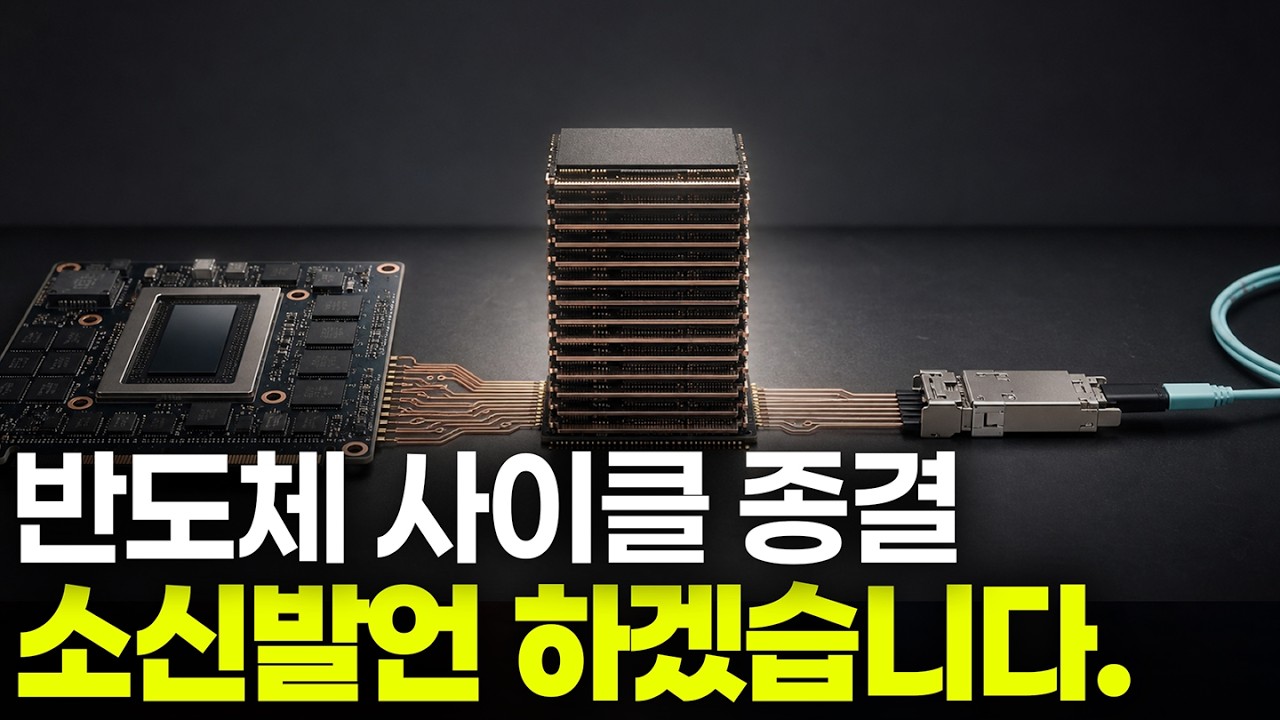
HBM, by contrast, is specialized memory packaged next to GPUs or AI ASICs.
Because it is designed and implemented together with Nvidia GPUs, AMD GPUs, and custom AI chips, customer-specific requirements are strong.
That means it is not easy to shift the product to another customer, and customers also cannot easily switch suppliers.
This structure is exactly the lock-in effect.
HBM is not just “expensive memory”; it is a core component of the AI semiconductor supply chain bottleneck and a product that creates a technological moat.
- DRAM: strong general-purpose memory character.
- HBM: high-bandwidth specialized memory attached to GPUs and AI ASICs.
- Customer-specific design: combined with Nvidia, AMD, and big tech custom chips.
- Lock-in effect: a structure where both customers and suppliers are hard to replace.
- Investment point: long-term contracts and technological competitiveness matter more than simple price cycles.
7. HBM market size: could expand from $57 billion in 2026 to $94 billion in 2027
According to Morgan Stanley estimates, the total HBM market could grow to around $57 billion in 2026 and about $94 billion in 2027.
That is almost a doubling of the market.
This estimate reflects GPU shipments, AI ASIC demand, price per gigabyte, and HBM content per chip.
So this is not just a vague “AI is good” story, but a structure where the actual semiconductor demand volume causes the HBM market to grow rapidly.
While current DRAM margins have become very high, HBM margins are still known to be relatively lower.
But if both HBM prices and volumes rise at the same time, operating profit contribution could increase further.
A particularly important benefit is that more long-term supply contracts improve earnings visibility.
In addition, next-generation memory ideas such as HBF, or high-bandwidth flash, are being discussed as medium- to long-term positives.
As AI infrastructure expands, not only compute but also storage, retrieval, inference, and cache architectures become important.
8. So why are stocks falling? Supply-demand issues matter more than fundamentals
It is hard to explain the current weakness in semiconductor stocks with fundamentals alone.
In the original text, a fund manager survey showed heavy concentration in semiconductors, low cash levels, and a leverage-related supply-demand twist in the Korean market amplified the decline.
Simply put, many investors were already heavily positioned in semiconductors, and when stock prices wobbled, stop-losses, profit-taking, and leverage liquidations happened at the same time.
In such phases, good news is not reflected immediately, and bad news is exaggerated.
News that China’s Kimi family of AI models had surpassed Claude or GPT also fueled the bearish view on AI semiconductors.
The logic is that if models become more efficient, GPU and memory demand might fall.
But in the AI industry, it is hard to conclude that efficiency gains necessarily lead to lower demand.
On the contrary, lower costs can lead more companies and users to adopt AI, creating a Jevons effect where total usage increases.
9. Hyperscalers cannot easily surrender in the AI race
The core of the AI investment cycle is that big tech and hyperscalers cannot simply stop competing.
Google, Microsoft, Amazon, Meta, Oracle, and companies in the Nvidia ecosystem could fall behind if they reduce AI infrastructure spending.
Morgan Stanley research suggests that hyperscaler capex may continue increasing even in 2027 and 2028.
There is also a forecast that hyperscaler computing capacity could rise from about 51GW now to 80GW in 2027 and 116GW in 2028.
In particular, the analysis that memory semiconductors could account for around 60% of data center investment in 2027 is very important.
This means the bottleneck in AI data centers is expanding beyond GPUs to memory, substrates, optical communications, power, and cooling.
- Hyperscaler computing capacity: around 51GW now, 80GW in 2027, and 116GW in 2028 forecast.
- Core components for data center investment: GPUs, HBM, DDR5, optical communications, substrates, power infrastructure.
- Memory share of 2027 data center investment: some analyses suggest around 60%.
- Core takeaway: this looks more like a bottleneck expansion than an AI investment pullback.
10. The next bottlenecks after memory: substrates, optical communications, MLCC, ABF PCB, CCL
AI infrastructure bottlenecks move over time.
In the early stage, GPUs were the biggest bottleneck, and then HBM emerged as the key bottleneck.
At the next stage, substrates and optical communications are likely to become more important.
AI servers do not work with only GPUs and HBM.
They also need optical cables, optical modules, switches, packaging substrates, MLCCs, ABF PCBs, and CCL for high-speed data transmission.
If these components are insufficient, data center deployment slows even if GPUs are secured.
The original text suggests that these areas could remain very tight through the first half of 2027.
Therefore, from an investment perspective, tracking bottlenecks in the supply chain after memory semiconductors is important.
- Optical communications: demand rises as data transfer inside AI data centers surges.
- Optical cables and optical modules: essential for expanding GPU clusters.
- MLCC: needed for high-performance servers and power stabilization.
- ABF PCB: a core substrate for high-performance semiconductor packaging.
- CCL: raw material for PCBs and a potential beneficiary of rising server and AI hardware demand.
11. Checking the AI bubble debate: OpenAI and Anthropic are moving toward monetization
The AI bubble debate is still strong.
The argument is that “AI companies don’t make money,” “big tech invests but cannot recoup,” and “model competition just burns cash.”
But if you look at the recent direction of OpenAI and Anthropic, the story changes somewhat.
These two companies have moved beyond simple user acquisition and are now seriously trying to monetize through enterprise APIs, coding agents, and workflow automation markets.
In particular, Anthropic has a larger share of usage-based API revenue from enterprise customers than from individual users.
Companies pay based on how much AI they use, and this structure can produce much larger revenue than subscriptions.
OpenAI has secured an overwhelmingly large consumer user base.
Its total user count is very large, but the share of paying users is still limited, and the percentage of users fully leveraging high-value functions like coding agents is still low.
In other words, there is still room for additional growth if paid conversion and enterprise market penetration accelerate.
12. OpenAI vs Anthropic: their revenue models are different
OpenAI is closer to a strategy of dominating the consumer market first and then expanding into enterprise.
Because it has many free users and low-cost subscribers, early costs can be heavy.
But having a large user base means it can pursue various monetization options such as ads, premium subscriptions, enterprise packages, and an agent marketplace.
Anthropic is strong in enterprise APIs and coding agents like Claude Code.
While many individual subscribers can be expensive to serve from the company’s perspective, enterprise APIs are usage-based and can have better margins.
The original text mentions OpenAI’s gross margin at around 40% and Anthropic’s gross margin at around 60%.
It is also important that Anthropic’s margins were much lower in the past but have improved rapidly recently.
- OpenAI: strong consumer base with significant room for paid conversion.
- Anthropic: potential for a high-margin structure centered on enterprise APIs and coding agents.
- Personal subscriptions: could be loss-making if heavy users dominate.
- Enterprise usage-based APIs: revenue increases directly with usage.
- Key issue around IPO: profitability, efficiency, and cash flow matter more than user count.
13. Why a new profitability metric like EBTIT is emerging
There is an argument that evaluating AI companies only with operating profit is insufficient.
That is because model training costs are enormous.
So some analyses are trying to use profitability metrics like EBTIT that also account for training costs.
The core point is simple.
To know whether an AI company is truly making money, you must look at server costs, GPU depreciation, power costs, cloud lease costs, and model training expenses together.
The original text also introduces an aggressive forecast that Anthropic could turn operating profitable from 2026 and generate very large profits in 2028.
However, since such forecasts can vary greatly depending on market growth, pricing policy, falling model costs, and the pace of enterprise adoption, they should be interpreted conservatively.
14. Why the enterprise AI application market is the biggest one
The biggest market in AI infrastructure investment will ultimately be enterprise applications.
A larger market may open up in business workflow automation and labor substitution than in rocket launches, satellite communications, or cloud infrastructure.
That is because AI agents can directly replace or assist high-wage labor.
If some work done by U.S. software engineers, lawyers, consultants, financial analysts, accountants, and customer support staff becomes automated by AI, a $20 or $200 monthly subscription becomes very cheap.
For companies, the gains from labor cost reduction and productivity improvement can far exceed the cost of adopting AI.
So when judging whether AI is a bubble, one should look not just at chatbot usage, but at the actual cost-saving effects of enterprise AI agents.
15. Core points that other YouTubers or news outlets often miss
Many news reports focus on surface-level issues like “semiconductor stock plunge,” “AI bubble concerns,” and “shock from Chinese AI models.”
But the more important points are below.
- First, stock prices and facts must be separated.
A falling stock price does not mean DRAM shortages and HBM demand have disappeared.
Based on current data, supply shortages are likely to continue through 2027. - Second, the P/E formula for memory semiconductors may change.
In the past, a low P/E signaled a stock peak, but this time HBM and long-term contracts are changing the quality of earnings. - Third, rising memory prices are not always good news.
If prices rise too much, PC and mobile demand can weaken, so expanding Q may matter more than P in the long run. - Fourth, AI model efficiency gains may lead not to lower semiconductor demand but to explosive usage growth.
If AI costs fall, more companies and individuals will use AI, and total data center investment demand may increase. - Fifth, the next bottleneck may be substrates and optical communications, not GPUs.
ABF PCB, CCL, MLCC, optical modules, and optical cables are essential for AI server expansion, and shortages in these areas may create new investment opportunities.
16. Investment summary: short-term momentum is weak, but fundamentals are still strong
Semiconductor stocks are weak in the short term.
Micron, Samsung Electronics, SK hynix, and AI hardware-related stocks have already risen significantly and then corrected, so more volatility is still possible.
But from a fundamentals standpoint, it is still hard to say the sector has clearly peaked out.
DRAM and NAND shortages remain, the HBM market is growing, and hyperscaler data center investment is likely to keep increasing.
In the end, there is one key question.
Will AI investment continue going forward?
If you think the answer is yes, then this correction may be a fear zone and also a phase where valuation appeal is increasing.
If, on the other hand, you think AI investment will slow sharply after 2027, then you should be more cautious about the possibility that the memory semiconductor cycle is ending.
For individual investors, it is more important to keep tracking supply chain bottlenecks, corporate earnings, long-term contracts, and AI infrastructure investment trends than to predict short-term stock prices.
In particular, rather than leverage or short-term trading, it is necessary to approach the market in a way that can tolerate volatility.
Investment decisions must always fit your own risk tolerance and portfolio framework.
< Summary >
Semiconductor stocks are under correction, but the DRAM and NAND supply shortage is likely to continue through 2027.
In past memory cycles, a low P/E was a peak signal, but this time the earnings structure may change due to HBM, long-term contracts, and AI data center investment.
The HBM market could grow from about $57 billion in 2026 to about $94 billion in 2027.
Hyperscalers cannot easily step back from the AI race, and memory’s share of data center investment is also expected to grow.
The AI bubble debate remains, but OpenAI and Anthropic are entering a monetization phase centered on enterprise APIs and AI agents.
The next supply chain bottleneck is likely to move after HBM into AI infrastructure components such as optical communications, ABF PCB, CCL, and MLCC.
Short-term stock prices are unknowable, but based on fundamentals alone, it is still difficult to conclude that semiconductors have clearly peaked out.
[Related Articles…]
- HBM Memory Cycle and Supply Chain Outlook
- AI Infrastructure Investment Cycle and Data Center Bottleneck Analysis
*Source: [ 월텍남 – 월스트리트 테크남 ]
– 월가 리서치 10개 더 읽었습니다. 반도체 사이클.. 아무리 봐도 이상합니다