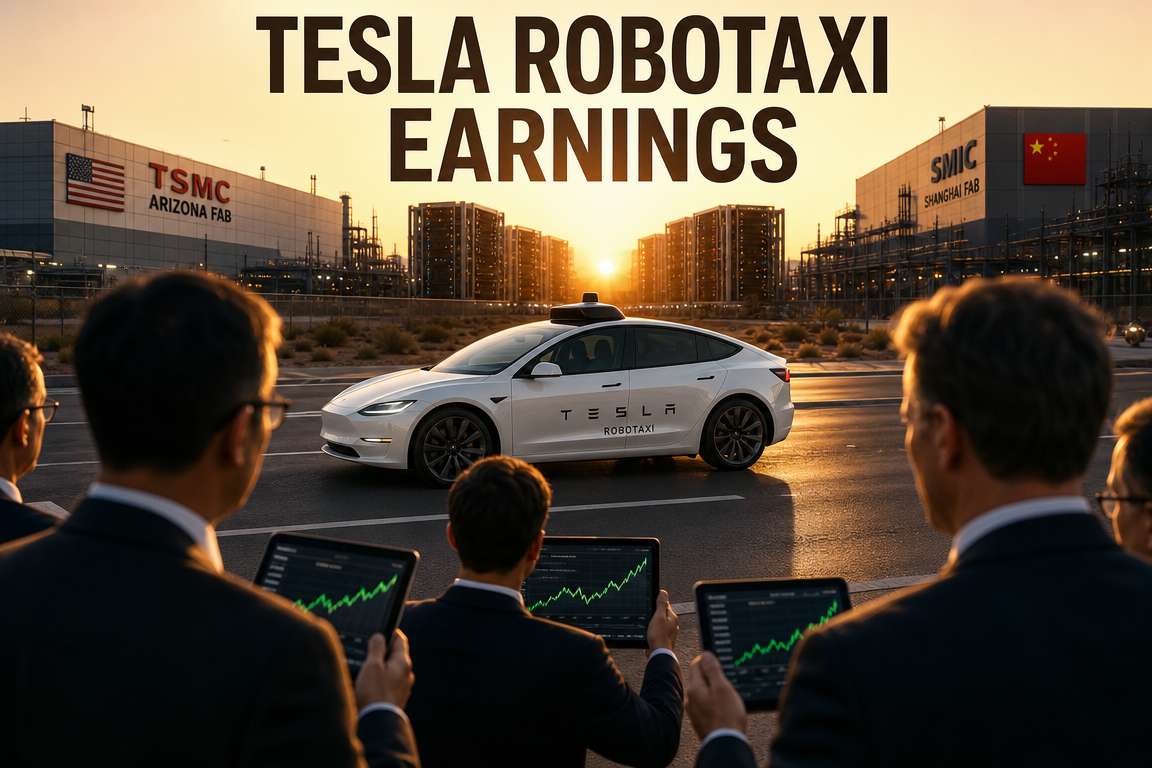
● Tesla RoboTaxis, 21 Vehicles, 7 Cities, Big Earnings Shock
Tesla Robotaxi Expansion to 7 Cities, But Only 21 Unsupervised Vehicles? Key Checkpoints Before Earnings D-1
The real focus for this Tesla earnings report is not revenue, but whether Robotaxi has reached a stage where it can generate meaningful economics.
On the surface, Tesla Robotaxi is expanding service coverage to Miami, Orlando, Tampa, Austin, Dallas, Houston, and the California Bay Area.
However, based on the source text, the actual number of unsupervised Robotaxi vehicles remains only 21, with 17 in Austin and 4 in Dallas.
In other words, Tesla is expanding the map quickly while adding vehicles very cautiously. That gap is the central issue for this earnings release.
This also intersects with U.S. interest rates, crude oil, inflation concerns, AI spending, FSD software delays, and pending Cybercab production capacity.
This report reviews the stock rebound, Robotaxi expansion, the gap versus Waymo, earnings expectations, margins and cash flow, and the key risks that are often overlooked in other coverage.
1. Tesla Stock and the Macro Backdrop: Market Sentiment Was Supportive Ahead of Earnings
According to the source, Tesla closed at $378.93.
The stock rose 2.53% from the prior day, showing strong momentum one day before earnings.
SpaceX was also cited at $123.54, up 3.08%.
Market sentiment was moderately supportive for Tesla.
Last week’s sharp selloff in semiconductor stocks reversed, helping restore some risk appetite in AI and technology names.
Micron rose more than 12%, while Intel gained 8%, supporting sentiment across AI semiconductors and technology equities.
Tesla trading volume also exceeded 30 million shares, indicating active repositioning ahead of earnings.
2. U.S. Rates and Inflation: Rising Oil Prices Are Again a Headwind
The source notes that military tensions with Iran have continued for more than ten days.
As a result, international crude oil prices reached a five-week high.
Higher oil prices feed directly into inflation expectations.
The Federal Reserve continues to emphasize its 2% inflation target.
However, a sharp rise in oil could revive discussion of additional rate hikes in the second half of the year.
Tesla is highly sensitive to interest rates.
As both an automotive company and an AI, robotics, and autonomy platform, Tesla is particularly exposed to changes in discount rates.
This week’s FOMC outcome is therefore important not only for Tesla but for broader U.S. equity direction.
3. This Week’s Economic Calendar: Tesla and Alphabet Highlight Big Tech Earnings
On Wednesday, U.S. time, Tesla is scheduled to report second-quarter results.
Alphabet will report on the same day.
This makes the week a major test for the broader Big Tech sector.
For Alphabet, the key issues are AI infrastructure spending and ad revenue recovery. For Tesla, the focus is automotive margins and Robotaxi strategy.
The source also notes that SpaceX is scheduled to report earnings for the first time as a public company on August 4.
The strategic linkage between Tesla and SpaceX is becoming increasingly relevant to investors.
4. Tesla and SpaceX: Starlink Antenna Integrated into Cybercab
The source states that the newly disclosed Tesla Cybercab interior includes a Starlink V5 satellite antenna developed by SpaceX.
Tesla AI chief Ashok Elluswamy said the system is not essential for driving.
Its primary purpose is navigation, customer service, and vehicle management.
For investors, however, this is significant.
It suggests that Tesla Robotaxi could evolve beyond a vehicle service into a broader AI mobility network connected through satellite communications.
Some Baird analysts reportedly suggested that Tesla and SpaceX could eventually merge.
That view remains speculative.
Neither Tesla nor SpaceX has announced any merger plan.
5. Robotaxi Expansion: Service Coverage Has Expanded to 7 Locations
Tesla’s official Robotaxi account promoted service launches in Tampa and Orlando.
This followed the rollout of fully unsupervised service in Miami just weeks earlier.
Based on the source, Tesla Robotaxi now covers 7 locations in total.
-
Florida: Miami, Orlando, Tampa
-
Texas: Austin, Dallas, Houston
-
California: Bay Area
The source also notes that Robotaxi usage may now be available at San Francisco International Airport in the Bay Area.
Airports are high-demand transportation hubs.
If Robotaxi can operate reliably there, it could improve service credibility and brand visibility.
Tesla has not disclosed the exact number of Robotaxi vehicles in operation.
6. Actual Scale in New Markets: Orlando and Tampa Are Still Limited
Service expansion is clearly positive.
However, measured by area, the rollout still appears experimental.
Orlando coverage is estimated at roughly 12 to 15 square miles.
Tampa coverage is estimated at roughly 4 to 5 square miles.
Although city names imply large-scale expansion, actual operating zones remain limited.
This is a critical distinction in the Robotaxi business.
Adding a city is not the same as providing stable commercial service across that city.
7. The Key Gap: 7 Cities, but Only 21 Unsupervised Vehicles
This is the main issue in the report.
Tesla’s serviceable Robotaxi footprint has expanded to 7 locations.
However, the actual number of unsupervised Robotaxi vehicles remains around 21, according to the source.
Austin, the most established and broadest market, reportedly had as many as 25 unsupervised Robotaxis at the end of April.
That number is now said to have declined to 17.
Adding 4 vehicles in Dallas brings the total to 21.
There is therefore a wide gap between service coverage and actual vehicle deployment.
That gap best reflects Tesla Robotaxi’s current stage of development.
8. Waymo Comparison: Tesla Still Faces a Material Scale Gap
According to the source, Waymo operates roughly 3,000 vehicles.
It also reportedly completes more than 500,000 paid rides per week.
Its service area has recently expanded by more than 20%.
In contrast, Tesla began service in Austin in June 2025 and has operated for more than a year, yet its unsupervised fleet remains around 21 vehicles.
Tesla’s advantages are clear.
These include data from millions of vehicles, a camera-based autonomy strategy, and vertical integration across AI chips and software.
However, Waymo is already ahead in commercial scale.
To gain market confidence, Tesla will need to demonstrate vehicle count, ride volume, paid usage, and safety performance rather than service area alone.
9. Why Vehicle Growth Remains Slow: Safety Validation and Regulatory Bottlenecks
Elon Musk said in the first-quarter earnings call that Tesla would pursue rigorous validation and avoid even a single accident.
This statement highlights Tesla’s current Robotaxi strategy.
Tesla appears to be prioritizing safety over speed of expansion.
The challenge is that this validation process can become a bottleneck.
Autonomous services face severe reputational, regulatory, and legal risks after any incident.
For that reason, Tesla’s restrained vehicle rollout may be rational.
On the other hand, critics argue that the limited fleet may indicate difficulty scaling beyond pilot operations.
10. Regulatory Risk: Camera-Only Robotaxis May Face Restrictions
Tesla continues to rely on a camera-based autonomy strategy.
The system uses vision-based AI rather than lidar or radar.
However, some jurisdictions are now discussing restrictions on this approach.
According to the source, the New Jersey legislature is considering a bill that would effectively limit camera-only Robotaxis without lidar or radar.
This is an important risk for Tesla.
Its focus on Texas and Florida may reflect a preference for more favorable regulatory environments.
Robotaxi expansion is not only a technology issue.
It also depends on regulatory alignment, safety validation, demand, and insurance risk.
11. Post-Earnings Volatility: Options Market Implies a 6% to 7% Move
The options market is pricing in a post-earnings move of about 6% to 7% in Tesla shares.
That would represent the largest expected move since October of last year, according to the source.
Tesla’s actual earnings-day moves over the last four quarters were roughly 3.5% to 5%.
This implies a much wider volatility range this time.
The source also notes that more call options were sold than put options.
That suggests investors are positioning for upside as well.
Still, elevated volatility reflects uncertainty more than conviction.
If margins, cash flow, or the Robotaxi roadmap disappoint, the stock could move sharply.
12. Wall Street Consensus: Revenue of $26.4 Billion and EPS of $0.53
Wall Street consensus expects Tesla revenue of about $26.4 billion.
FactSet and MarketWatch data cited in the source point to revenue of approximately $26.42 billion.
EPS is expected at around $0.53.
However, the EPS range is wide.
Estimates range from $0.27 to $0.74.
That dispersion suggests limited confidence among analysts regarding quarterly profitability.
Deliveries are strong, but the extent to which they translate into profit remains uncertain.
13. Deliveries Were Strong: 481,126 Vehicles in Q2
Tesla deliveries in the quarter were reported at 481,126 vehicles.
That represents 25% year-over-year growth.
It is the strongest second-quarter delivery figure in company history.
Tesla also sold 28,000 more vehicles than it produced, reducing inventory.
This is a clear reversal from Q1, when inventory reportedly built by nearly 50,000 units.
The data suggests demand for Tesla vehicles remains intact.
However, investors are not focused only on deliveries.
The key question is how much profit those deliveries generated.
14. Energy Storage: 13.5 GWh Growth Remains Intact
Tesla’s energy storage business also showed strong momentum.
Deployments reached 13.5 GWh, up more than 40% year over year, according to the source.
That is also a clear increase from 8.8 GWh in Q1.
Still, it fell slightly short of the 13.8 GWh expected by analysts.
Even so, growth in both automotive and energy remains positive.
This reinforces Tesla’s positioning not only as an EV company, but also as an energy infrastructure company.
15. First Key Earnings Focus: Can Automotive Margin Hold at 12.5%?
Tesla’s automotive margin was about 12.5% in Q1, according to the source.
That is one of the most important numbers in this earnings release.
Higher deliveries may be offset by price cuts, expiring incentives, and lower regulatory credit revenue.
Regulatory credits previously supported margins to some extent.
That contribution is now diminishing.
Tesla therefore needs to defend margin through pricing and cost efficiency.
If deliveries rise but margin weakens, the market is likely to react negatively.
If margins are better than expected, the stock could receive strong support.
16. Full-Year Delivery Outlook: 1.7 Million Units, Up 3.9% Year Over Year
Analysts expect Tesla full-year deliveries of about 1.7 million vehicles.
That implies growth of roughly 3.9% from last year.
This is too low to support a narrative of Tesla as a high-growth EV company.
That is why the market is assigning greater value to AI, FSD, Robotaxi, and Optimus.
However, future growth investments require current auto operations to generate cash.
Barclays has noted that Tesla’s core automotive business must remain stronger to fund AI investment.
Deutsche Bank has also said that changes in FSD software prepayment accounting are pressuring profitability.
17. Second Key Earnings Focus: Will Free Cash Flow Turn Negative?
Reuters reported that Tesla could post negative free cash flow for the first time in two years this quarter.
The source cites an estimate of approximately negative $3.3 billion.
In Q1, Tesla generated about $1.4 billion in free cash flow.
That means cash flow could reverse sharply in just one quarter.
The reason is straightforward.
Tesla has said it intends to invest more than $25 billion in AI and robotics.
Cybercab, Optimus, in-house chips, computing infrastructure, and manufacturing facilities all require capital.
The issue is that Robotaxi is not yet generating meaningful cash flow.
With only 21 unsupervised vehicles, near-term revenue contribution remains limited.
18. Optimus and AI Investment: Long-Term Growth, Near-Term Cost Pressure
Tesla has said it plans to begin producing 1,000 Optimus units this year and eventually scale annual output to 1 million units.
If successful, Optimus could materially change Tesla’s valuation framework.
For now, however, the program requires substantial investment in factories, equipment, labor, and AI training infrastructure.
Supporters argue that using automotive and energy cash generation to fund future growth is reasonable.
Critics say the gap between spending and realized results is becoming too large.
The fact that Tesla is spending heavily on Robotaxi while operating only 21 unsupervised vehicles remains a key point of scrutiny.
19. FSD Version 15 May Be the Main Bottleneck
Tesla has indicated that large-scale Robotaxi expansion may depend on FSD version 15.
Some investors believe slower deployment is tied to software readiness.
FSD version 15 is expected to feature an architecture with 10 times more parameters than the current version.
In that sense, the current limited rollout may represent the final validation phase before broader scaling.
However, the market has limited patience.
What matters is when FSD 15 arrives and when vehicle deployment expands from a pilot fleet to hundreds or thousands of units.
Technical direction alone is not sufficient.
Investors will need concrete timing and operating metrics during the earnings call.
20. Rising Cybercab Inventory: Is Hardware Ready While Software Is Not?
The number of Cybercabs waiting at Giga Texas is another important indicator.
According to the source, the count rose from 40 on May 8 to 245 recently.
That is a sharp increase over a short period.
Optimists may interpret this as Tesla preparing hardware in advance of a broader Robotaxi rollout.
Others may see it as evidence that software validation and regulatory approval are not keeping pace.
This is one of the most important leading indicators for the Robotaxi business.
Whether these vehicles move from storage to paid service will be critical.
21. Pre-Earnings Positive News Flow: A Move to Manage Expectations?
Tesla released several updates before earnings.
-
Tampa and Orlando Robotaxi expansion
-
Cybercab Starlink antenna disclosure
-
FSD version 14 Lite public rollout
All of these are positive developments.
But investors should focus on operating data rather than headline volume.
The key questions are how many unsupervised vehicles are deployed, how many paid rides are completed, whether margins are preserved, and how cash flow changes.
Those four metrics are the real basis for evaluating Tesla’s results.
22. What Other Coverage Often Misses
First, Robotaxi is a vehicle-density business, not just a city-count business.
Service in 7 cities matters less than how many vehicles operate in each market and how frequently they are used.
Robotaxi is a network business.
Low vehicle density leads to longer wait times, weaker customer experience, and lower revenue efficiency.
Expanding coverage is less important than scaling vehicle density within each market.
Second, safety validation is costly.
Validation is necessary to avoid incidents.
However, longer validation periods increase costs for vehicles, staff, compute, insurance, and operations.
If Robotaxi is not yet generating meaningful revenue, those costs pressure cash flow.
Third, Tesla’s AI investment thesis depends on automotive margins.
Investors want to value Tesla as an AI company.
But the company’s current cash generation still comes primarily from automotive and energy.
If automotive margin weakens, the AI narrative becomes harder to sustain.
Fourth, Cybercab inventory of 245 units is both a positive and a risk.
If these vehicles are about to be deployed, that is a strong positive.
If they remain idle because software or regulatory approval lags, questions about capital efficiency will increase.
Fifth, FSD 15 timing is the real earnings-call test.
Investors will want a clear answer on when Cybercab deployment and FSD 15-based scaling can begin.
Vague vision is not enough. The market needs dates, regions, vehicle counts, and operating metrics.
23. Key Items to Watch in Tesla’s Earnings Release
-
Automotive margin: whether Tesla can defend the 12.5% level.
-
Free cash flow: whether the expected negative $3.3 billion figure materializes.
-
Robotaxi fleet size: whether Tesla outlines a plan to move beyond 21 unsupervised vehicles.
-
Cybercab deployment timing: when the 245 vehicles at Giga Texas will enter service.
-
FSD 15 roadmap: timing and scale potential for broad rollout.
-
Energy growth: whether 13.5 GWh deployment translates into profitability.
-
AI investment level: how the more than $25 billion capital plan affects cash flow.
-
Regulatory risk: how Tesla responds to restrictions on camera-only Robotaxis.
24. Investment View: Tesla Has Entered a Proof Phase
Tesla still has a compelling long-term growth narrative.
EVs, energy storage, FSD, Robotaxi, Optimus, AI chips, and Starlink connectivity all target very large markets.
But the market is no longer valuing vision alone.
Given that Tesla’s stock already reflects substantial future expectations, this earnings report must be judged by the numbers.
Whether delivery growth translated into margins.
Whether the company can fund AI investment with current cash generation.
Whether Robotaxi can move beyond an experimental phase into commercial scale.
These are the central questions for Tesla investors.
The core issue is simple:
Is Tesla a company that has announced Robotaxi, or a company that can operate it at scale?
Elon Musk’s answer to that question during the earnings call will likely influence both near-term share performance and longer-term investor confidence.
< Summary >
Tesla Robotaxi has expanded to 7 service locations, but the actual number of unsupervised vehicles remains around 21.
The more important metrics are vehicle count, ride volume, paid usage, and safety performance.
Waymo remains ahead with roughly 3,000 vehicles and more than 500,000 paid rides per week.
The key earnings variables are automotive margin, free cash flow, Robotaxi expansion timing, and the FSD 15 roadmap.
Second-quarter deliveries were strong at 481,126 vehicles, but margin defense remains the critical issue.
AI and robotics investment support long-term growth but may pressure near-term cash flow.
The 245 Cybercabs reportedly waiting at Giga Texas are the most important leading indicator for deployment timing.
This earnings report is not just a quarterly results event. It is a test of whether Tesla can be re-rated as an AI autonomy company.
[Related Articles…]
- Tesla Robotaxi Expansion and Commercialization Outlook
- Autonomy Market Trends and AI Mobility Investment Themes
*Source: [ 오늘의 테슬라 뉴스 ]
– 로보택시 7개 도시 됐다는데, 실제로 굴리는 차는 21대? (테슬라 어닝 D-1)
● Computing-War, AI-Showdown, Tech-Power-Fight
Can China’s AI and semiconductors surpass the United States? The core of the U.S.-China power struggle is a computation war
Viewing the current U.S.-China power struggle simply as a political conflict between the two countries misses the core issue.
The real contest centers on AI models, semiconductor supply chains, global value chains, deglobalization, and control over computing power.
China is pushing AI and semiconductor self-sufficiency through DeepSeek, Moonshot AI, Kimi K3, CXMT, and Huawei.
The United States is exerting pressure through a supply chain centered on Nvidia, Micron, major U.S. technology firms, Dutch equipment, Japanese materials, TSMC in Taiwan, and South Korean memory semiconductors.
This report focuses on one key question.
Will China dominate AI and semiconductors, as it has done in electric vehicles, batteries, displays, shipbuilding, and steel?
Or will it ultimately face structural limits due to the U.S.-led semiconductor supply chain and AI infrastructure barriers?
The following sections assess these two scenarios as the likely endpoints of the U.S.-China technology rivalry.
1. The essence of the U.S.-China power struggle is not a trade war but a computation war
In earlier eras, global power was shaped by mobility.
National competitiveness depended on who could move faster and connect larger territories.
The next era was defined by firepower.
Military capacity, energy, and industrial production determined the global order.
Today, the central variable is computational power.
In practical terms, this means computing power.
The ability to train AI models faster, process more data, and deliver stable AI services has become central to economic power.
Accordingly, both the United States and China are moving in the same direction.
They are not only building AI models, but also linking AI services, AI semiconductors, data centers, power infrastructure, cloud computing, semiconductor equipment, and materials into integrated value chains.
The U.S.-China power struggle is therefore not about tariffs alone.
It is a contest over which country will become the operating system of AI infrastructure over the next decade.
2. China has already delivered a “cost-efficiency shock” in AI
China should not be underestimated in AI, because it has already disrupted the market.
A leading example is DeepSeek.
DeepSeek generated broad global attention by delivering strong AI performance at relatively low cost.
Compared with models such as ChatGPT, Google Gemini, and xAI’s Grok, Chinese AI is competing on performance per dollar.
Kimi K3 from Moonshot AI should be understood within the same context.
China is advancing AI models rapidly, not only through large-capitalized technology firms but also through younger startups.
This is an important point.
Rather than focusing solely on maximum performance, China is pursuing a strategy of delivering sufficiently capable AI at much lower cost.
If companies and consumers prioritize adequate performance and lower cost over absolute best-in-class performance, Chinese AI adoption could accelerate faster than expected.
This is why U.S. technology firms and global AI players are taking the situation seriously.
3. CXMT is the core of China’s semiconductor strategy
AI leadership is not possible without semiconductors.
Training AI models and operating inference services require high-performance GPUs, HBM, DRAM, NAND, network semiconductors, and server-grade chips.
China recognizes this weakness clearly.
As a result, semiconductor self-sufficiency has become a national strategy.
At the center of this strategy is CXMT, or ChangXin Memory Technologies.
While the United States is strengthening memory supply chains around Micron, China is attempting to build a domestic memory ecosystem around CXMT.
China’s semiconductor industry has not yet caught up with the advanced supply chain linking the United States, South Korea, Taiwan, Japan, and the Netherlands.
However, the key issue is that China is not retreating.
Even with a technology gap, China continues to raise its semiconductor capacity through domestic demand, state support, large-scale consumption, and long-term investment.
This approach resembles the path taken in electric vehicles and batteries.
Initial criticism centered on quality and capability, but price competitiveness and scale eventually reshaped the market.
This is why analysts worry that Chinese semiconductors may follow a similar trajectory.
4. The “severe scenario” in which China overtakes the United States
The first scenario assumes that China will eventually dominate the global AI and semiconductor markets.
This is not an implausible outcome.
China has already followed a similar pattern in steel, shipbuilding, consumer electronics, IT hardware, telecom equipment, electric vehicles, batteries, and displays.
It began by catching up with Western firms.
It then gained competitiveness through low-cost production and a large domestic market.
Finally, it improved technology and expanded global market share.
AI and semiconductors could follow the same path.
- Chinese AI models can scale quickly due to lower costs.
- Chinese semiconductor firms can sustain themselves through the domestic market.
- The Chinese government can continue long-term subsidies for strategic industries.
- U.S. sanctions may accelerate China’s push toward self-reliance.
- Global firms may adopt Chinese AI services to reduce costs.
In the AI services market, the most advanced model does not necessarily win.
For enterprises, a lower-cost model that is sufficiently capable, localized, and easy to deploy may be more attractive.
China is targeting exactly this segment.
If China secures a sufficient position in both AI models and semiconductor supply chains, U.S. technology firms could face pressure on profitability as well.
In that case, the global AI market would likely shift from a U.S.-dominated structure to a bipolar system led by the United States and China.
5. The opposite view: China may still struggle to surpass the United States
The second scenario argues that even if China makes meaningful progress in AI and semiconductors, it will still be difficult to surpass the U.S.-centered technology ecosystem.
The core of this argument lies in the structure of the semiconductor supply chain.
Semiconductors are not an industry that can be completed by one country alone, even if that country performs well across the board.
Design, equipment, materials, manufacturing, packaging, software, and customer ecosystems must all align.
The United States still holds a decisive advantage in this structure.
- U.S. firms lead in semiconductor design.
- AI GPUs and data center semiconductors are dominated by Nvidia, AMD, and Broadcom.
- Semiconductor equipment is controlled by key firms such as ASML in the Netherlands, Applied Materials, and Lam Research in the United States.
- Japanese firms are influential in semiconductor materials.
- TSMC in Taiwan dominates advanced foundry manufacturing.
- Memory semiconductors are led by Samsung Electronics, SK Hynix, and Micron.
This structure is difficult for China to replicate in the short term.
Even if China builds a domestic semiconductor value chain, bottlenecks remain in advanced equipment, sub-5nm process technology, high-performance memory, and design software.
The United States is also not acting alone.
It is restructuring semiconductor and critical mineral supply chains with allies including the Netherlands, Japan, Taiwan, South Korea, Australia, and Canada.
This is China’s most significant challenge.
China has a large domestic market, but it does not have the same technology alliance network as the United States.
6. Globalization is not ending; it is shifting into slower globalization
An important backdrop to this debate is the transformation of globalization.
Since China joined the WTO in 2001, globalization entered a new phase.
China became the world’s factory, and global firms used it as a production base.
During this period, China achieved double-digit growth and rose rapidly.
IBM, Apple, Microsoft, Huawei, and others became integrated into global supply chains, while Chinese firms moved from component manufacturing toward advanced industries.
This was the golden age of global value chains.
Companies did not produce everything domestically.
Components were made in China, design was done in the United States, assembly took place in other Asian countries, and sales were distributed globally.
This model became known as offshoring.
Firms also preferred just-in-time inventory systems rather than holding large stockpiles, because they believed free trade would remain stable.
That outlook began to change after the global financial crisis.
Western countries increasingly viewed globalization as a force that lowered prices and benefited consumers, but also contributed to manufacturing job losses, industrial hollowing-out, and rising inequality.
There was also growing concern that China had gained while manufacturing bases in the United States and Europe had weakened.
From that point onward, deglobalization, reshoring, and friend-shoring gained momentum.
7. The Huawei case symbolized the breakdown of globalization
Huawei is a representative case of China’s technology rise.
Starting as a startup, Huawei became the world’s largest telecom equipment company in less than two decades.
By 2012, it had become the largest telecom equipment manufacturer in the world, and it also expanded rapidly in smartphones.
By 2019, it held a significant share of the global smartphone market and had become a major global technology player.
However, the arrest of Huawei CFO Meng Wanzhou in 2018 changed the trajectory.
The United States linked Huawei to national security concerns, and the company later faced significant restrictions in global markets.
Notably, Huawei continued to grow in China while its overseas revenue was pressured.
This illustrates the environment Chinese AI and semiconductor companies may face in the future.
Even with strong technology, exclusion from global trust networks can limit international expansion.
8. Deglobalization does not mean world trade will collapse
Many assume that intensifying U.S.-China tensions will collapse global trade.
In practice, the situation is more nuanced.
Trade between the U.S. bloc and the China bloc accounts for only part of total global trade.
The more important change is the reconfiguration of trade routes, not a total decline in trade.
Products once made in China will increasingly be produced in India, Vietnam, Mexico, Thailand, and Poland.
In other words, globalization is not ending; it is slowing and changing direction.
This can be described as slower globalization.
Trade within each bloc may increase even as trade between blocs declines.
As the United States and China diverge, the global economy is likely to fragment into multiple economic zones rather than remain a single integrated market.
9. The shift by Apple, Samsung, Nike, Dell, and HP is already underway
Global firms are already reducing dependence on China.
Apple has long produced large volumes of iPhones in Zhengzhou, but it is moving part of its production to India.
Samsung, Nike, and Adidas have moved, or are moving, production facilities from China to Vietnam.
Dell is relocating some production from China to Mexico.
HP is also shifting parts of its operations to Thailand.
The key point is that production is not disappearing; it is moving out of China.
This creates beneficiaries from the U.S.-China rivalry.
- India can expand as both an Apple manufacturing base and a digital consumer market.
- Vietnam is emerging as a manufacturing base for electronics, apparel, and consumer goods.
- Mexico is gaining attention as a nearshoring hub close to the United States.
- Thailand is benefiting in electronics components and automotive supply chains.
- Poland is becoming a candidate for a key role in European manufacturing supply chains.
This shift is a negative for China.
China’s economy has long relied on investment and exports for growth.
If the United States and its allies reduce dependence on China, Chinese export growth is likely to slow.
Given the weakening of traditional industries, restrictions on future-growth sectors could lower China’s long-term growth rate.
10. The overlooked issue: the decisive factor is not only technology, but alliance-based supply chains
Much of the coverage focuses on how quickly Chinese AI is advancing or how powerful Nvidia’s GPUs are.
However, the more important issue lies elsewhere.
The winner of the AI competition may not be the country with the best model performance.
The real winner may be the side that can connect stable semiconductor supply, data center power, cloud infrastructure, software ecosystems, critical minerals, and global customer networks.
On this basis, the United States remains strong.
The United States is not competing with its own firms alone.
Its ecosystem includes Dutch equipment, Japanese materials, Taiwan-based foundry capacity, South Korean memory, Australian and Canadian minerals, and U.S. cloud infrastructure.
China, by contrast, must build a self-sufficient supply chain.
A self-sufficient supply chain has advantages.
It improves resilience against external sanctions and supports domestic demand.
However, it also has major drawbacks.
China must solve advanced technology bottlenecks on its own, it will struggle to control global standards, and its market expansion abroad will face limits.
In the end, the U.S.-China power struggle is not simply about whether Chinese technology is better than U.S. technology.
It is about which side can build a broader and more stable technology ecosystem.
11. What does this mean for the Korean economy?
For South Korea, this trend is highly relevant.
Korea plays a key role in the U.S. semiconductor supply chain.
Samsung Electronics and SK Hynix are globally competitive in memory semiconductors and HBM.
As AI data centers expand, demand for high-bandwidth memory and high-performance DRAM is likely to remain structurally important.
There are also risks.
If China rapidly catches up in memory semiconductors through CXMT, price competition in commodity memory could intensify.
If Chinese AI firms scale low-cost AI models, the revenue structure of U.S. technology firms could also change.
Korean companies must manage exposure to the Chinese market, the U.S. supply chain, and technology leakage risks at the same time.
For Korea’s economic outlook, one of the most important variables will be the position of Korean semiconductors within the U.S.-China technology rivalry.
12. Key indicators to watch going forward
- Monitor whether Chinese AI models such as DeepSeek and Kimi K3 continue to expand global usage.
- Track CXMT’s technology progress and capacity expansion in memory semiconductors.
- Assess whether U.S. export controls on semiconductor equipment become more stringent.
- Watch the pace at which Apple and other global firms reduce their China-based production exposure.
- Evaluate the growth of alternative production bases in India, Vietnam, Mexico, Thailand, and Poland.
- Monitor whether Samsung Electronics and SK Hynix maintain their position in HBM and AI semiconductor supply chains.
- Assess whether U.S. technology firms begin to monetize AI investments at scale.
13. Conclusion: China is advancing, but surpassing the United States is a different matter
China’s progress in AI and semiconductors is clear.
DeepSeek, Kimi K3, CXMT, and Huawei show that China is no longer limited to low-cost manufacturing.
China views AI and semiconductors as strategic sectors tied to national resilience.
Its drive toward technological self-sufficiency is therefore likely to continue.
However, whether China can fully surpass the United States is a separate question.
The United States is not only a technology leader but also the center of a global technology alliance network.
That distinction is critical in AI leadership and semiconductor supply chains.
China will continue to pursue a strategy based on domestic scale and state-led industrial policy.
The United States will defend its position through alliance-based supply chains and a deep technology ecosystem.
As a result, the global economy is likely to move toward a fractured structure, with the U.S. bloc and the China bloc competing across multiple sectors.
For investors, companies, and policymakers, the key issue is not to assume a single winner.
The priority is to track which industries grow within each bloc, which companies benefit from supply chain reorganization, and which countries emerge as alternative production hubs.
< Summary >
The core of the U.S.-China power struggle is a computation war centered on AI and semiconductors, not trade alone.
China is pursuing AI and semiconductor self-sufficiency through DeepSeek, Moonshot AI, Kimi K3, CXMT, and Huawei.
China could challenge the United States through cost-efficient AI and a domestic semiconductor ecosystem.
However, the United States still has a powerful supply chain that links design, equipment, materials, foundries, memory, and cloud infrastructure with allied countries.
Globalization is not ending; it is shifting toward slower globalization and bloc-based fragmentation.
Apple, Samsung, Nike, Dell, and HP are already relocating production outside China, and India, Vietnam, Mexico, Thailand, and Poland are emerging as beneficiaries.
For South Korea, Samsung Electronics and SK Hynix may gain opportunities in the AI semiconductor supply chain, but they must also manage China’s technological catch-up and the risks from U.S.-China tensions.
[Related Articles…]
- AI Era Semiconductor Supply Chain Reconfiguration and Investment Strategy
- Global AI Power Competition and Big Tech Economic Outlook
*Source: [ 경제 읽어주는 남자(김광석TV) ]
– 중국 AI·반도체가 미국을 넘을 수 있을까? 미중 패권전쟁의 진짜 결말 | 김광석의 북리뷰 | 대분열의 시대 [1편]