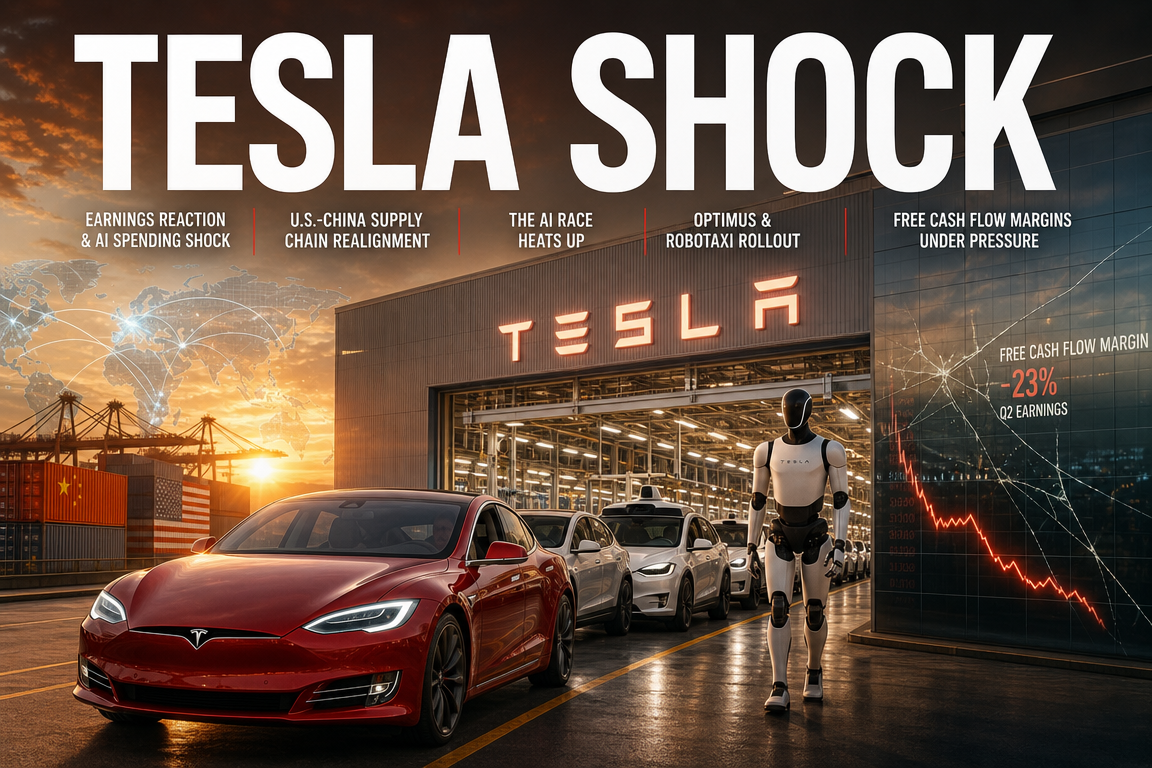
● Tesla Crash, Market Panic, AI Spending Shock
Tesla Shares Slide 14%: Why Did the Market Panic Despite Solid Headline Numbers?
The key issue in this decline is not an earnings shock, but Tesla’s rapid capital deployment into AI, robotaxis, Optimus robots, and battery supply-chain infrastructure at a pace far above current cash generation.
In the original report, Tesla stock fell about 3% in after-hours trading, but the decline widened to 14.52% during the regular session.
On the surface, revenue reached a record high and vehicle deliveries exceeded market expectations.
However, Wall Street focused more on declining margins, a negative free cash flow swing, rising R&D spending, and the execution difficulty of the Optimus supply chain.
This report goes beyond the headline earnings figures and explains why the market reaction intensified more than fourfold in a single day.
A central point often understated in other coverage is that Tesla is transitioning from an automotive cost structure to that of an AI manufacturing platform company.
1. Market sentiment was already weak
Tesla was not the only stock under pressure that day.
In the original report, crude oil rose for a fifth consecutive session, with Brent above $97 per barrel.
Following reports of an explosion along a mined shipping route near the Strait of Hormuz, several tankers reportedly reversed course.
Middle East risk and higher oil prices can renew inflation pressure.
This weighed on the broader U.S. equity market.
- S&P 500: -1.2%
- Nasdaq: -2.15%
- Dow Jones: -0.97%
- Tesla: $319.69, -14.52%
- SpaceX-related price: $118.24, +2.59%
The selloff in Tesla therefore reflected both company-specific developments and broader macro risk.
Weak EV demand sentiment, higher oil prices, and deteriorating risk appetite toward growth stocks all contributed.
2. Tesla’s Q2 results were strong on revenue
Tesla reported Q2 revenue of $28.24 billion, a record high.
This represented year-over-year growth of 25.5%.
The figure exceeded market expectations of roughly $25.7 billion to $26.7 billion.
Vehicle deliveries also rose to 481,126 units, up more than 25% from a year earlier.
On an external-growth basis, the results did not appear weak.
- Total revenue: $28.24 billion, +25.5% YoY
- Automotive revenue: $20.52 billion, +23% YoY
- Energy storage revenue: $3.14 billion, +13% YoY
- Services revenue: $4.58 billion, +50% YoY
- Deliveries: 481,126 units, +25%+ YoY
Automotive growth remained intact, energy storage returned to growth, and services revenue expanded 50%, indicating a broader ecosystem.
Based on revenue alone, the 14% decline appears difficult to justify.
3. The issue was profitability, not revenue
Wall Street’s concern centered on margins and earnings quality.
Tesla’s gross margin was 16.8%, down from 17.2% a year earlier.
Regulatory credit revenue fell sharply to $146 million from $439 million last year.
Operating expenses rose 47% year over year.
As a result, GAAP operating income was only $398 million.
The operating margin fell to 1.4% from 4.1% in the same quarter last year.
- Gross margin: 16.8%
- Gross margin, prior year: 17.2%
- Regulatory credit revenue: $439 million → $146 million
- Operating expense growth: +47%
- GAAP operating income: $398 million
- Operating margin: 1.4%
- EPS: $0.33
- Market expected EPS: $0.51
In practical terms, Tesla sold more vehicles and generated record revenue, but rising costs compressed the amount left over.
For growth stocks in the current market environment, margins and cash generation are more influential than revenue alone.
4. Cash remains ample, but free cash flow turned negative
Tesla is not facing an immediate liquidity problem.
Operating cash flow reached $4.7 billion, up 85% from a year earlier.
Cash and short-term investments totaled $43.5 billion at quarter-end.
The company still has a large liquidity buffer.
However, the market focused on free cash flow.
- Operating cash flow: $4.7 billion
- Cash and short-term investments: $43.5 billion
- Q1 free cash flow: +$1.44 billion
- Q2 free cash flow: -$1.09 billion
- Capital expenditures and related investment: $5.79 billion, +142% YoY
Free cash flow moved from positive to negative within one quarter.
The main driver was a sharp increase in capital expenditures.
Tesla is investing simultaneously in AI infrastructure, robotaxi production capacity, Optimus robots, battery raw-material refining, and 4680 battery scaling.
From the market’s perspective, the concern is that Tesla is generating cash, but spending even more to fund its next phase of growth.
5. Why the decline widened from 3% to 14%
Immediately after earnings, Tesla was down roughly 3% in after-hours trading, which was relatively contained.
However, the stock fell further in premarket trading and eventually dropped about 13% to 14% intraday.
It closed around $319.67, down 14.53%.
That move was unusually large compared with Tesla’s average post-earnings reaction over the prior five reports of approximately -1.59%.
What drove the sharper reaction?
The main factor was the commentary from Elon Musk during the earnings call.
Investors appeared to focus less on the reported figures and more on the scale of future spending required.
In particular, the discussion of Optimus and AI infrastructure was interpreted as a larger execution burden than expected.
6. R&D spending rose 49%: what is Tesla building?
Tesla’s R&D expense in Q2 was $2.371 billion.
This was up 49% from a year earlier.
Given revenue growth of 25.5%, R&D is rising at nearly twice the pace of sales.
With CEO compensation-related stock-based expense and general administrative costs added in, total operating expenses increased 47%.
Tesla’s spending is concentrated in four areas:
- Optimus robot components and production lines
- AI training clusters and Cortex 2 expansion
- Cybercab and robotaxi production facilities
- 4680 battery scaling, lithium refining, and battery supply chain development
This is a critical point.
Tesla can no longer be evaluated solely as an EV manufacturer.
It is becoming simultaneously an automotive company, an AI infrastructure company, a robotics company, and an energy storage company.
The challenge is that these expansions have not yet translated into fully visible earnings power.
7. Why Optimus raised investor concern
During the call, Elon Musk contrasted electric vehicles with robots.
EVs can still rely on an established supply chain for doors, glass, seats, and tires.
Optimus is different.
According to the original report, it consists of roughly 10,000 unique parts.
Tesla’s supply-chain executive said the company is building some components itself if it cannot find suitable external partners.
That statement carries significant implications.
Automotive manufacturing allowed Tesla to innovate within an existing industrial framework.
Optimus, by contrast, requires Tesla to create much of the supply chain from scratch.
Musk said the robot’s hand is being designed for fine tasks such as playing the piano and threading a needle.
He also noted that existing motors, actuators, and sensors do not readily support that level of precision.
In effect, Tesla is trying to solve a problem that requires redesign from the level of physical engineering fundamentals.
For the market, the message was likely:
Optimus may represent a very large opportunity, but the time and capital required remain highly uncertain.
8. Cybercab production has begun, but revenue has not
Tesla said Cybercab production has started at Giga Texas.
Shareholder materials indicated an annual production capacity of more than 125,000 units.
That implies roughly 2,400 units per week on a 52-week basis.
This was a meaningful change from the prior quarter, when no specific figure was disclosed.
However, capacity should not be confused with sales.
Actual output will depend on battery pack supply, component procurement, factory utilization, regulatory approval, and the pace of robotaxi deployment.
In other words, Tesla has spent to build the facility, but the timing of revenue and earnings remains uncertain.
This uncertainty added to stock volatility.
9. Musk chose speed over cost discipline
One analyst asked whether Tesla intended to slow capital spending to improve efficiency.
Musk’s response was clear.
He said speed can matter more than efficiency in certain phases and that Tesla would continue to invest aggressively.
In other words, Tesla is prioritizing future market positioning over near-term margin protection.
That approach can appeal to long-term investors.
But for investors focused on quarterly earnings and cash flow, it is less comfortable.
This is especially true in a market where AI semiconductor companies are already converting demand into earnings, while Tesla is still investing to bring AI into the physical world.
10. Wall Street remains divided
Analysts remain sharply split on the results.
RBC Capital said it was disappointed by margins but maintained a Buy rating and a $500 target price.
The firm pointed to robotaxi expansion potential.
According to the original report, robotaxi expansion is planned across San Francisco, Austin, Dallas, Houston, Miami, Orlando, and Tampa, with Phoenix and Las Vegas also under preparation.
Stifel also maintained a Buy rating and a $508 target price.
By contrast, Wells Fargo kept a Sell rating and a $130 target price.
Its concern is that competition and aggressive pricing may continue to pressure automotive gross margin.
- RBC Capital: $500 target, Buy maintained
- Stifel: $508 target, Buy maintained
- Wells Fargo: $130 target, Sell maintained
The wide range in target prices shows that the market has not reached a consensus on Tesla’s valuation framework.
Viewed as a traditional automaker, Tesla looks expensive.
Viewed as an AI and robotics platform, it still has substantial execution to prove.
11. The key point often missed: Tesla is shifting from an automotive company to a physical AI company
The most important issue is not simply that EPS missed expectations.
The real issue is that Tesla’s cost structure is changing materially.
Historically, the main question was:
How many electric vehicles can Tesla sell?
That question has now changed.
Can AI replace human labor in real-world driving, manufacturing, and household tasks?
That is a much harder, more expensive, and longer-duration challenge.
AI semiconductor companies are generating revenue from immediate data-center demand.
Tesla is trying to convert that AI capability into products that operate in the physical world.
Robotaxis target labor in transportation.
Optimus targets labor in factories, logistics, and households.
FSD aims to convert driving, a very large labor market, into a software product.
Tesla’s AI investment is therefore not limited to chatbots or office automation.
It is directed at replacing physical labor.
If this market opens, the scale could be substantial.
If it does not, current R&D spending becomes a burden.
That is why the stock is reacting so sharply.
12. What investors should monitor
For Tesla, neither “the stock is cheap after the drop” nor “the margins are too weak, so the story is over” is sufficient.
Investors should continue monitoring four items:
- First, whether free cash flow returns to positive territory
- Second, whether higher R&D spending translates into actual product launches and higher production
- Third, whether Cybercab capacity becomes actual robotaxi revenue
- Fourth, whether FSD adoption continues to rise and generate high-margin software revenue
The original report also noted that more than 55% of new North American deliveries are selecting an FSD subscription.
If that rate holds or rises, it could support a recovery in profitability.
If FSD adoption slows, robotaxi commercialization is delayed, and Optimus remains difficult to scale, market skepticism may intensify.
13. Being frustrated with Tesla is not the same as calling the story a fraud
Many investors may be frustrated by this decline.
Over the past five to six years, Tesla’s share price has not materially outperformed in the same way as AI semiconductor leaders such as Nvidia.
That relative underperformance can create a strong sense of opportunity cost.
If an investor wants immediate earnings, dividends, and stable cash flow, Tesla may not be the right fit.
However, a difficult operating phase is not the same as declaring Tesla’s autonomy, robotaxi, or Optimus efforts fraudulent.
Amazon also experienced a severe post-bubble drawdown and accepted years of losses to build logistics and cloud infrastructure.
Nvidia was once viewed primarily as a gaming graphics company.
None of this guarantees Tesla will follow the same path.
But the current earnings report suggests not a failure, but the cost burden of building a much larger future business.
14. Conclusion: the 14% decline reflects repricing of known risk
This selloff appears less like a sudden new negative development and more like the market finally pricing in a risk that was already visible.
Revenue reached a record high, and deliveries were strong.
But margins declined, free cash flow turned negative, and R&D spending accelerated.
Most importantly, the earnings call made clear that Optimus and robotaxi remain much more complex in supply-chain and manufacturing terms than the market may have assumed.
This is difficult for short-term investors.
For long-term investors, it is a key checkpoint in Tesla’s transition toward a physical AI platform.
The central question is whether Tesla’s substantial AI investment and R&D spending can eventually convert into durable, high-margin cash flow.
For investors who believe the answer is yes, the decline may represent volatility.
For those who believe the evidence is still insufficient, risk management may take priority.
< Summary >
Tesla stock closed at $319.69 in the original report, down 14.52%.
Q2 revenue reached a record $28.24 billion, and vehicle deliveries exceeded expectations.
However, operating margin fell to 1.4%, and EPS of $0.33 missed the $0.51 estimate.
Free cash flow turned negative at -$1.09 billion.
R&D spending rose to $2.37 billion, up 49% year over year.
The market focused on the cost burden of Optimus, robotaxis, AI computing, and battery supply-chain investment.
This decline reflects a repricing of known future-investment risk rather than a new negative catalyst.
The key issue is whether Tesla can evolve from an EV company into a physical AI platform company.
[Related Articles…]
*Source: [ 오늘의 테슬라 뉴스 ]
– 어제 -3%였는데 오늘 -14%, $321 주주는 지금 뭘 봐야 할까요 ?
● China-vs-US, Supply-Chain, AI, Power-Shift
Can China Really Surpass the United States? In the U.S.-China rivalry, the decisive variable is not scale but diversity
The key point in this article is not whether China’s GDP will surpass that of the United States.
The real issue is how effectively the United States, through its alliance network, can restructure supply chains in semiconductors, AI, batteries, electric vehicles, and critical minerals.
China, by contrast, has been the main beneficiary of globalization, but as deglobalization and supply chain realignment accelerate, it is increasingly likely to face simultaneous pressure on exports, investment, and access to technology.
At the same time, the AI race has emerged as a variable that could ease the burden of a high-cost era through productivity gains, making the U.S.-China rivalry not only a military and diplomatic issue but also a defining factor for the global economic outlook.
In short, China has strong momentum as it seeks to catch up with the United States.
However, the decisive U.S. advantage is not the dollar, military power, or big tech alone, but the economic diversity embedded in its alliances.
1. The most dangerous mistake in analyzing the U.S.-China rivalry is a bloc-based narrative
Some argue that China will eventually surpass the United States.
Others argue that the United States will never allow such a reversal.
Both arguments have merit.
However, framing this issue as pro-U.S. versus anti-U.S., or pro-China versus anti-China, obscures the structural reality.
The current shift is being driven by factors that are far more structural than ideology or sentiment.
Globalization is receding, the free-trade-centered economic order is weakening, and countries are rebuilding supply chains for national security reasons.
The key question is therefore not “Can China grow faster than the United States?” but “Which bloc, the U.S.-led or China-led, can build a more complete economic ecosystem?”
From this perspective, the outcome of the U.S.-China rivalry depends less on GDP rankings than on the combination of semiconductor leadership, AI leadership, critical minerals, manufacturing value chains, consumer markets, and financial systems.
2. Did globalization really make the United States and Europe richer?
Over the past 40 years, the global economy has been shaped by globalization and free trade.
Companies built factories in countries with lower production costs, while consumers in advanced economies benefited from cheaper goods.
China saw explosive export growth after joining the WTO in 2001.
It became the “world’s factory” and, through manufacturing competitiveness, rose to become a G2 power alongside the United States.
However, an important reversal is now becoming clearer.
There is growing recognition that globalization may not have been a decisive engine of growth for the United States and Europe.
Global firms improved profitability through low-cost production.
Consumers also gained access to cheaper products.
But productivity growth in the G7 has slowed, and manufacturing capacity has weakened.
In other words, the biggest beneficiary of globalization may have been China rather than the Western advanced economies as a whole.
This is why the U.S. strategy has changed.
In the past, free trade benefited U.S. companies and consumers.
But as China became too strong, maintaining free trade began to look like a strategic risk for the United States.
Since the Trump administration, the U.S. has actively pursued protectionism, tariffs, technology controls, reshoring, and friend-shoring.
This should be understood not as the policy of one president, but as part of a broader U.S. economic security strategy.
3. The decisive reason China is unlikely to surpass the United States: alliance diversity
The argument that China will not surpass the United States is not based solely on U.S. strength.
The core issue is the economic diversity of the U.S. bloc.
The United States is not containing China alone; it is doing so with allies that each contribute different strengths.
The U.S.-led bloc can be broadly divided into four groups.
① Japan, Germany, Taiwan, and South Korea: advanced manufacturing and technology leaders
Japan has strengths in semiconductor materials, precision chemicals, and equipment components.
Germany is a leader in industrial machinery, automobiles, and precision manufacturing.
Taiwan, led by TSMC, has world-class foundry capabilities.
South Korea plays a critical role in memory semiconductors, batteries, displays, shipbuilding, and EV components.
These countries fill manufacturing value-chain gaps that the United States would struggle to close on its own.
② The United Kingdom: a financial and services hub
Although its manufacturing influence has declined, the United Kingdom remains an important center for financial services and global capital markets.
The U.S.-led bloc does not operate on technology and manufacturing alone; it is also linked through finance, insurance, legal services, consulting, and capital formation.
In that context, the UK remains strategically relevant.
③ India, Mexico, Vietnam, the Philippines, and Poland: alternatives for relocation and low-cost production
These countries are often identified as potential alternatives to China as production bases.
Mexico is geographically close to the United States and is becoming a key candidate in the North American supply chain under the USMCA framework.
Vietnam is growing rapidly in electronics, textiles, and component assembly.
India still faces infrastructure and institutional constraints, but its population scale and IT talent pool make it an important long-term variable.
That said, India cannot be treated as fully aligned with the United States.
India is likely to preserve strategic autonomy among the United States, China, and Russia, and therefore should not be viewed as a fully committed member of the U.S. bloc.
④ Canada, Australia, New Zealand, Colombia, and others: raw materials and energy suppliers
Critical minerals are one of the most important elements in supply chain realignment.
China has significant influence over rare earths and the refining of key minerals.
The United States is seeking to reduce this dependence through cooperation with resource-rich countries such as Australia and Canada.
This will not be resolved in one or two years.
Mine development, refining capacity, environmental regulation, and logistics infrastructure all take time.
However, once the United States raises its degree of independence in critical minerals to a certain level, pressure on China through technology restrictions could intensify further.
4. The U.S.-led bloc is strong in semiconductors because it controls the full value chain
Semiconductors are not simply a chip manufacturing industry.
They are a highly complex sector integrating design, equipment, materials, fabrication, packaging, software, and intellectual property.
The United States is strong in semiconductor design and EDA software.
The Netherlands, through ASML, is dominant in extreme ultraviolet lithography equipment.
Japan is strong in materials and components.
Taiwan leads global foundry manufacturing.
South Korea has strength in memory chips and advanced manufacturing capabilities.
This shows that U.S. power does not stem from domestic strength alone.
The U.S.-led bloc is strong because it collectively controls the semiconductor ecosystem.
China is investing heavily in semiconductor self-sufficiency.
But it is not easy to secure advanced equipment, design software, critical materials, and global customer trust at the same time.
That is why the United States seeks to slow China’s technological progress.
The strategy is not to collapse the Chinese economy entirely, but to limit China’s pace in strategic technologies such as AI and semiconductors.
5. Supply chain realignment ultimately creates a high-cost era
The core logic of globalization was low cost.
Companies produced where costs were lowest, moved goods through the most efficient logistics networks, and sold into the largest markets.
Now, however, companies must choose the safest supply chain rather than the cheapest one.
This shift makes higher costs difficult to avoid.
In the past, firms could source components from a single country or supplier.
Now they must secure multiple supply sources to manage geopolitical risk.
They must also hold more inventory.
Even if production is cheaper in China, firms may be forced to produce at higher cost in the United States or allied countries.
In effect, the era is shifting from efficiency to security.
When security takes precedence over economic efficiency, the consequences are clear.
Production costs rise.
Corporate margins come under pressure.
Consumer prices increase.
As a result, the structural drivers of persistent inflation and elevated interest rates may last longer than expected in the global economic outlook.
6. The TSMC Arizona plant illustrates the reality: this is government pressure, not just corporate choice
Supply chain realignment is not being driven solely by voluntary corporate decisions.
Government pressure is a major factor.
The TSMC investment in Arizona is a leading example.
TSMC said it decided to build a U.S. plant in response to customer demand.
In practice, this “customer demand” can be understood as pressure from the U.S. government, U.S. big tech firms, and the U.S. semiconductor ecosystem.
South Korean companies are facing similar pressure.
Major industries such as semiconductors, batteries, automobiles, shipbuilding, and defense are increasingly being asked to invest in the United States.
European and Japanese firms are under the same pressure.
This trend is likely to intensify.
The United States is trying to rebuild a manufacturing value chain centered on its own economy.
The challenge is that this process substantially raises costs.
Labor, land, regulation, and construction costs in the United States are significantly higher than in China or Southeast Asia.
As a result, supply chain stability may improve, but product prices are likely to rise.
7. China’s weakness: excessive dependence on exports and investment
China has been the biggest beneficiary of globalization.
But as globalization weakens, China has more to lose.
For decades, China’s economy has relied heavily on exports and investment.
Investment, in particular, has accounted for an unusually large share of GDP.
The issue is that much of this investment has been debt-financed.
Property development, local government investment, and infrastructure expansion supported growth, but also increased leverage risk.
By contrast, roughly 70% of U.S. GDP comes from consumption.
China’s consumption share is lower than that of the United States.
This difference is critical.
The United States has a stronger domestic consumer market and therefore greater capacity to absorb external shocks.
China is more exposed if exports and investment weaken.
If the United States and its allies reduce imports of Chinese goods or restrict strategic items, the pressure on China could rise significantly.
8. The United States is unlikely to block all Chinese products
Many discussions of U.S.-China decoupling assume a complete breakdown in trade.
In reality, that is unlikely.
If the United States and its allies broadly block Chinese consumer goods, inflation could rise sharply.
Corporate costs would also increase.
For that reason, the United States is more likely to focus on strategic sectors rather than on all Chinese imports.
Those sectors include industries that threaten supply chain security and technological leadership.
Examples include semiconductors, smart devices, telecom equipment, batteries, electric vehicles, quantum computing, critical minerals, and pharmaceuticals.
In other words, the core of the U.S.-China rivalry is not a total trade cutoff, but technology control over strategic industries.
Chinese toys and household goods matter less than advanced semiconductors for AI servers, EV battery materials, telecom infrastructure equipment, and quantum computing technologies.
9. The most important point often missed in other coverage: the real U.S. strategy is not to destroy China
There is a key point here.
The U.S. strategy is unlikely to be the complete collapse of the Chinese economy.
That would destabilize the global economy and hurt U.S. companies and consumers as well.
The realistic U.S. objective is to slow China’s pace of catch-up.
In particular, the goal is to prevent China from rapidly closing the gap in AI and semiconductors by controlling key bottlenecks.
These bottlenecks include advanced semiconductor equipment, design software, high-performance GPUs, critical materials, data center infrastructure, and cloud access.
China can build its own ecosystem.
However, if the pace of technological progress is slower than that of the U.S.-led bloc, China will be disadvantaged in the rivalry.
Ultimately, the contest is not about who produces more, but about who moves to the next generation of technology faster.
This is a key point often missed in media coverage.
10. Can AI become the counterweight to a high-cost era?
Supply chain realignment raises costs.
AI, however, could partially offset this pressure through productivity gains.
AI can improve corporate efficiency, reduce labor costs, and optimize logistics and inventory management.
In manufacturing, it can support predictive maintenance, quality control, and automation.
In services, it can improve customer support, document generation, data analysis, and software development productivity.
In financial markets, it can be applied to risk analysis, portfolio management, and fraud detection.
In short, deglobalization is a force that pushes costs higher, while AI is a force that can reduce them.
The key issue in the global economic outlook is the balance between these two forces.
Whether AI productivity gains can offset the cost increases from supply chain realignment will be critical.
If AI delivers the expected productivity improvement, inflationary pressure may ease.
If AI investment is large but productivity gains are delayed, the burden on companies and governments will increase.
11. China is not passive: technological independence and resource leverage
China is also preparing for U.S. pressure through technological independence.
Its priorities include semiconductor localization, AI model development, stronger EV battery ecosystems, critical mineral control, and greater use of renminbi-based settlement.
China’s strongest leverage remains rare earths and critical minerals.
EVs, wind power, semiconductors, defense systems, and advanced electronics all depend on a range of critical minerals.
If China weaponizes these resources, the United States and its allies could face short-term disruption.
However, the U.S.-led bloc is trying to build alternative supply networks in Australia, Canada, Latin America, and Africa.
This will take time, but the direction is toward reducing dependence on China.
That is why the next two to three years are especially important.
The United States will seek to rebuild critical mineral and manufacturing supply chains, while China will try to raise its technological self-sufficiency.
This time race may become a major turning point in the U.S.-China rivalry.
12. Implications for South Korea: positioning matters more than choosing sides
South Korea is at the center of the U.S.-China rivalry.
For years, the Korean economy has balanced between the U.S. security order and the Chinese export market.
But as supply chain realignment accelerates, the strategy of benefiting from both sides is becoming harder to sustain.
In particular, sectors such as semiconductors, batteries, electric vehicles, shipbuilding, defense, and AI infrastructure are likely to be integrated more deeply into the U.S.-led supply chain.
At the same time, abandoning the Chinese market entirely is not realistic.
For Korean companies and investors, the issue is therefore not simple bloc alignment.
Some industries may gain premiums inside the U.S. bloc, while others may be exposed to slower demand in China.
For example, companies tied to advanced semiconductor equipment, AI data centers, power infrastructure, defense, and critical materials could benefit structurally.
By contrast, industries highly exposed to Chinese consumption and property investment may face slower growth.
From an investment perspective, the key is not simply whether a company is exposed to the United States or China, but where it sits within the supply chain realignment.
13. Key indicators to monitor going forward
To assess the direction of the U.S.-China rivalry, several indicators should be monitored closely.
-
Whether the United States tightens export controls on semiconductors to China.
-
The pace of capacity ramp-up at TSMC, Samsung Electronics, and Intel’s U.S. facilities.
-
Changes in China’s self-sufficiency in advanced semiconductors.
-
Moves to restrict rare earths and other critical minerals.
-
The pace of battery and EV supply chain buildout within the U.S.-led bloc.
-
Whether China’s consumer recovery improves and property debt risks stabilize.
-
Whether expanded AI investment translates into measurable productivity gains.
-
The extent to which India becomes embedded in the U.S.-oriented supply chain.
These indicators are likely to shape the global economic outlook and financial market direction.
14. Final view: China is strong, but the U.S.-led bloc is broader
China is a powerful manufacturing economy.
It already holds world-class competitiveness in electric vehicles, batteries, solar, rare earths, and some AI applications.
But the United States does not fight alone.
It combines technology, finance, energy, consumer markets, military power, and allied manufacturing and resource networks.
That is the diversity of the U.S.-led bloc.
China’s main weakness is that its own bloc does not yet distribute enough economic functions as broadly as the U.S.-led system.
Russia is strong in energy and military power, but limited in advanced manufacturing and financial systems.
Many of China’s partners are relevant in raw materials or low-cost markets, but insufficient for building a complete semiconductor and AI value chain.
Whether China can surpass the United States cannot be answered by looking at China’s growth rate alone.
The diversity of the U.S.-led bloc and the speed of China’s self-sufficiency must be assessed together.
Based on current trends, the United States may not be able to stop China’s rise entirely, but it appears to have far more tools to slow China’s progress in strategic technologies.
The next global order is therefore likely to move away from a single integrated market toward a divided structure of two technology, financial, and supply chain blocs.
< Summary >
Whether China can surpass the United States depends less on GDP size than on supply chains and technological ecosystems.
The United States’ greatest strength is the economic diversity of its allies.
South Korea, Japan, Taiwan, and Germany cover advanced manufacturing; the United Kingdom provides financial services; Australia and Canada supply raw materials; Mexico and Vietnam provide alternative production bases.
China has been the main beneficiary of globalization, but as deglobalization and supply chain realignment proceed, its export- and investment-dependent structure may become a weakness.
The United States is more likely to focus not on blocking all Chinese exports, but on strategic sectors such as semiconductors, AI, batteries, electric vehicles, telecom equipment, and critical minerals.
Supply chain realignment is creating a high-cost era, but AI-driven productivity gains may partially offset that pressure.
For South Korea, the key issue is not choosing between the United States and China, but determining its position within the semiconductor, AI, and battery supply chains.
[Related Articles…]
- Semiconductor Power Shifts and AI Infrastructure Investment Trends
- Global Supply Chain Restructuring and the U.S.-China Strategic Rivalry
*Source: [ 경제 읽어주는 남자(김광석TV) ]
– 중국은 정말 미국을 넘을 수 있을까? 패권전쟁의 결정적 변수 | 김광석의 북리뷰 | 대분열의 시대 [3편]