● AI Shocks
The Moment AI Beat a Human Lawyer, the Legal Market and the Global Economy Began Shaking at the Same Time
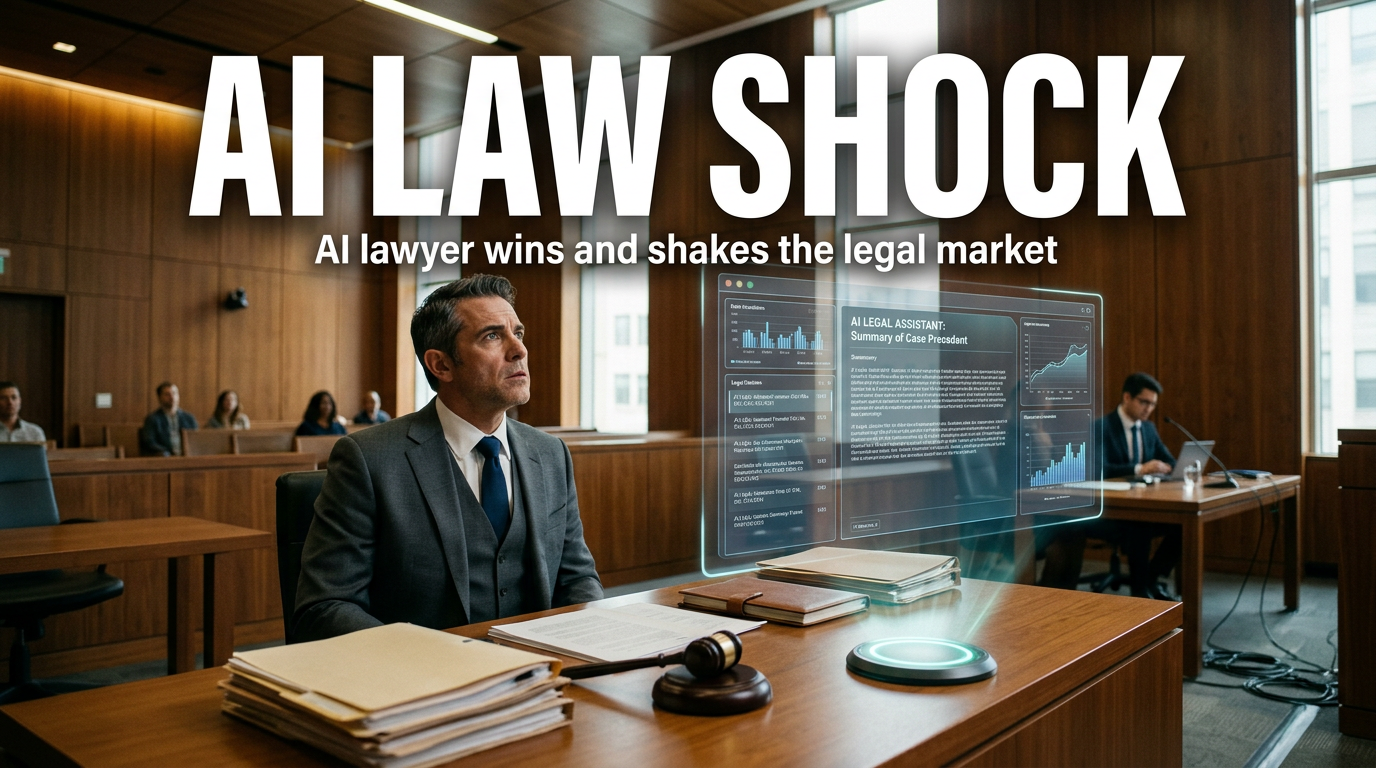
The landscape of legal services is changing.In the United Kingdom, AI recorded the world’s first victory against a human lawyer, forcing us to reconsider the AI adoption industry, digital transformation, generative AI, global economic outlook, and legal tech all at once.This issue is not just a technology news story.It is a symbolic event that shows how quickly AI can affect law firms’ cost structures, corporate litigation strategies, regulatory direction, and the replacement potential of high-level professional jobs.The core point is that AI may increasingly move beyond being a “support tool” and enter the center of actual judgment and practical work.
1. What Happened: AI Recorded Its First Victory Against a Human Lawyer in the United Kingdom
An AI lawyer system recorded a victory against a human lawyer in a British court.The core point is not that “AI has tried giving legal advice.”What has officially emerged is that AI’s judgment, logical structure, and ability to organize materials can be compared with those of human practitioners in an actual legal dispute environment.This is not only an event for the legal sector, but also an event that raises trust in the overall AI industry.From an investor’s perspective, this can be interpreted as a sign that AI has entered a stage where it can handle high-value work, rather than remaining a simple chatbot.
2. Why It Matters: A Signal That Changes the Structure of the Legal Market
This victory affects the cost structure of the legal market.Lawyers and law firms are representative professional service businesses with high hourly fees.However, if AI can quickly perform contract review, case law research, drafting of legal documents, and issue organization, clients will try to handle the same work at a lower cost.In other words, the pricing model of legal services may be shaken.This trend is highly likely to spread to other professional service industries such as accounting, consulting, translation, and research.Ultimately, AI is not simply a variable for task automation, but a variable that restructures the revenue model of the professional labor market itself.
3. The Economic Meaning of This Event: The Productivity Revolution Has Already Begun
From an economic perspective, this news is close to a real-world example of productivity improvement.Companies respond first not only to reducing labor costs through AI, but also to doing more work faster.The important keywords here are productivity, automation, labor cost reduction, corporate profitability, and AI investment.When AI proves effective in industries with high fixed service prices, such as legal services, adoption speeds up in other industries as well.This trend ultimately becomes a force that pushes companies to choose AI as a survival strategy during periods of economic slowdown.In other words, AI is not a “future technology,” but a present-day variable already affecting corporate earnings.
4. What the Market Should Watch: AI Does Not Immediately Eliminate Jobs, but Reallocates Work
Many people interpret AI news only as “jobs disappearing immediately,” but the reality is somewhat different.What happens first is work reallocation.Repetitive tasks previously handled by entry-level or junior employees are highly likely to be replaced quickly by AI.Meanwhile, work requiring final judgment, external negotiations, and responsibility may continue to rely on humans for longer.In other words, organizations may shift toward handling more projects with fewer people.This creates pressure on the labor market, but from a corporate perspective, it directly helps improve margins.Therefore, AI expansion increases employment anxiety in the short term, but in the medium to long term, it can raise efficiency across industries.
5. The Change to Read in the Global Economic Outlook: AI Is One of the Few Areas That Continues to Receive Investment Even During a Downturn
In today’s uncertain economic environment, companies are commonly asking, “Where should we spend money in order to survive?”One of the answers is AI.Even with the burden of high interest rates, companies continue to spend on AI infrastructure and software.In particular, cloud computing, semiconductors, data centers, cybersecurity, and workflow automation solutions are considered beneficiary sectors of AI expansion.The important economic keywords here are interest rates, inflation, economic slowdown, semiconductors, and data centers.If AI penetrates the professional labor market in practice, the technology stock rally may last longer based on earnings rather than simple expectations.However, overly rapid valuation increases also raise the risk of corrections.
6. The Essence of Legal Tech: AI Does Not “Deliver Judgments,” but It Organizes “Materials for Judgment” Exceptionally Well
There is one point that should not be misunderstood in this issue.Just because AI beat a human lawyer does not mean that AI independently enforces the law or delivers judgments.More precisely, it means that AI demonstrates tremendous efficiency in information retrieval, logical organization, issue summarization, and document drafting required in legal practice.In other words, AI’s strength is not in playing the role of a “judge,” but in serving as a “high-performance legal assistant.”However, if this assistant becomes extremely intelligent, the areas where human experts are needed may eventually shrink rapidly.That is why legal tech is not merely a convenience feature, but the starting point of restructuring the professional labor market.
7. Practical Points Companies and Workers Should Watch Immediately
Companies are no longer at the stage of deciding whether to adopt AI; they now need to decide which tasks to move to AI first.A realistic order of priority would be repetitive document work, data organization, draft writing, internal reporting, customer response, and contract review.From a worker’s perspective, it is necessary to distinguish whether one’s job is “thinking work” or “organizing work.”The more a job consists of organizing tasks, the faster it may be replaced by AI.On the other hand, problem definition, negotiation, decision-making, and strategy design are relatively more likely to survive for longer.Therefore, what is needed now is not avoiding AI, but using AI while increasing the value of human judgment.
8. The Most Important Point Other News Often Misses: This Victory Marks the Beginning of a Regulatory Battle
Most reports focus only on the technological shock that “AI beat a human lawyer.”But what matters more is what comes next.Once AI begins producing results in actual legal practice, governments and regulators around the world will have no choice but to act.That is because in areas with heavy responsibility, such as law, healthcare, and finance, a single AI mistake can lead to significant social costs.In other words, the key issue going forward will not be AI performance competition, but AI accountability and regulatory systems.Who is responsible, what data was used for training, how bias is verified, and how far legal validity is recognized will become bigger issues.This is the real turning point for the AI industry.If regulation lags behind technology, the market expands; if regulation moves quickly, industry standards change.Investors and companies must pay close attention to this timing.
9. Future Investment and Industry Trends: What Should Be Watched?
Going forward, companies that connect AI to actual work may become more important than AI-only companies.Examples include legal platforms, document automation solutions, data management, security, cloud computing, semiconductors, and business SaaS.Especially when AI enters professional fields, “field applicability” will determine corporate value more than “model performance.”Therefore, when investors look at the AI rally, they need to examine companies with real user demand more carefully than simple theme stocks.The balance between cyclical stocks and technology stocks also becomes important.Even if AI increases productivity, the market can still experience volatility when a short-term economic slowdown occurs.
10. Conclusion: AI Is No Longer Just Industry News, but the Center of Economic News
This British case shows that AI is no longer a laboratory technology.The fact that AI has begun producing results even in highly educated, high-income professional fields such as law means that the way work is done across the economy is changing.Going forward, companies that use AI well are likely to reduce costs, move faster, and secure higher profitability.On the other hand, industries that are slow to change may fall behind due to gaps in labor costs and productivity.Ultimately, this news should be seen not as “AI beat humans,” but as a signal that “AI has begun changing the standards of industry.”
< Summary >
AI recorded the world’s first victory against a human lawyer in the United Kingdom.The core point is the changing cost structure of the legal market, the reshaping of professional work, expanded AI investment, and productivity innovation within the global economic outlook.In particular, regulation and accountability are likely to become bigger issues than technology competition going forward.AI is no longer just industry news, but the center of economic news.
[Related Articles…]
Semiconductor Supply Chains and Investment Points Supporting the AI Era
How Productivity Innovation Is Reshaping the Global Economy
*Source: https://www.chosun.com/economy/weeklybiz/2026/07/24/IK52N3C4OFAHZKXGVJMUIDAEPQ/